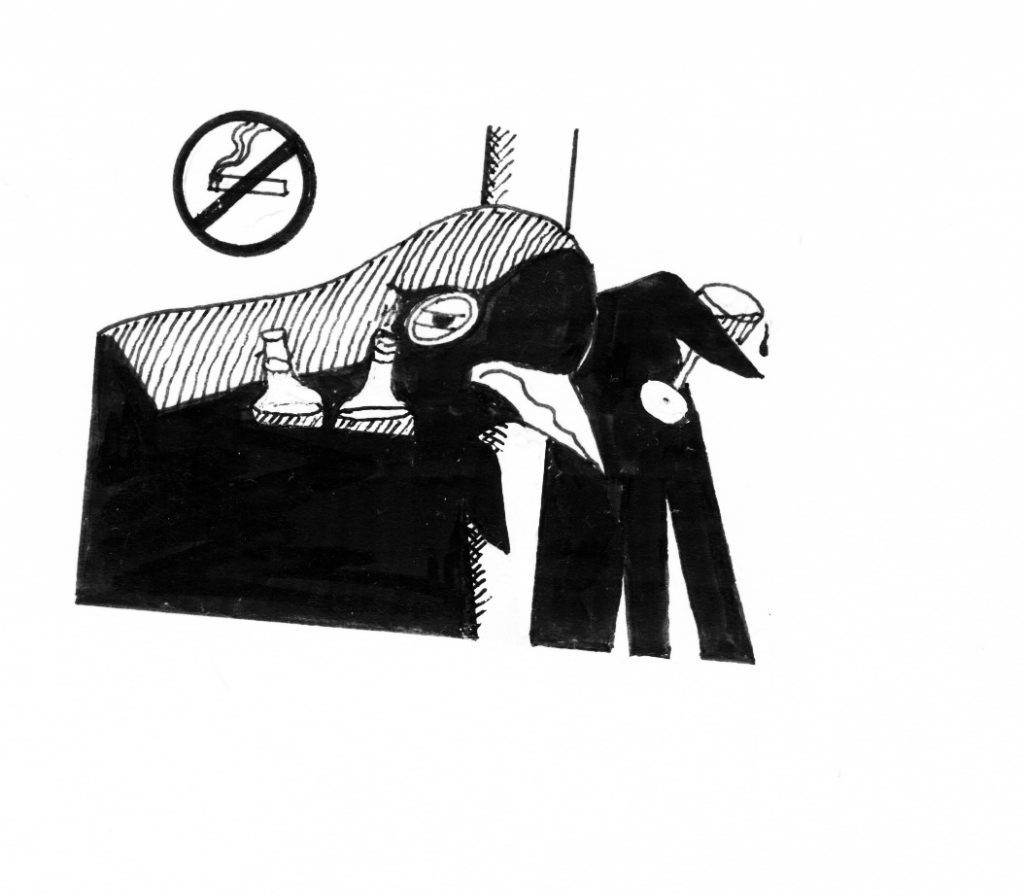
Tag: Christopher Wool

  • Dick French: On The Town – November 2017

    It used to be said that a night out with John Bellany would take three years off your life. I’ll find out one day. We were both great friends of Cyril Reason, who was one of our tutors at the RCA, and although Cyril was less extreme than Bellany he was a thirsty man. I’ll never forget one night in The Yorker, a tall thin pub on Piccadilly (no longer there) around ’67 or ’68. Cyril improvised a game of ten-pin bowling in the upstairs bar. Bottles for skittles and heavy, round glass ashtrays rolled on edge. What fun we had before being turfed out. And talking of turf, Bellany and Cyril once wangled their way into the Royal Enclosure at Longchamps (they liked the gee-gees). They were happily guzzling away at the free champagne when they felt themselves hoisted into the air by heavies and dumped over the fence with the proles. Like many artists of the past century (Mondrian and Kandinsky for instance) Cyril had some interest in the occult and theosophy and although only fifteen years older than me he had actually met Madame Blavatsky.

    There’s a show of John’s paintings at Fortnum and Mason’s, almost next door to where The Yorker used to be. His paintings are scattered around the store but there’s a helpful catalogue so you can locate them. They are mostly later paintings from the ’80s onwards, although there’s Scottish Fish Gutter and Lost Soul from around ’65. I don’t like the later stuff as much as his earlier work, some of which was extremely good. I first saw it up in the mural room at the RCA where he used to work. A lot of the other students didn’t know what to make of him as they were all being ‘Popsy’ and minimal. In contrast his work was darkly brooding and bloody, strong meat, if a little too Celtic and rootsy for me. There was another Scotsman working close to Bellany who did enormous paintings of women being raped and throttled in public lavatories. I wonder what came of him. Bellany’s later works became formulaic; too many maidens will almond eyes, pointy chins, and thin shoulderless bodies … although there is a good painting of a fishing boat in the shop window called Intrepid.

    In the late ’60s if you were doing anything a bit out of the mainstream people would come up and say: “Hmm. Very interesting but of course completely invalid.” By ‘validity’ I think they meant conformity to the rules of art as laid down by Clement Greenberg in the ’40s and ’50s… “Integrity of the picture plane”, avoidance of depth or illusion, and regarding the painting as an object…

    Talking of which I don’t suppose you can get more ‘valid’ than Jasper Johns who is having a big show across the road from Bellany at the RA. He is said to be “interrogating the relationship between language and art”. An artist who has made ingenious use of his inadequacies – he can’t draw and has no sense of colour – grey is the predominant shade in this exhibition. Not that they aren’t decorative and sometimes even elegant, in particular the ones with dangling strings, the ‘Catenary’ series. You can’t go wrong with a catenary.

    He started off doing targets, moved on to flags, numbers, letters and bronze beer cans painted to look like the real thing. That last idea was taken up later by many other artists – didn’t someone recently do bronze bin bags? Then there were a few cast body parts followed by decades of cross-hatching. The pattern had all the qualities that interested him, namely “literalness, repetitiveness, an obsessive quality, order with dumbness and the possibility of complete lack of meaning”. Say no more.

    In the ’70s he met Samuel Beckett and they were supposed to have collaborated on a manuscript called ‘Foirades’ or ‘Fizzles’. The etchings accompanying the text don’t seem to have much to do with it except that they were grey and that was Beckett’s favourite colour. ‘Foirade’ is French for a silent fart but you won’t learn that from the wall charts. Another thing you won’t learn there is that Beckett disliked Johns and so no further collaborations were planned. It’s unlikely that they were collaborations anyway as the etchings were much the same stuff Johns had been doing for years. ‘Foirades’ was on sale for $6,000 in 1976.

    It’s astonishing to consider the intellectual vacuity of the New York art scene which persists to this day. At the White Cube gallery in Mason’s Yard you can see a show called ‘From the Vapour of Gasoline’ (one of Basquiat’s profundities). The show is supposed to “chronicle the dramatic ideological shift and deconstruct a national self-image opening up the space between the authorial narratives of the US and the darker histories they concealed”. Christopher Wool – he of the stencilled messages – features largely. His works are extremely expensive, but then the world is full of rich idiots seeking a safe place to stash their cash. I couldn’t bet on it being safe for much longer because ‘The king is in the altogether’ and Damien seems to have burst. But I’m not one to gloat.

    At the National Gallery an excellent exhibition, ‘Reflections, Van Eyck and the Pre-Raphaelites’, argues that as students Holman Hunt, Rossetti and Millais became fascinated by Van Eyck’s painting of the Arnolfini wedding which hung in the west wing of the National Gallery. In those days the RA schools were in the east wing. It’s a convincing argument that this led to the Pre-Raphaelite Brotherhood who were fed up with the influence of Reynolds and the brown academic tradition of the time. They wanted brilliant colour and a more meticulous approach, Reynolds being characterised by his nickname “Sir Sloshua”. They started to paint on white grounds for sharpness and zing.

    They were also fascinated by the convex mirror on the wall behind the Arnolfinis and many of them made use of the same device in their own work. It seems likely that Velasquez was aware of this portrait as it once belonged to the Spanish court, but I suspect it’s stretching it a bit to suggest it led to his use of the mirror in Las Meninas. One of the great surprises of this show is a partial copy of Las Meninas by John Phillip from 1862. It’s extremely well painted, especially the maids’ dresses, but surely it represents an approach the Pre-Raffs were trying to escape.

    Also at the National is a show of pastels by Degas, ‘Drawn in Colour’. Well worth seeing, especially the women bathing. There are three of these, quite large for pastels. In one a woman bends over in a shallow blue tub, the blue of the tub reflected on her flank, and all against a red background. The pastel is laid on in broad parallel streaks in several built-up layers.

    There are dancers, horsemen and café scenes mostly from the Burrell in Glasgow. Next door to Degas is a gallery devoted to small landscapes painted mostly on the spot. Outstanding is Sunset in the Auvergne by Theodore Rousseau showing a distant view of the Puy de Dôme. It’s only about nine inches by seven. Don’t miss it.

    In the central hall you can see a show of paintings by Luca Giordano or Fa Presto as he was popularly known – the fast one. These are preparatory paintings for his decoration of the Galeria and Library of the Palazzo Medici Riccardi in Florence. The whole project took him only a year, 1682-83. I was particularly taken by the Allegory of Temperance. Maybe his tongue was in his cheek. There’s a very large Giordano further on in the National. It’s Perseus turning enemies to stone, very dramatic and well worth looking at. I suppose you could call Giordano a very late mannerist.

    At the Tate in ’64 they had a retrospective of Marcel Duchamp. Everyone took it very seriously, including me. I spent a long time pondering the significance of The Large Glass which I think was a replica made by Richard Hamilton. I thought it must be the repository of some arcane wisdom – serious and precocious that was me. A long time afterwards I realised that it was a joke, a very good joke which continues to amuse people to this day. Not many jokes can be funny for a hundred years. You’ve got to hand it to him. How about this … “The Bride fundamentally is a petrol can of love (or power-timidity). This timid potency, distributed to the motor with weak cylinders in contact with the sparks of his constant life (magneto desire) explodes and expands to the virgin who has arrived at the end of her desire.”

    I almost forgot, it includes a “gravity regulator”.

    Following a disappointing visit to The Chequers, the wonderful Spanish barmaid having moved on, I crossed over to the RA to see the Duchamp/Dali exhibition. Duchamp was quite a good cubist. He added some dynamism whereas Dali’s attempts at the same style were dreary, but it wasn’t long before the Spaniard developed his trademark illusionistic technique which curator Dawn Ades considers exquisite. I would call it “hobbyist”.

    All the familiar stuff is here, the bottle rack, stool/bicycle wheel, and that bloody urinal. What tedium. How can anybody still be interested in this crap a hundred years on? But they are.

    In one room there are a series of short films. I was hoping to see more of Gala and her charms but it wasn’t to be. One film shows an enormous banquet with Dali and Gala at the head of the table. I think it’s based on the feast scene in Bunuel’s great film Viridiana. It’s a theme that crops up again in the centrefold of the Rolling Stones album Beggars’ Banquet. Curiously, Bob Hope is among the guests. He takes the lid off a large serving dish and two frogs hop out. He does that Bob Hope face as they leap down the table.

    The traffic was so bad it took me an hour to get down to the press view of Outsiders at the Saatchi Gallery. I got there with only half an hour to spare. Imagine my surprise to find that when I signed the book mine was the only name in it. I wouldn’t normally have bothered but the ticket showed a nice girl’s bottom. Outsider art usually refers to the work of eccentrics or the mentally ill but the stuff on display was “general issue” by those just released from art school, all of which had been  knocked out very recently to fill the space available.

    To Whitehall for my morning draught in the Cock and Bottle. That monument with the dangling coats and hats is truly revolting, and the clay modeller’s conceit of leaving the pellets proud of the trousers makes Montgomery look as though he’s got dysentery. How refreshing for a while to gaze on the Burghers of Calais as I stroll along the river towards the Tate.

    Entering the Duveen Galleries I saw that the Queen of One-Trick Ponies is back in town. Her absence has not done much to furnish the space between her ears. I felt a great surge of pity for the poor woman as I surveyed the ranks of castings displayed along the floor (they are supposed to be the casts of the space underneath chairs).

    On to Haydon’s Punch and Judy where I can happily spend ten or fifteen minutes. And then a wander promiscuously through various galleries. I was in the mood for Samuel Palmer and after a few minutes with him I stepped through the arch to the unexpected pleasure of the work of Ray Harryhausen and some of the artists who inspired him such as John Martin and Gandy. Harryhausen was the maker of vintage Horror films such as The Beast from 20,000 Fathoms and Jason and the Argonauts. He specialised in stop-motion animation and many of the models he made to work from are on display. A single scene could take four months to produce. He bought Gandy’s extraordinary painting Jupiter Pluvius but the Martins were beyond his pocket. Displayed are many of his drawings related to his film scenes. They are certainly better than Dali’s drawings.

    Wandering again I found a beautiful Pastoral by Cayley Robinson (above). I remember it being in an antechamber when the National was showing Acts of Mercy about ten years ago. Tonally, it’s remarkable, the simplified shoreline reminiscent of Munch. The fleece of the sheep is picked out by the golden moonlight which slices vertically across the lake. This is the sort of picture that would be extremely popular as a poster, and I don’t think there’s anything wrong with that. Apart from that Scotch bloke I don’t think we have any popular art. And so on to the scandalous Duchess of Argyll, a woman I’ve always admired. Gerald Brockhurst’s portrait of her is rather good although he hasn’t quite managed to suggest her lascivious nature. Goya would have managed it somehow. Apparently the famous “headless man” was Douglas Fairbanks junior. As the picture was probably a commissioned piece it wouldn’t have been appropriate to be too revealing of her predilections.

    News from the grotto. The Sage has been giving much thought to the North Korean situation. He thinks that North Korea is China’s  opening move.

    Dick French
    The Jackdaw Nov/Dec 2017
  • Turning Wool into money … or fool’s gold

    Turning Wool into money … or fool’s gold

    Eric Coombes responds to an editorial about the art cash cow

    Is a celebrity a person ‘famous for being famous’, or merely ‘someone in the media that one had never heard of’. Despite being obscure – in this paradoxical and mysterious mode of obscurity – celebrities, however ill-informed and stupid they might be, are entitled to have their ‘opinions’ widely disseminated, and heard, at least with respect, and quite possibly with hysterical enthusiasm – especially if they are ‘comedians’. This entitlement is now regularly exercised, on an almost weekly basis, in supposedly serious discussion programmes such as Question Time.

    If we regard his ‘work’ as the equivalent of the celebrity’s ‘opinions’, then the status of Christopher Wool, who appears to have ‘risen without trace’, as described in the Nov/Dec editorial, is strikingly analogous to that of a celebrity with opinions as fatuous and ungrounded as Wool’s ‘art’. As our editor observes, the ‘value’ of a Wool ‘resides purely in its perceived status as a tradeable luxury’. There is nothing new in the craving for social status, and its pursuit through ostentatious display or ‘conspicuous consumption’, to use Thorstein Veblen’s term. But in the past, the ‘work of art’ – as tradeable luxury and vehicle of social display – however vulgar or spurious, at least had observable features that a rich undiscriminating fool could be duped into mistaking for the marks of aesthetic merit. What is new is the sublimation of social display to the point where the vehicle of display is purged of such features, and reduced to its essence as a counter in the game of social display itself.

    The situation is cleverly described by the editor as one where a ‘work of art’ (improperly so-called, to adapt an expression of Collingwood’s) has value in the same sense in which a share certificate has value, and, moreover, appears to function in much the same way. But a share certificate does not pretend to have value merely in itself: it is evidence of a property right, namely part ownership of a company, and in certain circumstances the right of ownership might be upheld by the production of alternative evidence – if, for example, the certificate had been destroyed in a fire.

    We might, therefore, want to take this analogy even further, to the interesting case of money itself. The real value of a banknote consists in nothing but the shared agreement to treat it as having value, by people who know perfectly well that this is the case, if they trouble to think about it at all.  It appears that the monetary ‘value’ of some ‘works of art’, now consists in nothing but their ownership being evidence of the owner’s having the money to buy the ownership of the evidence of the ability to buy the ownership of the evidence … .  Clearly, this sequence moves endlessly in a circle of self-sufficiency, which has no contact with any reality beyond itself.

    The analogy with money need not be laboured. Here too we clearly have circularity – circularity of a kind which characterizes the logical structure of all human institutions. (See John Searle: The Construction of Social Reality. I am using the term ‘institution’ in the widest sense to include not just formal institutions, but all domains of human possibility established by agreements and understandings, very largely tacit.) Is this a vicious circle? Well, despite recent events, presumably not, since the institution of money has not yet collapsed. Vicious circles are small circles, engaging with nothing but the contents of the circle itself. But the institution of money involves a huge circle, and one which is not self-contained, but part of a wider system of mutually supporting institutions which constitute society itself. The entire edifice of culture is constructed out of this unimaginably complex system of interlocking institutions, all depending on agreements, ultimately tacit, of which we may not even be conscious.

    The arts are no exception to this; and, in this respect like money, are connected with the institutions of the wider culture – in and through which people find meaning and satisfaction – by chains of tacit agreement. These chains can form virtuous circles because they are neither small nor self-contained. But traders in Wool and cognate commodities are confined to a small coterie of art-market plutocrats and their jackals, which excludes the wider culture. Tiny and self-contained, this coterie assembles itself into a vicious circle, which sustains a pretence destined eventually to collapse – not before doing much harm. It is parasitic on established institutions, which support it as the body supports lice. It is, however, no more harmful than the vicious circle of state art, which has also detached itself from the institutions of art (properly so-called), and usurped their authority. This true authority – when it exists at all – emerges tacitly in traditions of practice and criticism that are integrated into the wider culture, and belongs to institutions that are quite distinct from such officially constituted entities as the Tate Galleries, or the Arts Council.

  • Christopher Wool and the art market: selling the soul

    Christopher Wool and the art market: selling the soul

    American painter Christopher Wool (b. 1955) has been described by the New Yorker as “perhaps the most important painter of his generation”. Christie’s are in less doubt, describing him as “one of the last century’s most influential artists”. Even by the risible standards of bullshit spouted by auction houses and art dealers this is ridiculous. I’ve never heard anyone, artist or otherwise, ever say they were influenced by Wool. Have you? Well have you? Indeed, I’d never heard of him at all until about a year ago.

    Wool joined Gagosian in 2006, since when the noughts increased and the words got longer. In 2009, courtesy of an organisation called The American Fund for the Tate Gallery, the first of two Wools entered our national collection – the second, acquired in 2012, was also secured in part courtesy of this same influential body. No institution in the UK has ever staged an exhibition of Wool’s work, but let’s face it such a ‘celebration’ can’t now be far off. His backers will surely procure one soon. I wonder which gallery will be first to follow the money.

    To investigate how the art market operates I’ll concentrate on the sale of one of his pictures for two irreconcilable reasons: first, like Polaris blasting from under the ice cap, his reputation has been suddenly, suspiciously meteoric; second, I can’t discover an atom of merit or originality in anything he does. He is, therefore, a revealing example of how the art market, which is so disproportionately influential in dictating what we see in public galleries, is run for the investment benefit of rich people. (One of the most important dealers in contemporary art said recently of his collectors: “They have no interest whatsoever in art; they look at paintings as a diversification of their investments.”)

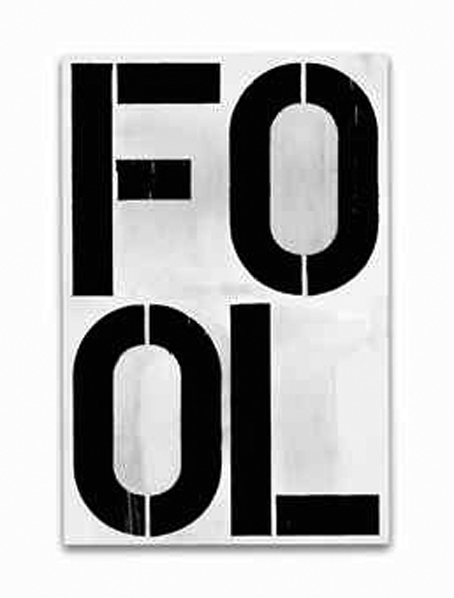
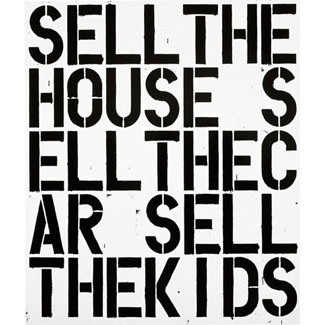
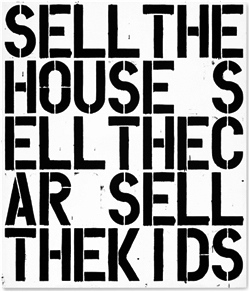
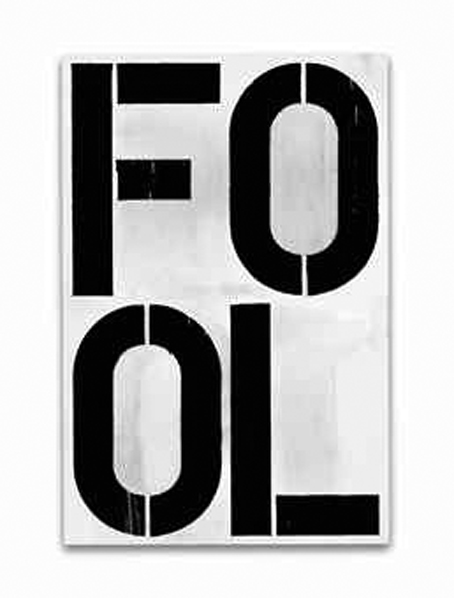
    Illustrated opposite is Apocalypse Now. This 1988, 7’ x 6’ work, painted in polyester enamel on aluminium, was sold by Christie’s last year for $26.4 million, over three times the previous artist’s record. Manifesting more than a trace of evangelical fervour, the person who bought it gushed: “I wanted the absolute best work by that artist and this is the best of the best. It’s in another league. There is Apocalypse Now and then everything else.” Why it should be ‘better’ and more valuable than similarly fabricated Wools reading SEX LUV, FOOL, BAD DOG and IF YOU CANT TAKE A JOKE YOU CAN GET THE FUCK OUT, one can only speculate.

    The technique is stencil, in mimicry of the graffiti legends and adverts which are supposedly its inspiration. And before you commend the concise nihilism of the message, these words are not the artist’s own. They are the looney Kurtz’s exhortation to his abandoned wife in Coppola’s Apocalypse Now: “Sell the house. Sell the car. Sell the kids. Find someone else. Forget it. I’m never coming back. Forget it.”

    Nothing about this piece, either in its handling or conception, might make you think it is of remarkable value. Indeed, objectively there is no good reason why it might not be worth 25 bob instead of 25 million. What establishes its value is something you can neither see nor understand without being indoctrinated as to what it is … usually by someone with an interest in flogging it for as much as possible. Its value resides purely in its perceived status as a tradeable luxury. It has, curiously, no more intrinsic value than any other share certificate.

    In its short life Apocalypse Now has passed through ten billionaire collectors. All were Americans except one, Frenchman François Pinault, five back, who is the proprietor of Christie’s, the firm who sold it this time. Incidentally, the owner before Pinault was Donald Bryant, until recently a trustee of MoMA New York who is also on the aforementioned ‘American Fund’ committee of the Tate, which was instrumental in the Gallery acquiring both its Wools. Californian winemaker Bryant obviously likes Wool, but not sufficiently, it seems, to hang on to what is allegedly his pièce de résistance. You will have noticed that the world of posh art is a very small and incestuous one.

    The speed of turnover in Apocalypse Now – 30 months on average – tells us something about the motivation of modern collectors, for whom genuine discernment would appear to be the last thing on their mind. The very idea of connoisseurship or discernment in collecting contemporary art is an absurd notion when the relative value of a work can be made up so it flies in the face of the little you can actually see. Art is now a fund manager’s hobby, a gamble or a pitch from which, as with any other investment, profit is periodically milked.

    The last seller of the picture, hedge-funder David Ganek, is also a trustee of the Guggenheim Museum in New York where Wool just happened to be enjoying a retrospective coincident with the auction of Apocalypse Now. In 2010, Ganek’s business partner was convicted for insider trading. Though himself deemed a co-conspirator Ganek was never charged. He left his company and paid $25 million in fines. There is a book to be written about the connection between contemporary art and insider trading. Everyone has now forgotten that the first sponsor of the Turner Prize, Michael Milken, the inventor of junk bonds, got four years for related offences. No more telling indictment of the contemporary art market exists than that it appeals to high-risk investors, hedgers and generally shifty operators to whose activities the cachet of art ownership is used to lend a patination of social respectability.

    Was the sale of Apocalypse Now a straightforward auction? No it wasn’t. It was sold before the sale because a guarantor had underwritten the low estimate price of $15 million. A third of the works in the same auction were also the subject of pre-sale guarantees.

    Christie’s threw their all behind this lot claiming that Apocalypse Now “is the emblem of a generation” – an obvious lie. They continued: “Christopher Wool’s Apocalypse Now is the essential image of our times… It’s much anticipated appearance at auction, firmly places Wool amongst the pantheon of great masters of the 20th century.” There you have it: “the essential image of our times”. Not the twin towers, or Obama being sworn in, or Neil Armstrong, or Mandela striding victorious from jail, or tanks in Prague or Tianenmen Square, or even Sergio Aguero scoring in extra time, but this second-hand slogan.

    And what of the artist himself? He has said: “With the painting the inspiration comes from the process of the work itself. Like music making the work is an emotional experience. It’s a visual language and it’s almost impossible to put words to it.” Not half.

    What conclusions might we draw from all this perversion of genuine standards:

    1. Monetary value is unrelated to aesthetic worth. By looking at contemporary art you can’t even guess to within three noughts what it might cost.

    2. Once a powerful cocktail of mutually interested dealers and speculators get behind an artist their rise is unstoppable. The auction market in contemporary art is a game played by six of the world’s biggest dealers, two salesrooms, 40 artists, about 30 billionaires and a clique of subservient museum directors and careerist curator-clones. No one else matters. In 2012 11 of the top 20 artists sold at auction were represented by Wool’s dealer Gagosian.

    3. Most commentary on the art market is disgraceful advertisement.

    4. At the top end, the art market encourages a sort of religious cult participation by hobbyist fat cats eager to cash in on safe bets.

    5. When the auction market has nothing to do with liking art or actual visible qualities, the dealer is happy, the artist is happy, the seller is happy, the other collectors of the same artists’ works are happy, and the auctioneer is deliriously, pants-wetting happy.

    6. The cowardly complicity of State Art before this squalid system is a shocking betrayal of what they really ought to be standing up for.

    The whole thing is a filthy racket.

    David Lee

    The Jackdaw, Nov-Dec 2014


  • The art market – selling the soul

    The art market – selling the soul

    American painter Christopher Wool (b. 1955) has been described by the New Yorker as “perhaps the most important painter of his generation”. Christie’s are in less doubt, describing him as “one of the last century’s most influential artists”. Even by the risible standards of bullshit spouted by auction houses and art dealers this is ridiculous. I’ve never heard anyone, artist or otherwise, ever say they were influenced by Wool. Have you? Well have you? Indeed, I’d never heard of him at all until about a year ago.

    Wool joined Gagosian in 2006, since when the noughts increased and the words got longer. In 2009, courtesy of an organisation called The American Fund for the Tate Gallery, the first of two Wools entered our national collection – the second, acquired in 2012, was also secured in part courtesy of this same influential body. No institution in the UK has ever staged an exhibition of Wool’s work, but let’s face it such a ‘celebration’ can’t now be far off. His backers will surely procure one soon. I wonder which gallery will be first to follow the money.

    To investigate how the art market operates I’ll concentrate on the sale of one of his pictures for two irreconcilable reasons: first, like Polaris blasting from under the ice cap, his reputation has been suddenly, suspiciously meteoric; second, I can’t discover an atom of merit or originality in anything he does. He is, therefore, a revealing example of how the art market, which is so disproportionately influential in dictating what we see in public galleries, is run for the investment benefit of rich people. (One of the most important dealers in contemporary art said recently of his collectors: “They have no interest whatsoever in art; they look at paintings as a diversification of their investments.”)

    Illustrated opposite is Apocalypse Now. This 1988, 7’ x 6’ work, painted in polyester enamel on aluminium, was sold by Christie’s last year for $26.4 million, over three times the previous artist’s record. Manifesting more than a trace of evangelical fervour, the person who bought it gushed: “I wanted the absolute best work by that artist and this is the best of the best. It’s in another league. There is Apocalypse Now and then everything else.” Why it should be ‘better’ and more valuable than similarly fabricated Wools reading SEX LUV, FOOL, BAD DOG and IF YOU CANT TAKE A JOKE YOU CAN GET THE FUCK OUT, one can only speculate.

    The technique is stencil, in mimicry of the graffiti legends and adverts which are supposedly its inspiration. And before you commend the concise nihilism of the message, these words are not the artist’s own. They are the looney Kurtz’s exhortation to his abandoned wife in Coppola’s Apocalypse Now: “Sell the house. Sell the car. Sell the kids. Find someone else. Forget it. I’m never coming back. Forget it.”

    Nothing about this piece, either in its handling or conception, might make you think it is of remarkable value. Indeed, objectively there is no good reason why it might not be worth 25 bob instead of 25 million. What establishes its value is something you can neither see nor understand without being indoctrinated as to what it is … usually by someone with an interest in flogging it for as much as possible. Its value resides purely in its perceived status as a tradeable luxury. It has, curiously, no more intrinsic value than any other share certificate.

    In its short life Apocalypse Now has passed through ten billionaire collectors. All were Americans except one, Frenchman François Pinault, five back, who is the proprietor of Christie’s, the firm who sold it this time. Incidentally, the owner before Pinault was Donald Bryant, until recently a trustee of MoMA New York who is also on the aforementioned ‘American Fund’ committee of the Tate, which was instrumental in the Gallery acquiring both its Wools. Californian winemaker Bryant obviously likes Wool, but not sufficiently, it seems, to hang on to what is allegedly his pièce de résistance. You will have noticed that the world of posh art is a very small and incestuous one.

    The speed of turnover in Apocalypse Now – 30 months on average – tells us something about the motivation of modern collectors, for whom genuine discernment would appear to be the last thing on their mind. The very idea of connoisseurship or discernment in collecting contemporary art is an absurd notion when the relative value of a work can be made up so it flies in the face of the little you can actually see. Art is now a fund manager’s hobby, a gamble or a pitch from which, as with any other investment, profit is periodically milked.

    The last seller of the picture, hedge-funder David Ganek, is also a trustee of the Guggenheim Museum in New York where Wool just happened to be enjoying a retrospective coincident with the auction of Apocalypse Now. In 2010, Ganek’s business partner was convicted for insider trading. Though himself deemed a co-conspirator Ganek was never charged. He left his company and paid $25 million in fines. There is a book to be written about the connection between contemporary art and insider trading. Everyone has now forgotten that the first sponsor of the Turner Prize, Michael Milken, the inventor of junk bonds, got four years for related offences. No more telling indictment of the contemporary art market exists than that it appeals to high-risk investors, hedgers and generally shifty operators to whose activities the cachet of art ownership is used to lend a patination of social respectability.

    Was the sale of Apocalypse Now a straightforward auction? No it wasn’t. It was sold before the sale because a guarantor had underwritten the low estimate price of $15 million. A third of the works in the same auction were also the subject of pre-sale guarantees.

    Christie’s threw their all behind this lot claiming that Apocalypse Now “is the emblem of a generation” – an obvious lie. They continued: “Christopher Wool’s Apocalypse Now is the essential image of our times… It’s much anticipated appearance at auction, firmly places Wool amongst the pantheon of great masters of the 20th century.” There you have it: “the essential image of our times”. Not the twin towers, or Obama being sworn in, or Neil Armstrong, or Mandela striding victorious from jail, or tanks in Prague or Tianenmen Square, or even Sergio Aguero scoring in extra time, but this second-hand slogan.

    And what of the artist himself? He has said: “With the painting the inspiration comes from the process of the work itself. Like music making the work is an emotional experience. It’s a visual language and it’s almost impossible to put words to it.” Not half.

    What conclusions might we draw from all this perversion of genuine standards:

    1. Monetary value is unrelated to aesthetic worth. By looking at contemporary art you can’t even guess to within three noughts what it might cost.

    2. Once a powerful cocktail of mutually interested dealers and speculators get behind an artist their rise is unstoppable. The auction market in contemporary art is a game played by six of the world’s biggest dealers, two salesrooms, 40 artists, about 30 billionaires and a clique of subservient museum directors and careerist curator-clones. No one else matters. In 2012 11 of the top 20 artists sold at auction were represented by Wool’s dealer Gagosian.

    3. Most commentary on the art market is disgraceful advertisement.

    4. At the top end, the art market encourages a sort of religious cult participation by hobbyist fat cats eager to cash in on safe bets.

    5. When the auction market has nothing to do with liking art or actual visible qualities, the dealer is happy, the artist is happy, the seller is happy, the other collectors of the same artists’ works are happy, and the auctioneer is deliriously, pants-wetting happy.

    6. The cowardly complicity of State Art before this squalid system is a shocking betrayal of what they really ought to be standing up for.

    The whole thing is a filthy racket.

    David Lee

    The Jackdaw Nov/Dec 2014