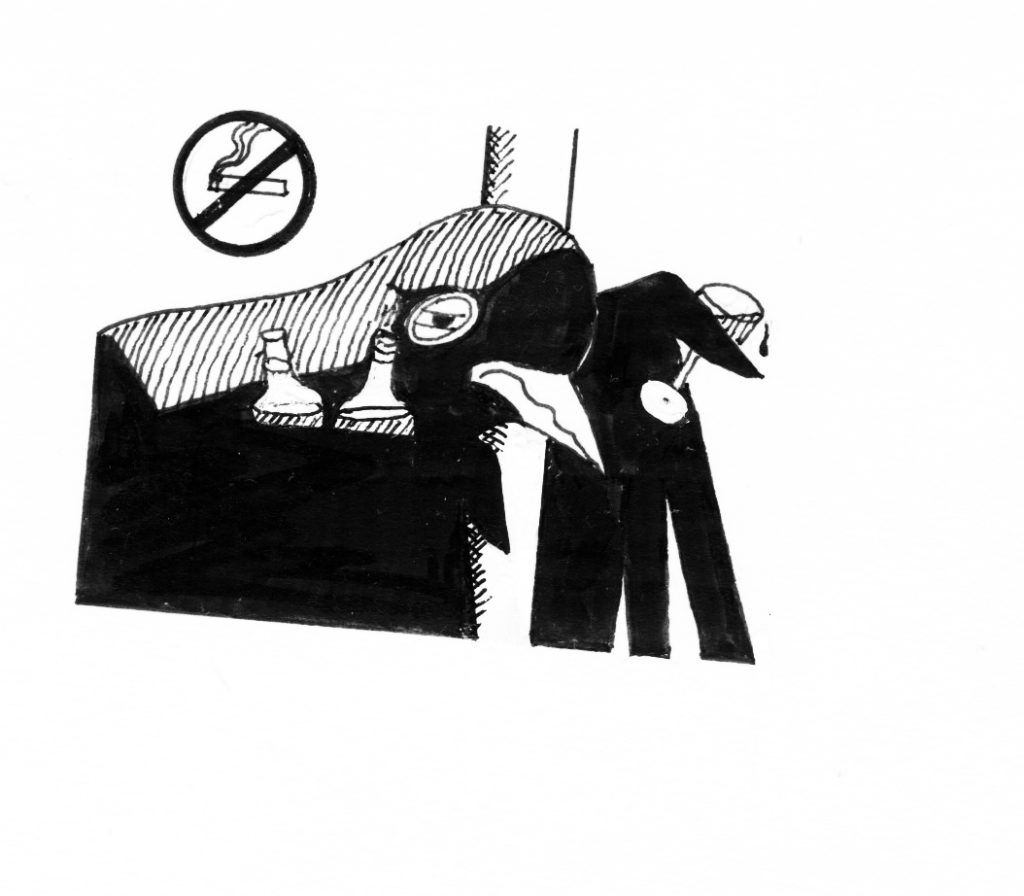
Tag: Baudelaire

  • Dick French: On The Town – May 2017

    Mr Wu was on the wireless last night. A very long programme on the World Service, but still I learned very little about him. He speaks as one heavily sedated. Talk about insclutable. He dwells in a large bunker under Berlin with 6,000 three-legged stools and some lifejackets. There was no mention of the poison beans, maybe he’s sold them all. The trailer described him as “one of the world’s most powerful artists”. It is puzzling how an aesthetic black hole can achieve such eminence. His career is enough to make even the most sceptical of us start subscribing to conspiracy theories. He’s one of these artistic accumulators who head things up. There’s a lot of them about. One thinks of MacFisheries, the bloke at the RA who makes animals out of coathangers and map pins. I suppose you could call it a modular approach which prevents you from making a mess… Now what can I heap up next?

    In the 19th century it took a long time for the French to latch on to the importance of Baudelaire. The Parnassian ideal was ascendant and accordingly it was possible to compose what was considered the highest poetry about almost nothing. Plus ça change.

    Art establishments have a primordial and instinctive terror of change. When Baudelaire wrote about “une oasis d’horreur dans un desert d’ennui” he could have been describing Mr Wu and the Art World.

    To the National Gallery for the exhibition of Michelangelo and Sebastiano del Piombo. Sebastiano was from Cesenatico, most famous nowadays for being the birthplace and training ground of ‘Il Pirata’, Marco Pantani, still adored by the tifosi even though almost his entire career was fuelled by coke and EPO. Contrast this with Lance Armstrong who is considered a disgrace.

    An impressive show, although two of the most interesting pieces are already in the National Gallery. One of them, The Raising of Lazarus, is among the earliest purchases of the NG. Something I’d never noticed in this painting is that a group of women close to the raising itself are holding their noses. This I learned from the wall chart, but closer inspection shows this to be untrue. They are raising their veils across the lower parts of their faces to avoid contagion. The plague, both bubonic and pneumonic, had been raging on and off for many years when this painting was being worked on and such a gesture was commonplace. Besides, after three days underground Lazarus must have been a tad smelly.

    Sebastiano composes on the diagonal and the triangle. A striking example of his triangular approach is The Judgment of Solomon. The darkening of the central figure’s head is extremely dramatic but this could be due to deterioration. In some of his paintings he lets the sfumato disintegrate the forms rather in the manner of Beccafumi. The black starts to creep in, especially in a painting of the Virgin and Child in which the infant resembles Charlie Drake. The Virgin’s head is also unsatisfactory – too much face.

    In The Visitation the foetal St John the Baptist is said to be leaping for joy in his mother’s womb during her encounter with the Virgin Mary. A difficult subject to depict. One can almost hear Sir Arthur Streeb-Greebling drawling “Well I think the word difficult is awfully well chosen”.

    There are some wonderful drawings and letters in this show. Michelangelo often worked on both sides of the paper which was expensive in those days. I think he was probably a bit of a skinflint. It’s interesting that Michelangelo drew mostly with the hand when nowadays we are encouraged to draw mostly with the arm.

    Many of these paintings have dramatic bits of landscape in the background in the red-tinged sky. I couldn’t take to The Lamentation. I think it’s the expression on the Virgin’s face. Those upturned eyes and the horizontal body seem insufficiently scourged with its immaculate underpants. Still I suppose this is no place for realism.

    “People don’t buy pictures because they admire them, they buy them because others covet them.” Advice given to Constable, but I can’t remember by whom. An Andy Warhol painting of Chairman Mao has just sold in Hong Kong for $1l million. How long can this crap persist? Warhol was once described as “an ambulant black hole”. And now we’ve got another one in Mr Wu.

    To the Mall to see the painter/stainers exhibition. At the opening I met no less than the Chief Stain himself. He seemed a nice chap. Sporting his enormous bling on a chain round his neck he looked a bit like a sommelier. For once the 1st prize was worth looking at. A large, elaborate, patched-together drawing by Chris Green. Bernadette Tinko showed a small picture of a filthy brown sink, which I rather liked, while opposite Alex Rooney showed a similarly sized clean white sink. I wonder if they know each other. Cherry Pickles shows another rear view mirror piece, A487, and Peter Archer’s Cliff Edge is sensitive.

    The Scrapyard Queen shows another of her car wrecks; as always very well done but I’m always hoping she’ll ring a few changes – naked men draped over the bonnet sipping from golden cans perhaps. But I don’t think she takes me seriously.

    My friend The Sage writes from his grotto in the Yorkshire Dales sending me a copy of the Royal Academy Spring Magazine. I can’t imagine how he gets hold of such things. (Age Concern apparently.) He’s very cross about this woman who’s been appointed Professor of Sculpture at the Royal Academy. She’s called Cathie Pilkington and makes the most atrocious plaster dolls which are supposed to be based on the Little Dancer by Degas. As always in this kind of work the exegesis is of more importance than the thing you have to look at. And there can be few things more unpleasant than what she makes. That such an incompetent can be put in charge of students astonishes me. But it shouldn’t really. After all they have Huge Mary in charge of painting. The Sage described them as “sugar sculptures for cake decorations”. She also intends to “dress, drape, protect or obscure with soft coverings” the RA’s collection of historic casts. She means to display her dolls in a way that will make them seem “tiny but vibrant” against lush velvet curtains. Does that mean she’s going to paint them black?

    To the John Soanes, always one of my favourite places. Unfortunately it was infested by a load of plaster body castings by Marc Quinn. “The museum is an unfinished total artwork. We’re continuing the process.” Oh yeah?

    Even though these things are body casts he’s managed to get them out of proportion. The separate upper and lower parts don’t fit together properly. Someone should grab him by the beard (I imagine he’s got one) and point out shoulder to nipple, nipple to navel, naval to the foothills of the fanny – same distance. Variations do occur of course but with the rather perfect specimen he has grabbed from behind this rule would hold. If her bum was a drug it would be Class A. Her tits too, petite.

    “I think that great art is time travel. Emotional time travel.” What on earth can he mean by this? “Quinn’s works invite us to reflect on the nature and meaning of time”. I should be used to such gnomic utterances by now but I can still be surprised and puzzled.

    And here’s my version of the grab from behind…

    Dick French
    The Jackdaw May/Jun 2017

  • Sense and Sensibility

    HalfordsSo it’s goodbye Cornelissens hello Halfords.

    Laura Gascoigne parks her brush and tries to follow the instructions for flatpack art, but has the picture upside down

    It’s a dull job being a customs officer, sitting on the border twiddling your thumbs until the next teenage drugs mule comes along. So it must have added to the gaiety of nations when in 2010 the EU Commission passed a ruling imposing full VAT import duty on electrical components and household appliances used in art. Henceforth disassembled light tubes from a Dan Flavin sculpture would be charged full whack at 20% of the work’s value instead of the preferential ‘art’ rate of 5%. It might be art when assembled in the gallery, ran the argument, but disassembled in transit it counted as light fittings. Sic transit gloria artis mundi.

    The wheels of the European Commission grind exceedingly slowly, but they’d better sort this one out before it causes tailbacks at Dover while fine art carriers loaded with DIY supplies discuss the finer points of art theory at Customs. Outsider artists have always used materials from hardware stores – nail mosaics are a popular genre, and a sealant Jesus sold a few years ago for £750 – but now that the definition of ‘found object’ has been extended to objects found in the aisles of Wickes, the DIY aesthetic has official sanction.

    We should have seen it coming when Jim Lambie was given planche blanche in 2003 to cover the floor of the Duveen Galleries at Tate Britain in trippy stripes of multicoloured vinyl tape. The previous year, the Taiwanese artist Michael Lin had carpeted the Palais de Tokyo in Paris in giant pink flowers inspired by Taiwanese embroidery. Since then the flooring contractors have been gaining ground, and commercial galleries are now entering the market. Two years ago the Alan Cristea Gallery transformed itself into a flooring showroom with the site-specific installation D.I.Y by Richard Woods, who covered walls and floor “in his trademark vibrantly-coloured and exaggerated wood-grain motif… installed as parquetry”. Naffness being a key ingredient in the DIY aesthetic’s demotic appeal, there is now apparently an art market for parquet.

    When Martin Creed clad the walls and floors of the downstairs toilets at the London Library’s new Mason Yard extension in his trademark vibrantly-coloured patchwork of marble tiles, I suspect he didn’t do the grouting himself, belonging as he does to the ‘You Do It’ YBA boomer generation. Today’s austerity generation of DIY strivers is more hands-on. For the tar and rubber paintings in his exhibition Freedom of Assembly at White Cube, Bermondsey (until July 5th), African American social practice artist Theaster Gates conscientiously developed “good roofing strategies… to arrive at painting or at least to get to the essence of roofing.”

    The aim these days is no longer for a high-tech Hirstian finish designed to appeal to billionaire collectors, but for a low-tech Bodgit & Scarper look – an abject object – worthy of exhibition in a socially responsible public gallery. It’s one in the eye for modernism’s utopian belief in the transformative power of functional form. As Ralph Rugoff said of the 30 international artists in the Hayward Gallery’s 2010 exhibition The New Décor, “what unites them is their ability to transform objects we associate with the everyday – a bed, a shelf, a lamp – into something uncanny and compelling [so as to] open up the discussion about interior space… with interpretations ranging from the absurd to the abject to the lyrical.”

    In this context, the lyrical tends to take the form of nostalgia for the bright new dawn of the post-war DIY movement. Today’s social anthropologists may claim that self-assembly furniture puts the contemporary male in touch with his hunter-gatherer roots – apparently it’s a stag night ritual in Sweden for the groom to bid a final adieu to bachelordom by assembling a piece of IKEA furniture – but wrestling a flat pack to the ground in a drunken stupor is a piece of piss compared with the challenges facing the original DIY pioneers. Their frontier spirit was celebrated in Untitled: Simparch, a 2005 exhibition at Tate Modern in which a group of American artists used instructions from the 1960s popular manual Plywood Working for Everybody to produce a range of exhibits from a ‘Fishing Tackle Cabinet’ to a ‘Storage Headboard’. The Tate described these objects, unfairly I thought, as “elements of an affluent, post-war vision of suburban domestic living” whose need was “fuelled by the ownership of material goods rather than basic necessity”. It seems to me that a fishing tackle cabinet is a must-have accessory for any hunter-gatherer, ditto a cupboard for storing trophy heads.

    But seriously, can this stuff be considered art? Those with doubts on the subject may be reassured to learn that amongst Franz Kafka’s early works was a volume entitled Accident Prevention Regulations in the Use of Wood-Planing Machines, dating from the author’s formative period in ’elf and safety (during which he is also said to have invented the hard hat). A Kafkaesque edge of surrealism is what most DIY artworks appear to aspire to. In 2003 the artist-run gallery Cubitt, at the cutting-edge of plywood as of so much else, hosted an exhibition cheerily titled HEY PRODUCTION! that took its cue from another pioneering handbook, Victor Papanek and James Hennessey’s Nomadic Furniture (1973). The show was organised by the self-styled Copenhagen Free University, a Danish outfit specializing in disseminating “forms of knowledge that are fleeting, fluid, schizophrenic, uncompromising, subjective, uneconomic, acapitalist, produced in the kitchen, produced when asleep, arisen on a social excursion – collectively”. They may have missed the passage in Kafka’s handbook warning against operating machinery when asleep, but fortunately no injury seems to have resulted.

    It’s fair to say that, apart an unhealthy obsession with subverting sideboards and debunking bunk beds – The New Décor included a bed shaped like an LA freeway overpass by Cuban carpentry collective Los Carpinteros – the DIY art movement does no real harm. All art is Do-It-Yourself, after all. If you’re alone in your studio, who else is going to do it? And functional failure is something every artist is familiar with. As the Swiss sculptor Urs Fischer put it in an interview: “As soon as I start to work with materials, things go wrong.” Still, when Baudelaire defined ‘modernity’ as “the ephemeral, the fugitive, the contingent; the half of art whose other half is the eternal and the immutable,” he wasn’t thinking of plywood, he was thinking of paint, a medium in which an eternal and immutable record of the ephemeral and fugitive can be trapped. DIY art is a whole other ball game: it makes a fetish of the fugitive and laughs at eternity. In Baudelaire’s artistic terms, it’s a game of one half.

    On this year’s Turner Prize shortlist is a collective of designers and architects calling themselves Assemble who “embrace a DIY sensibility”, according to the Tate. They’ve been nominated for their work with local communities improving a rundown estate in Toxteth, Liverpool and ‘rethinking’ an adventure playground in Dalmarnock, Glasgow. Adrian Searle predicts that making the world a better place through DIY efforts “is something artists… are going to have to be doing a lot more of in the coming years”. He may have a point, but it’s a limited one. DIY efforts can turn pedestrian dreams into reality, but only art can turn pedestrian reality into dreams.

    Laura Gascoigne