Ever since Anya Gallaccio made her name by exhibiting an ice block called Intensities and Surfaces in an East London pumping station in 1996, I’ve been monitoring the advance of ice through the contemporary art world, where it seems resistant to climate trends prevailing elsewhere. While the polar ice caps recede, the phenomenon of ice art only grows.
I wouldn’t mind if a) against the artists’ professed intentions, this didn’t actually contribute to global warming, and b) the ice wasn’t usually engaged in lecturing its audience in an uncool way. I remember grumbling at the time of Gallaccio’s exhibition that if I was going to hear from an ice cube, I’d rather it addressed me from a gin and tonic. Little did I suspect that over the next two decades I’d be on the receiving end of a chorus of sermons from ice cubes, not one of them accompanied by so much as a zest of lemon.
The big attraction of ice to conceptual artists is that the medium is the message, and the message is obvious. Conceptual art simply adores the obvious, and so it has taken ice to its bosom where, as with climate change, a cool start has been followed by accelerated warming. Here is an easy-reference 20-year calendar to prove it.
1997 – Francis Alÿs pushes an enormous ice block through Mexico City until it shrinks to a cube, then instead of popping it into a Tequila Ponche, like any normal hot and thirsty Mexican, he christens it Paradox Praxis and declares it “an allegory about failed modernisation strategies in the regionâ€. Que?
2009 – Andy Goldsworthy cuts a circle of ice in a frozen river with a rope compass and lets it float away. “The circle was locked and then, suddenly, it was joyously made free to move and rejoin the flow,†he declaims poetically, before skipping off like Fotherington-Thomas.
2010 – Karl Lagerfeld, scenting frost on the fashion breeze, imports a giant iceberg as the centrepiece of his spring Paris catwalk show for Chanel.
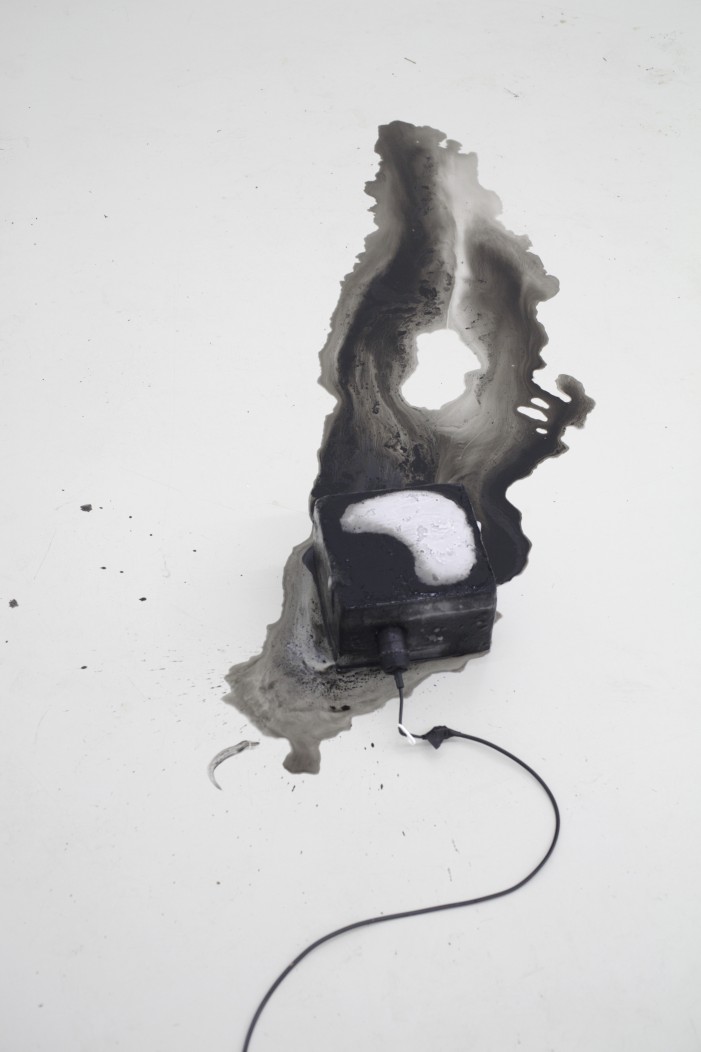
2011 – Kitty Kraus, in a group show of international artists “who explore ideas of flux and ephemerality†at Manchester Cornerhouse, shows a block of inky water with a light bulb at its centre. Titled Untitled, it melts onto the gallery floor creating “topographical patterns that viewers must navigate aroundâ€.
2012 – Neha Choksi, an artist drawn to “scenarios of erasure, exhaustion, detachment and disappearanceâ€, creates Iceboat, a film of herself rowing across a lake in a frozen boat until it melts.
2013 – The Holy See climbs aboard the freezer truck, installing a refrigeration unit in its debut Pavilion at the Venice Biennale to keep a painting by Lawrence Carroll on ice.
2014 – For the Liverpool Biennale Norma Jeane installs a solar-powered ice-making machine in the Old Blind School, which – for want of July sun in Liverpool – leaks. In October, coinciding with the publication of the IPCC’s Fifth Assessment Report on Climate Change, Olafur Eliasson arranges 12 blocks of ice in the form of an Ice Watch in Copehagen’s City Hall Square. Cut from the Nuup Kangerlua fjord in Greenland, the blocks’ total weight of 100 tonnes is equivalent to the amount of inland ice currently melting every hundredth of a second. “As an artist I am interested in how we give knowledge a body,†explains Eliasson. “What does a thought feel like and how can felt knowledge encourage action?â€
2016 – In Granary Square, King’s Cross Alex Chinneck erects a Christmas tree – complete with lights – contained in a 7m ice cube. Titled Fighting Fire with Ice Cream, it poses no risk to the station’s power supply as it is actually made of clear resin rather than water, and the pool that accumulates on the ground around it – which revellers presumably have to ‘navigate’ – is made of wax.
While on the subject of melting ice caps, it may interest you to know that this year’s Venice Biennale will see the launch of an exhibition of highlights of something called the Antarctic Biennale which, under the patronage of UNESCO, advertises itself as ‘developing Antarctica’s cultural potential’. Tell that to the penguins. Its most prominent partner is Kaspersky Lab, a Russian global cyber security company based in Moscow. Smell fishy? It is. As it happens, Kaspersky Lab has just been named as one of the companies with ties to the Kremlin that paid Michael Flynn a sledload of cash for a speaking engagement in Washington. You want ice with that, or would you prefer oil and gas? Kaspersky is not the only greenwash merchant dealing in ice art. In 2015 Rolls Royce commissioned Isaac Julien’s glacial video installation Stones against Diamonds, set among the glistening ice caves of Vatnajökull in Iceland. No doubt BP is even now planning something. Ice art is not as transparent as you’d think.
Gallaccio wasn’t the first to make art from ice; she trod in steps already dinted by 1960s masters Gyula Konkoly, Allan Kaprow, Ian Baxter, Rafael Ferrer and Paul Kos. More memorably, perhaps, in the 1970s naked cellist Charlotte Moorman performed avant-garde compositions by Jim McWilliams with a melting instrument between her legs and Serbian ice queen Marina Abramovic, in a performance titled The Lips of Thomas, cut her stomach with a razor before prostrating her naked body on a frozen cross – a display of sang froid that provoked a homage from Lady Gaga, who stripped off and wrapped herself around an ice block in 2013 in a fundraising drive for an institute of performance art.
There is no new thing under the sun, quoth Ecclesiastes, and in the matter of ice art the hole in the Antarctic ozone layer doesn’t seem to be helping. Heather Phillipson has done her best to inject a bit of novelty with her knickerbocker glory sculpture, THE END, for the Fourth Plinth, intended as “a monument to hubris and impending collapseâ€. Unfortunately by the time of THE END’s unveiling in 2020 the collapse will probably have happened and a pool of sticky cream with a cherry and a dead fly floating in it will seem a more fitting monument to hubris – which, with the pace of modern life, is faster-acting than in Ozymandias’ day. When we’re frozen out by Europe and the rest of the world, Phillipson’s Mr Whippy vanitas will leave us cold.
The fact is that while variations on vanitas painting are endless, the creative possibilities of ice and cream are limited and were long ago exhausted by the Italians. Often it takes the imagination of a non-artist to realise the transformative potential of a non-art medium. In the winter of 2012 in China’s north-eastern city of Jilin, Wen Hsu, a 58-year-old tenant dissatisfied with the compensation on offer for his vacation of a condemned apartment block that had been his home for 35 years, made his discontent visible by opening a window in his 7th floor flat, turning on the taps and leaving them running. The result was a spectacular icefall down the building’s façade that collected in a frozen wave on the pavement below. No mere artist ever produced such a thing of beauty from solid water or achieved such a practical result. Media coverage shamed the developers into improving their offer, an instance of felt knowledge encouraging action.
Laura Gascoigne
The Jackdaw May/Jun 2017