Tag: Laura Gascoigne

  • Whodunnit? Who cares…

    Certificate of authenticityQue barbaridad! You lend two of your best Boschs to a municipal gallery in a two-horse town in Holland that happens to be the artist’s birthplace, and how do they thank you? By reattributing the works to ‘follower of’ and, furthermore, downgrading a third painting in your collection that you didn’t even lend them.

    A public spat broke out in November between the Prado and the Noordbrabants Museum in ’s-Hertogenbosch after the Dutch curators of the Bosch quincentenary exhibition, which closes in May, refused to revoke the verdict of their catalogue raisonné that the paintings in question – one of them presciently titled The Cure of Folly – were later works by followers. Having spent nine years on their research, Hieronymus’s Homeboys were not about to back down. Let the Spaniards send in the Duke of Alva to recreate Brueghel’s Massacre of the Innocents, the Bosch Research and Conservation Project would be waiting for him. In February, ten days before the show opened, the Prado withdrew the loans.

    If it was any consolation, the Prado wasn’t alone. The directors of Ghent’s Fine Arts Museum and the Municipal Museum of Saint-Germain-en-Laye were also left weeping into their beer after the Dutch researchers’ axe fell on their ‘former’ Boschs. Staff at the Groeningemuseum in Bruges, on the other hand, were popping champagne corks at the BRCP’s judgment that their Last Judgment, previously ‘workshop’, was the genuine article.

    In the game of attributions it’s swings and roundabouts, and scholars sometimes seem to enjoy the ride more than the pictures. The catalogue for the Royal Academy’s current exhibition The Age of Giorgione is largely made up of lists detailing what painting was attributed to whom, by whom and when, and who has since deattributed and reattributed it. As whodunnits go, it lacks dramatic interest. Reattributions that raise scholarly temperatures only tend to bore and confuse the general public. Pity the poor magazine sub who had to email me on Easter Saturday morning to ask why my exhibition review attributed The Goldman Portrait to Titian when the National Gallery of Art in Washington, which owns the picture, says it’s by Cariani. For the time being, I summarily informed him, it’s by Titian.

    Only four works in the RA show are now ‘securely’ attributed to Giorgione; where once connoisseurs counted thousands of Giorgiones, a few handfuls remain. Rembrandt has fared proportionately better. During the Rembrandt Research Project purge conducted by Horst Gerson in the 1960s the world’s Rembrandt stocks fell from over 600 to 240, since when the total has crept back up to around 350 under Gerson’s more emollient successor Ernst Van de Wetering. It must be nail-biting for Rembrandt-owning nobs never knowing who a picture will be by when one wakes up in the morning. The Duke of Devonshire cleverly offloaded his Old Man in an Armchair onto the National Gallery in 1957 a decade before it was purged from Gerson’s catalogue raisonné. The picture has since featured in the gallery’s Fakes and Mistakes show in 2010 though not in Rembrandt: The Late Works in 2012, despite a reprieve from Van de Wetering. But a recent lucky winner in the Rembrandt stakes has been Buckland Abbey, where a Self-Portrait condemned to the stores after a thumbs-down from Horst recently scrubbed up so nice that Van de Wetering has relabelled it authentic. “It’s now so much easier to appreciate it as a Rembrandt,” purred the National Trust’s curator of pictures and sculpture in 2014 as the painting’s value appreciated by tens of millions.

    You win some, you lose some. Unfortunately, what creates employment for art historians also makes work – and pots of money – for lawyers. In the case of works in public collections that cannot be sold, changes of attribution are relatively harmless – museum curators can sit in their ivory towers idly wondering whether to de- or not to de- one another’s Rembrandts without fear of reprisal. But as Joseph Duveen discovered in 1921 when he was taken to court for dismissing Harry and Andrée Hahn’s La Belle Ferronière as a counterfeit, in the case of private collections it’s a different story. Hit a millionaire in the pocket, and it hurts. It may be no coincidence that the word ‘attribution’ is an amalgam of ‘attrition’ and ‘retribution’: when private collectors have pictures deattributed, they sue.

    In the modern art market where counterfeiting is child’s play, litigation is now rife. In 2009 Joe Simon-Whelan sued The Andy Warhol Foundation after its authentication board twice rejected his Red Self-Portrait on the rather surprising grounds that it was identical to ten other Warhol self-portraits. After the case had dragged on for three years and cost $7 million in legal fees, the foundation took the sensible precaution in 2012 of disbanding its authentication board, saying it would rather give money in grants to artists than fees to lawyers. The Keith Haring Foundation promptly followed suit, with the Jean-Michel Basquiat Foundation close behind.

    In the absence of an authentication board, where is a poor millionaire collector to turn? Sympathetic to the plight of the helpless, in November of last year a self-styled expert with the plausible name of Richard Polsky set himself up as a one-man Warhol authentication service. For a fee of $2,500 and a signature on a no-sue agreement, Polsky promises to provide wandering Warhols with a provenance, or not. The way he looks at it, someone’s got to do it. “If people are afraid to say what’s real and what isn’t, what sort of art market do you really have?” The market’s answer is a flourishing one. In the four years since the authentication board’s dissolution, sales of Warhols have generated more than $2 billion.

    In this climate of fear, independent experts less public-spirited than Polsky are becoming understandably loath to give opinions. For the authenticator, attribution is a two-edged sword – approval of a work that is then deattributed after changing hands for multimillions is as likely to land them in court as initial rejection. Windy scholars are adopting the pose of the wise monkey, carefully leaving catalogues raisonnés unfinished out of fear that collectors will sue when their works are omitted.

    Authentication, when you think about it, is a funny idea. How do you make something authentic by saying so? Ann Freedman, former director of the now defunct Knoedler Gallery in New York – currently the subject of a suite of lawsuits brought by disappointed collectors of Abstract Expressionists painted by a pensionable Chinese artist in Queens – maintains in her defence that she always consulted experts, among them a former curator at the National Gallery of Art and the author of the Rothko catalogue raisonné. She suggests that victims keep a sense of proportion. “Let me be clear, this is about works of art,” she told the April issue of The Art Newspaper. “I didn’t slay anyone’s first-born. We have to have some perspective on suffering”.

    What’s the cure for this folly? Putting the picture before the artist. When all the attributions are said and done, the picture is what the owner is left with. If every picture was valued on its visual merits, all bets would be off and the art market would stop being a casino. And scholarly catalogues might teach us something more interesting than which scholar thought which artist painted what picture at what point in time. Attribution shmattribution. Whodunnit? Who cares.

    Laura Gascoigne
  • Sense and Sensibility

    HalfordsSo it’s goodbye Cornelissens hello Halfords.

    Laura Gascoigne parks her brush and tries to follow the instructions for flatpack art, but has the picture upside down

    It’s a dull job being a customs officer, sitting on the border twiddling your thumbs until the next teenage drugs mule comes along. So it must have added to the gaiety of nations when in 2010 the EU Commission passed a ruling imposing full VAT import duty on electrical components and household appliances used in art. Henceforth disassembled light tubes from a Dan Flavin sculpture would be charged full whack at 20% of the work’s value instead of the preferential ‘art’ rate of 5%. It might be art when assembled in the gallery, ran the argument, but disassembled in transit it counted as light fittings. Sic transit gloria artis mundi.

    The wheels of the European Commission grind exceedingly slowly, but they’d better sort this one out before it causes tailbacks at Dover while fine art carriers loaded with DIY supplies discuss the finer points of art theory at Customs. Outsider artists have always used materials from hardware stores – nail mosaics are a popular genre, and a sealant Jesus sold a few years ago for £750 – but now that the definition of ‘found object’ has been extended to objects found in the aisles of Wickes, the DIY aesthetic has official sanction.

    We should have seen it coming when Jim Lambie was given planche blanche in 2003 to cover the floor of the Duveen Galleries at Tate Britain in trippy stripes of multicoloured vinyl tape. The previous year, the Taiwanese artist Michael Lin had carpeted the Palais de Tokyo in Paris in giant pink flowers inspired by Taiwanese embroidery. Since then the flooring contractors have been gaining ground, and commercial galleries are now entering the market. Two years ago the Alan Cristea Gallery transformed itself into a flooring showroom with the site-specific installation D.I.Y by Richard Woods, who covered walls and floor “in his trademark vibrantly-coloured and exaggerated wood-grain motif… installed as parquetry”. Naffness being a key ingredient in the DIY aesthetic’s demotic appeal, there is now apparently an art market for parquet.

    When Martin Creed clad the walls and floors of the downstairs toilets at the London Library’s new Mason Yard extension in his trademark vibrantly-coloured patchwork of marble tiles, I suspect he didn’t do the grouting himself, belonging as he does to the ‘You Do It’ YBA boomer generation. Today’s austerity generation of DIY strivers is more hands-on. For the tar and rubber paintings in his exhibition Freedom of Assembly at White Cube, Bermondsey (until July 5th), African American social practice artist Theaster Gates conscientiously developed “good roofing strategies… to arrive at painting or at least to get to the essence of roofing.”

    The aim these days is no longer for a high-tech Hirstian finish designed to appeal to billionaire collectors, but for a low-tech Bodgit & Scarper look – an abject object – worthy of exhibition in a socially responsible public gallery. It’s one in the eye for modernism’s utopian belief in the transformative power of functional form. As Ralph Rugoff said of the 30 international artists in the Hayward Gallery’s 2010 exhibition The New Décor, “what unites them is their ability to transform objects we associate with the everyday – a bed, a shelf, a lamp – into something uncanny and compelling [so as to] open up the discussion about interior space… with interpretations ranging from the absurd to the abject to the lyrical.”

    In this context, the lyrical tends to take the form of nostalgia for the bright new dawn of the post-war DIY movement. Today’s social anthropologists may claim that self-assembly furniture puts the contemporary male in touch with his hunter-gatherer roots – apparently it’s a stag night ritual in Sweden for the groom to bid a final adieu to bachelordom by assembling a piece of IKEA furniture – but wrestling a flat pack to the ground in a drunken stupor is a piece of piss compared with the challenges facing the original DIY pioneers. Their frontier spirit was celebrated in Untitled: Simparch, a 2005 exhibition at Tate Modern in which a group of American artists used instructions from the 1960s popular manual Plywood Working for Everybody to produce a range of exhibits from a ‘Fishing Tackle Cabinet’ to a ‘Storage Headboard’. The Tate described these objects, unfairly I thought, as “elements of an affluent, post-war vision of suburban domestic living” whose need was “fuelled by the ownership of material goods rather than basic necessity”. It seems to me that a fishing tackle cabinet is a must-have accessory for any hunter-gatherer, ditto a cupboard for storing trophy heads.

    But seriously, can this stuff be considered art? Those with doubts on the subject may be reassured to learn that amongst Franz Kafka’s early works was a volume entitled Accident Prevention Regulations in the Use of Wood-Planing Machines, dating from the author’s formative period in ’elf and safety (during which he is also said to have invented the hard hat). A Kafkaesque edge of surrealism is what most DIY artworks appear to aspire to. In 2003 the artist-run gallery Cubitt, at the cutting-edge of plywood as of so much else, hosted an exhibition cheerily titled HEY PRODUCTION! that took its cue from another pioneering handbook, Victor Papanek and James Hennessey’s Nomadic Furniture (1973). The show was organised by the self-styled Copenhagen Free University, a Danish outfit specializing in disseminating “forms of knowledge that are fleeting, fluid, schizophrenic, uncompromising, subjective, uneconomic, acapitalist, produced in the kitchen, produced when asleep, arisen on a social excursion – collectively”. They may have missed the passage in Kafka’s handbook warning against operating machinery when asleep, but fortunately no injury seems to have resulted.

    It’s fair to say that, apart an unhealthy obsession with subverting sideboards and debunking bunk beds – The New Décor included a bed shaped like an LA freeway overpass by Cuban carpentry collective Los Carpinteros – the DIY art movement does no real harm. All art is Do-It-Yourself, after all. If you’re alone in your studio, who else is going to do it? And functional failure is something every artist is familiar with. As the Swiss sculptor Urs Fischer put it in an interview: “As soon as I start to work with materials, things go wrong.” Still, when Baudelaire defined ‘modernity’ as “the ephemeral, the fugitive, the contingent; the half of art whose other half is the eternal and the immutable,” he wasn’t thinking of plywood, he was thinking of paint, a medium in which an eternal and immutable record of the ephemeral and fugitive can be trapped. DIY art is a whole other ball game: it makes a fetish of the fugitive and laughs at eternity. In Baudelaire’s artistic terms, it’s a game of one half.

    On this year’s Turner Prize shortlist is a collective of designers and architects calling themselves Assemble who “embrace a DIY sensibility”, according to the Tate. They’ve been nominated for their work with local communities improving a rundown estate in Toxteth, Liverpool and ‘rethinking’ an adventure playground in Dalmarnock, Glasgow. Adrian Searle predicts that making the world a better place through DIY efforts “is something artists… are going to have to be doing a lot more of in the coming years”. He may have a point, but it’s a limited one. DIY efforts can turn pedestrian dreams into reality, but only art can turn pedestrian reality into dreams.

    Laura Gascoigne

  • Overkill: art rising from the dead

    aurel_schmidt_body_swallows worldThings have gone rather quiet on the mortality front since queues stretched around the White Cube block in Mason’s Yard for a sight of Damien Hirst’s £50m sculpture For the Love of God. In those days of skulls and diamonds, Paul Wilks wrote a letter to The Jackdaw lamenting the morbidity of contemporary art, wondering why two horrific world wars had produced “art infused with LIFE” while a record period of peace and prosperity had left a legacy of art obsessed with death.

    He had a point – there was a lot of it about. From Ron Mueck’s Dead Dad and the Chapmans’ Hell to Sam Taylor Wood’s time-lapse films of decomposing fruit and furry animals and Marc Quinn’s endless stream of Blood Head selfies, the art world mood music of the turn of the century was the bells of hell going tingalingaling and the tills chachinging. In those halcyon years of boom before the bust, vanitas, vanitas, all was vanitas. Since then, however, things seem to have moved on. Sam Taylor Wood has graduated from death to sex and Marc Quinn, for his new exhibition at White Cube Bermondsey (until 13 September), has turned his attention from reflections on his own mortality to wider considerations of time and tide in big lumpy sculptures of Frozen Waves à la Maggi Hambling.

    While it’s still too early to speak of a full recovery, the morbidity does seem to be receding. We’ve heard less from the media about that ghoulish reincarnation of Joseph Beuys, Gunther von Hagens, still trotting his plastinated corpses around the globe, and there’s been mercifully little mention of his Russian fellow-ghoul Andrei Molodkin and his plans to boil down human volunteers into oil. Either the volunteers got cold-pressed feet or Molodkin dropped off the media radar. Either way, it seems to confirm the surmise that economic hardship promotes positive art. Good news for Greece, where we can now look forward to a revival of the Age of Pheidias.

    Meanwhile back in Blighty Charles Saatchi – the former financier of the YBA death merchants who made possible The Impossibility of Death in the Mind of Someone Living – has been bucking the trend with a silly season exhibition Dead: A Celebration of Mortality at the Saatchi Gallery, timed to publicise the launch of his book of the same title. Bound like a mini-tombstone between fake marble covers with incised gold lettering, this tasteful little tome relays a selection of the Evening Standard newspaper columns in which Saatchi has been jotting his weekly musings on life and death in that strangely disjointed style that makes you think of a clerk in a green visor tapping away at a vintage telegraph machine. Either that or it makes you wonder whether there might not be some connections missing in his brain.

    All the same, he does have a tinder-dry sense of humour (though if he’s advertising for the next Mrs S, ‘DSOH’ may not be enough to swing it) and his chapter headings are chuckle-worthy. Some are laugh-out-loud funny in a Seth MacFarlane cartoonish sort of way – ‘Run Over by Your Own Car, Driven by Your Own Dog’. Some are on the Goyaesque side of macabre – ‘The Answer to Population Expansion and Food Shortages: Eat Children.’ Some are sensibly practical – ‘If You Want to Murder Your Spouse, Use Arsenic’ (don’t throttle her in public). Some are Jesuitical – ‘Get to Heaven an Hour before the Devil Knows You’re Dead’ – and some disarmingly self-mocking – ‘Are You Being Bored to Death by this Book?’

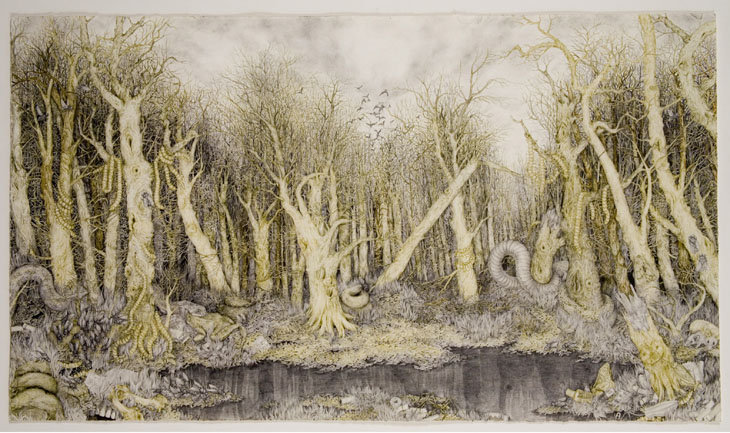
    This is what Saatchi is good at: the attention-grabbing one-liner that sells the product. Like his ES pieces, his exhibition was a string of loosely associated thin ideas. He collects art works like he collects facts, in bulk, and presents them in a similarly disconnected way, without argument. One gallery contained photographs of Russian mafia graves, a bomb in a suitcase and a floral tribute made of scrunched-up copies of the Daily Mail stained with blood and tea. Another displayed a pillar formed of resin casts of dead mice, a fake stuffed skunk in a museum case and a pair of genuine animal skins of a cat and dog. A third was a morgue of grotesque human dummies made of urethane wax, old sweaters and bandages, littered around in a range of abject poses. The only exhibit anyone lingered over was Body Swallows World (2006), a truly terrifying drawing of a forest of creepy crawlies by Aurel Schmidt that made Richard Dadd look like Grandma Moses and the Chapmans look ham-fisted. Otherwise, far from striking mortal terror into visitors (most of whom were too young to have begun to think of death) the tone of the exhibition was as insouciant as the small boy leapfrogging a tombstone in the vintage photograph outside the entrance.

    My father used to tell a story of a 19th century actor whose onstage deaths were so convincing that the audience would clamour: “Die again, Sam!” and he would oblige. The trouble with Dead: A Celebration of Mortality is that the clamour for its brand of snuff stuff has died down. Almost all the work in the show was pre-financial crash and to post-recessionary eyes it looked like death warmed up. Today’s audiences may not have lived through two world wars, but the past seven years have been no party and they want art which, if not life-affirming, has a bit of depth. Young artists have stopped making schlock art about death and older ones with any sense have grown out of it. The former YBA Mat Collishaw – who came to fame with the gory Bullet Hole shown at Freeze and now in the collection of the Saatchi of the Southern Hemisphere, David Walsh – has progressed to subtler meditations on mortality in his 2013 series of photographic still lifes, Last Meal on Death Row.

    One essay in Saatchi’s book tells the cautionary tale of American news anchor Christine Chubbuck who shot herself on screen in 1974 in protest at her channel’s obsession with gore. There’s only so much death a body can take. Even Damien Hirst, whose obsession with mortality may well be genuine, has stopped trying to flog a dead horse – with or without golden hooves – and started looking on the bright side of the life cycle. It began with that hideous series of Fact Paintings (2005-6) painted from photographs of the caesarian birth of his third son Cyrus and has continued in The Miraculous Journey, the recent sequence of equally hideous bronzes of developing foetuses commissioned as street furniture by the Qatari Royal Family in the run-up (they hope) to the 2022 Doha World Cup. Ironically, this is one case where funerary monuments to dead Nepalese workers might be more appropriate.

    Washed-up celebrity artistes end up in Vegas; washed-up celebrity artists end up in Doha. It’s no coincidence that both are deserts. On home turf, meanwhile, Hirst is following in the footsteps of his old patron Saatchi and seeking a new form of artistic immortality as a philanthropic museum owner. His free gallery in Newport Street, Lambeth, opening in October, is being built to house his morbidly titled Murderme Collection, but its inaugural show will be a life-affirming exhibition of paintings by his old adversary John Hoyland. Cheer, up everyone! There may be life after death.

    Laura Gascoigne


  • … Where’s the sense in multisensory art?

    Tate-SensoriumIt used to be known as ‘synaesthesia’; now ‘crossmodal perception’ is the scientific term for the ability of one sense to stimulate another. Experiments by Oxford University psychologists and researchers in New York have found links between reactions to sound and smell in the part of the brain known as the ‘olfactory tubercle’. It may sound like a plug of mucus in a brass instrument, but apparently it’s highly sensitive. When one researcher banged his coffee mug down next to the laboratory mice whose olfactory reflexes he was testing, their smell cells jumped.

    Artists, always looking for new angles, have played with crossmodal possibilities for years. But while modern artists like Kandinsky and Klee focused on art’s relationship with music, postmodern artists have developed a less salubrious interest in smells. At the Whitechapel Gallery’s groundbreaking exhibition This Is Tomorrow in 1956, Richard Hamilton installed a strawberry-scented carpet. That was yesterday, and things have moved on. In 2008 the Reg Vardy Gallery in Sunderland devoted a whole exhibition, If There Ever Was, to the fifth sense, regaling visitors’ nostrils with the aroma of the last meal of Death Row prisoner Jesse Tafero and claiming to reproduce the scent of the sun by heating the seven earth metals from which it is composed to melting point. In 2010 specialist fragrance artist Clara Ursitti subverted nasal expectations at Tatton Park Biennial by infusing the upholstery of a Nissan Sunny with the designer perfume of a Rolls Royce Silver Cloud, and in April this year, for the odour-themed exhibition I’m Here But You’ve Gone staged by the Fiorucci Art Trust in a Sloane Avenue townhouse, Mary Ramsden sprayed a black and white room with the scent of Panda Sex. I can’t give a nosewitness account, but according to a report in the Evening Standard it smelt of baby wipes and posh candles. If that’s what turns pandas on, it’s no wonder they have difficulty breeding.

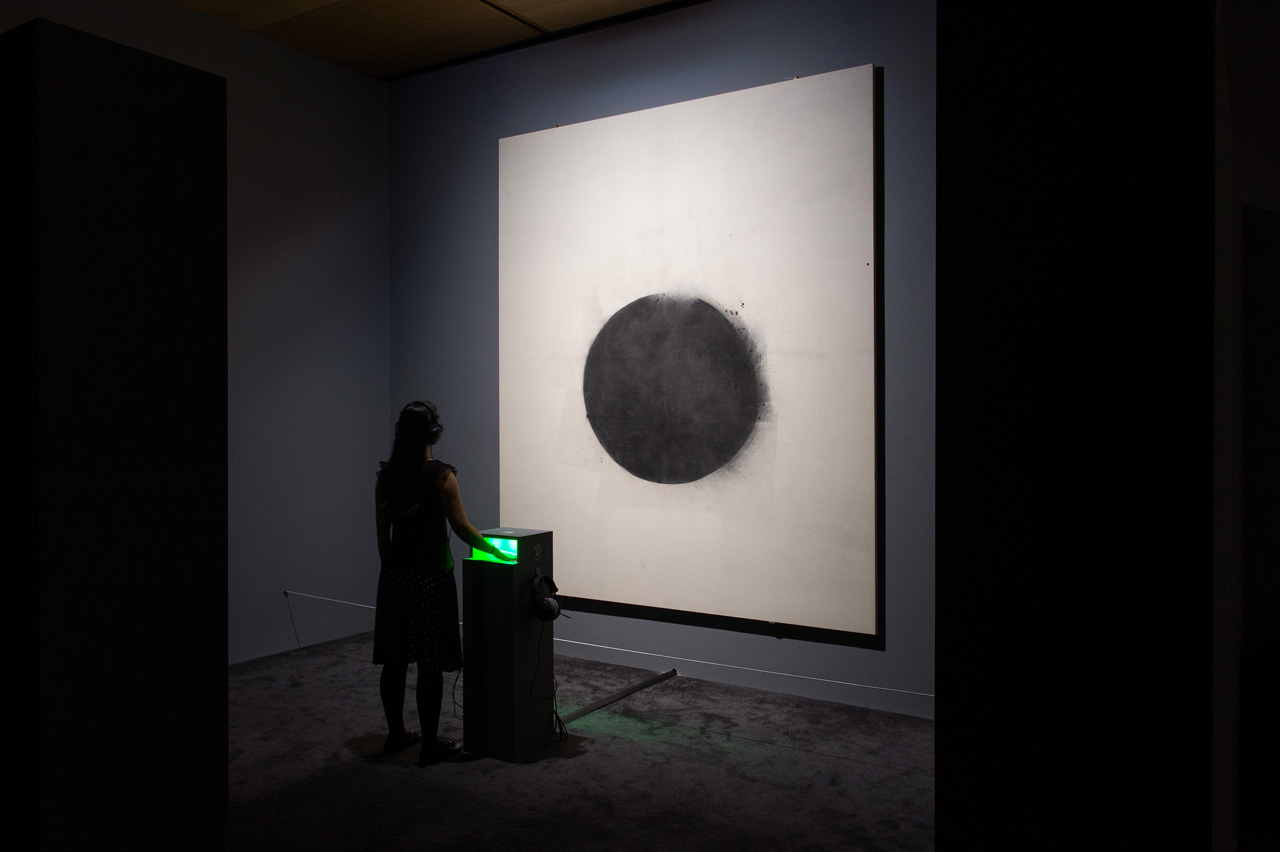
    Now public galleries struggling with the problem of ADHD-afflicted visitors who’ve lost the ability to focus on one thing at a time are hoping crossmodality could be the answer. Last summer at Tate Britain the special exhibition Tate Sensorium offered visitors a multisensory tour of four paintings from the collection – Richard Hamilton’s Interior II, John Latham’s Full Stop, David Bomberg’s In the Hold and Francis Bacon’s Figure in a Landscape – with added bells and smells. The experience of Hamilton’s Interior, for example, was aurally enhanced by the sound of clacking heels on 1960s parquet and distant traffic noise, while wall dispensers diffused the odours of furniture polish, hairspray and glue. (Or so we were told. All the scents in the show smelled to me like stale air-freshener, not surprisingly considering their creator trades under the name of Odette Toilette.) The sense of touch was tickled in front of the Latham by an ‘Ultrahaptics’ device using ultrasound waves to puff spurts of air, and the sense of taste in front of the Bacon by a ball of chocolate that exploded in the mouth into a gritty mix of edible charcoal, cocoa grains and sea salt, evocative of Bacon’s dingy earth palette but rather more exciting.

    As we listened, sniffed, felt and munched our way through the darkened rooms, our reactions were recorded on wristbands using lie detector technology to measure electrodermal activity through perspiration. The trouble was that the technology had no way of telling what exactly was getting us in a sweat. At the exit we were handed readouts of our reactions to the different works. My personal graph traced a level line of phlegmatic indifference to Hamilton, Latham and Bacon – without a blip for the chocolate – but went completely haywire in response to Bomberg. This led the Sensorium to conclude that my “strongest physical reaction was to sound and smell within The Hold”. It didn’t entertain the possibility that my excited response might have been to the visual stimulus of the painting, the only one of the four works selected to reward sustained optical exploration.

    There’s a growing assumption in our multimedia age that looking at pictures is no longer enough. In the 17th century, when artists painted Allegories of the Senses, viewers were supposed to use their imaginations – the sight of the poopy baby’s bottom in Jan Miense Molenaer’s The Sense of Smell was expected to do the business on its own. Now post-modern literalism expects more. Yet which seems funkier, the rumpled sheets on Sickert’s iron bedsteads or the real ones on Tracey Emin’s My Bed, reduced by years of conservators’ condition reports to a state of artificial deinsemination?

    On the evidence of the Tate Sensorium, the senses of smell, taste and touch contribute little to visual enjoyment. Hearing is a different case, as we know from film scores, which raised my hopes of the National Gallery’s summer exhibition Soundscapes for which six composers, sound artists and recordists were commissioned to write soundtracks to paintings of their choice. A problem with sound, of course, is that to appreciate it you have to keep quiet, which gallery visitors – unlike concert or film audiences – aren’t obliged to do. The calls of the raven, cuckoo and Lapplanders’ ‘yoik’ supplied by David Attenborough’s sound recordist Chris Watson as an undercurrent to Akseli Gallen-Kallela’s Lake Keitele would have been wonderfully atmospheric if not regularly drowned in waves of chatter every time the gallery doors were opened.

    Not all the soundtracks were as evocative as Watson’s. The melancholy sawing of Susan Philipsz’s Air on a Broken String, played as an accompaniment to Holbein’s The Ambassadors on a violin with a string missing, was as maunderingly self-indulgent as her 2010 Turner Prize entry and – apart from the knowing reference to Holbein’s broken lute string – had no connection with the picture. The other sound artists Janet Cardiff & George Bures Miller chose a more appropriate accompaniment to Antonella da Messina’s St Jerome in his Study in Guillaume Dufay’s early Renaissance composition Vergine Bella, but then managed to completely upstage the painting by installing a large wooden model of Jerome’s study in the centre of the room and relegating the original to a corner. Digital remix artist Jamie xx had a decent stab at replicating the pointillism of Theo van Rysselberghe’s Coastal Scene with pullulating electronic rhythms, and classical composer Nico Muhly’s theme for bells and viola da gamba was a harmless complement to The Wilton Diptych, but the only unqualified success was Gabriel Yared’s score for Cézanne’s Les Grandes Baigneuse. Yared is a film composer who knows his stuff. His orchestration for soprano voice, clarinet and tinkling piano vividly evoked the shifting light and leaves of a sylvan glade, while his repeating doo-whump figure in the cello supplied a thumping bass for the bottom-heavy bathers. The fact that the painting is the size of a wide-screen TV helped.

    Soundscapes was an interesting experiment, but was it successful in making people look at the paintings? Here’s a conversation The Jackdaw’s sound recordist overheard in the ladies’ toilets.

    Girl 1: “Did you go to the cinema?”

    Girl 2: “What cinema?”

    Girl 1: “The one with the film where all the artists talked about their

    work?”

    Girl 2: “Oh no! You mean I missed the main thing?”

    Laura Gascoigne

  • Art under kleptocracy


    Another month, another book on the contemporary art economy, this time from an overlooked perspective. The New Economy of Art, a joint publication by DACS and Artquest, looks at the art market from the POV of the average artist. Not surprisingly, it finds plenty to puzzle over.

    The conundrum it addresses is clearly set out in the preface by editors Gilane Tawadros and Russell Martin. “The art world is in crisis,” begins the first paragraph; “The art world is in the best shape it has ever been,” begins the second. The question of how these conflicting statements can both be true at the same time – “the disconnect between how artworks gain financial value even while their makers are poorly, or hardly, paid.” – is the mystery the authors of its six essays try to solve.

    Two weeks before the book came out, Christie’s New York achieved an all-time auction record for its November postwar and contemporary art sale, in which a Warhol Triple Elvis hit the jackpot – kerchung! – at £51.6m – and a row of Four Marlons paid out a further £43.9m. Both, appropriately, had previously hung in a casino in Aachen. The result was hailed by international head of post-war and contemporary art Brett Gorvy as confirmation of “a virtuous cycle of confidence in the art market”. Another season, another reason for making whoopee.

    On the other side of the art market, meanwhile, a more vicious cycle is in operation. The book’s authors quote the usual dismal statistics. It’s depressing enough to learn from the 2011 survey by the Centre for Intellectual Property, Policy and Management at Bournemouth University that UK artists earn a median wage of £10,000 – unchanged for 20 years – without discovering that the statistic includes designers, illustrators and photographers, and that the top 7% earn 40% of the total. Artists now officially rank as ‘marginalised makers’, a marginal constituency politicians aren’t fighting over. The economist Alan Freeman quotes figures showing our ‘creative economy’ growing faster than any other UK production industry, employing 2.5 million people and accounting for 5.2% of gross value added – but take out all the advertising, marketing, fashion, IT and other people he counts as ‘creative specialists’, and the fine artists are still scratching around on the margins.

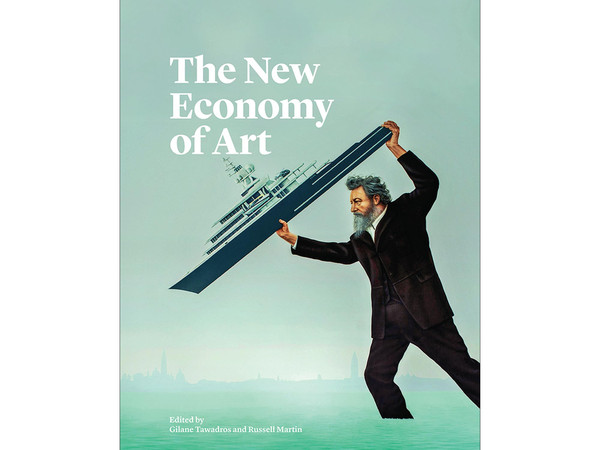
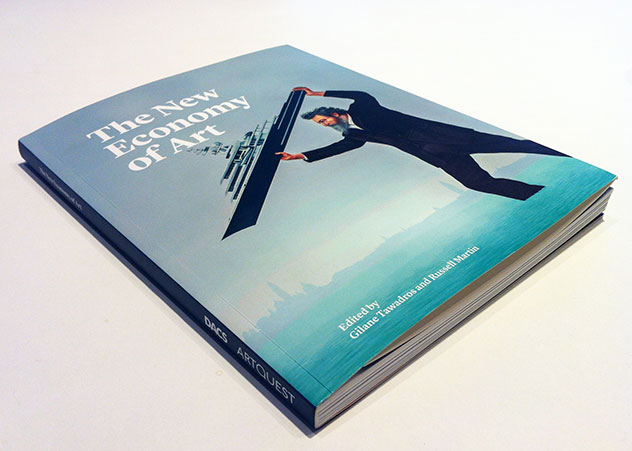
    The book’s cover reminds us that there is nothing new in this. It reproduces Jeremy Deller’s mural from the 2013 Venice Biennale picturing William Morris as a Victorian Poseidon hurling Roman Abramovich’s superyacht into the Venetian Lagoon. The mural’s title ‘We sit starving amidst our gold’ encapsulates the argument at the heart of the book while reminding us that Morris said it all before, and better. Compare Freeman’s dewy vision of a creative utopia “in which shared values, achievements, hopes and aspirations replace brute greed to lay foundations on which the true individuals of the future can confidently build the new worlds of their choosing” with this trenchant passage from Morris’s lecture Art Under Plutocracy: “So long as the system of competition in the production and exchange of the means of life goes on, the degradation of the arts will go on; and if that system is to last for ever, then art is doomed, and will surely die”. Only the substitution of association for competition, believed Morris, could “give an opportunity for the new birth of art, which is now being crushed to death by the moneybags of competitive commerce.” In the war of words, Morris wins hands down.

    Still, the book contains material which, if not revolutionary, is astonishingly inflammatory for a publication part-funded by the Arts Council. Have they read it? It has a quiet way of dropping bombshells. One is the casual mention by management consultant Keir McGuinness of the apparently generally accepted practice whereby “the decision of whether a [public] gallery will take a show or not depends upon whether you [the artist’s dealer] will make a financial contribution and the person who makes the largest financial contribution gets the shows”. Another is a statistic cited from AN’s recent Paying Artists report that “71% of artists receive no fee for publicly funded exhibitions and nearly 60% do not even have their expenses covered”. This against the background of an international art industry which, arts consultant John Kieffer points out, has a turnover of just under £40bn, with the UK’s market share of 20% amounting to three times the combined budgets of the English, Welsh, Scottish and Northern Irish culture departments.

    But the real eye-opener is the essay by curator Lynda Morris. Born in 1947, Morris is old enough to remember the heady days of the 1960s when a newly international avant-garde was promoted by dealers who were themselves artists, lived like artists on air and were perceived as having ‘moral authority’. What an antiquated concept that now sounds. After reading Morris’s analysis of the process whereby the present nexus of curators, industrialists, bankers and property developers took control of the art world, it seems to belong to another era.

    Morris pinpoints Thatcher’s appointment of Richard Rogers as chair of Tate Trustees in the 1980s as the start of the cultural ascendancy of architecture over art. “It was the moment in late Thatcherism when the State no longer provided social housing and, instead, the national lottery, a new arm of the gambling industry, enabled museum directors and their trustees to start to plan Palaces of Culture.” A proposal to regenerate derelict buildings for low-cost studios, housing and artist-led galleries put forward by officers of the then Arts Council of Great Britain – in association with artists’ collectives ACME and SPACE – was kyboshed by property developer Peter Palumbo, who as chair of the ACGB from 1988-94 presided over the drafting of the rules for National Lottery funding, including the ‘subsidiarity’ clause ensuring that money is allocated only to new projects and thus funneled towards developers and architects rather than artists. Artists are wonderful at sprinkling the fairy dust that turns urban wastelands into developers’ goldmines, but once the gold has been extracted the fairies can piss off and take their dust elsewhere. Prices for a ‘premium apartment’ in Neo Bankside, the new residential development overlooking Tate Modern designed by Rogers Stirk Harbour – formerly Richard Rogers Partnership – start at £4.5m.

    “We seem to have drifted from a market economy to a market society,” comments John Kieffer. It’s a form of society Margaret Thatcher would have recognised, but not William Morris. “It is this superstition of commerce being an end in itself, of man made for commerce, not commerce for man, of which art has sickened,” he wrote in Art under Plutocracy. Art under kleptocracy has brought no improvement. It has been left to President Xi Jinping to uphold moral values, warning Chinese artists last October not to follow the “stench of money” or “lose themselves in the tide of market economy” which the rest of the People’s Republic is happily riding.

    Are artists and Gordon Brown now the only people on the planet still expected to possess a moral compass? That could explain the disconnect highlighted by this book. If our market society is wholly reliant on artists for moral orientation, it has good reason not to seduce them with the stench of money, ie pay them. You could almost call it a virtuous cycle.

    Laura Gascoigne  

    The New Economy of Art, edited by Gilane Tawadros and Russell Martin, published by DACS, £14.99


  • Champagne feminist

    Sixteen years ago, I wrote an article for a short-lived women’s art magazine called Make responding to a complaint on the letters page that only childless women could succeed as artists. Off the top of my head, I immediately thought of half a dozen artists who disproved this rule and I interviewed them for a piece called A Woman’s Work. They included Shani Rhys-James, Evelyn Williams, Susan Wilson and Sarah Raphael. A quote from Raphael, who had just had a third child, appeared to clinch the argument: “Motherhood is such an overwhelming purpose that it has to be very powerful, the urge to do the other thing. It cuts the crap. I just haven’t got the time to sit around wondering what sort of artist I am. The kids get their trainers, that’s the main thing. I think it’s horseshit, personally, that you can’t be both.”

    Gender studies have since moved on, along with definitions of mother and womanhood. We’ve had handbags at dawn between David Furnish – or was it Elton John? – and Domenico Dolce – or was it Stefano Gabbana? – over the dress designer’s suggestion that men can’t be proper Italian mammas, and Germaine Greer has been sent into purdah for refusing to recognise transgender women as women. This throws up some interesting artistic questions. If Caitlin Jenner re-reinvented herself as a woman artist, would she produce women’s art? Given that artists draw on their life experiences and Jenner’s, up till now, have been a man’s, her artistic perspective ought to be male. But who knows? These days there’s really no way of telling until s/he is imprisoned for violent assault, when a decision can be made according to the gender of the prison.

    It’s legitimate to talk about ‘women’s fiction’ because women buy it, but is it invidious to talk about ‘women’s art’ when the vast majority of collectors with disposable incomes to spend on art are men? (Interestingly no one talks about ‘gay art’, perhaps because if you removed all the homosexuals from art history it would knock a huge hole, so to speak, in the male art pantheon.) We live in an increasingly touchy world. Such are our sensitivities on gender issues that some in the trans community – smaller than the community of giant pandas, but more visible – are calling for gender specification to be dropped from official forms. Since one of the presumed points of official forms is to ensure fairness, others in the feminist community have complained that this will make it harder, all things being unequal, to monitor sexual equality. No sex, no equality – we’re British.

    It hardly seems worth getting one’s knickers in a twist when all the data on gender collected to date has had no visible impact on the only significant measure of equality, the pay packet. But now women artists have found a surprising champion in Charles Saatchi. The wife-throttling philanthropist has chosen to mark his gallery’s 30th anniversary with Champagne Life (until March 6th), an exhibition of 14 emerging women artists from around the world. In the wake of the gallery’s recent series of exhibitions of contemporary art from Africa and Latin America, Russia, Germany, the Middle East and China, comes a show of art from the planet Venus. Any Martian glancing through the recent programme might be forgiven for thinking the female sex was a foreign country.

    Aware of the problem, the show’s publicity stresses that it “does not offer an overarching vista of ‘female’ artistic practice, nor does it presume to state that there is such a thing”. There are plenty of people around, however, who assume there is. Most wouldn’t dare go as far as Brian Sewell and claim: “There has never been a first rank woman artist. Only men are capable of aesthetic greatness”. But Sewell did agree with the Make magazine moaner: “Maybe it’s something to do with bearing children.”

    Historically, this was obviously true. Greer’s The Obstacle Race is a catalogue of female artistic ambitions hobbled or snuffed out by childbearing; between domestic commitments to children, husbands, fathers and brothers, a woman’s work as an artist was never done. Equally damaging, in her view, was the imitative hero-worship squandered by women artists on male teachers or husbands – or both, in cases where love-struck women students married their masters. “The artistic ego is to most women repulsive in themselves, and compelling in men,” is Greer’s analysis of the situation. Or as Degas put it to Suzanne Valadon: “You must have more pride.”

    Male ‘aesthetic greatness’ often goes with showing off; the problem is that the public can’t tell one from the other. Not being natural show-offs, women artists are too easily diverted from the self-satisfaction of making reputations by the deeper satisfaction of making things. “No artistic success has given me as much pleasure,” said Liubov Popova, “as the sight of a peasant buying a length of material designed by me.” The artist of ambition, argues Greer, “must have a masterful attitude not only to his subject, but also to the beholder whose attention he claims”. This, she suggests, is why women have tended to work small.

    Not any longer. There are no small works in Champagne Life, with the exception of two little heads hanging amongst Jelena Bulajic’s monumental portraits of old women. Still in her 20s, this young Serbian artist – who had two paintings in last year’s RA Summer Exhibition – is something of a prodigy. Although shortlisted for the BP Portrait Award, her magnified grisaille faces showing every wrinkle are not photorealist: from close to, they break down into pointilliste confections of marble dust, ground granite and limestone, kaolin, graphite and charcoal. In terms of technique, most of the paintings in this show ­– from the densely patterned mythological images of American Mequitta Ahuja, executed in acrylic, coloured pencil, oil, watercolour and wax crayon on vellum, to the nude body landscapes of Korean Seung Ah Paik, with their perfect nipples stippled in pigment sealed with rabbit skin glue – are in a different class from the slapdash efforts of the mostly male artists in the gallery’s recent Pangaea exhibitions. These women artists take a pride in their work: they like making things.

    Is it patronising of a male patron to stage a women-only exhibition? The Tate has been promoting women’s art, but only through safe solo shows of established artists. Saatchi, meanwhile, has brought together 14 strikingly different young women artists in a group exhibition whose effect, intentional or not, is to blow the idea of ‘women’s art’ out of the water. Yet on the most basic measure of equality – money – art by women still ranks a distant second. In 2014 the holy cow of American modernism, Georgia O’Keeffe, broke auction records for a woman artist with the sale of Jimson Weed/White Flower No 1 for $44 million at Sotheby’s New York; the following year Picasso’s Women of Algiers sold for almost exactly four times as much at Christie’s. It puts the 20% gender pay gap in the workplace into proportion.

    One glass ceiling leads to another. As long as the art market is dominated by male collectors on whom a sniff of senescent Picasso acts like rhino horn, nothing’s going to change. Saatchi’s gesture is welcome, but any celebration would be premature. Until women’s work commands equal prices, the champagne can stay on ice.

    Laura Gascoigne


  • Wonders of creativity

    Laura Gascoigne investigates why what was once so very special is now common as muck and comprehensively commandeered by the fat controllers

    In The Masque of Augurs, Ben Jonson introduces the comic figure of Vangoose, a “rare artist” and producer of masques with a reputation for the wildly fantastical. “Now we would bring in some dainty new thing, dat never was, nor never sal be, in de rebus nature… a mere ‘devisa’ of the brain,” the artist promises his Jacobean audience. “If it go from de nature of de ting, it is de more art; for dere is art, and dere is nature, you sall see.”

    Vangoose’s obvious difficulty with the English language is not due solely to his being Dutch. The 17th century had no word, in Dutch or English, for the quality of artistic creation he’s trying to describe. Astonishingly, the word ‘creativity’ only entered the English language in 1927 in a lecture by the philosopher Alfred North Whitehead. For more than two millennia before that, Plato’s philosophical verdict in The Republic that a painter “merely imitates” held sway, and the advent of Christianity didn’t shake it. If anything, it reinforced it. Leonardo could go so far as to claim that an artist uses “shapes that do not exist in nature” but he could go no further, since ‘creatio ex nihilo’ was the sole prerogative of the Creator. It wasn’t until the Enlightenment, when Joseph Addison dared to suggest that human imagination “has something in it like creation”, that the divine monopoly on creativity was broken. In the next century, Romanticism finished the job.

    Today, creativity is as common as muck. We find the word ‘creative’ applied to everything from art and writing to psychology, philosophy, and technology, not to mention accounting. Like so much else, it has gone cross-disciplinary – it has even jumped lexical categories to become a noun referring to someone working in advertising. But the most significant change of the past 20 years has been not in its range of applications but in its meaning. As the American psychologist Michael Mumford noted in Creativity Research Journal a decade ago, “we seem to have reached a general agreement that creativity involves the production of novel, useful products [my italics].” Out of the Romantic cult of an economically useless imaginative faculty has grown the dreary McKinseyite concept of a mental ability to be cultivated for the purposes of productivity. So we have ‘creative industry professionals’ hot-desking in ‘creative hubs’ and ‘incubator spaces’ to speed the fermentation of moneymaking ‘devisas’ of the brain to boost the economy. One wonders what Ben Jonson would have made of it.

    The ‘creative industries’, according to the CBI, now account for more than 6% of Britain’s GDP – just 3% behind the financial services sector – and represent an inflatable life-raft in a floundering economy. Scoff if you like at Meedja Studies and ‘Mickey Mouse’ courses, but there are number-crunchers at the Treasury who are seriously counting on Mickey and Minnie to save our island from disappearing off the global economic map. For a post-industrial nation that no longer makes things, creativity conjures the illusion of a deus ex machina materialising out blue skies thinking in a shower of gold. It’s no accident that the opening sentence of Alex Salmond’s Guide to an Independent Scotland hailed Caledonia as “an ancient nation, renowned for the ingenuity and creativity of its people”, or that Sir Sean Connery, in a New Statesman article hubristically headed ‘There is no more creative act than creating a nation’ [tell that to the Almighty, Mr Bond] argued that independence would present the Scots “with an unparalleled opportunity to promote our creative excellence”. In these days of corporate-creep, Hollywood and Holyrood speak the same language.

    Don’t get me wrong. I’m as relieved to have escaped a haggisectomy as the next Sassenach, but when I hear the word ‘creativity’ I reach for my revolver. Why? Because what was once a faculty free as the air we breathe has been thoroughly and comprehensively monetized. How did we let this happen? I date the start of the rot to the reign of John Birt, that Blairite Svengali of blue skies thinking and foggy speech who educated a generation of cultural administrators in the language of corporate creative bollocks. Take this example from Jana Bennett, former Head of Vision at the BBC, quoted in Private Eye’s ‘Birtspeak’ column in 2007: “Now that it’s clear the conversation genuinely can be a creative two-way process, and in many cases multi-way, we are witnessing the possibilities opened up when many ripples bump against one another and the patterns of interference, the ‘mash-ups’, they create. We have the opportunity more than ever before to willingly seed the clouds of creativity and see a creative rainfall.” Since Bennett’s speech, the c-word count has risen. She notched up a modest four mentions; the Tate, in the publicity for its new IK Prize for ‘digital creativity’ unveiled in August, managed six.

    The clouds of creativity are clearly massing, thanks partly to the efforts of ‘creativity enablers’ devising ways of optimising meteorological conditions through the establishment of ‘creative hubs’, ‘incubator spaces’ and ‘innovation labs’ in happening places. “When you join THECUBE,” coos the website of one such establishment in Shoreditch, “you join a curated diverse and smart community of scientists, engineers, designers, technologists, artists, futurists and anthropologists”. Artists, one notes, are only fifth on the list – ahead of Marinetti and Lévi-Strauss – but one assumes that all the disciplines share equally in the benefits of “innovation through community”. THECUBE’s founders got the idea, their website says, in the aftermath of the financial crash, when they “hypothesised that it was the start of an economic and anthropological pivot”.

    If you’re wondering how exactly a pivot starts, THECUBE’s engineers may be able to help. But let’s not nitpick. Around a “highly fuzzy concept” like creativity, an occasional lack of clarity is inevitable. There’s no such problem in Africa, however, where of the 28 languages currently spoken only one – Arabic – has a word for ‘creative’. It’s not that Africans are short on creativity, it’s just that in the matter of rainfall they prefer the wet kind that makes seeds grow into edible crops. Fuzzy concepts are luxuries for developed economies. In Taiwan, for example, they take their creative agronomy so seriously that last summer Taipei Contemporary Art Centre staged a Strategic Business Plan Public Stakeholders Consultation Focus Group Exhibition [snappy title] to show the products of three ‘creative game-based workshops’ that ‘looked at aspects of the business of contemporary art’. The workshops were run by visiting Senior Tutor in Curating Contemporary Art from the Royal College, Kit Hammonds, a specialist in “imaginations of the future found in science, business planning and speculative fiction”.

    The line between art and business is now so fuzzy that an IBM Global CEO study of 2010 named creativity as the most crucial quality for leadership success (which could explain why so few CEOs are female, since women, as we know, are better at procreativity). How to reclaim creativity from business? By defending to the death our artistic right to exercise it in pursuit of the wildly irrational and unproductive. As Veronese, a champion of creativity avant la lettre, told the Inquisition: “We painters use the same licence as poets and madmen” – and he meant madmen, not ad men.

  • Art under kleptocracy

    Art under kleptocracy

    Laura Gascoigne examines the paradox of why most artists’ earnings are below the poverty line while the art market is thriving as never before

    Another month, another book on the contemporary art economy, this time from an overlooked perspective. The New Economy of Art, a joint publication by DACS and Artquest, looks at the art market from the POV of the average artist. Not surprisingly, it finds plenty to puzzle over.

    The conundrum it addresses is clearly set out in the preface by editors Gilane Tawadros and Russell Martin. “The art world is in crisis,” begins the first paragraph; “The art world is in the best shape it has ever been,” begins the second. The question of how these conflicting statements can both be true at the same time – “the disconnect between how artworks gain financial value even while their makers are poorly, or hardly, paid.” – is the mystery the authors of its six essays try to solve.

    Two weeks before the book came out, Christie’s New York achieved an all-time auction record for its November postwar and contemporary art sale, in which a Warhol Triple Elvis hit the jackpot – kerchung! – at £51.6m – and a row of Four Marlons paid out a further £43.9m. Both, appropriately, had previously hung in a casino in Aachen. The result was hailed by international head of post-war and contemporary art Brett Gorvy as confirmation of “a virtuous cycle of confidence in the art market”. Another season, another reason for making whoopee.

    On the other side of the art market, meanwhile, a more vicious cycle is in operation. The book’s authors quote the usual dismal statistics. It’s depressing enough to learn from the 2011 survey by the Centre for Intellectual Property, Policy and Management at Bournemouth University that UK artists earn a median wage of £10,000 – unchanged for 20 years – without discovering that the statistic includes designers, illustrators and photographers, and that the top 7% earn 40% of the total. Artists now officially rank as ‘marginalised makers’, a marginal constituency politicians aren’t fighting over. The economist Alan Freeman quotes figures showing our ‘creative economy’ growing faster than any other UK production industry, employing 2.5 million people and accounting for 5.2% of gross value added – but take out all the advertising, marketing, fashion, IT and other people he counts as ‘creative specialists’, and the fine artists are still scratching around on the margins.

    The book’s cover reminds us that there is nothing new in this. It reproduces Jeremy Deller’s mural from the 2013 Venice Biennale picturing William Morris as a Victorian Poseidon hurling Roman Abramovich’s superyacht into the Venetian Lagoon. The mural’s title ‘We sit starving amidst our gold’ encapsulates the argument at the heart of the book while reminding us that Morris said it all before, and better. Compare Freeman’s dewy vision of a creative utopia “in which shared values, achievements, hopes and aspirations replace brute greed to lay foundations on which the true individuals of the future can confidently build the new worlds of their choosing” with this trenchant passage from Morris’s lecture Art Under Plutocracy: “So long as the system of competition in the production and exchange of the means of life goes on, the degradation of the arts will go on; and if that system is to last for ever, then art is doomed, and will surely die”. Only the substitution of association for competition, believed Morris, could “give an opportunity for the new birth of art, which is now being crushed to death by the moneybags of competitive commerce.” In the war of words, Morris wins hands down.

    Still, the book contains material which, if not revolutionary, is astonishingly inflammatory for a publication part-funded by the Arts Council. Have they read it? It has a quiet way of dropping bombshells. One is the casual mention by management consultant Keir McGuinness of the apparently generally accepted practice whereby “the decision of whether a [public] gallery will take a show or not depends upon whether you [the artist’s dealer] will make a financial contribution and the person who makes the largest financial contribution gets the shows”. Another is a statistic cited from AN’s recent Paying Artists report that “71% of artists receive no fee for publicly funded exhibitions and nearly 60% do not even have their expenses covered”. This against the background of an international art industry which, arts consultant John Kieffer points out, has a turnover of just under £40bn, with the UK’s market share of 20% amounting to three times the combined budgets of the English, Welsh, Scottish and Northern Irish culture departments.

    But the real eye-opener is the essay by curator Lynda Morris. Born in 1947, Morris is old enough to remember the heady days of the 1960s when a newly international avant-garde was promoted by dealers who were themselves artists, lived like artists on air and were perceived as having ‘moral authority’. What an antiquated concept that now sounds. After reading Morris’s analysis of the process whereby the present nexus of curators, industrialists, bankers and property developers took control of the art world, it seems to belong to another era.

    Morris pinpoints Thatcher’s appointment of Richard Rogers as chair of Tate Trustees in the 1980s as the start of the cultural ascendancy of architecture over art. “It was the moment in late Thatcherism when the State no longer provided social housing and, instead, the national lottery, a new arm of the gambling industry, enabled museum directors and their trustees to start to plan Palaces of Culture.” A proposal to regenerate derelict buildings for low-cost studios, housing and artist-led galleries put forward by officers of the then Arts Council of Great Britain – in association with artists’ collectives ACME and SPACE – was kyboshed by property developer Peter Palumbo, who as chair of the ACGB from 1988-94 presided over the drafting of the rules for National Lottery funding, including the ‘subsidiarity’ clause ensuring that money is allocated only to new projects and thus funneled towards developers and architects rather than artists. Artists are wonderful at sprinkling the fairy dust that turns urban wastelands into developers’ goldmines, but once the gold has been extracted the fairies can piss off and take their dust elsewhere. Prices for a ‘premium apartment’ in Neo Bankside, the new residential development overlooking Tate Modern designed by Rogers Stirk Harbour – formerly Richard Rogers Partnership – start at £4.5m.

    “We seem to have drifted from a market economy to a market society,” comments John Kieffer. It’s a form of society Margaret Thatcher would have recognised, but not William Morris. “It is this superstition of commerce being an end in itself, of man made for commerce, not commerce for man, of which art has sickened,” he wrote in Art under Plutocracy. Art under kleptocracy has brought no improvement. It has been left to President Xi Jinping to uphold moral values, warning Chinese artists last October not to follow the “stench of money” or “lose themselves in the tide of market economy” which the rest of the People’s Republic is happily riding.

    Are artists and Gordon Brown now the only people on the planet still expected to possess a moral compass? That could explain the disconnect highlighted by this book. If our market society is wholly reliant on artists for moral orientation, it has good reason not to seduce them with the stench of money, ie pay them. You could almost call it a virtuous cycle.

    The New Economy of Art, edited by Gilane Tawadros and Russell Martin, published by DACS, £14.99

    http://www.dacs.org.uk/latest-news/order-your-copy-of-the-new-economy-of-art?category=For+Artists&title=N

  • View from the summit

    Laura Gascoigne wades through managerial drivel to consider the plight of museums outside London.

    Searching for quirky museums for a series in The Oldie, I turned up the name of the Astley Cheetham Art Gallery in Stalybridge, Greater Manchester. A recce of the BBC Your Paintings website revealed that its Victorian collection, left to the town in 1932 by mill owner John Frederick Cheetham and his wife Beatrice Astley, contained – alongside later acquisitions of local scenes by the usual artists of the ‘Northern School’ – an astonishing cache of Italian devotional paintings by the likes, or circles, of Niccolò di Tommaso, Jacopo di Cione, Jacopo da Sellaio, Pier Francesco Fiorentino, Timoteo Viti, Bernardino Luini and Girolamo Siciolante da Sermoneta.

    Santa Madonna! I’d struck gold. In high excitement I called the local authority number, to be informed that due to funding cuts at Tameside Council the gallery on the first floor of Stalybridge Library was only open on Saturdays in August from 10am to 3pm, although it was hoped to extend opening times in the near future. But before that happened, the obliging young curator said I was welcome to visit and she’d show me round.

    I arrived to find a mixed hang of thirty works on the theme of Colour, ranging from a red Ship on Fire by James Francis Danby to a blue Heron by Cedric Morris (a gift of the Contemporary Art Society), but of the hoped-for hoard of Italian Renaissance paintings only a St Catherine of Alexander after Luini. When I expressed disappointment, the curator explained that displays had to be rotated and a previous hang on the theme of the collection’s history had included more of the early works I wanted to see. But if people were interested in particular paintings, personal viewings could be arranged. I ended my Oldie article with a warning to readers not to expect to find the Italian masters on view, and received a query from the magazine’s new editor, Alexander Chancellor, wanting “to know why this should be”.

    And very good question. How long had he got? The Museums Summit at the National Gallery organised by The Art Fund in July went on for three hours without getting round to answering it. There was gracious acknowledgement from Liz Forgan, former chair of ACE, that there are galleries outside London with collections of national standard – especially where “local authorities … take their responsibilities seriously like Aberdeen Art Gallery” (ie are lucky enough to be sloshing in oil) – and denial that a problem existed from John Kampfner, perma-tanned director of the newly formed Creative Industries Federation, or CIF (not a multi-purpose cream cleaning solution but a new independent voice for the cultural sector, apparently). “One word I dislike is ‘regional’,” he announced. “It’s not operational in the United States.” Well yes, but that is the United States. Kampfner is touchy on this subject, as he’s also Chair of Trustees of Turner Contemporary, Margate – or should that be Deckchair of Trustees? That would explain the perma-tan.

    I learned not to use the word ‘provincial’ years ago after narrowly avoiding a sock in the puss from the arts editor of the Birmingham Post, but I didn’t know ‘regional’ was now also off limits. What are Londoners to call museums out of London? Awayday museums? A visit takes the best part of a day plus the cost of the train fare, even if it’s free to get in. Which raises that other touchy subject, entry fees. On this point the Deck Chair collapsed into even more convoluted managerial jargon. Turner Contemporary, he admitted, had been under pressure to introduce charging but they’d done some ‘economic scoping’ and concluded that “the fall-off in footfall and civic financial engagement are more negative than the advantages we would get by charging.” In other words, they’re stuffed either way.

    The speaker best qualified to talk about civic financial engagement was Graham Beal, director of Detroit Institute of Arts, who explained in simple English how the DIA’s present problems originated in a civic-minded decision of 1919 to make the museum into a City Department. It was unfortunate that while he was speaking images of the masterpieces the museum is under pressure to sell were flashing up, auction-style, on a screen behind him. Detroit is a special case, but its situation isn’t radically different from that of local authority galleries in depressed areas of the UK. When Javier Pes of The Art Newspaper asked whether decisions by Southampton, Northampton or Croydon councils to sell works in their collections to fund cultural improvements might not be described as democracy in action, his question was passed over in embarrassed silence.

    Statistics were bandied about, though nobody mentioned data confirming that the overwhelming majority of British gallery-goers still belong to social classes A and B. When the DIA ran a poll asking the general population of Detroit what the museum meant to them, the answer came back that it was superfluous. In response, Beal “remade the museum” for the general public, beginning by burying the art history.

    Art history is almost always a casualty when museums are remade for the general public. It doesn’t seem to be high on the agenda of the remade Whitworth Gallery in Manchester which, director Maria Balshaw proudly informed us, will reopen in October with a neon sign by Nathan Coley over the entrance welcoming visitors to ‘A Gathering of Strangers’. Help! If electronic readouts in bus shelters reminded us we were gatherings of strangers, it would trigger murderous paranoia even in those of us not newly released from psychiatric care. But Balshaw believes that museums “should contribute to societal wellness as well as dealing with societal malaise” and that their “natural social work is to bring people together who wouldn’t otherwise meet”. At her use of the word ‘wellness’, I could feel Penelope Curtis in the seat next to me rolling her eyes. Since Curtis’s critically acclaimed historical rehang at Tate Britain visitor numbers have dropped by 10%, making the gallery less popular than Chester Zoo.

    “The intrinsic value and the instrumental value of the arts are not distinct,” Chris Smith insisted in his keynote speech, deputising for George Osborne who had better things to do. Osborne’s Treasury, meanwhile, is doing its best to drive a wedge between the two. The DCMS is currently engaged in trying to put a financial value on the benefit of an individual visiting museums, something both Smith and Munira Mirza, London’s deputy mayor for Education and Culture, agreed was unquantifiable. As Smith also pointed out, the instrumental value of ‘spend’ by cultural tourists only applies in the capital: “If you adopt it as a criterion it becomes a negative argument in the regions.” (He used the R-word.)

    It’s a negative argument regional galleries don’t need. What they need are flourishing economies that produce real revenue – not Creative Industry Federation fluff – so that local authorities can afford to keep them open without flogging off their treasures or turning them into societal wellness clinics. The BBC’s Will Gompertz wound up the summit with the question: “Is the National Gallery only successful when there are 10 million people in there and we can’t see a picture any more?” It’s not a problem for the Astley Cheetham Art Gallery, where people can’t see the pictures because it’s shut.

    Astley Cheetham Art Gallery is now open from 10am-3pm on the first and last Saturdays of every month.

    Laura Gascoigne

    The Jackdaw, 2014

  • Just think

    Laura Gascoigne wonders if the artists who purport to be thinkers are any good at thinking.

    “I think, therefore I am.”

    “I think differently, therefore I am an artist.”

    To traditionalists it may already seem that the entire art world has arrived at destination Hell in a handcart and there is nowhere further to go, but actually the journey isn’t over yet. While the general public remains unconvinced of Josef Beuys’s final solution that everyone is an artist, it still expects a reply to the following question: if it’s not the way artists draw, paint or sculpt that makes them artists, what qualifies them for the title? Here’s the latest answer: it’s the way they think.

    To qualify as a contemporary artist you have to walk the walk, talk the talk and think the thought, all at the same time. (Gum-chewing is an optional extra.) The theory goes, apparently, that by some creative providence artists’ brains are wired differently to everyone else’s, an accident of evolution that lends their thoughts aesthetic value in themselves. Any works that might result, if any do, are only of value as physical manifestations of this mental difference, byproducts of thought processes that may be exchanged as commodities for financial profit but could just as easily be dumped without detriment to the maker’s status as an artist. The kernel, the essence, the nub of art is thought, and the purer its expression, in principle, the better – no gunk, no junk, just the juice of undiluted creative thinking. But in our messy world of gunky realities, this ideal is difficult to achieve. How does the differently thinking artist break the ties that bind him to the world of objects? It’s a problem the Café Gallery, Southwark Park – always at the cutting-edge of creative cerebration and municipal lawn-mowing – has been trying to address.

    Its summer exhibition, which if you hop straight on a number 188 bus you might just catch before it closes on June 29th, is called Thinking Things, and concerns itself with this very problem of “exploring thinking’s ambivalent entanglement with sculptural and visual forms”. It takes its name from an essay by the literary theorist Steven Connor which, if you’ve missed the bus, you can read online. Connor’s thinking on thinking starts from this premise: “Thinking, which is properly nothing and nowhere, can only lay hold of itself in the form of a thing. But not just any thing will do, for it seems that it needs to be a special sort of thing, a thing apt to embody thought – a thinking thing.” That is, as I understand it, a thing with a thought bubble, but not just any old thing with a bubble – not a bar of soap.

    The exhibition, supported by something called Pro Helvetia – not a brand of probiotic yogurt but the Swiss Arts Council – considers the thinking problem in relation to the practices of a number of contemporary artists including Richard Serra (the only one I’d heard of) and to the work of the late French writer, filmmaker and educator Fernand Deligny. (There had to be a Frenchman in there somewhere. When Brits start spouting thought-bollocks, cherchez la grenouille.) And there’s more. “Complicating the dichotomy between ‘things’ (materials, objects) and ‘thoughts’ (ideas, concepts), the exhibition focuses on the contradictory alliances and uneasy codependencies of mind and matter, object and idea. It looks at how thinking often depends on material forms and becomes thing-like, and how objects can become abstract like thoughts.”

    I can’t see quite how you complicate a dichotomy, though I expect you get points in French philosophy class for trying. But concentrate now, because we’re going to another level: “A ‘thinking thing’ has all the qualities of thought, while no longer being a thought. It is an atmosphere, cloud, storm, gas, air, secretion, ooze, balloon and bubble [you see, I knew there’d be bubbles]: all things that in their puzzling incompleteness capture the drifts and vagaries of thought… At the heart of the exhibition is a concern with the fundamental processes of art’s conception: how thinking about form and forms of thinking in art come about.” In other words, it’s the thought that counts.

    Trend-spotters will have seen this idea coming as long ago as the 1998 Hayward touring exhibition Thinking Aloud curated by Richard Wentworth, the thinking man’s artist – or is that the arty man’s thinker? Whatever, let’s not complicate the dichotomy. Wentworth described his show as “an opportunity to see what happens when you fray the edges and actually provoke more open-ended ways of looking.” What happened was that Tate Britain took up the challenge and ushered in the Millennium with New British Art 2000: Intelligence, a show of 20 contemporary artists including Tacita Dean, Douglas Gordon, Bob and Roberta Smith and the crown prince of frayed-edge thinking, Martin Creed. The Tate gave the idea a more sinister spin by comparing contemporary artists to “intelligence agents at large in society, gathering, sifting and transforming the raw data of our life, critically examining our environment, the way we live and our relations with each other… They see art as a means for imagining the world differently, or ‘thinking otherwise’ as the French philosopher Foucault put it.”

    What did I just say about Frenchmen? It’s Foucault and his copains who are largely responsible for spawning a generation of British art school graduates who fondly imagine they have reinvented thinking. And the delusion is spreading. Last year Tate Modern teamed up with a German car manufacturer to launch a series of BMW Tate Live Thought Workshops (yes, really) to teach the general public to think like artists – rather than, presumably, Jeremy Clarkson.

    There’s nothing new about the idea of artistic intelligence. We’ve known all along that in art it’s the thought that counts, ever since Michelangelo explained that “an artist paints with his brain and not with his hands” – or his prick in the case of Renoir. But this obsession with the thought behind the art rather than the art itself is a phenomenon of the last 20 years. Every religion needs a creation myth, and I guess this is the creation myth of conceptual art. It allows conceptualism to be presented to the public as a cult of creativity vested in the artist rather than the work, compensating for the fact that the work leaves the public cold. Meanwhile it swells the heads of the not-so-bright who went into art because they fancied themselves as thinkers while lacking the intellectual cutting-edge to cut the mustard in the Mensa department.

    Artists aren’t stupid but neither, Leonardo excepted, are they intellectual giants. If they had the brainpower of philosophers they’d be philosophers, ditto mathematicians, microbiologists, astrophysicists and all the other professions their ‘thinking otherwise’ now licenses them to dabble in. But should they be wasting creative energy on thinking at all? Not according to Ensor. “Reason is the enemy of art,” said the Oracle of Ostend. “Artists dominated by reason lose all feeling, powerful instinct is enfeebled, inspiration becomes impoverished and the heart lacks its rapture.”

    Fortunately, help may be at hand. The first stirrings of a counterrevolutionary backlash were felt in February when the South London Gallery hosted an evening of talks and screenings titled Stupidious, which proposed “stupidity as both a subject and a strategy of artistic production.” Who would have thunk it? With a healthy injection of stupidiosity, the heart may yet recover its rapture.

    Laura Gascoigne

    The Jackdaw, 2014