Tag: Turner Prize

  • Olympic posters: our native genius

    Olympic posters: our native genius

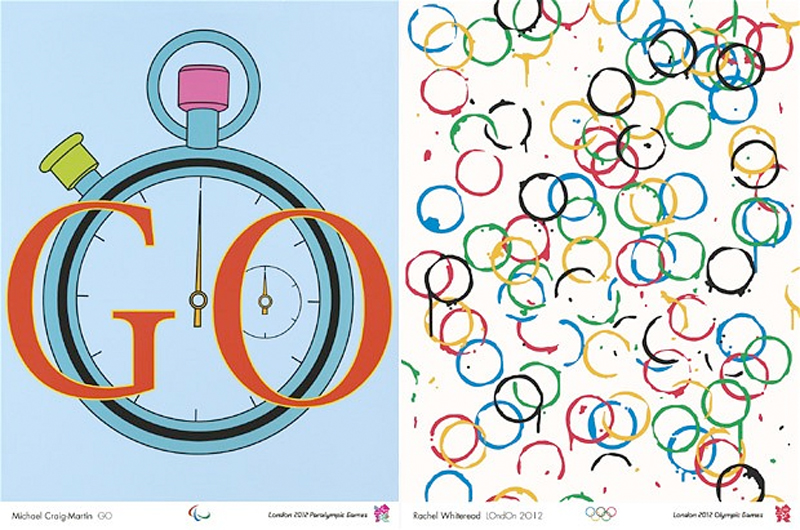
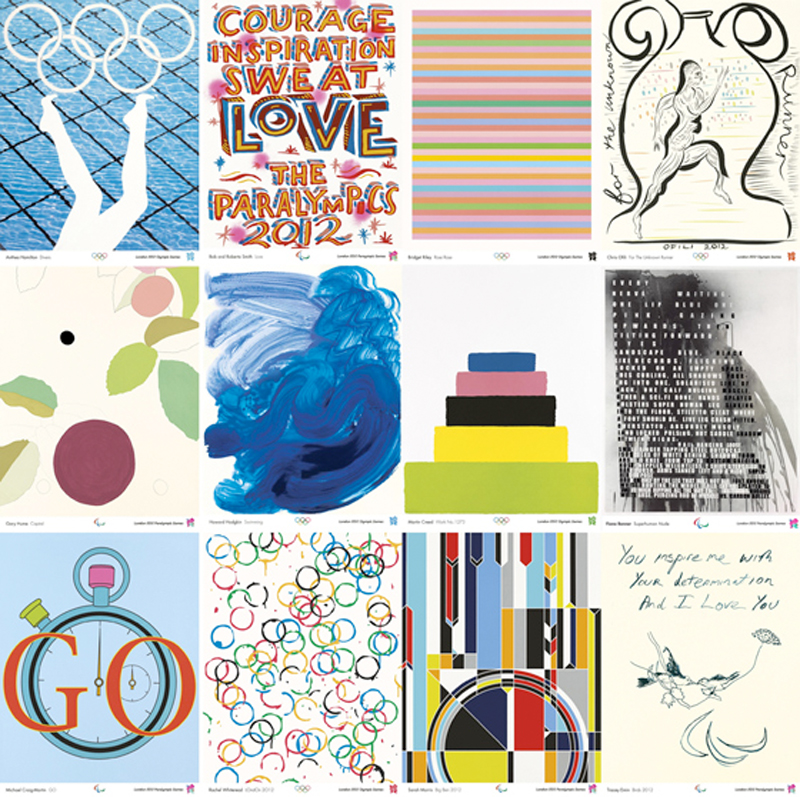
    The Turner Prize nominees and winners came up with a predictable set of embarrassing posters for the Olympics. Apart from the perpetrators themselves, no one could be found to say a good word about their efforts. Someone needs to get a grip. First we were presented with an inept logo which had cost £400,000 for what looked like two minutes work; then there was an artless rollercoaster sculpture selected by the President-For-Life; and now this lot of fashionable scribblers who couldn’t design a wheel from blueprints have done their worst, also, very conveniently, courtesy of the President-For-Life. Inevitably, as with Gibbereesh’s rollercoaster the PFL chose his reliable lackeys from the Turner Prize not to mention a serving Tate Trustee, Bob and Roberta Smith, i.e. one of those currently responsible for employing him.

    Rachel Whiteread and Gary Hume excelled themselves with lovely colouring in – if their efforts had arrived crumpled from the nursery you might have fixed them proudly to the fridge. Bridget Riley knocked off her usual stripes. Each small poster – and these are nothing like the grand sheets of Lautrec – will be available to buy for £7 when an exhibition of the works opens at the Tate next summer.

    Now for the good news, that is if you are one of the participating artists. The posters are being released as signed prints courtesy of Counter Editions, thus enabling the artists to reward themselves in the manner to which they have become accustomed. Bridget Riley’s stripes, for example, is in an edition of 250 and started at £3,000 an impression – yes, that’s a gross of £750,000 for one signed screenprint, and it has already sold out. The Margate Express has hers in an edition of 300 at a throwaway £1,800 apiece – a mere £540,000… It is also sold out. The gross will, of course, have been far greater than the sums cited here as the cost of each print increased as the edition sold out. Still available however are ‘Professor’ Gary Hume’s blots (near right), a snip at £540 in an edition of 250 (£135,000 minimum gross) and Howard Hodgkin’s blue wave (£1,300, ed 300, minimum gross £394,000 – far right). No wonder the artists stood in a line laughing when their works were unveiled.

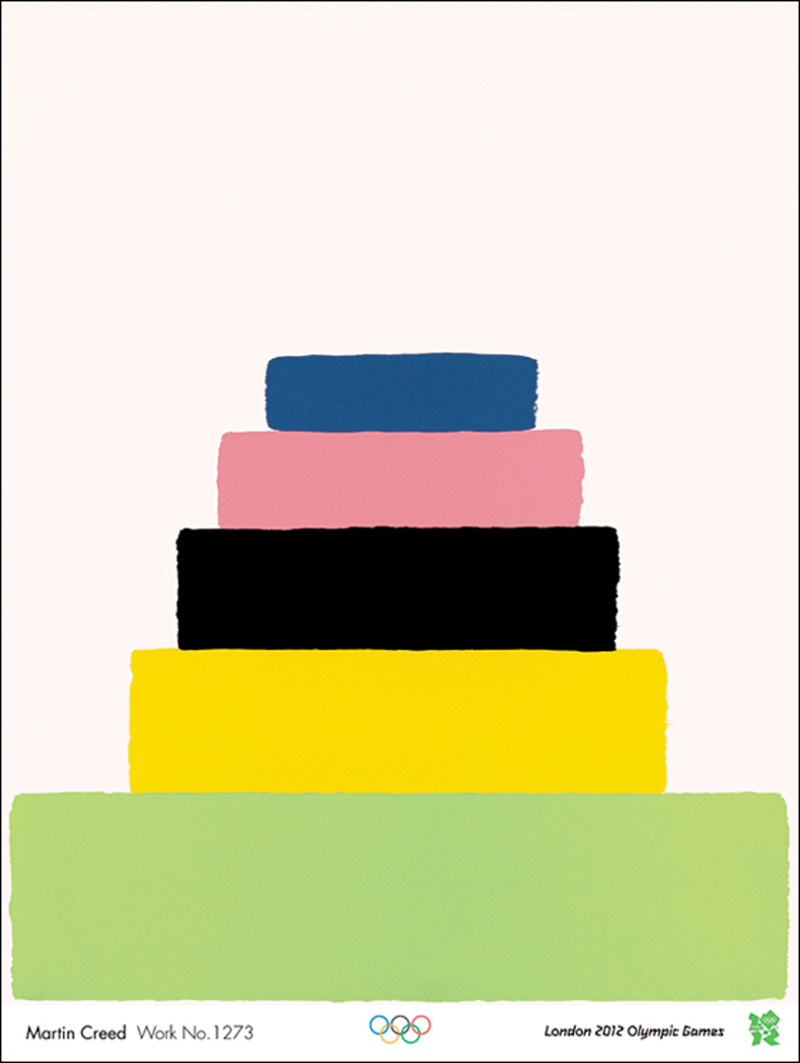
    Martin Creed, at last now widely regarded as educationally subnormal, said of his inspired marvel (£490, lithograph edition 250, minimum gross £122,500): “The colours are based on the Olympic colours but they are changed to make them nicer.” Here is the Mental Paralympian of State Art talking.

    What we got in this project was the usual bunch of over-rated contemporary artists promoting themselves and their art and not the Olympics. We can’t discover from anywhere what the deal was with the artists; were they actually paid to come up with their contributions or was their remuneration to be the loud ker-ching of limited editions? If you come across any information please let us know.

    … And then there was the dear old Margate Express. No are event is nowadays complete without her embonpoint rippling over the proceedings. On the same page of the papers when these Olympic efforts were announced you could look across from the Express’s maudlin scribble to Leonardo da Vinci’s drawing of hands on show in the National Gallery. An unfair comparison, yes, but it is surely impossible to look from one to the other and not think what a catastrophic deterioration has occurred not only in the technical ability of artists but in the willingness of those responsible for protecting standards in art to promote such conspicuous rubbish.

    By the way, if you wish to purchase all 12 of the posters you can buy the set in a nice box for £11,805. A commemorative heirloom for all the family to enjoy, and what a bargain.

     David Lee

    The Jackdaw, Jan-Feb 2012

    Latest News

    These posters are beginning to reappear on the market.

    Three editions sold out within days: they were Tracey Emin, Rachel Whiteread and Bridget Riley.  Now , one of the Rileys is being sold  at auction with an estimate of  £2,000-£3,000. This poster racket was not only a scam to line the pockets of already well-to-do artists but also to allow a quick turnover to collectors eager to cash in on the fever generated by the actual events.

    The complete set of posters are no on view/on sale at Tate Britain until September  23rd. So buy now. They’re crap, but what an investment.

  • Hitting the bottle

    Hitting the bottle

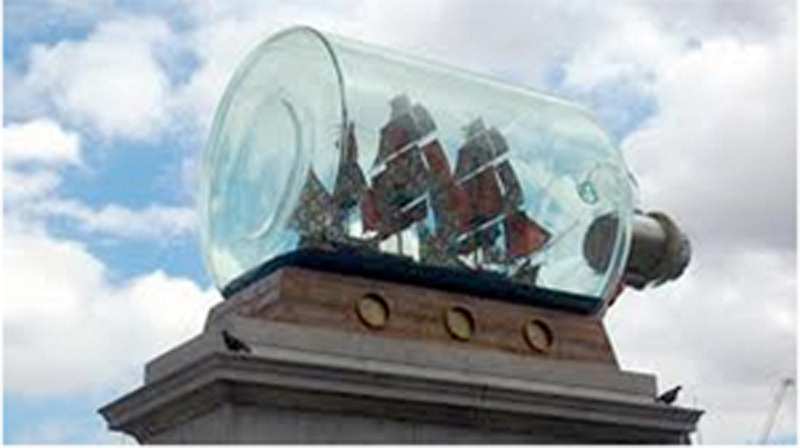
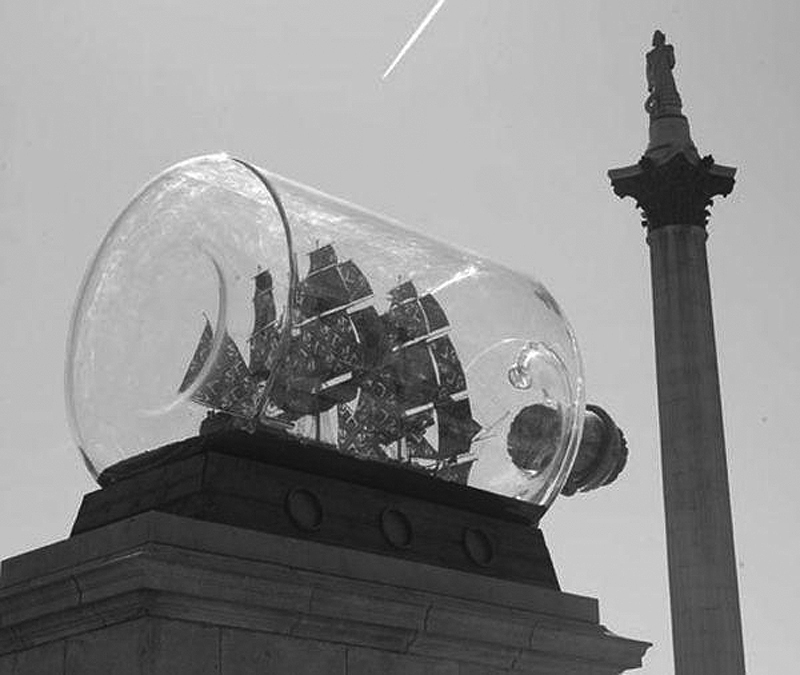
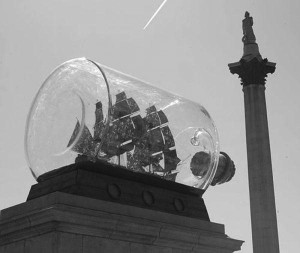
    The National Maritime Museum in Greenwich has bought for £362,500 the ship in a bottle by Yinka Shonibare which had sat ornamentally becalmed on the fourth plinth in Trafalgar Square for the previous 18 months. It is the Greenwich museum’s job to collect ships and related tackle and, lately, any sea-related nonsense deemed  ‘challenging’ by State Art’s omniscient spivs. It is significant, if you hadn’t realised, that the ship’s sails are made from patterned ethnic material of the sort usually swathed around gigantic arses in Dalston market. This encourages what one of the Tate’s finest drivellers grandly declares as “a transformation of perception”. Elsewhere, the same stuff is said to make an incisive comment on Britain’s nasty maritime heritage, “an exploration of colonialism and post-colonialism” no less. Needless to say we are not informed into what our “perception” is “transformed”, nor how “colonialism” is “explored” by deploying some patterned swatches purchased from a Brixton stall. I suppose we must now accept this species of commentary as the naturally occurring guff which will in perpetuity follow conceptual art wherever it goes.

    The sculpture, dubbed Nelson’s Ship in a Bottle, has recently been unveiled on a plain ziggurat base bang outside the National Maritime Museum’s main entrance. Here its presence will doubtless be interpreted as a Blair-like mea culpa for the historical misdeeds of our racist, slave-driving antecedents. Others may interpret its prominence and worship as illustrative of an abject and risible political correctness. Whatever, the bottle is a pretty enough toy untroubled by art. I wish to investigate briefly this apparently straightforward purchase because it reveals the questionable ways in which contemporary art is conducted by a small number of people for the benefit of an equally small number of other people who pop up ubiquitously pulling strings in proceedings such as these. It is curious indeed how the names are always the same ones. These ‘questionable ways’ may be baldly summarised as follows:

    1. We are never told the whole truth, even by public relations’ companies paid to deal with inquiries, and especially concerning the actual cost of anything. State Art is terrified of you knowing the truth, which is the reason why so frequently it is caught out lying.

    2. Obtaining accurate and complete information from arts bodies requires Kafkaesque determination and, when finally a morsel is vouchsafed, it is always uncooperatively partial and might easily contradict what has been released before.

    3. State Art has to be secretive in order to make the public believe that the visual arts are kept cruelly on the breadline and are not, as is the truth, awash with quite staggering amounts of cash which miraculously come available for the right people. If you are a Yinka Shonibare, with access to the engines of State Art, whose institutions you have dutifully served, this system is a licence to print money.

    4. The number of bodies dealing with contemporary art is far too numerous and wastefully duplicating of effort and resources, and any independence in their policies and actions is compromised by frequent interchange between them of the same few personnel.

    Three issues ago Moping Owl asked why we needed to buy Shonibare’s ship when, she thought, we already owned it. Didn’t we?  Had we not already commissioned and paid for it to sit on the plinth?  Well yes, sort of. Owl’s was a natural mistake, especially in view of what we had already been led to believe by what, up to that point, we now know had been an economical rationing of information. £362,500 is three times the record price paid at auction for any work by Shonibare. To pay apparently so much over the odds is surely just a little questionable, but the truth is that this figure is nowhere near what was actually paid for it. The real price far exceeded the published number, but you won’t have found the full, accurate cost in any newspaper because even now we can’t be certain we know all the amounts involved.

    When the purchase was gleefully trumpeted, as though we’d just acquired for peanuts a lost masterpiece by Praxiteles, a breakdown of the cost was supplied. This was based on the interesting claim put about by the artist’s dealer that an unnamed South Korean businessman had been prepared to pay £1.25 million in order to display the bottle in his garden. This outcome was described as “a real possibility” – which sounds to me a bit like the belief among, say, QPR fans that there is ‘a real possibility’ of their team winning the Premiership next season. This sum was apparently accepted even though, at that time, the price was ten times more than had ever previously been paid for a work by the artist. Complicated tax concessions applicable to a purchase by a British museum meant that the top line price was reduced to £650,000, the Treasury having waived the difference. This lower sum was made up as follows:

    £140,000: production costs funded by the Greater London Authority

    £97,500: 15% museum discount from Stephen Friedman Gallery

    £50,000: Grant from the Art Fund ***

    £264,300: Contributions from the public via a fundraising appeal ***

    £49,100: National Maritime Museum contribution ***

    £49,100: Matched contribution by Stephen Friedman Gallery and James Cohan Gallery, New York, on behalf of Yinka Shonibare, MBE

    (*** These sums total £363,400; that is, close to £362,500.)

    As far as I can ascertain at least three additional sums that were paid have not been included in this final account. The Arts Council awarded £70,000 for this project, as it does for all fourth plinth commissions; the Greater London Authority, in addition to its £140,000 production costs, gave an “artist’s fee” of £30,000; and the Henry Moore Foundation gave a grant of £20,000 to the artist for this project. In the privileged wonderland of State Art these additional sums, a mere £120,000, are pocket money. But we still paid them, and the total involved is five times the average Briton’s annual income. I can see no reason why these omitted additional sums should not have been deducted from the price paid by the Museum. Why were they not included in the reckoning? And how many other charities, trusts etc., contributed amounts which disappeared into the coffers when first the project was mooted? The £140,000 contributed by the Mayor’s office for production costs was, according to the initial agreement, to be repaid if the work sold. This is apparently true of all works made for the plinth, though we are unaware of any sums ever having been repaid from previous occupancies.We must assume that Boris is sat waiting eagerly for his refund (after all he can buy one-tenth of a new Routemaster for £140,000). Despite repeated requests for information nothing remotely resembling candour has emerged from the Mayor’s office. The fact is that the GLA alone paid Shonibare in production costs and fees a sum far is excess of the highest amount the artist’s work had ever previously sold for. And we didn’t even get to own it. Is the Arts Council’s £70,000 equally reimbursable upon the sale of a work? If not, it should be. The Arts Council, perennially bleating about its poverty, should surely be on the case for a return of its investment. As usual our requests to them for information have been ignored. They are far too busy producing worthless pamphlets of self-congratulation.

    The price paid by the NMM was independently assessed by Haunch of Venison and Roche Court, a minor secondary market sculpture dealer in the West Country. Haunch of Venison is a gallery owned by Christie’s who, coincidentally, sold the previously highest priced work of Shonibare, a large installation, for $194,500 last November. (Another installation was sold by Christie’s in April this year for as little as $98,500.) It is hard to see how any objective person could have verified a price of £1.25 million ($1.94 million) for a sculpture by this artist, even one which had sat prominently hawking itself in the centre of London for the previous year and a half. Given that they have a monopoly of sale on Shonibare’s sculpture (Sotheby’s has never offered a work by him) it was not in Christie’s – of course I mean in Haunch of Venison’s – interest to undervalue this piece. In other walks of life we might call this a conflict of interest. Shonibare was handsomely reimbursed twice for this bottle; once when he made it and a second time when he sold it. Additionally, we had a right to expect a knockdown price from the 50-year-old artist whose career has been generously supported by the State. Shonibare is an executive member of the Usual Suspects Club. He was nominated for the Turner Prize in 2004, the year Jeremy Deller won (Deller, incidentally, is one of two artists on the selection committee for the Fourth Plinth, both of them Turner Prize winners). His fledgeling career was made easier by cash grants from both the Arts Council and the Greater London Arts Board and he has enjoyed exhibitions in virtually every Arts Council-funded gallery throughout the country, as well as at the Tate. He has also served on Arts Council committees and bought works of his choice for the Arts Council collection. His present visibility would have been inconceivable without expensive public promotion. This should have been reflected in the price for the bottle. After all, we didn’t owe Shonibare anything, quite the reverse. He has made a strong career on the back of crucial public investment in him and, in my view, he has used that reputation to inflate the bottle’s price when selling it back to us. What a marvellous system this is if you are, as the Arts Council put it, “the right kind of artist”.

    At the very minimum we paid the following for the bottle:

    £362,500 published cost

    £140,000 Greater London Assembly

    £30,000 fee also from the GLA

    £70,000 Arts Council grant

    £20,000 Moore Foundation grant

    (£622,500 in total).

    When the work’s sale to Greenwich was completed Shonibare said: “I am absolutely delighted and touched by the public’s generosity.” I bet he is.

    David Lee

    The Jackdaw, Jul-Aug 2012
     

  • Courses for horses

    Courses for horses

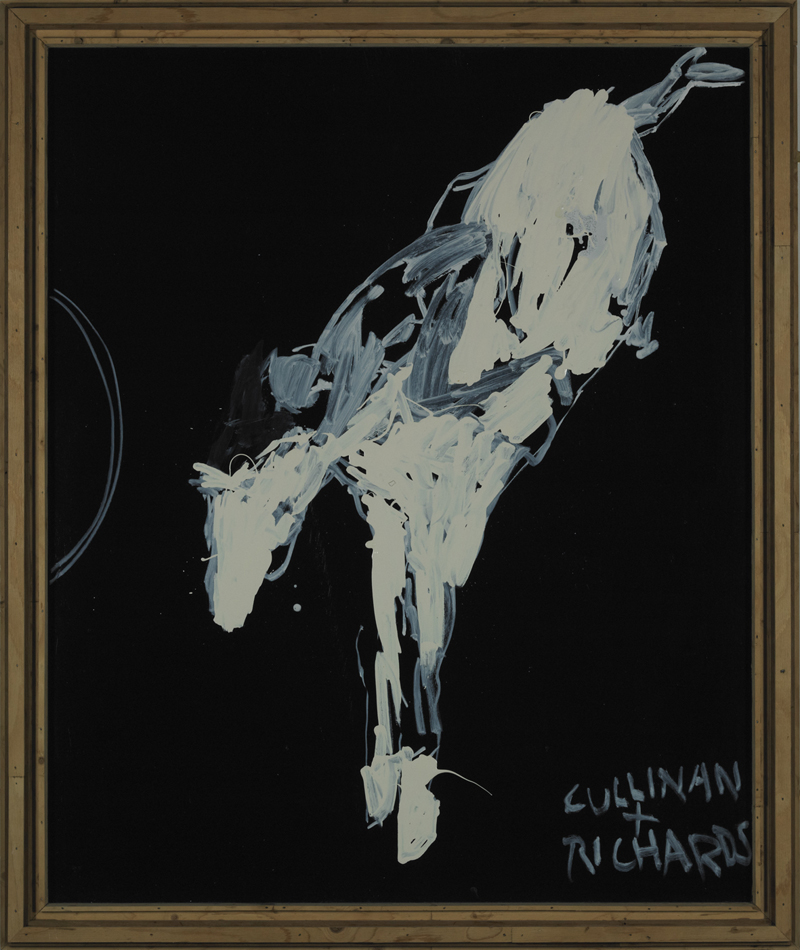
    62 pictures, the most ever in its 60-year history, have been selected for this year’s John Moores Prize, the winner of which is announced on September 13th. The Jackdaw had heard of five of the 62. 40 years ago we would have heard of all fifty artists, and each represented by one of their better efforts. The exhibition at the Walker Art Gallery runs from September 15th to January 6th and, as we have pointed out in the recent past, it has been subverted to the cause of State Art such that it’s now in all but name a Turner Prize for painting.

    Curiously for a painting prize there is no gifted painter on the selection panel: this includes Yentob, who doesn’t know the first thing about painting; Blazwick, the Whitechapel director and State Art board member who will doubtless be referring all decisions to the top; George Shaw, who paints council estates by numbers in enamel; Angela de la Cruz, a sculptor-cum-assembler; and Fiona Banner, who writes stories in longhand on canvases. The three artists on the panel have all been nominated for that passe-partout State Art membership card, the Turner Prize.

    Illustrated here is Cullinan Richards’ Collapse into Abstract (Black), which with a title like that will surely be a challenging investigation into the nature of painting qua painting. Over 3,000 artists entered a work for consideration, which means that 47 other pictures were rejected for each of those chosen. Were all 47 really worse than Richards’s collapsing abstract?

    No question this will be – like the last one – a bloody awful collection of wince-inducing daubs but one will have to attend in order to enjoy a hearty laugh at the artbollocks written about each entry, always a highlight of the exhibition. And there’s always the permanent collection of the Walker, which is easily the best in England outside London.

    David Lee

    The Jackdaw, June 2012

  • Tate Trustees and the public interest

    The Tate recently named two new trustees, one of whom is painter Tomma Abts. She is a 44-year-old German, recently appointed Professor of Painting at the Kunstakademie in Düsseldorf, who won the Turner Prize in 2006. As an artist trustee, she replaced Jeremy Deller, who won the Turner Prize in 2004. Abts’s paintings are all the same small size (48 x 38cms) – it is claimed this tic is conceptually crucial for a reason never convincingly explained – and consist of polite abstract designs which might have looked original on curtains at the 1954 Ideal Home Exhibition. So much for the Cutting Edge. The Tate claims her pictures “possess a formal definition and coherence that suggests that they could never have existed any other way … [and] seem to achieve what only painting can, inhabiting both this reality as an object or ‘thing’, and a parallel world with its own set of rules and relationships that demand to be judged on their own terms.” As per with their interpretive literature, all helpful stuff. Am I being cynical? Yes. Why? Because using any sensible criteria Abts doesn’t deserve to be a trustee of an important British museum.

    The job of Tate trustees is to oversee the efficient running of the gallery “as guardians of the public interest” – and please note that it says  ‘the public interest’ not ‘State Art’s interest’, for as you will discover these two mutually exclusive agendas tend to become blurred in the minds of certain individuals. Improbable as it sounds, guidelines for the functions of trustees are drawn up by the Tate itself, not by independent arbiters. Such complacency hardly reassures an outsider that the public interest, rather than the Tate’s, is being looked after. Indeed, such self-scrutiny is hardly better than the continuing disgrace of policemen investigating their own mistakes.

    In 2008 the number of trustees was increased from 12 to 14 and as required by the Museums and Galleries Act 1992 “at least three” of these must be artists. Thirteen are appointed by the Prime Minister and the last is nominated by the trustees of the National Gallery from among their own membership. Unlike their fellow trustees, who are mainly those with business expertise, and who can serve up to two terms of four years (a period of office trimmed recently from five), artist trustees currently serve only one term of four years. You may find it odd – I certainly do – that while there are three contemporary artists with gilt-edged State Art credentials on the Tate’s board of trustees there is no place for a single art historian. I’m obviously old-fashioned because a museum of historical art with no art historians sitting on its governing board seems verging on the perverse.

    When an artist trusteeship becomes vacant it is widely advertised in the papers, giving the impression that any capable, knowledgeable, articulate artist of repute might apply. Nothing could be further from the truth, for there is a codicil written in invisible ink along the bottom of these ads, which reads: “If you have not won or at the very least been nominated for the Turner Prize, kindly fuck off and don’t waste our time.” The Tate squanders scarce cash paying for these advertisements which are nothing short of a calculated deception. Artist trustees are in fact a self-appointed clique comprising only winners of the Turner Prize with a couple of reliable also-rans chucked in. Since new regulations were imposed in 1992 the only exceptions to this rule have been Julian Opie, who famously refused his nomination for the Turner on the grounds that the prize “had become a frivolous publicity stunt”, and Bob and Roberta Smith, the sobriquet of a dimwit called Patrick Brill, who is otherwise a regular purveyor of infantile stunts at Millbank – you may recall his Tate Christmas tree whose lights visitors were asked to illuminate by peddling a generator. He’s very concerned about the environment apparently.

    Being a trustee involves attending six meetings a year and is said to require a day a month in reading and preparation. I must point out that the Tate’s artist trustees are easily the worst attenders at these meetings, and are frequently absent. In the case of Anish Kapoor (Turner Prize winner, 1991) his absenteeism, which included missing half the meetings in two consecutive years and scarpering early from others, would have surely seen him sacked from the board of any efficiently run private enterprise.

    Of currently serving artist trustees two are Germans – besides Abts the other is magazine photographer Wolfgang Tillmans (Turner Prize winner, 2000). Could they really not find a British photographer, or even a British abstract painter, worthy of these positions? Admittedly, Germans do most things better than we do but surely this is insulting to British artists. And how can a professor at a German art school, which presumably requires her to actually attend some of the week, perform the duties of a trustee required to be resident here?

    The process by which artist trustees are selected – laughably characterised as “an open competition” or “an open competitive process” – is indicative of what happens when a clique achieves a complacent monopoly and is allowed by servile arts commentators to get away with it. Minutes of meetings make it clear that artist trustees are encouraged to invite applications from those they consider suitable as their own replacements, especially when candidates who have responded to the ads are not considered worthy, which one may reasonably surmise is always. Indeed, I wonder if there was ever a case of a successful artist trustee having responded to the ads rather than having been – that weasel word – ‘invited’ to apply… And so Turner Prize winners beget other Turner Prize winners, or at the very least other near-misses of that persuasion.

    Candidates for artist trusteeships are interviewed by a panel comprising trustees, including the artists, plus an “independent assessor” who is present to ensure that legal niceties, “best practice” etc., are observed and everything looks above board. But how can it be above board when only Turner Prize winners are appointed? Perhaps this independent assessor ought to be involved from the start of the process in order that more than Turner Prize nominees might be seriously considered, if for no other reason than to keep up appearances of openness. Eyebrows would be raised at such a narrowness of potential candidates in any other sphere of public life: imagine, for example, the Commander-in-Chief of the armed forces always being selected from the same regiment.

    You may ask why is it so important for the convenient running of the Tate that its artist trustees are always winners of the Turner Prize. The answer is for the obvious reason that having been awarded a career-changing gong by the institution of which they are now overseers, they will never rock the boat by asking too many tricky questions about the Tate’s direction in its dealings with contemporary art. This is one of many ways by which State Art has become institutionalised: no one but the reliably subservient is ever allowed on the inside to question Tate, or indeed Arts Council, policies.

    On the other hand these parti pris trustees can be useful when outside criticism of the Tate becomes noisy. For example, in July 2004 Trustees discussed newspaper coverage of a Tate work, Rodin’s The Kiss, which Cornelia Parker (who was nominated for the Turner in 1997, the year it was won by Gillian Wearing, inevitably herself a recent artist trustee), had the previous year controversially wrapped up with a mile of string. This stunt was claimed by the artist to be “challenging the claustrophobic nature of relationships”. Artist trustees present in the meeting (which included the aforementioned Wearing) were able to defend their fellow artist for the benefit of other sceptical trustees. They pointed out that it was the job of the Tate to provoke controversy and discussion, which this work did.

    It is in the interests of these artist trustees to support the Director. They know they will be serving only for a brief period following which they might reasonably look forward to the reward of a Tate retrospective or other continued patronage, purchases etc.

    Serota has stated a preference for such younger trustees. Referring to the trusteeship of Anthony Caro many years before, he remarked in 1998 to the Sunday Times: “Tony was well over 60 when he became a trustee. He was a very effective trustee, actually. He cared passionately about certain things and was a powerful force … but it just seems to work better when you have artists who are a new generation, or indeed erring on the younger side, really.” And we know why he thinks it “seems to work better”, because older artists of a more independent, more knowledgeable, more experienced character might argue cogently for a policy or direction other than the one being pursued by the Director. They have nothing to lose by disagreeing with him. Let’s face it, the current crop of artist trustees is in Serota’s pocket. They owe him and he knows it. He can rely on their support without a second thought.

    In a 2008 interview Serota said of his trustees: “I don’t have any part to play in their appointment”. Remember this, it’s important and we’ll return to it in a second.

    Many years ago Serota said that public nominations for the Turner Prize (perhaps you don’t remember that ridiculous charade whereby we all wasted our stamps and faxes) were seriously considered by the judges. We discovered in 2006 what we already knew, courtesy of an indiscreet Turner Prize judge, that this was in fact a lie and they were binned with risible disregard. We also discovered at the same time, and from the same source, that Turner Prize judges were given a list of appropriate artists and exhibitions – just to help them along you know, point them in the right direction. And there we were thinking in the innocence of our ignorance that they might nominate anyone…

    Serota also stated in 2005 that the Tate only rarely acquired work by serving trustees. The Jackdaw checked up on that and discovered (see the editorial for Dec/Jan 2006 on our website) that he wasn’t telling the truth. Indeed, this whopper cost him a bollocking from the Charity Commission. There were also a number of other flagrant economies with the truth concerning the Tate’s acquisition of work by serving trustee Chris Ofili, who was naturally a Turner Prize winner (1998), which also resulted in another six of the best from the CC. (I almost mentioned here the fact that in the last editorial – also on our website – we indicated how the Tate recently misled us over their attendance figures, but you must be getting fed up with that one.)

    So, bearing in mind Serota’s far from perfect form, when he remarks “I don’t have any part to play in their appointment” I need to ask myself: ‘Do I give him the benefit of the doubt and believe him this time?’ Well, as it happens, no I don’t. Even cursory familiarity with the Trustees’ minutes betrays this one as untrue. On the contrary he is frequently involved in their appointment; indeed, the process of Trustee appointment is administered by his own office. He even attends candidate interviews “in an advisory capacity”. Presumably he offers ‘advice’ which plays no material part in the process, so why is he there in the first place? Indeed, we read on: “The key stages of the appointment are overseen by a panel which will normally include the Director.” (Who, presumably, doesn’t play any part.) On one recent occasion he encourages artist trustees to nominate likely candidates for their replacement knowing only too well the sort of artists they are likely to suggest. No part?

    Let’s have this one straight: Serota is ‘advising’ on the appointment of someone, a trustee, who will function as his own employer. This is a wretched abuse of the supposed ‘independence’ of process and would be considered as much in any other public body. It is, as usual, as blatant a conflict of interest (not to mention a betrayal of ‘the public interest’ about which the process purports to be so concerned) as you would expect to find at the Tate, whose management of conflicts of interest, incidentally, was declared woefully inadequate by none other than the Charities Commission.

    The Tate should not be involved with either the compiling of its own trustees’ duties, or in the nomination or selection of Trustees themselves. How can ‘the public interest’ be considered served when the organisation under scrutiny is writing the job description of its own scrutineers. If we are to have artist trustees let’s have them from a cross-section of the artist community and not just those representing the Turner Prize. And let’s have some eminent art historians in there too.

    David Lee

    The Jackdaw May-Jun 2011