Tag: David Lee

  • Is there a doctor in the House?

    Dennis Skinner once quipped loudly across the Commons to a faltering Cecil Parkinson at the Despatch Box, ‘It’s the in-breeding that does it!’ I was reminded of this amusing sneer when Doctor Maria Balshaw was announced as Serota’s replacement, an elevation met with the customary uncritical lauding with which a fawning Fourth Estate now greets all State Art appointments.

    Balshaw comes with all the genetic defects of the State Art clone. She’s boyishly “enthusiastic”, has “energy and excitement”, does daily yoga and charity triathlons and has even won a ‘Personality of the Year’ award. She has mounted “exhibitions of international significance” i.e. of the usual suspects. She has taught ‘art theory’, albeit at a pretend university. She is also adept at “campaigning” and beyond reproach at self-congratulation and the exaggeration of what she understands as her achievements. And she knows the State Art Political Correctness scriptures, all sixteen volumes, by rote and quotes fluently from them at every opportunity. 

    In charge since 2006, she has wrecked the Whitworth Art Gallery with an unnecessary and ugly extension. She claims she transformed it into “a triumph on the international stage”, “a truly state of the art space”. I think this latter means it’s double the size whilst giving the impression there’s hardly anything to look at. She filled it with over-exhibited conceptual art of no discernible distinction. And if her vandalistic hanging of the historic watercolour collection is anything to go by she has neither feeling nor understanding for the display of traditional and historical work – a frightening omen. On the other hand she is extremely good at spreading thin material even more thinly, and is, therefore, tailor-made to lead the Switch House whose purpose would appear to be precisely that. For outside the café windows she commissioned a metal tree from Anya Gallaccio, Ms Freeze. It might look like demolition-site scrap but it is of “international significance” because she says so. She also commissioned Marina Abramovic, Sarah Lucas and Cornelia Parker – and what imaginative programming that was. How brave to venture down paths so rarely trod. She’s incapable of thinking with originality beyond a list of two dozen familiar brands, so the dealers who rely on the Tate for ‘co-operation’ may sleep easy. Incidentally, her feeble additions to the Whitworth collection will, in the future, embarrass even her.

    She left the City Art Gallery more or less alone (she was placed in charge there as well in 2011), though pictures have inexplicably disappeared. I’ve not seen Tim Clifford’s expensive ‘Duccio’ for ages. Where is it? She’s also susceptible to puerile stabs at populism: placing Banksy’s infantile agitprop alongside Etty’s brilliant soft-porn masterpiece of Ulysses and The Sirens shows, for example, an unerring gift for the fatuous juxtaposition. 

    Naturally, with her grounding in State Art, conflicts of interests are water off a duck’s back: since 2014 she has served on the Arts Council … which funds the Whitworth. 

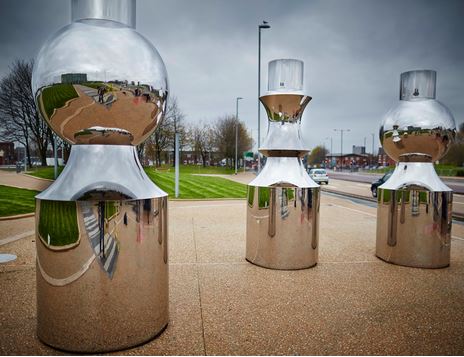
    She is now in charge of the national collection of British art and the scholarship of its history, or what’s left of it at the Tate. Don’t be thrown by the ‘Doctor’ tag, her contribution to scholarship is nil. It’s a frightening thought that the supremacy of State Art has brought us from the academic peaks of Professor Bowness to this in under a generation. Needless to say she writes eighty-proof drivel.With those like Balshaw who’ll do and say anything to get on, you see them in their true colours when, like the snake-oil salesmen they are, they try to convince you to disbelieve your eyes. But the expensive haircut, the pushy clothes, the bouncy arm-flapping, these cut no ice at such moments. It was Balshaw Manchester can thank for spending £400,000 on the silliest of stunts. (I’ve discussed this before, it’s on the website.) This was Ryan Gander’s ‘sculpture’ described as “a world masterpiece”, and is another of her “internationally significant” accomplishments. It’s not just that it’s a tawdry piece of trash, that much is obvious, but that she was prepared to lie so brazenly about its importance. Like Serota, then, she will be prepared to deceive for the cause. Her appointment is a disaster. 

  • Has the Arts Council betrayed its origins?

    Serota takes over at the Arts Council this month, 47 years after first being employed by the same body as a regional arts officer in what was his first job after university. In the interval the Council has developed into a blunt instrument by which State Art, an ethos it co-authored with Serota during his 27-year dictatorship at the Tate, has been forcibly imposed throughout the contemporary art field. Assisted by less important bodies (including a number of charities who ought to know better), half a dozen influential dealers and a legion of devoted apostles and brand-obsessed superrich collectors, the Arts Council and Serota’s Tate evolved a common purpose. It now feels almost pre-ordained that these Yin and Yangs of a disreputable system should be united under the President-For-Life to inflict upon us more of the same.

    By concisely rehearsing the Arts Council’s genesis I want to examine how a body, which didn’t start life with an exclusively extremist agenda, became the principal funding agent for what they themselves call a ‘challenging’, ‘innovative’ art; an art from which hardly anyone else but those professionally involved in it benefits, and in which the wider public – who pay for it – express no interest save indifference or derision.

    So what happened to produce the monster we have today, with its Westminster HQ, exaggerated sense of entitlement, uniforms, swanky websites, overmanning, pretentious drivel, gender and ethnic obsessions, and self-promoting literature concerned only with the decaying rump of the avant garde?

    The Arts Council (I’ll persist with this name though it has changed regularly) evolved out of the Committee (later Council) for the Encouragement of Music and the Arts formed in December 1939. The first general Treasury grant ever for the arts, £25,000, was offered in April 1940 for classical music, drama and art. This matched £25,000 given by The Pilgrim Trust for touring concerts and exhibitions, seven-eighths of the money going on music. Government subsidy was increased to £85,000 in 1942 when the Pilgrim Trust pulled out and when opera and ballet were added to the roll-call of recipients; it was £175,000 a year by the war’s end.

    Before CEMA was established arguments had reverberated for 20 years as to whether art should be publicly funded. A more compelling case for subsidy arrived with the war. The first awards were considered shrewd commercial investments by Exchequer mandarins. For the tiny sums cited above the morale boosting potential of art and music (especially sing-songs) for an undernourished and overworked civilian population of mainly women was considered more than compensation. The impact of these touring plays, concerts and exhibitions was so overwhelming, the public reaction so vocally grateful, that the continuation of Government support in peace time seemed a no-brainer. Additionally, throughout the war, and especially from 1942 when he took over CEMA, Maynard Keynes lobbied tirelessly for the post-war continuation of subsidy.

    And things undoubtedly had to change. As William Coldstream explained in the mid-’30s, artists didn’t expect to sell work except occasionally to their friends or, if they were lucky enough to have one, to a patron. Recession had destroyed any impulse for art sales. In the wake of the 1930s Depression and then the second great war, the market for modern work being dead, the need to help painters and sculptors survive had become an imperative. Even well-known artists struggled to live. Most scraped a subsistence by teaching and from occasional sales to a few wealthy supporters. A process of rigorous, almost cruel natural selection by quality was in place. In 1939 writer Raymond Mortimer pleaded that artists “need saving”. Soon after the war critic Cyril Connolly described the practice of private art collecting as “extinct”. In proposing State subsidy Keynes suggested that “We must learn by trial and error. But anything [that is, any policy of State assistance for the visual arts] would be better than the present system. The position of artists today is disastrous”. Unless you happen to be one of those The Jackdaw calls ‘the usual suspects’, those magnificent few of State Art, a cynic might shout ‘No change there then!’.

    The end of the war, with its promise of a better place for the exhausted and beaten down, provided the impetus for the creation of a supportive organization which would circulate the arts widely and thereby – crucially – stimulate over time a desire to collect artists’ work among a much broader population.

    The Arts Council was founded in August 1946 and given £235,000 to spend (the equivalent of £29 million today), the bulk of which went (as before) on classical music, opera, ballet and drama with art a distant fifth – touring exhibitions and artists’ materials were altogether cheaper than the backing required by travelling orchestras, bands, troupes and reps. By the mid-’50s classical music alone received six times the subsidy spent on the visual arts. In 2015/16, the last published report available, the Arts Council spent £463 million of which a small fraction (it’s a difficult figure even to guess but it settled at between 5% and 10% in the ’70s) is spent on the visual arts. In addition, the Council is also responsible for disbursing their slice of lottery cash, £268 million a year, a sizeable portion of which throughout its 20-year history has been spent on capital visual arts projects and also, more recently, on revenue grants to favoured ‘core’ clients (the Serpentine Gallery, for example, has received no fewer than twelve lottery awards).

    In the 70 years of the Council’s existence the State has effectively assumed complete control of visual art, whereas prior to 1939, and with the exception of funding for the national museums, the creation of the National Theatre and a one-off grant for the creating an orchestra in Birmingham, the influence of Government was non-existent: painting and sculpture had in those days been left to the market, then understood to be the best arbiter. Some, of course, argue that it still is.

    On the founding of the Arts Council, early commentators (Orwell among them) expressed serious concerns that state patronage would quickly come to imply censorship and a dictatorship of taste – obviously bad things. With hindsight how perceptive were their fears.

    A lengthy discussion of precisely this potential problem took place in March 1944 when a letter appeared in The Times signed by MPs and artists, condemning what they perceived as an obvious ‘Modernistic’ bias in the selection of CEMA’s exhibitions. Signatories included printmakers D Y Cameron and Frank Short, painters Alfred Munnings (soon to be elected PRA) and Frank Salisbury and sculptor Richard Garbe. They berated the poor quality of exhibitions circulated by CEMA as being “devised to carry on the baleful influence of what is known as ‘Modernistic’ art” at the expense of “traditional glories”. Keynes’s reply to this charge is highly revealing. He lists the 25 exhibitions circulated to date, only six of which had been mixed shows of modern artists – the only two one-man shows featured Sickert and Wilson Steer, neither of whom would have considered themselves remotely ‘Modernistic’. The list also included historical surveys from national collections and selections from Royal Academy Summer Exhibitions. Among the “mixed bunch of fogeys” (this is Keynes in self-deprecating mode) selecting the exhibitions were artists Tom Monnington, Duncan Grant and Henry Moore. Keynes could not have stated CEMA’s policy more clearly when he wrote in conclusion: “Our own practice and deliberate policy is to allow every form of serious endeavour its opportunity.” Supporting Keynes, other correspondents praised the “wide and catholic” choices from “modernistic to academic”. The most enthusiastic and moving letter of commendation for the touring shows came ironically from the Ashington Art Group of miner painters in Northumberland, who testified that in their community they had received three exhibitions which elicited “golden opinions” from schoolchildren, youth groups, women’s organisations and church parties. They especially enjoyed seeing original work of a kind only previously known through bad reproductions. 

    There is no evidence here ­­– not a scrap ­– to suggest that the precursors and founders of the Arts Council had any intention of showing only ‘Modernistic’ art, or of favouring vanguard styles at the expense of others. The reverse is demonstrably true. Their intention was to show everything of merit and the positive response of the Ashington Group is testimony of their success.

    Throughout the Arts Council’s existence, and especially in its later maturity, it has undoubtedly taken to an extreme the private views and preferences of those who willed it into existence. Today the Arts Council does precisely what Fry, Bell, Keynes, Clark, Read and others wanted it to do in encouraging appreciation of the avant garde, except that it now does it to the exclusion of everything else. The Arts Council’s founding principles, written by Keynes almost word for word, were, however, pragmatic for having been argued over. In the Royal Charter for the Arts Council of August 9th 1946 (three months after Keynes’s death), this is what it says should be developed: “a greater knowledge, understanding and practice of the fine arts exclusively and in particular to increase the accessibility of the fine arts to the public throughout Our Realm, to improve the standard of execution of the fine arts and to advise and co-operate with Our Government Departments, local authorities and other bodies on any matters concerned directly or indirectly with those objects.”

    Such slippery bureaucratic flannel is now irrelevant and has anyway long since been superseded by tinkerings and other vague ‘forms of words’, through which calculating fixers could drive their carriage and fours. The fact is the Council now exhibits, encourages and buys for its collection only what it describes as “innovative” and “challenging” work. Naturally, the Council itself decides what these words mean and to what and to whom they can be applied. The effect is that everything else has had to fight its own battle for survival. The Council no longer represents the visual arts as a naturally divers entity, as Keynes intended, but only a corner of this potentially rich tapestry. And the Council is comfortable with this. It no longer makes any show of even-handedness where style is concerned, to the extent that it has become the censoring organization Orwell feared it might. Whereas in the beginning it may have paid lip service to balanced provision of styles and techniques, it now tells us to accept what we’re given whether we like it or not. Additionally, there are now also the Council’s sinister and prurient obsessions with ‘diversity’, ‘accessibility’ and gender/minority quotas. If only in place of this puerile stab at social engineering they were as interested in exhibiting a representative ‘diversity’ of approaches and mediums instead of so relentlessly monotonous a diet of conceptualism.

    With the creation of the Arts Council, for the first time the State took on responsibility for funding Contemporary Art, a phrase in which ‘Contemporary’ would come to mean ‘Extreme’.

    One other inheritance from CEMA requiring acknowledgement is the collecting of art. In 1942, in an attempt to increase the number of exhibitions they were capable of preparing quickly, CEMA allocated £750 for the purchase of works by living British artists. Some of this cash was spent commissioning limited edition prints from the most famous artists in order that they might circulate the same collection to different venues simultaneously. All these works (including numerous items inherited from the The Pilgrim Trust bought for the same purpose) were passed on to the Arts Council who continued with the policy of buying works from a gamut of painters and sculptors. The early collections are online in full. Look at them, their range is faultless. Selection was omnivorous and over the collection’s history it became an important means of assisting young artists at the fragile incipient phase of their careers. In 1975 when the Council was driving headlong towards greater control of its clients, and when it was still claiming that its job was to “maintain and improve the traditional arts” (already then a barefaced lie), the Council’s budget for purchases was increased by 300%. As with other aspects of Arts Council policies in the visual arts the works bought today are only those considered, yes, ‘innovative’, ‘cutting edge’ and ‘challenging’. To ensure compliance purchasing is now done by six officials who are most often either directly or indirectly employed by the Council itself. Naturally, they don’t buy modern figurative painting, except in rare cases where it ticks ethnic or other minority boxes.

     Equally important, in the touring exhibitions of CEMA and those of the British Institute of Adult Education in the 1930s, was the need to decentralise and to circulate modern art to regions where it was unknown. It was always the intention of the Council’s founders to use the shows as a vehicle to encourage greater public participation in the visual arts, especially with more difficult recent work for which exhibition selectors themselves were important advocates and patrons. Despite the misguided concerns of bias raised in 1944 mentioned above, when the Arts Council appeared selection continued to be even-handed. The varied list of exhibitions the Arts Council supported initially and throughout the 1950s and ’60 are testimony to this. Even from as late as the founding in 1968 of the Hayward Gallery (Arts Council created and funded) the diversity of work was exemplary in providing something for everyone. Indeed, until this century the Hayward was an indispensable part of my own education, until, that is, it shut the door on the past and other aspects of the present with which its hierarchy exhibited no sympathy. At this point the Hayward started showing the same international conceptualism by a seemingly limitless supply of foreign unknowns as the Serpentine, South London Art Gallery, the Whitechapel, Camden Arts Centre and the godfather of them all, the Institute of Contemporary Art, more about which below.

    This desire to engineer a new audience for art has also been a headline aim of the Arts Council. Initially they were still idealistic enough to believe their own laudably democratic rhetoric: at that stage they couldn’t have known any better. The fact that this ‘widening of access’ mantra is still, 70 years later, burning brightly throughout their self-promotional literature is an indication of the Council’s lack of success in establishing an audience for the work it wishes to show. Over the lifetime of the Arts Council the demographic of those interested in art, and especially in extreme art, is unchanged. Art remains the preserve of the well-educated and those professionally involved with culture industries. However impossible it is to engender participation in the otherwise uninterested, and despite knowing by now that such efforts are anyway perennially doomed to failure, the Government like to hear this often repeated ambition – and so it is destined forever to remain a stalwart of the Council’s principles in order to please political masters who then allow them ‘arms-length’ freedom to spend taxpayer cash on their own fascinations. We have seen sufficient evidence over recent decades to know that attempts at implementing deterministic policies are doomed to failure if they are – without wholesale populist debasement of content – to preserve what makes museums and galleries worth visiting in the first place.

    The first time that what the Arts Council stood for in the visual arts had been written down in detail was in Labour’s document called A Policy for the Arts published by the first Minister for the Arts, Jennie Lee, in 1965. This is the matrix for any art policy statements published since. All the old boilerplate favourites are here Brassoed to a high shine: “the arts being made more widely available” especially in “drabber industrial areas”; the financial difficulties of artists must be immediately addressed; to follow universal education and universal national health there must be universal art provision; the removal of “the cheerless, unwelcoming air” of galleries; new art centres for all; grants to help young artists get started; “a new social climate … is essential”; everyone deserves the best … and so on. We’ve heard this litany myriad times since – they are now the default phrases programmed into the computer of every Arts Council drone.

    Also in A Policy for the Arts, indeed in its very first paragraph, it states: “No one would wish State patronage to dictate taste…”  Oh no definitely not. God forbid. Perish the thought. Unfortunately, in subsequent literature, and despite it being echoed by Arts Council chief Lord Goodman in 1970, this estimable sentiment was soon toed under the settee while no one was looking. It never re-appeared.

    In the immediate aftermath of Jennie Lee’s aspirational document a significant development took place in the Council’s relationship to the visual arts. Policies which until this time had concentrated on touring exhibitions, artists’ bursaries and purchases for the collection were expanded to include the gallery domain itself. From now on the Council would try to control not only what was exhibited but the venues themselves, including their programmes. Even better they would start their own galleries. This was a crucial strategy in furtherance of revised objectives to control every aspect of visual art provision. It was the tactic by which taste dictatorship specifically disqualified as anathema by the Labour policy document emerged as a clear though unstated aim. This change did not result from any single decision (not that we should ever have known because Arts Council meetings have scandalously never been minuted). Instead, it evolved gradually as the number of new galleries increased. These were created specifically to give outlets for those making Modern Art. Indeed, new galleries would eventually be designed so that no other kind of work except conceptualism and installations could be shown properly. Significant increases in Government funds to the Arts Council promised in Lee’s document allowed them to effect this important change. 

    The original outlet of this franchise system was the ICA, the first “rallying ground” for extremism as Wyndham Lewis called it, which had been helped before (since its foundation in 1948) but which from 1968 received an annual subvention. This has continued to date and currently runs at £1.5 million a year with the add-ons of bail-outs (due to maladministration) and Lottery funds. What started only as ad hoc assistance in the case of the Institute of Contemporary Art moved into top gear with the founding of the Hayward Gallery (also 1968), the Serpentine (1970), the Whitechapel (from the mid-’70s), Camden Arts Centre, Matt’s Gallery (1971), Chisenhale Studios (1983) and, later, South London Art Gallery. Other galleries opened in the provinces, Ikon in Birmingham for example as early as 1965, though state subsidy came later. By 1975 the Council was keeping afloat three London galleries, the ICA, the Hayward and the Serpentine, and six regional ones. Additionally, a national network of Council-funded photography galleries followed the founding of The Photographers’ Gallery in London in 1971. The Council also soon began subsidising new art magazines whose purpose was to write about what was shown in its own galleries. And so the Council’s approach to visual art quickly evolved into a neat self-contained operation which outsiders might easily have believed was independent.

    This process of opening franchise galleries quickened after the introduction of the National Lottery in 1994, that jackpot for the arts whose funds led to a rash of arts centres around the country with similar agendas dictated by the Council. Some of these were notorious white elephants and led to the wasting of tens of millions. (Like the bankers in 2008, Arts Council/Lottery functionaries never get sacked even for the most egregious mismanagement.) It is an irony that the appalling wastes of money of which the Council has been guilty have coincided with their predictable annual complaints about Government parsimony. If you were starting from scratch a process of public funding for the visual arts you’d look at the Arts Council as a risible demonstration of how not to do it.

    The Council was now also susceptible to the growing and irresistible current of Modernistic novelties, that selling out to ‘progress’ for its own sake described in the last issue (What Happened to Art Education?, The Jackdaw, 130), which affected all national institutions after the war. In The Demon of Progress in the Arts Wyndham Lewis identified this current as early as 1954 and had described it as “a contagion that hurries an artist to zero and to the death of talent” and “a mad bug which has entered into the body of the arts”. He said the relentless drift was towards “infantile extremist sensationalism”. Considered a crank by many, Wyndham Lewis’s views were in hindsight astutely prophetic.

    Official zeal for more avant-garde approaches to making art expressed by the early godfathers of the Arts Council would find its apogee in the exhibition policies of these new Arts Council franchises. The previously feared prescriptiveness and censorship would blossom here. For the first time the Arts Council could exercise complete control over who and what was shown, and where, by placing these financially dependant clients under the directorship of their own staff. This was key. Of course they continued paying lip service to the politically expedient phrases listed above, whilst ignoring them completely. An early example of how Arts Council philosophy could be maintained within house is the fact that the next Chairman of the Arts Council, Serota, who, as has been stated above, from 1970 had been groomed in the Council’s offices, started his gallery career in 1973 as the director of one of these new outlets, the Museum of Modern Art (as it was then called) in Oxford, which had opened the year after Jennie’s Lee’s document and had been created by the Arts Council to promote its own policies. Three years later Serota moved up to another burgeoning Arts Council client, Whitechapel Art Gallery, which though it had existed since the 19th century had been gradually repositioned as a gallery of the avant garde. Having one of its own in charge meant that the right kind of work by the right kinds of artists would be shown, Serota having already proved himself reliably on message.

    Accompanying Arts Council cheques came the inevitable coercion. For the Council, paying the piper now meant calling the tune and by the early ’80s strings had become blackmail with menaces. I had personal knowledge of this now ubiquitous practice. During the ’80s I contributed to a photography magazine whose existence relied exclusively on Arts Council subsidy. This money, a pittance, was not awarded because this was a seriously edited publication with an international reputation commanding tremendous devotion among informed devotees. It was given in order to further the Council’s own ends in what might crudely be termed its snowballing social engineering agenda. The editor of Creative Camera, who was a friend and a person of considerably greater knowledge and accomplishments than anyone then working in the Council’s visual art and photography departments, was told that continuation of his grant depended on demonstrable conformity to what would later become known as Political Correctness. He once casually confided to me that he had been asked by his paymasters to supply immediately the names of black photographers whose works had appeared on the cover. As he explained to me, he didn’t know the answer because it had never occurred to him to ask. Flippant non-compliance, he was told, would seriously affect his next annual application. The Council also demanded representation on the magazine’s governing board. This now insidious and common  tactic is employed by the Council as a first step to takeover. A short time afterwards my friend quit in disgust, the magazine becoming a shadow of what it had been, forced as it now was into chasing approval from its paymasters. The Council’s determinism was now shameless.

    Also during the Thatcher years Arts Council policy in the visual arts overlapped exactly with activist leftism. As a common enemy  Thatcher unified in animosity everybody of other political persuasions. In the visual arts the Arts Council became nakedly left wing. It said it wasn’t, but you didn’t need to look further than the revolutionary agendas of some of their revenue clients, especially in the photographic field, for evidence of the contrary.

    This politicising bias wasn’t the only area for which the Arts Council began to attract regular mockery. They were now prepared to support anything at all Progressive, especially if it endorsed the Council’s anti-bourgeois credentials. Increasingly public subsidy became associated with stunts that offered nothing remotely interesting to the public. From the ’80s onwards newspapers were weekly exposing the ridiculous antics the taxpayer was funding. The fact that there were scores of these enormities, all of which were claimed as significant by their protagonists, and which now are forgotten, is indicative of the shocking waste of scarce resources they represented. Nothing has remained of them. The most infamous incident, and the harbinger of what was to come, was the award in 1975 given to three men to walk around the countryside with poles on their heads. The Council later admitted its mistake. Unfortunately, having nailed their colours to the mast of novelty for its own sake, it was an error their regional outposts couldn’t resist repeating in pursuit of vanguard credibility. 

    From the early ’80s onwards newspaper and magazine readers were treated to regular exposés of the Council’s perverse modus operandi in the visual arts. In a series of articles in Art Monthly Michael Daley demonstrated the relationships between recipients of funds and those who were on the Council’s committees; too often, he discovered by meticulous research, they were the same person. Membership of the Council’s visual arts committee had also been engineered to be doctrinally compliant. They comprised directors of Council-created and -funded galleries who were now among the major recipients of Council funds. Not surprisingly they awarded themselves more and more money. Exposed by a Sunday newspaper as corrupt conflicts of interest these committees were quietly disbanded. 

    When Serota, the Council’s own man, went to the Tate in 1989 and institutionalised Contemporary Art in a new version of the Turner Prize, publicity about which would monopolise visual art coverage throughout the year, the emergence of State Art was complete. Its disconnection from anything wider society might recognise as art was achieved. From now on it would be four legs good. We entered the New Age of the Modern Art Evangelist, the robot who floats about in black trying to look and sound like ‘one of us’ and whose career depends on saying and writing the right things. There was no longer any pretence in Arts Council galleries that they would show all contemporary art or even acknowledge that any recent art history other than their own had ever existed. We had entered the Year Zero age when Contemporary Art fixers believed art history had begun the previous week. They no longer wanted or needed to know anything that had happened prior to that. Another small matter was the language they invented in order to explain their preferences to the rest of us: unfortunately it wasn’t English. 

    And this is the condition we find ourselves in now. Fuelled by the taxpayer and the working class gambler here is the finished article of State Art, whose functionaries operate with impunity and who are knighted and medalled, and whose policies both main political parties cravenly support.

    ******************

    The crucial position of the Arts Council in dictating what we see in the visual arts is not likely to be relaxed whilst absolutist Serota is in charge, for he is State Art. More likely, under him power will be centralised even further. As local authority funding is squeezed to a drip, help from the Arts Council will become even more essential and, therefore, the potential for coercion and dictatorship proportionately increased. 

    If ever there was an intended attempt to socially engineer a new constituency for visual art it has failed miserably. In order to achieve this an audience is needed and this is precisely what the State Art exhibited by the Arts Council doesn’t have. Indeed, it is even more exclusive than the allegedly old fashioned, class-exclusive work it replaced. There is no audience for the style of Contemporary Art the Arts Council favours and this is the reason why its galleries, especially those in the provinces, are eerily empty.

    The Arts Council was started with brave aims. It now bears no resemblance either to what it was or what its fathers intended it to be.

    For 70 years the State has poured money into visual arts in order to produce mountains of what is stillborn and instantly forgettable: the Switch House, State Art’s new Parnassus, is an expensive monument to the indifferent. The effect has been first to encourage and then to institutionalise a truly epic quantity of local, national and international mediocrity hardly anyone cares about but which costs a small fortune to store, conserve and transport and wouldn’t exist without public subsidy. Serota will make a perfect figurehead for such a flabby, wasteful, complacent and self-important system. And finally, when it comes to prescience in anticipating the failure of publicly funded extremism, the gold medal with laurel cluster must go to T. S. Eliot. In the 1930s he expressed anxiety that public funding of the arts would too easily lead to state control and a proliferation of mediocrity in place of the prospering of what was then a genuinely unpredictable avant garde. Some crystal ball! 
  • Art education is stuck!

    Two years ago someone suggested I answer the question ‘What Happened to Art Education?’. This appealed slightly because it was a subject about which I thought I ought to know more than was the case. Something is clearly awry when so many complaints are aired about the poverty of tuition and when degree shows have become such forgettable, even laughable accumulations of artless clutter.

    My own experience of teaching in art colleges has been limited. In the 1980s I was a tutor in the Photography Department at the Royal College of Art. Admittedly I was hopeless at it. Eventually I quit because of personal embarrassment that my contribution was inadequate and that students deserved better. One problem was that I couldn’t discover precisely how judgements of quality were arrived at – so much seemed arbitrary and capricious, obvious to others but opaque to me. During those years, and subsequently, I lectured and talked at many colleges around the country without ever considering myself an educationalist. Despite overwhelming feelings of being a charlatan imminently in danger of humiliating exposure, to my shame I never refused offers of work – infrequent as these were I needed the paltry fees they generated.

    Not surprisingly the possibility of researching the story of how art education had come to be the way it is aroused my curiosity. As a functionary on art papers for over 25 years I’ve received hundreds of complaints from art students about the absence of practical instruction and of the coercion applied to force students to work in ways contrary to their natural instincts.

    In contemporary art’s administration and education a dead end has undoubtedly been reached. For example, we’ve had nearly thirty years of sameness from the Turner Prize (see page 26). The kind of stunt featured in it now is much the same as it was decades ago. The unchallenged authority of State Art means that indifferent, instantly forgettable work will endure apparently in perpetuity. This year it’s a pile of coins, a few years back it was a pile of ash, and before that piles of second-hand furniture, clothes, rice and stones. Who now recalls (or cares) what all these pile-stunts ‘challenged’ or ‘subverted’? I know I can’t. For the first time stylistic evolution has stopped dead. We’ve reached the end of art history and the beginning of terminal boredom. 

    In fine art education we have also attained the equivalent nihilist cul de sac courtesy of State Art’s stranglehold. Those who were taught to do nothing practical now demand others do the same, because this is all they know and their continued employment depends on conformity to an intolerant and self-satisfied orthodoxy. Around 1980, for the first time in 140 years, art education stopped evolving. Everything associated with the past had been dropped and replaced by the ultimate democratic liberty of everyone doing whatever they please. 

    In this issue I am publishing my research findings. I’ve tried to précis the story of fine art education from its origins, concentrating on England, and particularly since 1945 when the downhill slalom began.

    I encourage those with greater experience and knowledge to correct any errors and misapprehensions. Within reason I’ll publish all replies. The detailed story of what has happened to lead us to the present dead end needs telling. Regrettably, the inconvenient truth is that at the moment the Government can only afford to issue art students with a vocationally worthless but very costly piece of paper.

    I haven’t been able to propose any way forward because I’m not sure there is one, the current system being so securely rooted in the Establishment. No improvement will take place while a convenient consensus continues to exist between political parties that State Art is all there is. The Left supports State Art because it wants to be seen as progressive, anti-élitist and open-minded while the Right is terrified of being labelled stuffy, reactionary and uncool. Thus, whoever is wielding power State Art will always remain the art of the State.At the end of the piece I’ve made some recommendations. If adopted these would make it easier for those who wish to receive a traditional art education without having to experience the prejudice which currently prevents them receiving equal treatment. 

  • Pictures of nothing and very like

    John Moores Exhibition 2016

    Most of Europe’s countries are either bankrupt or in economic meltdown, their infrastructure crumbling and public services reduced; the Middle East and Levant are in post-apocalyptic ruin, in part the result of lies told in our own Parliament; an exodus of desperate humanity is seeking refuge from a criminal death-cult; innocents are being slaughtered in streets all over Europe by brainwashed looneys; across the globe are pockets of strategically induced and entirely avoidable famine; infant mortality in parts of Africa is at worse levels than in Georgian Britain; meanwhile, at home we have thousands of steelworkers needlessly losing their jobs; pension pots of the poorest being robbed wholesale by bloated ocean-going bellies; armies of formerly skilled artisans reduced to wearing hairnets in order to package fatty swill fuelling an obesity epidemic; we have a political élite who are out of touch with what voters think and who award themselves large pay increases and eyewatering expenses and property perks; we are returning to the bad old days of increasing numbers sleeping rough on the streets; we have an education system – 13 years of free, full-time tuition – which is the envy of the Third World but at the end of which a large proportion of our children still can’t read, write or speak their own language properly; pension companies and fat cats steal our money and get away with it, their bosses paying themselves 130 times what their average worker earns; we stand watching powerlessly as an age of repellent inequality in finance, housing and opportunity runs out of control; a materially obsessed populace is beset by mass addictions to alcohol, shopping and virtual reality; our highly educated young adults, already burdened with colossal debts before they’ve done a day’s work, can’t find anywhere decent, affordable or secure to live, public housing for some irrational reason having been killed off; we have profitable companies who employ a disgraceful but fashionable new form of exploitation called ‘internship’, slavery by any other name; and many adults can’t even afford to live on their minimum wages because of engineered restrictions placed on the hours they are allowed to work. 

    If ever there were importunate subjects and narratives for visual artists to address surely it is now. But where are the Hogarths, Herkomers, Fildes, Greens, Dorés, Millais’, Bretons, Bastien-Lepages, L’Hermittes, Holls, Caton-Woodvilles, Sickerts, Dixes, Groszs and Kitchen-Sinkers of today? Of all the places they really ought to be, they are not to be found in Liverpool. As far as the latest John Moores (Walker Art Gallery until November 27th) is concerned the world outside might as well not exist.

    What then are the painters in this exhibition up to? With the exception of three of the 54 works (selected from 2,500 entries) they are concerned with aspects of painting itself. They seem exclusively devoted to navel-gazing irrelevance, and in some instances even seem deranged by it. Encouraged by post-modernism, coercive institutions, weak museums and the debased state of art education, they have been reduced to paranoia to the extent of painting pictures of nothing. And so inadequately limited has been their expensive further education that even if they wanted to they own no means of communicating to others.

    All the painters in the John Moores can come up with is variants of the following drivel, and I quote from the catalogue:

    “My paintings are visual fictions with concrete reality.”

    “I shift from one painting to another, experimenting playfully with mark making.”

    “My practice is to construct paintings that fix colour and form in various, tense economies.”

    “As I work, a painting’s alchemical make up, and the substance and process, is reflected in sync with my ideas and experiences.”

    “My work revolves around the merging of private and public spaces.” 

    “My practice explores perceptions of pictorial space and the extent to which figuration can be used as a tool for pictorial enquiries.”

    “As a painter, I enjoy the problem of using two dimensions to convey an experience of time and space in the physical world.”

    “My works are explorations of the art world.”

    “My current paintings are an exploration of the intangible within the human condition.”

    “My practice takes up aspects of inherently human activity that begin with the hand.”

    “In my interrogations of the technical problems of the medium, I frequently conceive of painting as a two-dimensional stage space that curtails fictive distance as it represents it.”

    The judges are no better. Here is Ansel Krut, who used to be a serious painter, describing the winner (above): “The painting uses an almost minimal vocabulary to open up a world of great sympathetic imagination. It touches on the nature of silence, on distance and on exclusion. But most importantly, it touches on the privileges of looking.” Ansel, old chap, you’ve caught the disease. Who seriously gives tuppence for “the privileges of looking”, whatever they might be? I spent six years at some of the best universities in the world in order to have not the faintest idea what you’re on about. Who have you written this crap for? People are they? How many? Three?

    The catalogue introduction is the work of another judge, one Richard Davey, an art critic who is also a priest. Suffice to say what he has written will be incomprehensible to his parishioners, if he has any left. As far as State Art is concerned priests make perfect critics. They already believe a pile of fantastical tripe so it’s no real sweat to convince themselves – by using the religious blind faith State Art always demands of its adherents – that incompetent daubing irrelevant to everything except itself is highly significant. The winner’s work is described by Davey in that phrase beloved of desperate State Art hacks – “deceptively simple”. That one always makes me laugh. Believe me there is nothing deceptive about this picture. There are no hidden depths, veiled revelations or secret corners. Pure and simple it is simple. What you see is all there is. There is nothing of life here. It was born quite dead.

    Artists have been hand-picked for their credulity in having fallen for the irrelevant precepts of an incompetent art education. Surely a good artist is by definition someone who communicates, not just to three others in the know but to everyone. They should consider it their duty to be involving, otherwise what’s the point? These painters don’t seem to realise that they’ve been thoroughly cheated by charlatans.

    Being part of the Establishment, State Art has taught and encouraged those in its seminaries to surrender the right to be important and to make lasting work. This disgraceful orthodoxy has condemned its painters to be fashionable for seconds but irrelevant in perpetuity. Fine art ‘university’ education is the most outrageous  failure, but it is a disaster we seem incapable of escaping.

    For what it’s worth the thoughtful pictures are Steph Goodger’s crude efforts based on famous 1871 photographs of Parisian communards ranged in tiers of coffins, a subject with obvious modern echoes; a decent enough account by Mandy Payne of a concrete landing on a grim housing estate; and a Polaroid-size monochrome by Nicholas Middleton showing a group of people staring into a tunnel used as a fly-tipping site. These works all committed the sin of having a subject other than what happens if you subject paint to this, that or the other means of application. They weren’t great paintings but their authors were at least making some effort to refer to life.

    I’m the sort of non-academic simpleton dismissed as unsophisticated and disadvantaged by those who select and show this sort of stuff. They tell me that I’m not looking hard enough or often enough, and that I’m not ‘poetic’ or ‘sympathetic’. In truth my failing is to like pictures that are beautifully painted and which move me about failings and fragilities,  love, tenderness and fear, death too, and which open my eyes and senses to things I haven’t seen or felt. Why should anyone give a toss about how paint behaves under this or that condition, any more than if a great writer uses two, three or all eight fingers to type with? Such matters are an impertinence. We’ve now had more than a generation of this stagnation and it’s become boring beyond endurance.

    The John Moores is what you get if you don’t teach people to look beyond themselves and the insularity of Serota’s frightened and petrified art world. It’s also what you get if you allow an important prize to be kidnapped by an intolerant doctrine like State Art.

    May I suggest that in 2018 the prejudging of the John Moores be conducted exclusively online by a programme which automatically eliminates entrants using any of the following words; ‘exploring’, ‘exploiting’, ‘challenging’, ‘testing’, ‘examining’, experimenting’ – and especially if these precede ‘notions’, ‘practices’, ‘aspects’ or ‘theories’. No accomplished artist ever used any of these descriptions because genuine artistic intelligence precludes such nonsense.An extraordinary paradox in recent art, including the paintings featured in the current John Moores, is that the Left staunchly defends allegedly ‘progressive’ artists who paint nothing comprehensible or recognisable. As art has travelled further away from appreciation by the masses (a phenomenon first noticed by a troubled William Coldstream in the mid-1930s), so the Left has supported more avidly art’s increased exclusiveness. Don’t you find that odd? 

  • Do you feel patronised?

    Jagger SentryCrossing the centre of Manchester recently heading for the match, an old friend asked me to step inside a handsome Victorian mill considered the Medici Palace of Cottonopolis.  He’d worked on the conversion of this pile years before and hadn’t forgotten the impression a particular bronze made on him as he entered the building each morning. Although he admits to knowing nothing about art no one needed to tell him this statue was remarkable. He could see it and feel it for himself. It had left its mark.

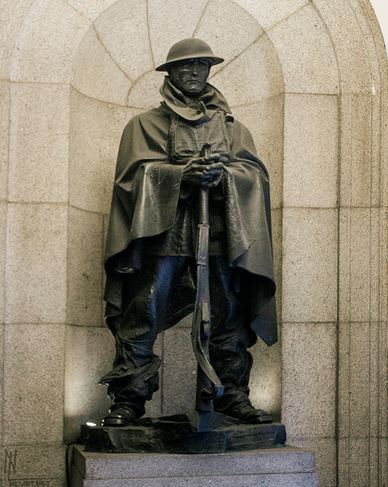
    Between the grand arched entrance, so typical of quattrocento Florentine palazzi, and the high lobby are matching shrines hidden from the street. On the right is the domineering silhouette of a figure instantly recognisable to fans like myself as Charles Sargeant Jagger’s The Sentry. This was a most pleasant surprise. There’s no mistaking the gravity of an encounter with Jagger’s work, recognition is immediate, the signature unique. His pieces celebrate the staunch resolve and dignity of ordinary blokes. I tried to locate this piece decades ago but never managed to see it, the building having for years been boarded up. Surviving calls from rapacious developers for its demolition, the 1856 edifice eventually reopened in 1982 as the Britannia Hotel, since when its ground floor bars and cafés have become popular night haunts.

    In the matching chapel opposite the imposing figure are inscribed in granite the names of 87 employees of S and J Watts, the wholesale haberdashers for whom the mill had originally been built, who had been killed in the Great War. Erected in 1921 the sculpture was among Jagger’s first commissions following the delayed start to his career caused by his own exemplary military service.

    Though undeniably impressive few of those entering the complex will notice the sculpture. They are probably too eager to avail themselves of, among other thrills awaiting, a ‘Happy Hour’ offer of two pizzas and two pints for fifteen quid, the advertising board for which stands a few feet from Jagger’s plinth.

    Eight years ago the bayonet was hacked off in a drunken prank and has never been replaced despite this being an important detail of a Grade II* listed work. To check on the original appearance including bayonet (the maquette is inset opposite), there are reduced versions in Liverpool’s Walker Art Gallery, at Eltham Palace in south-east London (Stephen Courtauld, who lived there, was a fellow officer with Jagger in the Royal Worcesters and, coincidentally, it was his family’s textile firm which eventually bought the Watts building), and in the museum at Rotherham where Jagger was born, the son of a colliery manager.

    Exactly 100 years ago, Jagger (1886-1938), who had on declaration of war instantly volunteered with the Artists Rifles, arrived back in England from Gallipoli via a Malta hospital having been shot through the shoulder, a potentially disastrous injury for a carver and modeller. But Charles recovered quickly and was re-posted to the Western Front where, in April 1918 during the German Spring offensive, he was sniped through the chest two inches above his heart. Astonishingly, he survived and was awarded an MC for conspicuous bravery. This wound undoubtedly contributed to a cruelly early death due to heart failure accelerated by overwork.

    When the war ended he took up the Rome Scholarship won before the outbreak when graduating from the RCA. Recommended by George Frampton, he was soon making war memorials, a job for which, given his experiences, no one could have been better qualified. Jagger famously said: “I got to love the Tommy in the Trenches and I’ve tried to show him as I knew him – not as he looked on parade at home.” The caped sentry’s legs are protectively swaddled in sack cloth against the cold and wet, an informal addition to uniform permitted during frontline duty.

    When The Sentry was unveiled opinion was split down the middle. Liverpool architect Charles Reilly remarked: “It is extraordinarily impressive as it stands there with intense immobility, a little large and crude perhaps for its surroundings; such a figure makes one understand the rock of national character against which the German flood broke in vain. It is truly monumental in its combined steadfastness and power. It is sculpture like this, and this only, free from any trivial suggestions, that can at all express the depth of feeling the war called forth.”

    Meanwhile, Roger Fry, who was always proud to know better than anyone else and who had already established himself as chief standard bearer for the avant garde, wrote of Jagger’s figure: “Nothing approaches the commonness, the effective, brutal, catch-penny vulgarity of his work”.

    Fry and his fixer followers won the subsequent taste war hands down. Jagger, Ledward, Frampton were forgotten, their works neglected, even wantonly ruined in the case of Jagger’s Unilever carvings. Understanding how the Establishment operated Fry was the first of a breed – today totally victorious – whose addiction to artistic novelty, whatever character it takes, is all and absolute. He was the first to proclaim loudly his low opinion of everything traditional, a view which eventually became so uncritically accepted as to become a basic qualification for anyone seeking preferment in the visual arts – Fry is the Vito Corleone of State Art. Those who refused to follow where Fry, Clark, Keynes and Co. led were dismissed as so many reactionary simpletons. To be an apostle of the avant garde was to be right – no argument. Thus, Fry’s heirs have learnt over decades of ascendancy to assume a patronising aesthetic and intellectual superiority over the rest of us. They treat us like blind children who are too thick to learn the big secret to which they themselves, alone, exclusively, enjoy special privileged access and insight.

    All I would ask is that you look for yourselves and are not cowed by those claiming to know best. Because they don’t. Perhaps Manchester’s Jagger really is vulgar, meritless and pedestrian. And perhaps Ryan Gander’s reflective bollards are, truly, “a world masterpiece”. What do you think?

    Leaving Jagger behind, as chance would have it our route to the ground took us past Gander’s chromium cruet. (It was a very cultural evening.) “What do you make of that?”, I enquired casually. “What’s it for?”, my friend asked.

    David Lee

    March/April 2016

    Ryan Gander Manchester


  • Fibres torn from the brain

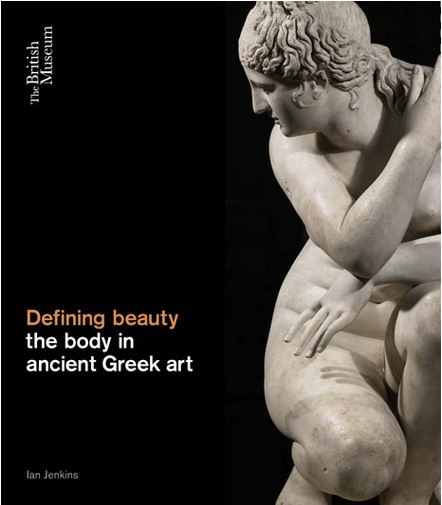
    Body in ancient Greek artIn all the doting coverage of ‘Defining Beauty: The Body in Ancient Greek Art’ at the British Museum, no mention was made of the fact that the bulk of major exhibits featured were from the museum’s own collection. Stupidly, I had believed – and perhaps was even misled by advance publicity – that the exhibition would feature a range of major sculptures I hadn’t seen before. I should have known better. During the months before the display opened, regular visitors would have noticed a weekly disappearance of prize pieces from the Greek and Roman galleries. Indeed, for two months in advance of the show half the Duveen gallery exhibiting Parthenon material was crudely boarded off like a building site. Art critics, many of whom nowadays are at sea dealing with anything made before last weekend, were bowled middle stump by Defining Art. They didn’t know the BM sufficiently well to realise that many works for which they were recommending the public pay handsomely could have been seen free any time in the preceding 262 years and will be free again after July 5th when the spectacle closes. It serves the museum right that attendance for what was doubtless planned as a cash-cow blockbuster hasn’t risen above a trickle. A sad irony is that works are better appreciated in the deserted exhibition than they are normally when enveloped by noisy swarms of disaffected foreigners shuffling along with scarcely a glance at anything deemed unworthy of a selfie. It goes without saying that the more important works illustrated in the accompanying book (which isn’t a catalogue), indeed the crucial ones to the show’s thesis, were not included in the exhibition: they live in Greece, a country with whom regrettably we have no dealings.

    We’ve become inured to the scam operated by many museums whereby they demand payment for what should be gratis. And the Department of Culture, the House of Commons’ Select Committee, and assorted museum trustees, all otherwise so proudly defensive of our free museums, let them get away with it. However, Defining Beauty set new standards in such fraud. With the exception of a rare bronze of middling quality recently trawled from the Adriatic off Croatia, the influential Belvedere torso from the Vatican and a few oddments, I emerged feeling well and truly robbed of £16.50.

    In previous issues I’ve criticised the BM for misrepresenting the experience of a visit there. We’ve been told often, mainly by the Director, that the museum tells a definitive story of classical sculpture and civilisation and shouldn’t be tampered with – this is their Elgin Marbles Sicilian defence. The collection is too patchy to attempt any such thing. And even if it were not, all the galleries are not open at the same time anyway. Visitors are never allowed to see the full story. Recently, I was ejected from two rooms in quick succession as they were closing only minutes after opening. They claim shortage of cash but in the last 15 years the BM has spent hundreds of millions on two major building projects, one of which is a shopping mall with a vile swimming pool roof. Constant closures ensure that many of the more fascinating pieces are off bounds every day. On my most recent visit galleries housing the Bassae frieze and the Mausoleum of Halicarnassus were, as usual, shut. But at least the wondrous, blissfully empty architecture galleries, in my experience closed for years, were open ­– a red letter day indeed.

    ­ As I write, news arrives that the BM has leased for five years 500 works to a Qatari museum for an undisclosed fee. Depletions to galleries of the sort mentioned above will, it seems, become a permanent fixture as the museum realises its main financial asset is the quality of collections they can pimp to the highest bidder (which, conveniently, fucks Greece). Am I the only one who thinks renting masterpieces in bulk to the Middle East is just a tad risky?

    We are entering a different age to that post-war world of museums where I discovered escape, solitude, inspiration and willing expertise on tap. Museums no longer principally exist to benefit those dedicated to what they preserve. I regret this loss of innocence and its replacement by venal opportunism. At the same time, I’m grateful to have experienced the best of it while it lasted.

    David Lee

    July/August 2015

  • Are you disadvantaged?

    The Department of Culture recently published a White Paper, the first from that department since Jennie Lee’s in 1965, and apparently only its second ever. This chic pamphlet, in truth more PR exercise than policy document, prominently contains that new-age mantra, “access must be increased for those from disadvantaged backgrounds”. The Arts Council also write this sort of optimistic guff, and they don’t mean it either. They only mean it if the ‘disadvantaged’ are prepared to like what the Arts Council want them to like. God forbid that the ‘disadvantaged’ should actually express preferences of their own. And this must echoes its 1965 predecessor – they were on message then too: “The best must be made more widely available.” Imperative or not, nothing happened. The disadvantaged, and presumably they mean anyone who doesn’t visit museums, weren’t seduced by free admission then and they won’t be today, or tomorrow.

    If contemporary art fanatics had their way they’d make gallery attendance compulsory, requiring a form of mass re-education: “You will watch this interminable video by our favourite and extremely challenging blurry filmmaker from Kazakhstan … who we got plastered with three nights running at the Gwangdong Biennale.”

    Access to museums already being free, how might the disadvantaged be forced into submission? Two possible answers suggest themselves. You could round up pasty-faced skulkers on a sink estate, deposit them outside a museum and have the director and his staff fire kalashnikovs round their feet until they flee into the galleries. Alternatively, you could exhibit the sort of stuff which might appeal to these disadvantaged folk. A display of assault rifles, stillettos and machetes perhaps, or violent video games and snuff movies, or panoramic tellies with full Sky Sports and pornography packages. You might scatter burger boxes, skunk butts, crisp bags and beer tins under the pictures in order to make everyone feel at home. And why not offer them a couple of free ten-pound bets? That seems to work.

    Curiously, there’s no word in the White Paper about the ‘advantaged’ who don’t visit museums. This includes most aristocrats. They’re also thick, inbred, ill-mannered, drug-crazed and unemployable. And do tell me Squire Vaizey – while I’ve got you on – am I disadvantaged because I’d rather have my teeth pulled by Hogarth’s dentist than sit through an opera? Give me Buddy Holly any day than some caterwauling eyetie. And I’d rather divebomb naked with my mouth open into a slurry pit than sit through a ballet or a ‘modern dance’, whatever that is. Give me a Sergio/Yaya one-two every time. No, let me go a-disadvantaging myself cabbing Deltics at Barrow Hill, or trudging across Rivvie Pike, or tending the world’s most expensive courgettes, or watching whimbrels where they’re not supposed to be, or just having a few pints in the Cheshire Cheese (again). Rather any of these pastimes than visit a palace of bogus crap like Tate Modern. Am I disadvantaged? Are you talking to me? Well are you talking to me?

    This White Paper has the self-congratulatory, de-haut-en-bas tone associated with all Arts Council literature, which, suspiciously, this document closely resembles in appearance. Every page tells its own tinted porky-pie diagram and the most obsequious political correctness oozes like dripping from every letter. It has also decided, again like the Arts Council in its own PR, what the outcomes will be even before policies have been implemented: “They will be inspired by their experiences and will be encouraged to inspire others.” Talk about the Gestapo: “You vill be spired-in! Or you vill be shot!”

    Will this White Paper alter the social demographic of museum attendance which has remained static for decades? Not a hope.

    Squire, I’ve been in more museums than you’ve had hot dinners and, yes, I am still seriously disadvantaged. Throughout my entire adult life I’ve been cheated by State Art’s monopoly force-feeding me a diet of conceptual and minimal trash of no discernible merit. The only thing I’ve been seriously disadvantaged by is State Art’s prejudice against the sort of work which – for all my peasant upbringing and scummy tastes – I’ve always preferred to look at.

    David Lee

    DCMS White Paper disadvantaged editorialMay/June 2016


  • Brian Sewell (1931-2015)

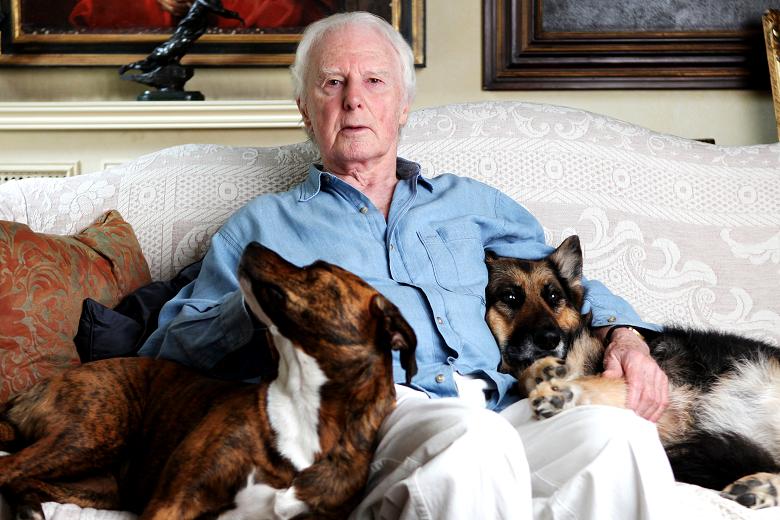
    beautifulbrianwithdogsIt isn’t my intention to repeat the tediously familiar stories peddled by obituarists relating controversies which Brian’s inclination to mischief and provocation helped encourage. Instead I want to address two issues unconsidered elsewhere: his astonishing generosity and the disgraceful but typical hypocrisy of the BBC towards him. Brian was a working man. He called himself ‘working class’, a description some dismissed as affectation. It wasn’t. Like his commuter readers he needed to work in order to survive. Neither was he rich. Nevertheless, he still donated liberally to promising but needy art history students and charities, in particular those dealing with homelessness and the welfare of animals, and he encouraged friends to do the same. Equally, buying work from promising youngsters in order to get them started was to him a duty. He was also selflessly free with his time, knowledge and contacts. When he was your friend you felt it.

    In early 2000 I quit editing Art Review, for which Brian had contributed many superb pieces on 20th century art’s main figures and which always arrived in uncorrected typescript as though having emerged perfectly like a Mozart manuscript. He telephoned and asked me what I would do now. I told him that I was devising the inaugural issue of The Jackdaw, which would continue the opposition to State Art’s absurd and damaging monopoly I’d begun only tentatively (for commercial reasons) at Art Review. He mused a second and said that to give such a venture any chance of long-term survival it would be very expensive. I disagreed, arguing that I could keep costs down by not employing anyone, including myself, or renting an office and having poncy stationery. I’d tried to raise investment for the idea but no one took the bait. The next morning I received in the post from Brian a cheque for £10,000. This staggering act of generosity and confidence was undeserved and his insistence I accept it terrified me. I told him I’d pay it back as soon as I could. Circumstances – including my unique hopelessness as a capitalist – meant that it took me thirteen years to honour my words – thirteen! – and only then as a result of an unexpected legacy. It was a relief to be able to redeem the debt not least because, in consequence of a change in the Standard’s ownership leading to revised employment conditions for the staff, Brian was having to do the same work for a fraction of what he’d formerly been paid. He needed the money. But never once in all those years did he raise the subject of my debt let alone ask for it to be repaid. And, of course, he refused any interest on the grounds that, as he wrote to me, ‘my failings are many but they do not include usury’.

    Without Brian The Jackdaw would not have survived beyond a handful of issues. I don’t think many who follow the terrain would disagree with the assessment that, of all his contemporaries in art criticism, in art historical terms he was easily the most knowledgeable. Given his ability to speak clearly and articulately – without artbollocks (which he always pedantically insisted to me should be properly spelt artballocks) – and because of his reputation as an elegant and amusing essayist – don’t forget he won both the Orwell and Hawthornden Prizes – he was hurt by the fact that Radio 4 never once asked him to appear in a review role on either of its main art programmes, Front Row or its predecessor Kaleidoscope. The list of waffling no-hopers in art criticism those programmes have employed would fill pages, but they never asked him. He would never have admitted it publicly but this omission hurt. What a surprise then that not six hours after his last difficult breath, his death made the main BBC news where he was lauded as an influential leading critic, blah blah. If they thought this was true why did they so rarely use him? The answer is simple. The BBC’s programmes, which in the visual arts are uncritical advertisements for their subjects, are willing promoters of the disgraceful sewer that is State Art, about which Brian held damning views. Over the years he suggested many programmes, all rejected. It speaks volumes that the BBC asked Grayson Perry to give the Reith Lectures, but not Brian. Of all the many independent voices we never hear, his cruel neglect in particular demonstrates that in visual art you will be marginalised unless you toe the establishment line.

    David Lee

    The Jackdaw November/December 2015


  • Elgin marbles: should they go or should they stay

    Elgin marbles: should they go or should they stay

    David Lee thinks loans both ways should be considered.

    We have rehearsed the pros and antis of retaining, loaning, handing back or exchanging the Elgin Marbles in the pages of the Jackdaw many times. The main arguments on both sides, few as they are, remain the same and recent reiteration of these familiar points would suggest nothing new will ever be proffered on either side. Certainly the case for the sculptures’ return will not be advanced by the Greeks enlisting a junior lawyer because she’s married to a famous actor. Any impetus given by that opportunistic stunt petered out once the press wearied of airport snaps of Mrs Clooney’s million-buck grin while offering nothing but the most fatuous of platitudes.

    Greece claims the balance has recently tipped in their favour with the opening of a new museum below the Acropolis. But their chief arguments in favour of restitution remain predominantly emotional and sentimental ones which play to the home gallery.

    The Acropolis marbles are handsomely exhibited free of charge in the British Museum and have been well cared for, in contrast to the way in which the Greeks have demonstrably failed to protect their own allegedly cherished carvings. Far more visitors will see the works in London than would be the case in Athens where, admittedly out of season, the Acropolis Museum – £12 to enter – can muster negligible trade bulked up (as indeed it is in London) by noisy parties of demob-happy schoolchildren – in the Greeks’ case a generation deemed ripe for the most shameless brainwashing.

    The argument that these sculptures are by Greeks from a unique moment in Greek history and from which all modern Greeks are descended is so much jingoistic claptrap. Greeks claiming descendance from the Athenian Pericles is as preposterous as me citing the ancestry of King Caractacus; as if the Roman, Angle, Saxon, Viking, Pict, Celt, Visigoth, Dane and French invaders, commonwealthers, colonisers and asylum seekers had never come between us, and changed our make up beyond recognition. It’s just silly.

    As someone who simply enjoys looking at classical sculpture, I recently visited Athens to see if workable alternatives about the future of the Elgin Marbles might be considered. Currently, the issue is clouded by irritating, point-scoring politicians intent on manipulating publics for their own ends. All those who love sculpture and art history should have an important say in any outcome because in the end we are the only ones who will actually take the trouble to look at them properly.

    From the outside the new Acropolis museum is as inelegant as most new buildings, its one quirk being a penthouse floor twisted from true as if a Rubik’s cube had had its top layer half-turned. What was left of the Acropolis sculptures after the explosion of 1687 when the Parthenon blew up destroying most of its peristyle and interior, not to mention assorted subsequent lootings, defacings, quarryings and Elgin’s removals, is exhibited on the top floor with gaps left where the frieze and pediment sculptures from other museums, chiefly the BM, would fit in. Having been eroded smooth and rounded by the most poisonous atmosphere of any city in Europe, much of this material is of disappointing impact and quality. Snatches of detail and passages of beauty hint at what might have been, but little in the way of real art appreciation is possible. From looking here at what remains of the Parthenon sculptures you would never suspect them of forming part of an inimitable masterpiece.

    A cynic might conclude that the Greeks need the BM sculptures because their own are largely unreadable wrecks. Unpalatable as it may be for the Greeks, an objective conclusion must be that if Elgin had not removed sculptures their survival may have been jeopardised. This cuts no ice in Greece because wherever you travel Elgin is presented as the Great Satan. The poor wee Scot is denounced in tube stations, museums, airports and on street placards, and even at remote archaeological sites across the country. Nowhere is there any acknowledgement that without Elgin’s intervention during a volatile period of foreign occupation, there might be little worth a second look.

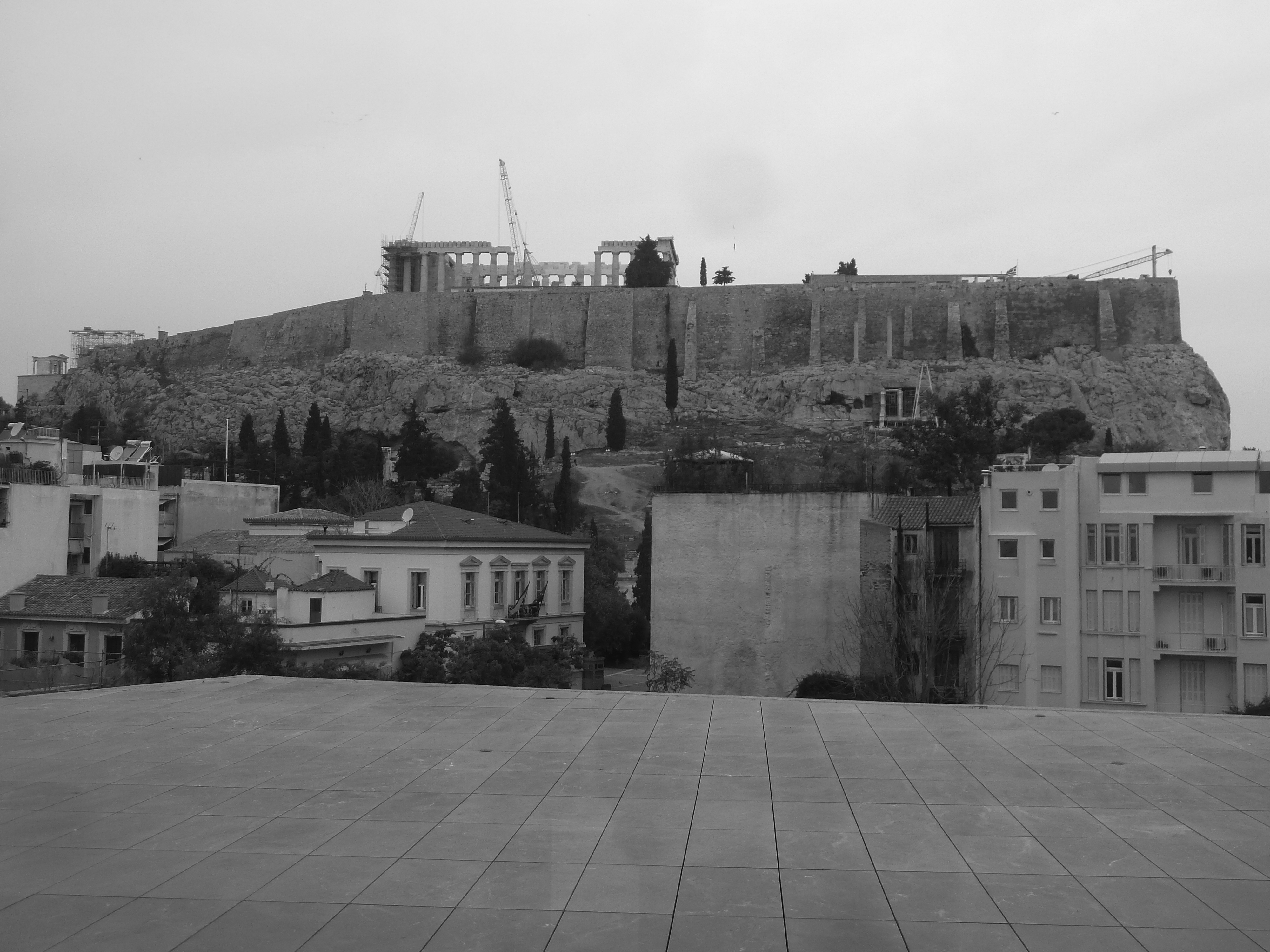
    The argument that the nearly complete frieze would be exhibited within sight of its original location has some little merit. From one side of the new museum (see picture above) one can look up to the rear, less photogenic aspect of the Parthenon, though you can’t see where the frieze would originally have been placed because it was obliterated in the explosion and subsequent collapses, earthquakes and demolitions. It was in any case more or less invisibly located high behind the peristyle arcade.

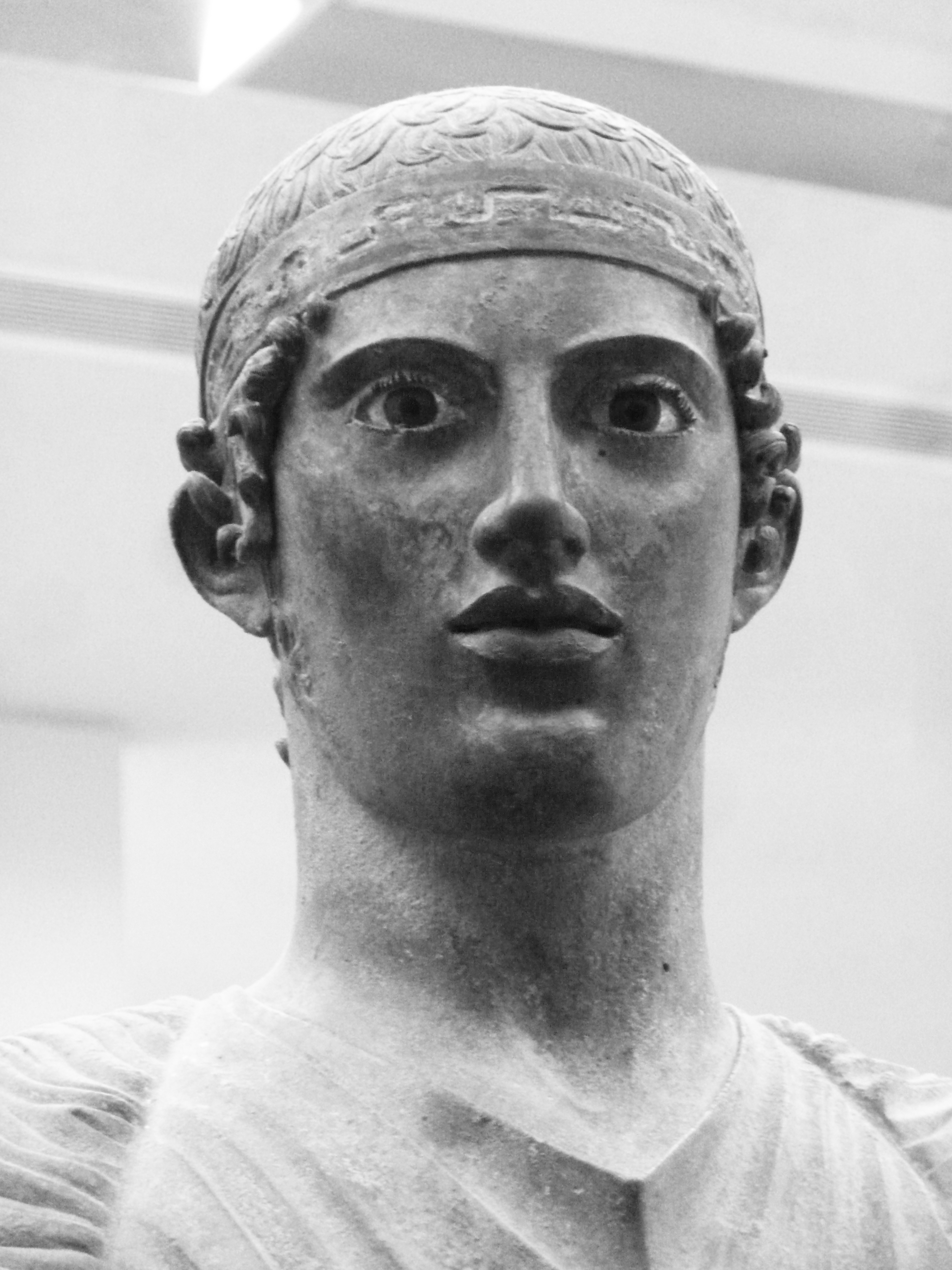
    In its other galleries the Acropolis Museum is an unforgettable experience, spacious and with the most fabulous carvings and bronzes sensitively displayed. For devotees of sculpture and the classical world it is unforgettable, joyful even. The calibre of work, the gradual evolving understanding of form and surface pattern, especially in the archaic, pre-Periclean period, is staggering – the scholarly designation ‘primitive’ is laughably inadequate when dealing with such accomplishment. For students of Greek sculpture this museum, as well as the quality of the even more breathtaking collection at the National Archaeological Museum on the other side of the Acropolis (see cover), fills in stylistic gaps not even hinted at in the British Museum’s story of classical sculpture – it is revelatory.

    Among the main arguments against restitution adduced by director MacGregor is that the BM’s Greek galleries tell the full story of classical sculpture. Familiarity with museums in Greece gives the lie to this fantasy. The British Museum doesn’t even get close to giving a complete account. To start with it is rare that any visitor to the BM experiences all its classical galleries open at the same time. Even after a lifetime of regular visiting I’ve rarely managed it. The architecture galleries in the basement are open only every Preston Guild, and the Halicarnassos galleries daily closed. Getting to see the marvellous Bassae Frieze in its bespoke attic is more of a lottery than El Gordo. MacGregor’s rhetoric  gets a far better press than it deserves.

    BM displays give a decent impression from, say, 450BC to 300BC but a visit to Greece soon exposes the threadbare nature of even that proposition. For all the beauty of some of its exhibits, the BM doesn’t present the full subtlety of what happened. Indeed, it will only be able to make such a claim when major loans are vouchsafed from Greece. This is why we should stop the war of bickering and insults and seriously consider a series of temporary swaps of material that would thrill aficionados in both countries.

    Presently Greek arguments for complete restitution are too easy to skittle. Not least the one about how important they claim the Parthenon marbles are to them. I first visited the Acropolis in 1971 since when the site has changed indiscernibly. The cranes themselves must be antiques by now. My generation is likely to live its entire lifespan with the Parthenon obscured by scaffolding, sheeting, peremptory signage and heavy lift equipment. The hilltop is a chaos of rubble, building works, ugly police-style cordons and railway lines – small wonder so few of the visitors who trek up linger here for more than a couple of minutes, for this is not a pleasant place to be. The Greeks claim to care passionately about this important symbolic site, yet progress is glacial. So far it’s taken them three times longer to restore a few patches than it took Kallicrates, Iktinos and Pheidias to conceive, build and carve the lot from scratch. But the torpor and apparent indifference evident on the Acropolis is typical of that infecting the country’s other important archaeological sites. Wherever you venture, from Epidavros to Delphi to Knossos, there is little or no building at the one cool time of the year when work ought to be forging ahead. Any urgency to conserve is bewilderingly absent.

    One problem to achieving any rapprochement is Greek resistance to negotiation and their attitude in general towards ‘loans’. One can’t blame the BM for a lack of engagement because the Greeks use the same definition of ‘negotiation’ as do the Argentinians when referring to the sovereignty of the Falkland Islands. In both cases ‘negotiation’ means only one possible outcome, total capitulation on our side. No wonder the British Museum is resistant to embarking on such a journey when the Greeks refuse even to acknowledge that it is the sculptures’ legal owner.

    Definition of the word ‘loan’ presents a serious problem for the Greeks. It is perhaps impertinent to mention that the Athenians built the Parthenon with money stolen from neighbours and never repaid. Old habits apparently die hard… Can one have any real confidence that a ‘loan’ of Elgin material would be returned?

    Despite all of this we should try putting aside childish disputes. The possibilities for exchanges of material between the BM and Athens are tantalising for sculpture lovers. Imagine, a swap of Elgin material for archaic kouroi and kore and bronze statuary of a quality unimaginable to regulars of the British Museum. What a mouthwatering prospect that would be, to see, for example, a large kouros, one of so many in Athens.

    The Greeks should change tack. They should magnanimously offer loans to the BM of works of such greatness that those against any form of extended exchanges between the two countries would be disarmed by so generous a spirit and the genius of the work. The main argument Greeks should deploy is this prospect of the mesmerising works they could offer in return.

    David Lee

    The Jackdaw March-April 2015

  • Tottenham Caught Napping

    Advised that as part of the Crossrail project (current budget £15 billion) each of five central London tube stations through which it passes had been allocated, for the purpose of decoration by their artists, to the five principal dealers associated with State Art, you might think a major public contract couldn’t possibly get away with such lazy commercial partiality. In fact, this is precisely what has happened. That such a deal could have been allowed to proceed without the merest peep of suspicion or opposition from any commentators indicates just how far it is now taken for granted that private, mercenary interests in art dovetail perfectly with those of supposedly ‘independent’ opinions and wider public policy. State Art has sold its soul. It has been bought.

    Each gallery will select its own artists for commissions worth up to a million quid apiece, which are then given the nod by a panel. This devolution of responsibility saves overseers the trouble of actually thinking about it for themselves.

    Recently trumpeted is the tarting up of Tottenham Court Road underground by two Turner Prize winners: Douglas Gordon, who makes tedious films of no recognisable artistic or cinematic merit; and Richard Wright, who does wall patterns of an appropriately ‘challenging’ persuasion. Needless to say, even before the artists have lifted a phone, their efforts have been declared ‘masterpieces’.

    The previous artist to ornament TCR tube was Eduardo Paolozzi in 1984. He covered tunnels with mosaics in that colourful wiring-diagram-cum-snakes-and-ladders idiom he was partial to for so long. According to The Twentieth Century Society, who are eager to preserve them, some of these are now under threat, although Transport for London has said “we’ll do our best to protect as much as we can” – which makes it sound as if the demolition ball is already swinging ominously nearby. Not that Paolozzi’s murals are that significant – let’s face it, they’re hardly the Stanza della Segnatura.

    The Crossrail art project, also now designated The Culture Line, describes its process as follows. “Artworks are being selected by an advisory Round Table of representatives from national and local arts organisations and commercial galleries. Among the galleries already identified to work in partnership with Crossrail are Lisson Gallery for Paddington station, Victoria Miro for Liverpool Street, Gagosian for Tottenham Court Road, White Cube for Bond Street station and Sadie Coles for Farringdon. Crossrail is in discussions with other renowned galleries for the remaining stations at Whitechapel and Canary Wharf.” Renowned, indeed… And thus it is that Gordon and Wright are represented by Gagosian, who looks after Christopher Wool (editorials passim) and eleven of the twenty bestselling artists at auction.

    When State Art is the very fabric of the establishment choosing committee candidates never results in a range of opinions. Thus, these “advisory round tables” are always euphemisms for the usual suspects. And here, as ever, the chosen few have not let us down, having dutifully selected as beneficiaries others from the top table of State Art. Some of these knights and damsels of the round table have been previously associated with high profile galleries and, who knows, might like to renew their trade connections in the future.

    Honestly though, how long must it take for a colloquium of State Art lickspittles to arrive at the names of the five most fashionable mongers in the West End? Three minutes? Two? A quick round of skinny lattes and jammy dodgers and Bob’s your uncle – then it’s off home for a well-earned tweet. Wouldn’t you just love to have eavesdropped ‘negotiations’ resulting in the richest galleries being allocated discreet chunks of Crossrail action? Without question the process will have been as pure and disinterested as the driven snow.

    It is further announced that at Paddington Lisson’s American conceptual artist, one Spencer Finch, is to adorn the glass canopy of the new station with a sort of taxonomy of skies. He said: “I am so excited to have this opportunity to get to know these English clouds and do something beautiful with them on a grand scale.” He should get Constable on fast dial.

    David Lee

    The Jackdaw March/April 2015

    http://www.crossrailart.co.uk/the-culture-line/