Well, a Museum of course needs things to show, and any self-respecting Storehouse, whether afloat or on dry land, likewise needs things to store: so you will be pleased to know that several significant acquisitions have already been – how shall I put it gently? – acquired:
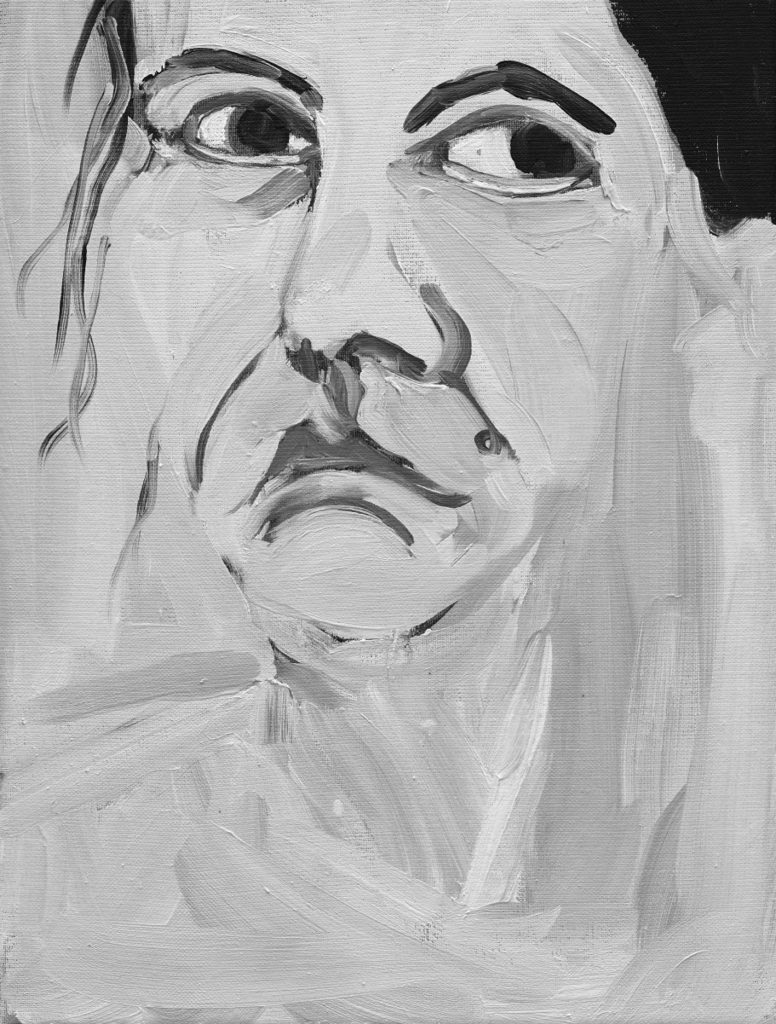
item: a large portrait by Kalinde Wiley, an American, from her Yellow Wallpaper series, of Melissa Thompson, an east-Londoner whom she bumped into one day in Ridley Market, Dalston. “It represents the artist’s ongoing practice of subverting (goes without saying) historic European portrait traditions (about time too) with works that elevate sitters and challenge perceptions of blackness, to raise important questions (answers on one side of the paper only) about race, identity and the politics of representations.†The Art Fund has chipped in, so clearly it wasn’t cheap.
item: a hot pink Daria frock, worn by Beyonce for her Black is King album, by Molly Goddard, a dress-maker from Hackney. It is her largest so far, “inspired by baby doll dresses and exaggerated in scale, celebrating the power of femininity,†as such things do.
item: 10 photographic prints by Jamie Hawkesworth, from his Preston Bus Station series.
item: a 48-tile glazed ceramic frieze, Auntie, Mum and Me, by Mawuena Kattah (above). Her work draws upon her extensive personal archive of family photographs taken in Ghana, and more recent family studio photographs taken in London.
item: Itari, a visceral terracotta vessel (sounds exciting) by a British-Nigerian artist, Ranti Bam, “embellished with colours, patterns and textures inspired by her exploration of the written wordâ€, which does rather leave us staring at each other with a wild surmise. Puzzling to say the least, but let’s leave it at that.
item: the archive of Anglepoise man, Sir Kenneth Grange.
item: a display of Frankfurt Kitchen, the model modern fitted kitchen designed by Margarete Schutte-Lihotsky in 1927.
All in all, a mixed bag, wouldn’t you say? And public money well spent? Yes, well, but, some of it, certainly, perhaps, up to a point, Lord Copper.
I don’t know what it is. Perhaps it’s just me getting on a bit: but I do get the feeling more and more that nowadays things are coming off the bat a shade too fast for comfort, and going through for four every time. Indeed there are moments when I’m not altogether sure what’s going on at all. I mean to say, I’ve always assumed I had a fair command of English, but too often these days what comes through door or inbox passeth all understanding but with no regulation salve of Peace attached. It often might as well be Double Dutch, if you’ll forgive my saying such a thing in these delicately-poised times. The last thing I would do is cast any self-perceived micro-slur or aspersion on the genial denizens of dyke and polder across the water, and, picking my words carefully, not at all on the euphony of their native tongue. The French, of course, are another matter, especially at the moment: as for the Scotch, Welsh or Irish, say no more.
But I ask you, what do you make of this? The V&A, it appears, has Tate-like imperial ambitions, and, as I understand it, is in active process of colonising portions of the dank fens and reedy bogs around Bow, Stratford and adjacent Essex, leaving the Dutch connection perhaps not so far-fetched after all. Just to assure us that all goes well, its latest bulletin goes like this.
“Director Gus Casely-Hayford unveils creative vision for V&A East’s two new sites in East London – a contemporary programme that platforms global creatives we’ve never heard of shaping today’s critical conversations, empowers young people and the next generation of creatives, and is rooted in the local community.†Are you any the wiser? Lucky you.
The plot thickens, as of course it always does. Construction is well under way, with both the V&A East’s Museum and Storehouse ‘set to launch’, as is rather alarmingly promised, in a year or three. I suppose those rising sea-levels we hear so much about must be quite a worry in those lowly parts. This latter edifice, or boat, “will offer a new immersive visitor experience (see what I mean: goggles and a towel doubtless provided) taking visitors behind the scenes (or shouldn’t that be below?) and providing unprecedented public access to (and this is where the old synapses might begin to twang just a bit) 5000 years of creativity.â€
When your eyes have stopped watering, I’ll go on. Several ‘creative partnerships’ have been announced, so we can’t say we haven’t been warned. A Youth Collective Programme is to offer local youth “a paid rolling advisory opportunity (which sounds fun) to directly shape this new institutionâ€, which sounds less so. Always read the small print is my advice to Sharon or Aziz, or whomever might turn up. And then there’s something called RESOLVE, described as an interdisciplinary design collective appointed to be the first Youth Workers in Residence: at which doesn’t the heart sink just a fathom or two deeper into the deep? Except we then learn that lurking in the offing is A Vibe Called Tech, a new creative agency and consultancy, founded by one Charlene Prempeh, the mission of which is ‘to explore the intersection of Black creativity, culture and innovation’, and farther down the poor old ticker dives, full fathom five.
Charlene, by the way, has already been consultingly creative, or creatively consulting if you prefer, for, amongst many others, the BBC, the Guardian and Frieze. She also has a regular column in the FT and is on the editorial board of the Tate. Oh brave new world.
So there we are, and there it is. And with such shipmates safely aboard and Captain Gus at the helm, the good ship V&A East sails proudly into the future, surely in safe hands.
Hope springs eternal, so the poet sings, or dum spiro spero, as that wise and prudent old bird, King Charles I, would put it, and he should know. But then again, true as truth may be, I have to say there are times, and these not the least of them, when it would seem to have shrunk to the merest trickle. Perhaps by the time you read this I may well have been proved mistaken – and oh how I do hope so – but please don’t go round to the bookie’s just yet, no matter how short the odds.
But at least Spring has sprung, just about, and the tendre croppes popped up here and there, and the yonge sonne come out now and again: just the time of year indeed, as that other old bird once sang, whan longen folk to goon doon to the pub again for a swift half or two, and then perhaps to take in a gallery and catch up on a bit of Art at last – get one’s eye in again, as it were.
And so, bifel it in that season on a day, it was in rather that hopeful frame of mind that I reached for the wagger pagger bagger (middle-English for waste-paper basket since you ask) to see what of interest might quite by chance have found its way there. For, if they’ve done little else throughout our national sequestration, our major cultural institutions have kept us more than well enough supplied with information, both on what they’re not doing and we’re not seeing. The aforesaid wpb is indeed a most useful item: no home should be without one.
But, oh, dear: information is all very well, and has it place, but interest doesn’t necessarily dance attendance upon it, and I’m not sure I need have bothered. If what I found is true measure of what’s in store for us, I think I’ll stay put at the Goose & Dairymaid. For in the event, far from encouragement, several melancholy figures rose instead to flit through the pervading gloom, to remind me as they passed of what our cultural commissars and apparatchiks have now brought us to, and what we have lost – the ghosts as it were of Art Past, Present and To Come.
So what is it they mourn, these sad revenants? Can one be the Ghost of Skill and Craft, now sacrificed on the altar of Technology, the curatorial obsession with which has been long apparent but now grievously aggravated by the exigencies, excuses and opportunities afforded by the late confinement? And is another perhaps that of Particularity and Excellence, now abandoned in light of those fashionable imperatives, Diversity and Social Engineering, with their no less obsessive preoccupation with purity of thought and moral posturing? Gosh, here too come the shades of Judgement and Discrimination, forsaken in the name of Equivalence and Fairness; and that, too, of Scholarship, elbowed out long since by the fell demons of Accessibility, Relevance and Re-Interpretation. And saddest perhaps of all, at last come hand in hand those ghostly figures long forgotten, the Old Curator, the Artist and the Ordinary Visitor, each steeped in love for what Art actually is and whose only wish is to respond to it through their own eyes and minds.
If all that might sound a bit harsh, well, as I hinted at earlier, I’m not in the best of moods. But where to begin? Well, as good a place as any is the National Gallery, that temple to the rare and beautiful which, in all these respects, indeed often all at once, seems to have been especially busy.
I’m sure we can all agree both that the small study exhibitions of recent years, devoted often to a single painting, have been good things, and that that masterpiece of the Northern Renaissance, Jan Gossaert’s Adoration of the Kings of about 1510, one of the glories of the collection, is an entirely worthy subject for such treatment. Straight-forward scholarly presentation, however, would seem no longer to be enough.
More than an exhibition, Sensing the Unseen: Step into Gossaert’s ‘Adoration’, is an “immersive experience where (if experience has a local habitation – answer on one side of the paper only) visitors could (though perhaps for not much longer) journey through an interactive high-resolution image of a picture with sound, poetry and light in socially-distanced pods.†It sounds just the sort of thing that would have given those shepherds abiding in the fields all those years ago quite a turn, pretty well socially-distanced as they were anyway, I suppose, and no pod in sight. But fear not, for the good tidings I bring you are that the Director Gabriel, or one of his Seraphs perhaps, has had the whole thing re-imagined not just online but in a ‘mobile edition’.
So don’t say you haven’t been warned. “Six poems in the voice of King Balthasar, a character (and how we love ‘a character’) in the Adoration will interpret six scenes from the painting while, wonderful to behold, interactive sound brings them to life… Users will journey through the scenes, starting with the broken pavement and ending with the celestial angels, using touch to zoom (no, it’s not that funny) into visual details they may have missed… They can also share their favourite details on Instagram (behave yourselves)… Data analysis will be used to help understand more about how visitors interact with paintings on their phones†I’m not often lost for words, as you know, but I shall struggle on.
“The fair Miss Emma McFairyland, Innovation Programme Lead, whatever that is, says: ‘Our aim … is to create enjoyable, meaningful experiences which engage new and diverse audiences with the collection in different ways’:†and you can’t say fairer than that and I’m sure they will. “The mobile experience brings together sound, images, poetry and interaction, doubtless boggling both mind and knees, to explore (of course) the themes of rupture, transformation and renewal through (and here things get a bit metaphysical) the perspective of King Balthasar (and here you might reasonably raise an eyebrow, or even two), a witness to Christ’s birth.†But we pass on.
Collaborators in this worthy enterprise “include Nick Ryan and Theresa Lola, former Young People’s Laureate, who wrote and voiced, if that’s the word we’re searching for, the poems. Ryan is globally renowned (of course he is) for creating experiences that push the boundaries (and here we get metaphysical again) of listening besides engaging new audiences with audio.†So there. “Technical analysis has revealed the skill which the artist put into the picture.†Where would we be without technical analysis? “There is a considerable amount of underdrawing and Gossaert has made a great many changes at all stages.†Well, fancy that. Who would have thought it. Such skill. Well I never.
I think it’s time to follow the wise example of King Balthasar and his Chums and depart into our own country another way.
Well here we still are – or perhaps not by the time you read this: goodness me, let’s hope so – but I do rather worry about how you’re all bearing up in these strange and straitened times. Social distancing is one thing, but this Social Hibernation altogether something else: and, with no release in prospect, it does get me down somewhat. But that said, and if around here is anything to go by, it does seem that this time the prescript is honoured more in the breach than strict observance. And I have to admit I do stretch the point a bit myself, with a saunter down to Brockwell Park – only now and again you understand: and just for exercise of course – with the off-chance of a gossip with Silent Joe, the resident Heron, as a bonus. Mind you, that can sometimes be a bit of a frost. Like most people I know whose sole interest is spearing fish, he’s not the greatest of conversationalists, and extreme social distancing is the only option, what with him standing on one leg in the middle of the pond and me perched up a tree. But better than nothing I suppose, otherwise I’d be stuck here alone in this freezing tow’r, with nothing to warm my five old wits but crumpled Arts Council press releases and old copies of Art Monthly.
SWEET CHARITY
Ah yes: Art Monthly, the gift that keeps on giving. As I remember, it was set up by two old art-birds, Jack Wendler, who had a gallery, and Peter Townsend, said to be an Australian, over a few drinks in the Museum Tavern in 1976, and seemed a good thing at the time. But that glad, confident morning didn’t last long. The Arts Council soon took it in hand, a dead hand if ever there was one, and has kept it on life support ever since to the tune at the latest count of 40,000 smackeroos for the year.
So what has it to offer this time to help lift the Februarian gloom? Here is Jill Magid (no, nor have I), glossing her I-phone snap of a virgin paper tube split in half to spill out bank-fresh coins. “Like all my projects, in Tender I subverted one element within a larger system. During the current Covid 19 pandemic, a coin shortage developed in the US so the US Mint began overproducing coins, as one does. The coin shortage, like the Tender coins became an artefact of Covidâ€. Project? Subverted element?? Artefact of Covid??? If you’ve lost the thread, not to say the will to live, you’re not alone.
Next, “Art as Evidence as Art†gives the lobes and synapses another gentle jolt. Miss Stephanie Bailey asks herself “whether Forensic Architecture’s artworks raise further questions about the continuing violence of colonial democraciesâ€: a good question, no doubt, but just a shade perplexing too. What, dear Stephie, has democratic colonial violence to do with Art, or Artwork if you must? I now feel rather for the aged aged man I once saw a-sitting on a gate: questions, questions, all these questions. I couldn’t get his drift at all, but at least I didn’t thump him on the head, as someone did, so I’m told.
But Fair Stephanie hasn’t finished with us yet. “What is notable about the Forensic Architects’ contribution to the cases of Pavlos Fyssas and Zak Kostopoulos (no: again I’m afraid not) is the intent to uncover, beyond the causal relationship between perpetrator and victim, longer histories of oppression and violenceâ€: which is, I suppose, an answer of sorts, but well worth a thump on the nose were chivalry not to stay the fist. For of which or what is it all about? Notable or not as it may be, is intent a contribution of itself: and what, if any, longer histories were thereby uncovered? Good intentions are all very well, but be careful where they lead.
We live indeed in a wicked world. Forensic Architecture, you perhaps should know, is a research agency, based at Goldsmiths’ College (naturally), that makes it its business to investigate violations of human rights committed by states, corporations and police and military forces around the world. It was, or so it would seem, thus well-qualified for nomination to the Turner Prize of 2018, which unaccountably it failed to win. It is also an emergent academic field related to the presentation of architectural evidence within legal and political processes.
Art Monthly is a registered charity, enjoying a consequent statutory duty to maintain its exclusive charitable purpose and deliver a clear benefit to the public in general. It meets such obligation, of course, equitably and with all due punctilio, quite free of political interest or engagement. It is also an Art magazine. Next month: Ginny Limbo on “The Borrowed Landscape as cultural appropriationâ€; and Jeremy Acroprop on “Diversity, Exclusivity, and the Empty Frameâ€.
IT’S FOR OUR OWN GOOD
So to the Social Services, and to that notable arm of the modern Welfare State, Arts Council England, now flourishing under the firm, wise hand of Farmer Nick. What’s this at the bottom of the pile? Ah yes, a pre-Christmas bulletin on the recent accomplishments and goodly works of the Arts Council Collection, headed invitingly: “A Hello From our New Director, Deborah Smithâ€. Hello Debbie.
Pray continue, goes up the cry, and I can tell you it’s worth the wait. “What a year it has been! .. a challenging yet inspirational time. I’m honoured to be leading the Collection’s next chapter, if that’s what one does to chapters, and excited by the future of developing connections across cultures in embracing our mission of working in partnership to bring great art to as many people as possible.†Whew: I’m quite out of breath already, and still trying to work it out. It’s the sort of sentence one has to read twice and still be none the wiser three goes later. A diagram helps.
But on we go. “New Acquisitions – we announced (confessed would be the better word), that 38 works by 21 artists were acquired for the nation, a diverse range of works by artists including Pugh, Pugh, Barney M’Grue, Cuthbert, Dibble and Squab. Working with Communities – Our National Partner Programme venues Firstsite, Newlyn Art Gallery & The Exchange and Sunderland Culture (Awaa the Lads) collaborated closely with their local communities to develop exhibitions and projects which reflect the richness and diversity of their local areas – including Super Black, Art Champions, Go on Being So and My Name is not Refugee. In Barnsley, the Cooper Gallery worked collaboratively with the ACC and Autism & Asperger’s Barnsley to create Allegories for the Senses, an exhibition focussed on the senses. Exhibitions & Loans – In the moment: the art of wellbeing, an exhibition exploring how art can help relaxation and provide a break from life’s daily worries took on a new relevance this year!â€
“The Future – 2021 marks the 75th year of the Arts Council Collection and we look forward to celebrating through a plethora of activity …†Oh dear.
A MOTTO
No matter how worthy or well-meant, when the Message takes over, Art leaves the room.
Oh dear. I had expected to be out and about again by now, as did we all, even if it did mean wearing the mask and keeping one’s distance, and hardly daring to look at anyone, let alone breathe. But no: here we all still are, stuck at home and doing as we’re told, good boys and girls to a man, or woman as the case may be – though it’s becoming increasingly hard to tell which is which in these confusing self-identificarious times. And to make life ever more troublesome than it needs to be, there then follows the awkward business, taken with all due care and consideration for the feelings of others – a natural civil duty and obligation after all – of wondering on the most meagre of evidence if we are dealing with a truly delicate plant, a manifest lunatic, or a joke. People do take such offence at the slightest and most innocent provocation, whether imagined or contrived, don’t you find, and we don’t want to end up at the bottom of the river like that lump of old bronze.
At least that genial if tiresome national treasure, Sir (it can’t be long) Cynthia Puppy RA, potter to the stars, doesn’t put us to that trouble. We know perfectly well where we are with him, usually that state of mild embarrassment as when the joke falls flat, yet again. But at least when he’s on the television he seems to prefer to leave his frock in the wardrobe and ankle socks in the drawer. He’s been on it quite a bit lately, supposedly to keep our spirits up amidst the gloom, and he seems somewhat less colourful too so far as I can tell, watching in black and white as I do – a Sony 9†portable c. 1970 since you ask, which I have to give a shake from time to time to get a picture: I mislaid the aerial long ago. And without the Alice Band his hair is rather floppier, and much longer too. I’m surprised Mrs Cynthia, who has been appearing with him on the programme, hasn’t picked up the pudding bowl and given him a trim. She does her own hair, perhaps in the same way, rather fetchingly in grey and white stripes, like a badger, very neat.
Where was I? Oh yes, the programme. It was called Cynthia’s Art Club (I speak from fading memory) in which under his eponymous direction the viewer of every hue and cry, talent, description and proclivity, was encouraged to produce what he, and I fear you and I too, moving with the times as we must, would call an ‘artwork’ on the set theme of the week, safe in the understanding, since we are all artists now, that art wouldn’t come into it.
Cynthia, meanwhile, had been far from idle, calling on both long experience and natural talent slowly to produce – for it had perforce to last the series – one of his pots-cum-sculpture, or sculpture-pots if you insist. It would, we were assured, come to signify and celebrate his experience of the lockdown and what it meant to him, or something like that. And we followed its progress as it grew, or sprouted might be the better word, episode by episode, into something rather more than just a pot or indeed common sculpture: something, how shall I say, more exotic, fetishistic, even organic, like a small triffid, or mutant cactus. And every so often Mrs Cynthia would potter in and say, “Ooh, that’s nice Dear. Yes that’s much better. It’s changed a bit, though, and what’s that chunk of metal doing? Oh, I see. Hmmmâ€. And then she’d potter off.
On the whole Cynthia’s Art Club was all rather charming, in an evening institute kind of way, and certainly very popular. But then art as therapy so often is. Let’s Fill this Town with Artists, as the old song goes. We’re all artists after all, aren’t we?
Goodness knows we have more than enough to mope about these dark days, even without the current plague, what with the evenings drawing in and the weather on the turn, again. It seems to happen every year, Winter. Was it always like this, this cold, wet, windy, foggy, snowy thing, with a spot of flu thrown in for good measure? I blame Global Warming, or Climate Change as everyone now calls it, hedging their bets.
Of course the plague doesn’t help, especially at my age, and I can’t say I’m looking forward to being confined to barracks yet again, alone and warming my five wits as best I can in this draughty old belfry, to venture out only at risk of neighbourly denunciation by the horrid old crow next door, and possible debility and death. I know it’s for my own good and, if I didn’t, I know I’d soon be told so by lovely Fiona Gloom or sweet Sophie Despondency on the evening News. Get a grip they’d say, think of others, and do your bit of shielding, whatever that is.
It is a public duty, I know. It makes me almost ashamed to mope at all, though only almost. But then life is strange, and rather wonderful too, and, blow me off my twig, what should happen but that Art appears, smack on cue, to take my mind off such selfish introspection and despair and give me, as I knew it would, something really worth moping about. And, just so, across the wire the message comes, Chantal Joffe (say no more, I hear you cry) is to have another show to follow the one she had, when was it now? – ah yes, the week before last. Gosh, how Time flies.
I’m not sure quite which is the more dispiriting. One can just about understand, though not necessarily forgive, a Barrow Boy, Spiv or Snake-oil Salesman for making a few bob flogging off dodgy goods. After all, there’s always been more than something of the back-street market to the art trade, good times or bad: caveat emptor and all that. And, again, who can really blame an artist for cashing in on a manifest lack of talent given half a chance. Take it while it’s going I say. After all, no one’s forced to buy the stuff.
So no: it’s not the chancers who make my very heart faint and my poor soul grieve so much as the fellow travellers, useful idiots, critics, administrators and curators and, not least, self-serving artists, who by their abandonment of critical judgement keep the whole sad charade on the road. Theirs is the greater betrayal. Trahison des clercs says it all.
I’ve nothing against Miss Joffe, who has shown all over the world, has works in pretty well every major collection, clearly can’t draw or paint to save her life, and is not all that bright if what follows is anything to go by. Along with her new paintings, the show, we’re told (wait for it), ‘premieres’ (no, don’t laugh) some pastel self-portraits (illustrated), about which she has this to say: “You can get a kind of brutality with pastel that you can’t with paint. With paint there’s always an extension of your arm and brush. Whereas pastel is so primitive. You can’t draw hard enough.†Well, I mean to say, I know we now see through a glass darkly but what on earth is all that about? I still feel quite dizzy, and I’ve only read it twice.
The show is called Story, and many of the paintings are of her mother. They consider, so Victoria Miro’s in-house hack helpfully informs us – chez whom the show of course takes place – “consider issues of aging, motherhood and invisibilityâ€, doubtless with profound conclusions drawn, albeit un-vouchsafed as yet. She brings a “combination of insight and integrity, as well as psychological and emotional force, to the genre of figurative artâ€: at which point I feel we should all take a deep breath and put our heads between our knees for minute or two. Whew. Figurative art a genre, eh? Roll over Rembrandt, Rubens, Velasquez what?
But on we plough: “Defined by its clarity, honesty and empathetic warmth (one can never have too much empathy) her work is attuned to our awareness as both observers and observed beings, apparently simple yet always questioning, complex and emotionally rich.†No, nor do I.
A book accompanies the show in which we find Olivia Laing, novelist and soi disant cultural critic, treading water somewhat, and not exactly waving: “Over the years, a kind of hardening takes place, a process of separation and individuation on both sides… The mother recedes inch by inch, becoming smaller and harder, emerging as a person with needs and sadnesses in her own right.†Receding and emerging, smaller and harder: I don’t like the sound of that. Let’s hope there’s a vaccine soon.
Back with the scribe, Chantal’s “is a deceptively casual brushstrokeâ€, though I’m not so sure that deceptive is quite the word: casual will do. “Her paintings only waveringly adhere to their source (yes: we can see that) – be it a photograph, magazine page, or even a reflection in a mirror – instead reminding us that distortions of scale and form can often make a subject seem more realâ€, or perhaps not. “Notions of sensuality and self-disclosure (sounds interesting) are parcelled up in works of mobile immediacy.†Mobile immediacy – well there’s something to set the imagination adrift, I must say: swings and chandeliers spring to the febrile, hopeful mind. Mobile immediacy – I shall try to remember that, if not for long. “Hers are deeply questioning images about ever-shifting human connections (those chandeliers again) and the endless intricacies of looking.†Answers on one side of the paper only, the deeper the better.
So there we have it: what justification there is rests either on the narrative alone, as read in the imagery, or on the artist’s subjective experience of its making: of the actual technical quality and resolution of the work as work, painting as painting, drawing as drawing, not a word.
Chantal is a graduate of Camberwell and the RCA, both renowned painting schools in their time, and now a Royal Academician, its Professor of Painting no less, elected by a body that nowadays counts amongst its number such as Our Tracy, Yinka Shinybone, Bob-n’Rob, Young Grayson, and the Misses Dean and Wearing. Some years ago it gave her its Wollaston Prize, nem. con. – which is to say 25,000 of the best and brightest for ‘the most distinguished painting in the summer show’ – worthy heir indeed to the shades of Reynolds, Turner, Lawrence, Millais, Spencer… Perhaps trahison des clercs isn’t strong enough.
I don’t know about you, but I find it’s becoming increasingly hard to keep up in this brave new art world of ours, fly as I might. Perhaps it’s just my tired old wings, but I have a horrid feeling it might be rather more than that, even if I do manage to catch up with whatever it is for half a furlong. Taking in air significantly as I heave alongside, yet still peering keenly through the misted specs, it’s ten-to-one on I’ll still make neither head nor tail of what it is I’ve actually caught up with. All that effort spent and innocent curiosity frustrated: it is a shade dispiriting don’t you feel: but anno domini I suppose, as we used to say.
I mean here we all are, doing as we’re told, still masked-up beak and wattle, soaping the talons at every turn and dutifully keeping our distance, stuck in Zoom-space and desperate for release and something to look forward to. So when a note came pinging through the aether from the chap at the Pace Gallery – you know: tradesman’s entrance at the back of the Academy, up the stairs and off to the right, the old servants’ quarters, chambres de bonnes – announcing its reopening in September with a show entitled Bloom, ahaa, ahaa, I said to myself a couple of times, ahaa ahaa; at last, something to look forward to. I rather like pictures of flowers.
But how soon the heart sinks, and all the farther and heavier when jacked up a bit first. It didn’t take long. Bloom, it transpires, is a show of the work (detail illustrated) of yet another world-famous artist we’ve never heard of called Trevor, Trevor Paglen to be precise, American and in his mid-forties. He is known, we learn, “for investigating the invisible through the visibleâ€, which is a start of sorts, I suppose, for all its rather darkly Pauline cast of mind. Where he actually lines up, though, sounds more like the start of the Grand National than the Derby. A ‘Wide-reaching approach’ is the formula favoured here – not something approaches often are in my admittedly limited experience, except at Cheltenham or Aintree – and his “spans (again an unusual thing for any self-respecting approach to do) image-making, sculpture, (now there’s a surprise) investigative journalism (that’s more like it), writing, engineering, and numerous other disciplines.â€
Quite the Renaissance Man. It’s tempting to have a guess at what those others might be – brain surgery? quantum physics? ballet dancing? experimental geography? sudoku? It’s a dangerous game, though, for, who knows, we may be right. But let’s press on. He has written “five books and numerous articles on … experimental geography (there you are: hole in one), state secrecy, military symbology, photography and visuality of all thingsâ€. His “investigation into the epistemology of representation can be seen in his Symbology and Code Names series which … explore questions surrounding military culture and language.†Does one ‘explore’ a question? Perhaps. So what has he discovered? What are the answers to these questions? We still long to know. Do tell.
“Among his chief concerns [is] learning how to see the historical moment we live inâ€. I find waking up in the morning and opening my eyes a not unreasonable start, or approach if you’d rather. He is also keen on “developing the means to imagine alternative futuresâ€, at which point I’d rather leave him to puzzle it out for himself, or dream on – our Trev is a laureate of the Macarthur Genius Prize after all. Just speaking for myself, I’d have thought the usual means by which to imagine is the imagination and, as for the future, can there ever be an alternative? I suspect we’ll be rather stuck with the future we get, when it comes of course, as it does, like it or not, later today if not before: che sera. But who am I to say? These are deep waters, Watson. Moving fingers. Questions, questions: answers on one side of the paper only, and don’t forget to put your examination number in the top right-hand corner.
But to be fair, if I must, the words above are not his, though I’m sure he crossed the eyes and dotted the teas, but those of Mr Pace-Gallery, all taken down in faithful dictation by Jessica, his lovely secretary, or was it Barry. So what has Trev to say for himself? Here goes: pace yourself. “Computer vision and artificial intelligence have become ubiquitous (gosh). The works in this exhibition seek to provide a small glimpse into the workings of platforms that track faces, nature and human behaviour … I am interested in exploring the numerous examples of computer training sets creating AIs that reflect and perpetuate unacknowledged forms of racism, patriarchy and class division that characterise so much of society.†No, nor do I: not a word. Reflected and perpetuated yet unacknowledged? Hmmm. A mystery.
The eponymous Bloom of the exhibition is “a series of large-scale photographs that depict flower formations, flowers, leaves, petals, stalks, that sort of thing, conceptualised by various computer vision algorithms created to analyse the constituent parts of real-life photographsâ€; at which point I fear I’ve quite lost the thread along with the will to live. What, quite, goes up the universal cry, is a real-life photograph, for goodness sake? And its constituents? – all those algorithms for a scrap of paper and few chemicals exposed to light? That old combination of sledge-hammer and nut springs unbidden to the mind. But wait: there’s more if you can bear it. “The colours and shapes … represent similar areas that the AI has detected in learning from other images of flowers. They do not represent real-to-life colours, good heavens no, there’s not much algorithmic fun in that, so much as what the AI thinks the different parts of the images are, if you see what I mean.†I think I’d better go and sit down for a while, if you don’t mind, in the garden, somewhere in the shade, with that jar of snake-oil cream I picked up in Brixton market, to keep off the midges.