In the dash to internationalism the national is trampled underfoot, argues Laura Gascoigne.
In November, Lund Humphries celebrated 75 years of publishing books on British art with an anniversary talk at the ICA titled ‘Is there such a thing as British art?’ It was chaired by Tim Marlow, now of the Royal Academy, and debated by a panel composed of Iwona Blazwick from the Whitechapel, Emma Dexter from the British Council and artists Nathan Coley and Yinka Shonibare. Don’t ask me what was said, as the event was so oversubscribed I couldn’t get a ticket.
British art is on a bit of a roll. True, no YBAs made it onto ArtReview’s Power 100 list last year, but Cameron’s gift to his new ‘bro’ Obama of a Henry Moore print of Stonehenge did seem to reflect a newfound confidence in our national art. It certainly upped the ante on the special gift-giving relationship after the boxed set of classic American film DVDs presented by Obama to Gordon Brown in 2009. But while national pride in the art of the past still seems permissible, it has started to look iffy when applied to the present. Patriotism has no place in a global art world. Hence the further questions raised by the Lund Humphries debate: “Is there an inherent, identifiable ‘Britishness’ in the art made in these islands today? Or is any notion of a culturally significant Britishness now redundant?â€
In his autumn pep talk to participants in the 56th Venice Biennale, President Paolo Baratta recalled the reaction against national pavilionism in 1999 that prompted the creation of the International Exhibition “to offer the world a global sounding boardâ€. The man in charge of this year’s sounding board is Nigerian Okwui Enwezor and his exhibition, inclusively titled All the World’s Futures, will invite visitors to “read the Giardini with its [sic] ramshackle assemblage of pavilions as the ultimate site of a disordered world, of national conflicts, as well as territorial and geopolitical explorations.â€
In a disordered world, blowing one’s national art trumpet is obviously out; the polite thing to do is to tootle on the trumpets of one’s fellow nations. And currently auditioning for the post of international trumpeter-in-chief is the director of our very own Tate Modern, which has been scrambling to diversify its collections in preparation for the post-pavilionist age. In November 2012 a special report on Tate’s International Activities announced the formation over the previous decade of a series of Acquisitions Committees supporting “Tate’s global reachâ€. Between them, the North American (2001), Latin American (2002), Asia-Pacific (2007), Middle East and North Africa (2009) and African (2011) committees have added over 100 works to the collection. Two more committees – South Asia and Russia & Eastern Europe – are in the pipeline.
It was Serota’s cultivation of a global powerbase, rather than his winning personality, that won him top spot in last year’s Power 100. “Tate Modern very aggressively internationalized quite quickly,†explained ArtReview’s editor Mark Rappolt. “It is not a national collection, it is an international collection that happens to be in London.†Like the British Museum, in other words, except that the nations from which the Tate is acquiring this stuff are unlikely to hire Mrs Clooney to get it back.
In our hyper-connected world, global art is a development as unavoidable as global terrorism. But whereas global terrorism has a clear idea what it’s about, global art is undecided. At the moment it’s professing anti-capitalism in a general, innocuous sort of way. Enwezor’s Venice exhibition will open with a live reading of all four volumes of Marx’s Das Kapital, “building into an epic display of oralityâ€. Groan if you will, but Enwezor is a global player with a bunch of biennials under his belt. He curated the Lagos section of Tate Modern’s Century City in 2001 and was responsible for fellow-Nigerian Meschac Gaba’s Museum of Contemporary African Art 1997-2002 – “challenging ideas of an authentic ‘African’ experience†– that took over several rooms of Tate Modern in 2013. I remember it as a pleasantly shambolic collection of brightly coloured ephemera with interleaved bank notes representing capital. When the rooms were cleared, the Museum was put into storage. It was an early purchase by the African Acquisitions Committee.
I’m wary of art acquisition by committee, believing that great collections are formed by individuals, but acquisition by foreign art committee – if you can still say ‘foreign’ – is far more worrying. On its leader page the Russian-owned London Evening Standard welcomed the Tate’s 2012 announcement of its international activities on the grounds that its ambition to “build itself up as an international brand… can only help to add to London’s image in the worldâ€. Hang on there, Lebedev. Tate & Lyle is an international brand. The Tate is, or was, a national art gallery. It is responsible to the nation for many images, but London’s isn’t one of them. It is also expected to maintain ethical standards a notch or two higher than your average multinational. Two more reasons given by ArtReview for Serota’s global domination of its Power 100 were the amount of income the Tate receives from foreign private sources and the number of collectors on its international acquisitions committees – collectors who are presumably honour bound to recommend the artists in their own collections.
Are these acquisitions really necessary? If the object is to introduce audiences to art from around the world – and ‘ART FROM AROUND THE WORLD’ is what it is currently advertised on the builders’ hoardings outside Tate Modern – there are cheaper alternatives to acquisitions, known as loans. But as you will have noticed, this spurt of international collecting activity coincides with the tacking of Herzog & de Meuron’s multistorey starship park onto the back of Giles Gilbert Scott’s former power station. The Tate is looking to its international committees and foreign income sources to solve the problem of filling this vast unwanted space on the cheap by shopping in relatively undeveloped markets. But it could shop even more cheaply at home if it was prepared to look at national artists without international reputations.
“Real Art history is always part of national history,†wrote the Russian critic Boris Groys a few years ago. “There is a global art market, but there are no international institutions.†The Tate aims to change that. Assuming its extension is ever finished – and mothballing it would take a mountain of camphor – its internationalism may give it short-term novelty appeal. If it succeeds, other national galleries will follow and the world will be dotted with multinational outlets offering sameness rather than diversity in the name of universality. What will be lost in translation will be local dialects, the nuances of expression peculiar to art that is rooted in a shared culture in a particular place.
The test of universality in art is not its ubiquity but its ability to communicate on a human level across cultures. Here’s what the cosmopolitan Kitaj had to say on the subject: “I have a hunch that pictures only achieve universal interest by way of the muddle of obsessed attentions (the stuff that excites one in life) to which a very skilled painter exposes his or her picture… That attention might be variously Christian, African, Neurotic, Alien, Decorative, deeply English or any complex sensibility – you name it, but I wouldn’t trust an art too much if it was damn well determined to be universal like Esperanto, which a lot of art now looks like… because you are what you are and what can be more human than that?â€
John Lessore and John Wonnacott wrote the following essays for the catalogue accompanying their joint exhibition, The Life Room and the City, at Norwich Castle Museum and Art Gallery
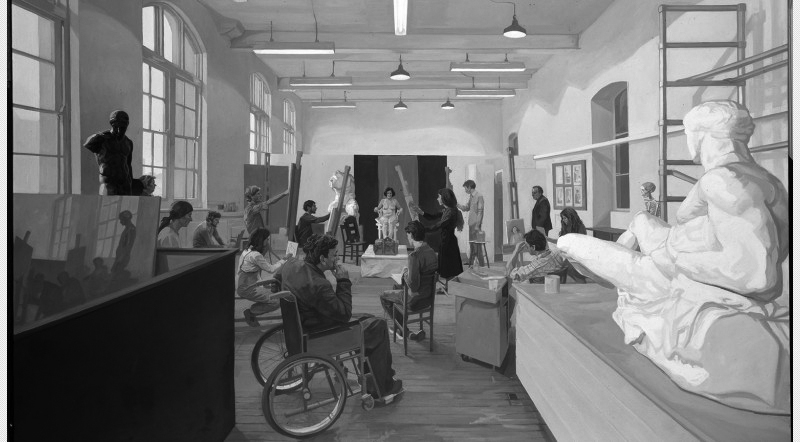
The Life Room, 1977-1980, by John Wonnacott with a ‘pensive’ John Lessore in the foreground
First, John Lessore discusses his attachment to drawing and his approaches to teaching it
As a student, I wanted to be taught, and the lack of serious teaching, even in the mid-fifties, was frustrating. Less is taught now. When talking about drawing, one has to distinguish between the skill of rendering and the art of making a living image, between the optic and the visual: these are fundamental definitions.
Although it is now recognized that the net is wider, one used to look to the Florentines as the great draughtsmen of our western tradition, at their best, both artisans and artists. The overlap fascinates. Artisans know what they are doing and can achieve a good product. Artists are blind: every time they work, they aim to surpass themselves; they take risks and can fail as well as succeed, and are surprised by unforeseen results. As opposed to a skill, an art brings little satisfaction because it is prone to self-doubt, even after realisation. While our forbears made sure they were both artisan and artist, most of us today only wish to be artists; I think this is a mistake and one of the reasons we are so much less than they.
Drawing is necessary to, and part of, all visual art; it’s not just something on paper, but, for the purposes of teaching, this is the most common medium. One tries to create a luminosity that gives back the purity of the original sheet before we assaulted it. Drawing without light is not drawing. Lights must be part of a drawing, as well as darks, and one must create light as well as space. Drawing is, of course, the basis of figuration and, as in literature, a descent into description or reporting will kill it. One navigates between statement and suggestion to create movement and life. At the Slade, few people spoke to me about much of this; all was post-Euston Road, measurement dominated. I found the resulting rigidity lifeless. Monnington alone talked about movement.
The basis of rendering is the picture plane, a so-called imaginary, usually vertical, transparent pane, as of glass, at the same distance from the eye as is the paper, through which one maps the subject. This invisible plane and the paper must both be perpendicular to the eye to avoid too much distortion. One draws on the paper as if one were tracing an image on the plane. This results in “sight size†images; so a figure only a few feet away should fit comfortably on an A4 sheet of paper. For many, it is natural to draw this size, and almost everybody did until larger drawings began to appear in the second half of the 19th century. It was used by the great Italian, Dutch and French painters and is natural to most of us. One might bear in mind that the great draughtsmen of the past always tried to make life easier for themselves and used any short cut available. It seems foolish not to do the same. But those dyslexics whose disability lies in a difficulty of remembering small shapes could be well advised to draw larger to side-step this problem. Drawing smaller than sight-size is incredibly difficult; when it appears to have been done it may indicate short-sightedness and be sight-size after all.
I do not measure. It is a skill, the difficulties of which increase with distance, that requires learning and discipline. By nature most of us are bad at it. The alternative is directional reference; we are better at this, using the same part of the brain and nervous system that we use to pick up, and drink from, an over full cup or glass without spilling a drop. Using a straight edge, real or imaginary, one can line up any two unrelated points on the subject, transfer this relationship to the drawing, repeat this to triangulate, and so on. One should not have difficulty keeping angles. It is not useful for very short intervals because these are easy to judge by eye. I teach this practice: but not measurement. A good sense of proportion helps but is not vital.
The above paragraph relates mainly to accuracy, the basis of rendering; it is not essential to art but its absence tends to be a nuisance. It should become a habit and not require much thought. It is like the notes on a page of music: playing the correct notes will not turn them back into music, but not doing so will make life even harder. I don’t think it matters if one’s drawing is “wrong†but I believe one needs to be aware of the fact. Great drawing usually breaks all sorts of established rules; alas, breaking rules does not create great drawing. Much beauty in art is due to human error; I imagine this is because it is not cerebral but the product of instinct, the greater part of all creativity. Vision and expression are instinctive; we all see differently and should all draw differently. It is skill that stylises and vision that differentiates. And art, as Proust wrote, is not a matter of intelligence.
One cannot really learn to draw; this miracle gift is, or isn’t, in us. One can learn to render; the rudiments are quickly acquired and the skill can support the art. But the alchemical magic of drawing is locked in individuals. Teaching can add much to one’s working practice, especially the use of ancillary facts, but I think the nearest it gets to a higher state is that one can teach people to see what they have and haven’t done and so appreciate their personal vision. And this is no small thing. We have great difficulties here but sometimes, say when looking at a work upside down, in a mirror or after a long interval, one sees with a bit of objectivity. But one never really knows; we are incapable of seeing our own poetry. I find it more difficult to teach people if I do not know their work.
Painting was always my home. I have had at least two immense privileges: I grew up in a family of good artists and I came to know a great many more. I didn’t really know what it was like not to live in art and, when as a child, I began to glimpse the way non-art people lived, I didn’t like it. I became a student because I thought I would be taught to draw but this was not attempted; it took me time to understand that drawing isn’t really learnt but its languages might in ways be understood. My ambition was to learn to paint from drawings so as to have a wider range of subject matter than I should from painting direct. It was this practice that made me aware of what I’d left out that I needed to know or put in that I didn’t, and that this was as near as I could get to learning to draw. I was very lucky in that, on leaving the Slade, I won a travelling scholarship and went to Italy. Seeing Italian paintings in situ astounded me. That one could see the hills in the background of a medieval fresco in a church and then step outside and see those same hills centuries later was like stepping from dream to dream. The frescoes did not seem ancient but held a timeless reality of now. Hitherto, I had only ever seen great Italian paintings divorced from their proper surroundings and I saw how much more beautiful and real they were, just as French paintings are in France. I believe it is immoral to transport paintings overseas and one should have only the most compelling reasons for doing so.
After Italy, came France, marriage and long years of domesticity during which I tried to realise my hopes of being a painter. I wanted to paint compositions with sufficient identity to be convincing, i.e. to have “probabilityâ€, and to be able to paint what I cannot see before me. I felt and feel subject matter is a repertory to choose from rather than report as a duty and I took myself into a practice of painting from drawings, memory and imagination, as I had always wanted. I have tried to feed this into my teaching. I have taught since 1965 but for a five-year gap in the 90s.
As a student, the only lectures I attended were Gombrich’s History of Art. I never went to Anatomy, understood my need of it later and taught myself from a Victorian book. The central presence in my subject matter being that of the spectacle of humanity, I find this study appropriate since all mammals share a basic musculature and skeleton, although most non-humans have tails and no fixed collarbones. A study of our surface form and kinetic abilities must be of use to some artists, as it was to me, and should therefore be offered in teaching. I used the Anatomist Philip Evans to introduce anatomy at Norwich, where I shared the teaching with John Wonnacott; it was appropriate to leave perspective to John. Again, this should be offered but is not relevant to every artist. John is more concerned with objective perception, less interested in anatomy. As I tend to reconstruct from memory or make things up, I value this knowledge as an adjunct.*
Love of the human form must be the cause of that peculiar concept, “The Life Roomâ€, a lovely title. In 1977, Ed Middleditch, decided he wanted to start one at Norwich School of Art, where he was Head of Fine Art, and asked John, himself a superb draughtsman, to do this. He, in turn, brought me in; and so we ran this strange enclave of students desperate to draw and paint from life. I certainly could never have imagined it would be so successful as to acquire national importance but it was to become a hub of serious endeavour before being disbanded by a change of regime. All things have their time and this episode worked well.
My passion is the spectacle of humanity; the world passing before my eyes is an endless delight; and, from time to time, I try to snatch a fragment. Art, having lost unity of tradition, has gone off in all directions; and this leaves us free to pick and choose anything we want to pursue and any way to pursue it. We live in the dubious paradise of the individual. However, in spite of this anarchy, certain values are constant and universal, for example characteristics of eyesight, and for me, the chief value outside ourselves is the consensus of acknowledged genius in the great European tradition. It is the beauty one sees in one’s surroundings and the love of great art that fire one to paint; it is dissatisfaction with much contemporary art and, initially, the need to earn one’s keep, that push one to teach. These two aspirations are those to which I have devoted my working life.
* Starting in autumn 1979, at fortnightly intervals over the term, there were five Anatomy lectures called Human Surface Form: The Trunk, The Head and Neck, the Upper Limb, the Lower Limb and the Ageing Process. Together, Philip Evans and I wrote accompanying texts for the students to take home as there was too much information to be remembered. I would take notes during every lecture and, over the years, update the texts so that, in the end, although the brains came from Philip, I had done much of the script. A gifted Norwich student of ours, Michael Croker, agreed to provide diagrammatic illustrations. These notes are appended to this catalogue.
LEARNING TO SEE
John Wonnacott recalls being a student and teacher of drawing
JW: I used to teach drawing, at Reading University and at Norwich School of Art. Always, when I started a class, I would stand up in front of them and I would say, ‘All of you know me as a figurative painter. If you’re anything like I was, you’ve probably come into art school with a head full of ideas, full of visions, and you are going to ask me to give you the techniques to realise these. You’re thinking in terms of techniques like modelling, like making a thing recede. I’m going to tell you I don’t know any of these techniques. I don’t know them, and I don’t believe in them. It’s not your brain looking at the world and you learning to model it; it’s your brain reading your retina which is already flat. Try to realise the flatness. It’s the brain that’s doing the job.’ How does that sound to you, as a philosopher?
ACG: It sounds almost exactly like the lecture I give when talking to students about perceptual knowledge. In perceiving we make assumptions, and our cognitive capacities make specific and detailed contributions in each act of sensory awareness; so that our brains are quite literally shaping and colouring what we experience and yet the detail of the perceived content is objective. What strikes me about your work is the power of observation and the detail in that observation: that is why it feels so true to the obdurate reality of things, because it represents the world in ways that we would not make up.
(Extract from a conversation with Professor A.C. Grayling in December 2010, published in John Wonnacott, A Tale of Two Houses, Agnew’s Gallery, 2011)
My own apprenticeship in drawing began in a large high-ceilinged basement Life Room at the Slade, where in our first year we joined students from throughout the school to work from the model in poses lasting no more than one day. A vivid memory of this room is of the unscheduled appearances of Professor Sir William Coldstream hovering above us on the balcony leading from his ground floor office. I don’t think Bill ever talked to us first years individually but we lived in awe of the perceptive dry wit and caustic analysis delivered through maestro performances in his open school crits that were great occasions in the Slade calendar. My A3 charcoal drawings from this period show his pervasive influence. The earlier A3 pencil drawings, the Standing Male Nude and the study from Rubens are more influenced by a fine Wyndham Lewis drawing that my contemporaries will remember passing in the Slade entrance on their way to work.
In our second year, the rigour of Patrick George’s two day-a-week course the previous year gave way to the intellectual aestheticism of the painter/writer Andrew Forge. In his Life Room a model held the pose for two weeks, which then seemed ages, and it was just great to draw at last with paint and colour. The White Nude, completed under this tutelage shows, I think, my then hero worship of Oscar Kokoschka, who later visited the Slade. In my final year Andrew announced at a school crit, before awarding me the Steer Medal, that “Wonnacott must learn not to knock in every nail but to leave space for the imagination of the viewer.†I disagreed then and I am ever more certain now that I believe in knocking in not just the large nails but through to every smallest brush stroke. It is in these last moments of drawing that shapes become invested with the resonance of memory.
In our third year, those of us who were still determined to work from the model could choose to paint in one of a series of small life rooms under the supervision of the finest life painters in the country. I queued from crack of dawn to secure my place in Frank Auerbach’s room where he would turn up twice a week armed with catalogues of Soutine, Rembrandt, Matisse, or whoever he was currently absorbed in. Frank made the act of painting the most important of human endeavours and expanded the possibilities of both looking and inventing. The Reclining Nude was one of three paintings I built in this room.
In the corridor outside our life room final year students worked on large paintings built in emulation of the Klines, Motherwells, De Koonings and other 50s American painters who were filling the new art magazines at that time. These acted as a source of visual refreshment as we emerged for breaks from concentrated study of the model.
Somewhere around the end of my fourth year, Helen Lessore, whose Beaux Art Gallery had become my second art school, put on a show of Mike Andrews paintings that included The Family in the Garden. This kick-started my own painting, The Family (1963-74), that occupied me through the 60s, gaining me a gallery contract some twenty years later and freedom from teaching. Just as I had been bowled over by Helen’s show of Frank Auerbach during the time he was teaching us, I knew that I must now learn from Mike how to slow down and rethink the whole painting process. The looking and the inventing were no less instinctive but now a part of me was forever on my shoulder, watching and analysing the relationship between the two processes, occasionally advised by a reticent and nervous Mike Andrews, offering, for example, his thoughts on the purpose of a particular brush stroke. Besides starting the seventeen-foot Family painting in my postgraduate year I finished four paintings in Mike’s life room.
Before the destructive effects of the Summerson Committee and the eventual takeover by Newcastle’s (later Goldsmith’s) media studies model of Art Education, there were hundreds of small art schools, all based loosely around drawing, to feed the National Colleges. Any young painter requiring only a single person’s living income could find enough part-time teaching to survive. In 1965 I was asked by Claude Rogers, a founder of the Euston Road School, to set up a life room for him at Reading University, where he was taking over the professorship. Claude also agreed to ask Ray Atkins, a painter for whom I had developed the greatest admiration whilst we were together at the Slade. From the start Ray and I determined to work alongside the students. I drew for my two days at the beginning of the week while Ray often worked on substantial paintings at his end, with one of his models posing for at least half a term. It was rewarding to be instructing students in measurement and objective analysis in a room dominated by Ray’s energy-packed images. I seem to have mislaid all my large life room drawings from this period but they laid the foundations for my painting of the Norwich Life room and also for my 1974 paintings and drawings of Anne.
A few years after Claude retired, Ed Middleditch asked me to build a similar life room at Norwich and we persuaded John Lessore to join us. While I feel that Claude Rogers was troubled by our life room wars – the departmental tensions that built up around our commitment to drawing – there was a mischief in Middleditch that relished the irritation we caused his other friends on the staff. If most of the student ‘pearls’ brought on by our irritant have struggled to build reputations in this drawing-averse art world then I hope that they will at least look back, as we do, on working in a great atmosphere of mutual criticism – of each other’s works and thoughts across the generations. It seems to me that this is something of how our great university departments used, and ought, to function.
The Life Room at Norwich lasted as long as it did because it was so well lit and beautiful a space, because we were fortunate in the intelligence and friendly cooperation of our models, and because we had the support of that great draughtsman Middleditch and of the historians Lynda Morris and Tim Wilcox. I think it also helped that John Lessore and I approached drawing from such different positions at our respective ends of the week. While we were both committed to drawing the figure from direct observation, John’s teaching concentrated more on the figure and mine on the observation.
John’s own drawing has always exhibited a natural grasp of the richness of flow and rhythm in the human figure that most students found both infectious and directly helpful. The brilliant Friday anatomy lessons that he organized at Norwich with Philip Evans were standing room only. Instruction in any area of visual knowledge as central as anatomy to the history of Western painting will be actively sought out by any seriously ambitious young painter. Like John’s students, I too in my youth attended Slade anatomy classes with enthusiasm. I was also taught, in formal perspective classes, the mathematics needed to construct graphic representations of complex objects – I particularly remember a circular staircase from a set distance, height and directional viewpoint. However, as I have subsequently found this of as little direct help to me in unravelling actual appearances as anatomy has been in my response to the figure or botany and geology to landscape painting, I did not, a little to my regret, ever help organize formal classes in linear perspective for my own students. Nevertheless, I have over the years learned to recognize how our programming with perspective geometry directs and informs all our looking. In the Life Room I would encourage students to decide, before a mark is made, on the direction of their central focus, the extent of the visual field that interested them and the angle to the vertical of the virtual picture plane on which they were measuring. This last is particularly important, though rarely explained, in the Life Room where the model is frequently lying on the floor at a few metres from the artists’ feet.
An attempt at objective measurement is for my own work all important as a way of cleaning appearances of banal association. I am again grateful to the Slade for their first-year drawing course, teaching us to think flat by drawing the shapes between objects and by measuring direction and proportion with a ruler held at arm’s length on a virtual picture plane – techniques I still offered in my own teaching. In retrospect, the only significant difference between my teaching at Norwich and the teaching I had received at the Slade is conceptual.
Slade exercises were understood as a means of visually translating a 3D world into 2D image; an idea that becomes redundant when it is fully accepted that appearances on the retina are already flat, no translation is needed. This change of perceptual model makes little difference to youthful exploring of graphic invention in the life room but seems to me fundamental for the further development of any painter who wants their formal decisions to be made in direct response to their excitement, and to the optical mechanics, involved in looking.
Even for a painter like me, concerned only with appearances not the objects that reflect them, drawing people (hence the life room tradition) is of special importance. Neuroscientists tell us that the appearance of people and particularly their faces requires separate, neuron-rich, areas of the brain to receive and decode them as we read complex emotional and psychological meaning into every nuanced change of shape and pattern. These shapes can only be assessed objectively by the most concentrated determination to override such insidious prompting pressures.
John Lessore and Ed Middleditch approached the activity of drawing more from sensibility than from analysis and Ray Atkins, at Reading, almost danced his way to the easel, the process was so physical. There are many others of our generation and much younger who could energize, and enjoy energizing, a life room from within their own understanding. But few of them would I think want to contribute a module of drawing offering skills of depiction for possible use in some as part of an unrelated course. There would seem little point. For the discipline of drawing to be approached at all, let alone to any degree mastered, it must be practiced all day and every day. Personal breakthroughs in invention and understanding are few and far between and must be nurtured and protected against the dissipation of art school noise.
After John and I left Norwich in 1985 the activity and purpose of the Life Room there seemed to change. Any shared understanding of drawing as an intellectual and aesthetic discipline underpinning the exploration of 20th century painting had become irrelevant to most art school staff and students. I no longer teach because I am too jealous of my time, but I firmly believe that within the sometimes stimulating cacophony of the contemporary art school, there should always be found one well-lit monastic space where those wanting to draw can face the hopeless limitations of their talent without distraction.
Patrick Cullen explains the enduring appeal of paintings requiring only to be looked at
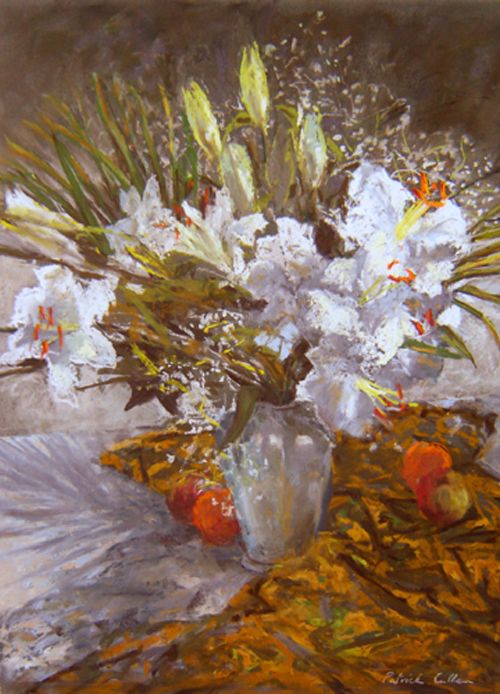
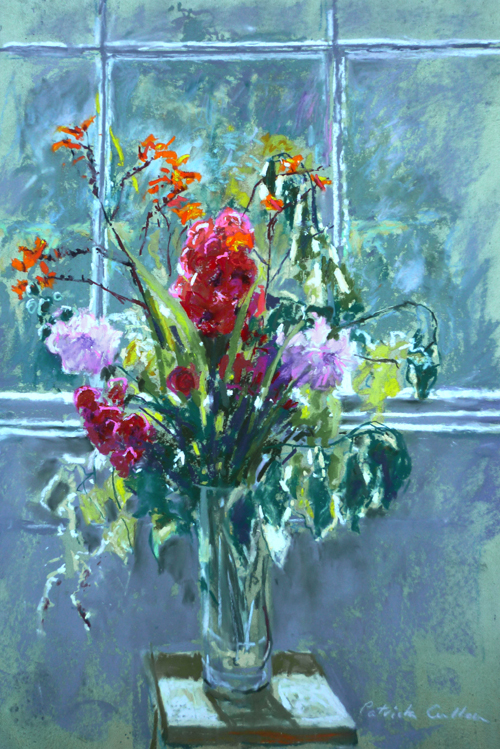
I showed some paintings of flowers I had done recently to a friend. He said he quite liked them but they appeared to create a problem for him. He seemed to feel that flowers were no longer a subject for serious artists, more one for Sunday painters. Yes, he agreed, there had been wonderful art in this genre in the past, but surely art progresses, certain things cease to be part of the zeitgeist. Shouldn’t a contemporary artist address subjects relevant to the times we now live in?
This set me thinking. Two things: when and in what sense were flowers ever relevant? And what kind of pressure do we artists put on ourselves in order to live up to that title: a serious artist? What if I’d been a song writer or a poet and had shared something new I’d written, would the question of whether it was art or not have even crossed my friend’s mind?
There is a problem with the English use of the words “art†and “artist†which has different consequences for those working in the visual arts than for those artists who don’t, e.g. writers, musicians etc. A writer, novelist, playwright, poet etc., would usually define what they did by one of these terms. Musicians, composers, singers, instrumentalists (pianist, etc) similarly. Unless they have the massive ego of The Artist Formerly Known As Prince, they would probably not chose to call themselves an artist (or Prince for that matter). This leaves the judgement as to whether what they produce is art to others, and frees them of any responsibility to always aim that high. But painters, sculptors etc. are automatically enlisted as artists and what they do art, because of the two distinct uses of these terms in our language. Art is both a highly qualified description of work in any creative medium implying a level of importance or seriousness and possibly aesthetic beauty. It is also used as a value free description of everything painters and sculptors etc. make. The same anomaly applies to the word “artistâ€.
This linguistic quirk puts painters and the rest in a subtly different relationship to “Art with a capital A†than their writer or musician counterparts. This had something to do with how my friend related to my flower paintings. If, thereby, a bit more pressure is on painters to live up to the artist epithet at all times, another pressure must surely result if the way “serious art†is defined in our culture undergoes a shift as it has of late in the visual arts. If we judge what our society deems to be important art by the winners of our leading art prize, the Turner, then surely many painters, let alone a painter of flowers, must have wondered from time to time if what they do is still regarded as art at all. After all only two painters have won it in the last twenty seven years and only a handful have even made the short list, this for the prize named after Britain’s supreme painter.
Nobody was able to describe convincingly how these innocuous paintings achieved all this, but the message was clear: whatever Carnegie thought she was up to, her work was chosen because of all the challenging, conceptual talking, interrogating, investigating, unloading and reloading etc., it succeeded in doing. Putting aside the question of how much academic investigation a painting can really undertake on its own, there can be little doubt that without all that intellectual baggage, real or imagined, Carnegie would not have caught the judges’ eye. Implicitly, had she been reckoned to have painted flowers in a more straightforward way, celebrating their beauty and fragility in the manner of a Bonnard or a Manet, rather than at one and the same time challenging and subverting such notions, she wouldn’t have had a cat’s chance in hell of making that shortlist. Which should not really surprise us given the current dominance of all things conceptual; what is interesting is how much in the process is being dismissed as amateurish or as not serious art.
In the past many of the great painters turned at times to the subject of flowers. Each found their particular language but the spirit in which they did so was one of accepting the natural beauty of this subject and celebrating it in a way that brought pleasure. Great originality of approach marked out the best of these but the idea that they should interrogate why artists paint this subject in the first place would not have occurred to them. Van Gogh thought and wrote a lot about painting and waxed passionately about sunflowers, irises, almond blossom, indeed about most of his subjects, but the thought of him ruminating on the psycho-social constructs determining his aesthetic evaluation of flowers or their relevance to the socio-political matrix of his day is ludicrous. He was highly intelligent but not, fortunately for us, that sort of intellectual. He painted flowers because he loved them, intensely, with something approaching a religious fervor. He was so moved by their beauty that he felt compelled to try and distill something of his feelings in paintings. In the process he was doing something much more interesting than “following the conventions of representational paintingâ€. Nor did he confine himself to conventionally beautiful motifs. For clearly painting his feelings in relation to his subject he is sometimes called the first expressionist. Many artists and non artists still feel something like this, perhaps not as intensely as Van Gogh or possessing his genius, but they relate to his instinctive urge to paint in response to the things he saw around him. This is not sentimental twaddle but a profound human urge going back to the cave paintings. Even though expressionism as a term arrived late, all good painting includes a degree of expressionism, in the case of figurative art because it involves the expression of the artist’s response to a subject.
During the age of romanticism Keats feared that science’s explanation of the rainbow would rob it of its power to astonish us. Perhaps he was right and wrong; wrong because the beauty of the rainbow does not depend on our being ignorant of its causes. A child is amazed by the rainbow not because it hasn’t learnt the science behind it yet, but because it’s so stunning. But Keats was right in so far as a lot of knowledge and intellectual thought can come between us and the immediate sensation of seeing something freshly. Because we think we’ve understood it we forget that the miracle of the rainbow does not reside in an idea or a question (how did it get there?) but in its sheer visual impact. Our capacity to be moved by beauty is not really something science has a great deal to say about, yet for centuries it has been the mainstay of humanity’s interest in the visual arts. We tend to scoff at rainbows and flowers (along with sunsets), but these are just the most popular examples of a million natural phenomena, including the human face and figure, which can inspire wonder if our cynicism allows it, and provide subjects for artists. Nor, crucially, need they be beautiful. The best art achieves beauty where least expected. Like a poet an artist must fashion his raw material to create the visual equivalents of eloquence, rhythm and rhyme. Fortunately there’s also no shortage of desire for art that can revive jaded eyes with new ways of looking at the things we see but fail to notice all around us.
The problem with conceptual art is that although at its best it can make us question things by provoking thought in surprising ways, it also tends to divert us from this desire for a direct line to the way another person sees something, as opposed to an idea or concept they may have had. The latter is generally better served by the written word. At its worst conceptualism drags us into a whole lot of academic commentary about the philosophy and language of art. All the praise for Carnegie’s work cited above was invariably of this art about art persuasion. This is what academics do and it has its place, but when artists do it, it doesn’t make for good art. I hope Carnegie is much freer of all this theorizing when she paints than those judges and critics imagined. This is not a plea for art with no intellectual content, but a plea to redress the balance in favour of art that is primarily about looking. Looking intently without immediately interrogating is less easy than it sounds.
Turner himself was rather partial to sunsets. He must have painted hundreds if not thousands; not thank goodness because he wanted to conduct an academic enquiry into some artistic genre but because he wanted the world to see sunsets through his eyes, to see a greater drama, sunsets as heraldic conquerors, blooded tragedians, burning martyrs and pale ghosts. Like Van Gogh, but half a century earlier, he was also an expressionist. His sunsets though closely observed are never dry records of an actual event. His abiding popularity points to a continuing appetite for art that unashamedly celebrates the poetry in nature in a unique and original fashion. That this kind of painting should die is no more likely than the death of poetry itself.
If you paint and are capable on occasions of being amazed by flowers, I defy you not to paint them. They’re bloody hard. How to be original about something painted so often? Yet flowers offer a remarkably diverse motif offering every shape and colour and a whole world of flora “personalitiesâ€. They’ll certainly open up your palette. Of course they’re infuriatingly pretty, but if you can find a way through that they are and will always be a brilliant challenge for artists in any era. Let others decide if in doing so you’ve made art, you’re more likely to if you remember you’re first and foremost a painter.
Painter Desmond Sloane rehearses the career of an important British artist and poet who fought in the trenches and whose work is too often overlooked.
‘Part of me, the artist within me, has never left the trenches.’ So wrote the artist and poet David Jones about his service as a front line soldier in the First World War. Jones was never an official war artist, and yet his wartime experiences dominated his life and work, in a way which was not true of, say, Paul Nash, or any of the other artists who were. In this sense, Jones is the quintessential artist of the Great War, and the centenary of its outbreak seems a good moment to remember him.
David Jones belongs to the rich tradition of British artist/writers – Blake, Rossetti, Lear, Wyndham Lewis – but he is probably the least familiar of these today. Nor was he well known in his own lifetime (1895–1974), as either artist or writer, although he had influential supporters. Kenneth Clark was a fan of his paintings, and John Rothenstein bought them for the Tate. His work was shown intermittently by commercial dealers, and also at the Tate in 1954. The Royal Academy offered him membership, which he turned down (‘a loathsome institution’). W B Yeats admired his epic war poem In Parenthesis, as did T S Eliot, who called it ‘a work of genius’. W H Auden considered a later poem, The Anathemata, to be ‘probably the finest long poem written in English this century’. Official recognition came in the form of a CBE in 1954 and a CH in 1974. But although he achieved a succès d’estime, acclaim by a wider public eluded him, as did financial security – ‘Whatever I do’, he complained, ‘I can scarcely make ends meet and I work till 2 a.m. always.’
However, interest in Jones has been picking up recently. A number of books about him have appeared, including a (not very good) biography in 2003. But as an artist he has not had the recognition he deserves. Attention has focussed on his writing rather than his art – his poems are dense, difficult, full of obscure references, the kind of thing that literary academics love to get their teeth into. Another problem is that much of his best visual work is in watercolour, a factor which has limited its public exposure. His paintings are delicate, evanescent works, difficult to display and, perhaps more importantly, to reproduce. Jones stated the problem himself: ‘the subtly differing colour-changes & barely visible smudges & bits of pencil line & accents of water-colour here & there which hold the whole thing together, if with some fragility, in the original, become just a pallid mess in ordinary reproduction.’
In some ways his strengths as an artist have turned out to be weaknesses as far as his long-term reputation is concerned. Even apart from his literary output, the range of his work is extraordinarily wide – drawings, oil paintings, watercolours, wood engravings, copper engravings, drypoints, carvings, inscriptions. He never stood still, was always developing his work in new directions, and yet it remained distinctive and could never be mistaken for anyone else’s. Like all really interesting artists he went his own way, was a member of no school. All this makes him a fascinating figure, but one who is hard to categorise, and therefore uncongenial to the kind of curators and art historians who like to slot people into neat pigeonholes. Shortly after Jones’s death the critic John Russell said of him that he ‘fits nowhere in today’s canons, but it is a wonderful thing to have him.’
His friend, the poet Kathleen Raine said of him that ‘he had a fragile hold on life and needed love and beauty’. There is a sense of his being a spectator of life, rather than a participant. He never married, never had a job (apart from his army service), never earned his living, never had a studio. For much of the time he depended on other people for money and a roof over his head. When, at the age of 46, he moved into a rented bedsit in Kensington, it was the first time he’d had a home of his own. In 1914 Jones had already spent 5 years at art school (supported by his parents), and was uneasily aware that he would soon have to leave and make his way in the world. This was not something for which he was well suited by temperament, and enlistment in the army provided a welcome alternative. Horrible though his frontline experiences were (he was wounded in the Somme campaign), there were aspects of army life which suited him very well – the anonymity, the camaraderie, the lack of responsibility. He retained a penchant for army slang and military metaphors throughout his life, and the image of the soldier (20th century, Roman, medieval) appears repeatedly, in his writing and his painting.
The end of the war saw Jones back at art school, but he began to feel that this would not give him the apprenticeship he wanted. He said later: ‘I thought and I still think that art schools are pretty hopeless’ (though he spent seven years in one). It was not until 1921 that he began to find a way forward. In that year he converted to Roman Catholicism and met the sculptor Eric Gill, who was then living among a guild of Catholic craftsmen at Ditchling in Sussex. Jones was impressed by Gill, and soon joined his group. The Ditchling community was ideal for Jones. It provided a refuge from the rough and tumble of the outside world, but also linked him to the London art scene via Gill’s connections with galleries and patrons.
Much of his time at Ditchling was given to wood engraving, strongly influenced by Gill’s pseudo-medieval style. Then, in 1924, Gill upped sticks to Capel-y-ffin in the Welsh Borders, and Jones followed. It was here that Jones found himself as an artist. Though he grew up in suburban London, he always felt a special affinity for Wales through his Welsh father, and his Welsh heritage was crucial to his sense of history and the importance of the Celtic dimension in British culture. He had no interest in modern Wales – the Wales of coal mines, steel works and rugby clubs. The Wales he loved was a country of myth and not of fact, and it fed his imagination and his work for the rest of his life.
After the move to Wales Jones began to free his style from the primitivist idiom borrowed from Gill. His early Welsh paintings still have something of the feel of wood engravings about them – they emphasise pattern and the decorative qualities of the design, with strong lines and carefully placed figures. But he soon evolved an idiosyncratic approach of his own, using pale colours applied discontinuously in dabs and strokes, giving an effect of vibrancy and movement. His work began to attract the attention of the art world. He was shown in West End galleries and, in 1928, joined The Seven and Five Society, at that time the most progressive group of artists in Britain – amongst others, the membership included Ben Nicholson, Barbara Hepworth, Henry Moore, Ivon Hitchens and John Piper.
Although Gill’s influence on Jones’s work was short-lived, the sculptor’s ideas, and the ideas he transmitted from others, did have a lasting influence on his thought. Gill’s reputation has been damaged by lurid revelations about his sex life, but he is an important figure who deserves to be properly assessed. What Gill (and the Catholic Church) gave to Jones was a degree of certainty, an intellectual underpinning for his artistic instincts. Gill, like many Catholic artists, was captivated by the ideas expressed by the neo-Thomist philosopher Jacques Maritain in his book Art and Scholasticism, and he passed his enthusiasm on to Jones. Up to this time Jones had been, in his own words ‘completely muddle-headed as to the function of the arts in general.’ He now began to see how the developments in modern art that attracted him could be combined with his religious concerns. He later wrote that the aim of the Post-Impressionists was ‘to make a ‘thing’ – lets say a mountain … under the form of paint, and not an impression of a ‘mountain’ … this idea was … similar or analagous to what, I understood, the church held with regard to “the Massâ€.’ In the Mass the priest re-presents Christ’s sacrifice under the form of bread and wine, just as a Post-Impressionist re-presents a mountain in paint, ‘as a made ‘thing’ a signum of a reality of some sort’. What is represented becomes a sign of something else, and if that something else is a sign of something divine, then the art can claim to have a sacred character or function. Maritain wrote that the impact made by a work of art is in proportion to its power of signification, the ‘more a work of art is laden with significance … the vaster and richer and the higher will be the possibility of joy and beauty.’ Maritain’s influence was not, however, entirely beneficent. His doctrine of signification was one source of the overloading of Jones’s later pictures with history and mythology.
Jones’s mature works, the ones that he regarded as perhaps his best, were painted in the late 1920s and early 1930s (in 1932 he suffered a nervous breakdown which stopped him painting for several years). He said that what he wanted in his paintings was ‘a certain affection for the intimate creatureliness of things – a care for places, men, trees, animals, and yet withal a pervading sense of metamorphosis and mutability’, and this is what he achieved. He painted the world as he saw it, but it was a world in a state of flux. The usual spatial relationships are overturned – distant objects float into the foreground, while near objects are fused into the background. Some parts of a picture are detailed, some left vague. Jones said (echoing Maritain): ‘our business here below is to make the universal shine out from the particular’. This is why individual objects in his paintings – a razor, a toothbrush, a pair of scissors – seem to have a life of their own, animated by some mysterious force.
Jones was surely right in thinking that these paintings were his most successful. Dancing colour is combined with intricate drawing, form is reconciled with content, unity is combined with movement. But this success was achieved at a cost. It is hard not to interpret a picture like Curtained Outlook, painted just before his breakdown in 1932, as a reflection of his troubled psyche – the world he depicts seems about to dissolve, inside and outside mingle, one plane merges into another, walls crack, curtains almost burst into flames. He never liked to repeat himself, was pushing himself in new directions all the time, was fiercely self-critical, and the strain was making itself felt. In 1928 he complained: ‘I’ve done so many utter duds – it’s so exhausting and depressing’. And in 1931: ‘[I’ve] been trying to paint but with no result save intolerable annoyance and rage’. Not only was he trying to paint, he was trying to write at the same time – in 1928 he had begun work on his war book In Parenthesis. He wrote in 1932: ‘I’ve done no painting – it’s awful – struggling with this beastly book and I really now think it’s awful rubbish.’
In Parenthesis was finished in 1932 (though it was not published until 1937), and shortly afterwards Jones suffered the first of the nervous collapses which plagued him for the rest of his life. What caused it? His fight to express his vision in paint and the sense that he was falling short must have played a part. He wrote later: ‘the 1932 group [of paintings] got nearest to what I had in mind – but a very long way from the goal. (I suppose that may partly explain my complete crash – I was conscious for some time before it came that I was straining every nerve to do something more than I had power to do).’ His uneasy social and financial position may also have contributed. He had begun to move in a world of Catholic intellectuals and wealthy art patrons, where he often felt out of place and an ‘imposter’. Yet he no longer felt comfortable in the lower middle-class suburban world of his youth. The asocial context of the army and communities like Ditchling suited him better than this social no man’s land. His confused sexuality probably played a role – his later pictures are littered with sexual symbols, which suggests that there were all sorts of unresolved conflicts lurking beneath the surface. The delayed impact of the war must also have been a factor, perhaps the most important, in triggering his breakdown. A friend wrote: ‘every impressionable person who fought in the front line trenches did suffer some permanent damage which went under the generic name of shell-shock.’ It is significant that the crisis came just after Jones finished the book which recalled his wartime service. The year before, he had painted a view of the sea called, prophetically, Manawydan’s Glass Door. The title is from The Mabinogion, a collection of Welsh heroic tales. It refers to the door the Welsh warriors are warned not to open, lest they see again all the terrible things they have experienced.
After the breakdown he lost his artistic momentum. Painting was difficult for him, as it tended to bring back his nervous trouble, something he found incredibly frustrating. ‘It seems so maddening that all I want to do and care about is paint and that is the one thing that makes me really ill. What a fate … it is absurd.’ He went to live in a hotel room in Sidmouth in Devon – while he stayed, as he put it, ‘in hiding’ at Sidmouth his nerves ‘were not so bad’ but they deteriorated as soon as he ventured ‘into the great world!’ Inevitably, he lost touch with the contemporary art scene. He wrote to a friend in 1936: ‘I have just received a communication from the Worshipful Company of 7 & 5 to the effect that I am not a member – having only registered 2 votes at the last election. What a pity I did not send in my dignified letter of resignation a year ago – but in a way it’s much nicer to be hoofed out.’
Jones eventually returned to London, in 1940. There he started to paint his ‘subject’ pictures. These are no longer paintings from life of straightforward objects (however unstraightforward the treatment). They are complex, carefully constructed pictures, highly detailed, with multifarious undertones and overtones. Jones had a wide, though unsystematic, range of knowledge – classical, Welsh, archaeological, theological – and he poured it into these pictures. The painting process became much more laborious than in the past, when paintings were often completed in a day or two. They could now take years, endlessly revised and worked over. Jones himself regretted this, but couldn’t seem to do anything about it: ‘What I want to do is one full of the complications and allusions but executed with the freedom and directness that used to be in my still-life and landscapes – that’s what I want to do before I die.’ He was trying to work out a form which would embody his vision – his sense of the past, of the process of redemption, of our mixed Celtic/Classical inheritance – but this became ever more difficult as his perception of things became deeper. In 1961 he lamented: ‘it’s an intolerable labour to turn out anything… I don’t believe it’s just laziness, I think it’s more the consciousness of the complexity of the problems – when one is younger one seems to see with a curiously simple yet clear vision, the things one wants to do – I’ve lost that.’
What he saw as the erosion of signs was a particular problem for him, as a follower of Maritain. He regarded 20th century Britain as a ‘late’ civilisation, which was no longer part of an enclosed common culture. The inheritance of image, idea, and myth from past centuries was no longer there for writers and artists to draw upon. ‘The artist deals wholly in signs. His signs must be valid … for him and … for the culture that has made him.’ Otherwise, it ‘sets up a strain … produces a neurosis.’ Perhaps this was one source of his nervous troubles, and to his sense that his work had lost the ‘nowness’ which had always been important to him. ‘I often feel old and terribly outmoded nowadays’, he said, and was dismayed by the lack of understanding he received.
As the years went by he became increasingly detached from the art world, indeed from the world in general. In 1947 he moved from London to a room in a boarding house in Harrow, in the outlying suburbs. He retreated from the commercial art world, broke with his dealer and refused to sell his paintings. Not surprisingly, he was short of money and complained incessantly about it – he was ‘obsessed with poverty’ noted one friend. He was dependent on supporters who either gave him money or persuaded official bodies to help him. Jones was quite happy to let other people sort out his financial problems in this way – it was one aspect of the avoidance of responsibility which was so characteristic of him. Jones ‘was used to being totally spoilt’, observed one friend, and another remarked that Jones thought it ‘perfectly right and proper that people with more cash than artists should give their patronage by giving money.’
Though he was painting less at this time he was writing more, though in Jones’s mind the two activities were complementary: ‘I try to write by the same process as I paint. The two acts seem to me to present just the same problems as to ‘matter’ and ‘form’.’ He said that he regarded writing In Parenthesis as a challenge to see if he could make ‘form’ and ‘content’ work ‘in writing as compared with the same problems in the visual arts’. Indeed, In Parenthesis is a book of scenes, conceived pictorially (it was originally intended as a set of illustrations with long captions). The text of In Parenthesis mixes the language of the trenches with images from Celtic legend, from Welsh sources, from Malory, Milton, the Song of Roland, and the Catholic liturgy. In other words it is a mingling of cultural sources and of past and present, just as Jones’s paintings are.
The culmination of his work as a combined writer/painter came in the inscriptions he began to make from the 1940s onwards, and which he developed into a significant independent art form. They offered a solution to the conflict between complexity and clarity which presented such difficulties in his pictures and his poetry. The inscriptions of their nature provided a simplification, as words are both abstract form and conveyors of meaning. His attitude to lettering was different from Gill’s, who liked the beauty of letter forms as such. For Jones they were also the means of conveying his manifold layers of meaning in visual terms. The letter forms he employed complemented the texts he used and carried in themselves the implications he needed. Just as passages in his writings refer to works in Latin, Welsh, Old English and Middle English, so the lettering in his inscriptions has Greek, Roman, Early Christian and Anglo-Saxon characters. They offer a clue to the artist’s thought, but the essence of the work is in the shape of the letters and their juxtaposition. The old problem of reconciling form and content is triumphantly solved.
But despite the late flowering of his art his mental health remained fragile. By the 1960s he was dependent on a regimen of sleeping pills and tranquillisers. The side-effects of lethargy and loss of focus contributed to his feeling of ageing. He said in 1965: ‘I feel about twice as old as I did a couple of years ago’. He referred to his room as his ‘dugout’ and rarely left it. ‘I never go much beyond the hallway out there’ he told a journalist. He saw only those who came to see him, though these were many. In 1963 he had a visit from the composer Igor Stravinsky, who commented afterwards that it had been ‘like visiting a holy man in his cell.’ Others had also been struck by the quasi-priestly character of Jones’s life in his later years. He was regarded by many friends as an ‘honorary celibate priest’. At the time of his Tate show in 1954 Helen Sutherland, the most important collector of his work, told him: ‘They [the pictures] did seem like an offering, a sacrifice – a broken spirit and a contrite heart … but broken like the bread is broken, to make a new wholeness – a holy communion after their kind.’
Painter John Nutt reappraises the forgotten and routinely maligned William Orpen.
Largely for historical and religious reasons, the Irish have been persistently marginalised in British society. Orpen was the youngest of five children of a prosperous Irish Protestant solicitor. He was born in 1878 in Oriel House, Grove Avenue, Stilorgan near Dublin, where he enjoyed a comfortable middle class Irish childhood. He became a stateless dissident in spite of his wealth and knighthood and he is arguably the most significant artist that Britain produced at the start of the 20th century. Recently there has been some revival of interest in his work. Re-visiting WW1 in 2014 it seems appropriate to look hard at Sir William Newenham Montague Orpen, KBE, RA, RHA.
Orpen came back to public attention when a painting of Yvonne Aubicq, entitled The Refugee, was discovered by Rupert Maas on BBC Antiques Roadshow. This portrait of Orpen’s war mistress was a copy of the original painting entitled The Spy in the Imperial War Museum. A Roadshow spin-off recording the copy’s discovery is available on YouTube. The original painting caused the artist considerable difficulty. He tried to get it past the official British army censor, Lt Col Lee, by inventing a story to justify a private painting completed whilst engaged as a war artist. He told a tale about a fictional female spy who was to be executed and who removed her greatcoat to expose her naked body in front of the firing squad, all nonsense. Unfortunately this was 1919, and as Mata Hari and Edith Cavell had just been executed, this poor judgement was distinctly awkward for Orpen. Facing a court martial, it was the intervention of his friend Max Aitken, Lord Beaverbrook (who had just established the War Artists’ Advisory Committee in 1918) that saved his career. It is thought that the recently discovered painting is a copy painted for Lord Beaverbrook.
One hundred years on we have difficulty with all of Orpen’s oeuvre. Its slick, tense and formal representation appears superficial – it was produced at the same time as Duchamp’s readymades. The effortless skill belies the psychological depth of which Orpen was capable. In June 1916 Charles Masterman, Head of the War Propaganda Bureau, set up the war artists’ scheme at Wellington House. The printmaker Muirhead Bone was very anxious to avoid conscription and was sent to the Western Front as the first official war artist. Orpen was the fourth artist to be enlisted in 1917. He was given the honorary rank of major, and provided with an official car, a driver and an annual salary of £500. He could never have been conscripted as he was only five feet two. He set out with an intention to record what he saw and adhered with single-minded industry to the army remit, suspending judgement and recording truthfully what was in front of him.
What distinguished Orpen from other war artists was his overall excellence and his work ethic: Augustus John did practically no work while Nevinson suffered emotional issues. Masterman insisted that the artists should have a free rein and Nevinson didn’t know what was expected of him. Masterman also believed that they should make documents as well as propaganda. His intention was that the avant-garde would storm the moral high ground, but Orpen wasn’t exactly avant garde. This is a measure of a century of cultural decline. Who could be sent today: Carla Black, Jeremy Deller or Martin Creed? There is nothing of the moral outrage, spite or anger of Dix, Beckman or Grosz in his war paintings, only a resigned acceptance which developed into total disillusionment. In contrast, Paul Nash declared that, as a war artist, “Feeble, inarticulate will be my message, but it will have a bitter message and may it burn their lousy soulsâ€.
Orpen also produced many official army staff portraits and after the war he became a successful and wealthy society painter, portraying British post-war aristocracy. Following his early death at the age of 52 in 1931 his reputation faded and was completely demolished by the personal attack of his wife’s nephew Sir John Rothenstein, Director of the Tate, who disliked him intensely. “I have seldom known any man, and never a man of superior talents, with so little intellectual curiosity and so feeble an intellectual grasp, or with so contemptuous an attitude towards the life of the mind as Orpenâ€, he wrote in Modern English Painters. Rothenstein’s father William had offered his services to the war artists’ committee but because of his German connections he was initially turned down.
Orpen was limited, in Rothenstein’s view, by not having had a public school education. His war diary, An Onlooker in France, is difficult to read and rarely describes his real feelings, except for an identification with the ‘poor bloody infantry’. Recording his disillusion at the end of the book the mask slips when he expresses anger with ‘frocks’ (politicians) for the lack of sympathy they displayed for the millions of dead at the Versailles Peace Conference. Rothenstein complained that when he was a boy he often had to ask Orpen to repeat himself. He was difficult to make sense of, he spoke so rapidly. His childlike character meant that he never turned down the opportunity to participate in a children’s game. It is said that on one occasion when leaving the Hibernian Academy in Dublin with a group of worthies he set off at a run at the head of a group of children joining in their game of kicking a can down the street. At the age of twelve when he was sent to the Dublin Metropolitan School of Art, going on to the Slade at seventeen so, encouraged by his mother, he had worked continuously as an artist from childhood. His lack of literacy according to Rothenstein emerged in gauche imagery, in the form of an Irish naivety that wasn’t understood or appreciated. The Harvest, The Western Wedding, The Holy Well and Sowing New Seed are examples of paintings that exhibit weird narratives which are in reality satires upon Irish allegories.
Rothenstein’s assertion that he had “little intellectual curiosity†and that he was a poorly equipped Irishman incapable of engaging intellectually with the momentous tragedy of the Western Front is unfair. Few who witnessed WW1 at first hand had any intelligent grasp of what they experienced, least of all the Army staff officers whose lack of training, imagination and flexibility have since become a paradigm in English culture for intellectual inadequacy. It took the privileged public school scholarship of a Rupert Graves or Siegfried Sassoon to chronicle the tragedy of the war, but Orpen succeeded in recording it dispassionately in images. Poor working class infantry had all left school at 12, so Orpen’s education may have been deficient but it was standard. His nephew also informs us that he was visually handicapped, that he had protanopia, a red deficiency which affects 1% of the male population. Some authorities assert that Orpen tried to compensate for this as his career progressed. Rather than paint what he saw, as other colour-blind artists have done, he exaggerated colours, and this may have been a necessary compensation as displayed in the colourful effects he used in some of his later portraits. His portraits of Dame Madge Kendal, Mrs Thomas Howarth and Mrs Charles Hughes are examples of a lurid and acrid palette. Rothenstein cites four elements as evidence of his failure as an artist (i) an Anglo-Irish family (ii) an exceptionally happy childhood (iii) a lack of formal education and (iv) attendance at art school whilst still a child. He asserts quite wrongly that while Orpen regarded Irish politicians with affection he never expressed admiration for any English public figures apart from Lord Derby. His main friends were Irishmen, gallery owner Hugh Lane and novelist George Moore, and that he was also quite incapable of reading anything serious. Rothenstein also repeats that he resented growing up because it led to disillusion with the world. This makes no allowance for the alienating experience of WW1.
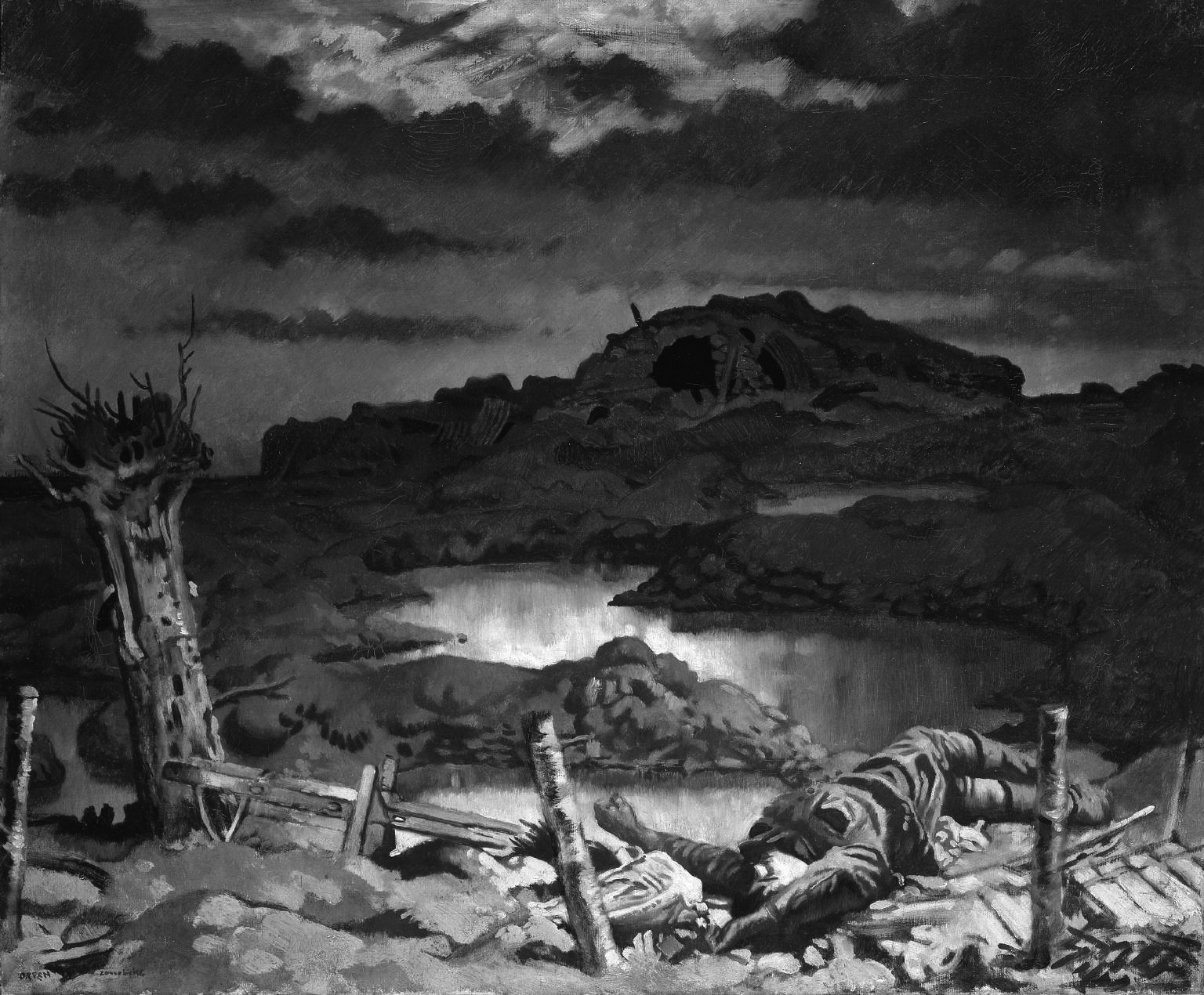
When not painting staff officers’ portraits, Orpen was recording devastated landscapes. Zonnebeke (opposite) is one of the greatest paintings to emerge from the trenches, and it proves that he could create a heart-breaking image when required – but, necessarily, portrayal of the general staff took precedence. Rothenstein maintains that Orpen was in the top ten draughtsmen that Britain has produced but both his imagination and his originality were second class. If Orpen could do anything he could draw as accurately as any renaissance master. Proof of this great ability as a draughtsman is demonstrated in On the Irish Shore (1910), a drawing containing all the elements of his character; the whimsical Irishness, the superb skills and the characterisation. One has only to compare his war portraits with those of his contemporaries, Sir John Lavery or Augustus John, to see that Orpen’s are more astute and concise in realisation. Grudgingly, Rothenstein admits to Orpen’s prodigious industrial-scale output, his meticulous craftsmanship and his capacity for a punishing work schedule.
According to Rothenstein, Orpen was fortunate to attend the Slade at its zenith alongside Wyndham Lewis, Ambrose McEvoy, Augustus John and Edna Waugh (Lady Edna Clarke-Hall). Once there, he regularly drew into the early hours. He was taught by Wilson Steer, Henry Tonks and Fred Brown and it was here that according to Rothenstein he produced his only masterpiece “full of whimsy and eclecticismâ€, The Play Scene from Hamlet. This painting is a contrived student work, a confused old master rehash, yet according to Rothenstein it marks the summit of his career because of its numerous references to other great artists. By contrast, The Mirror (1900) is an honest painting. It is the portrait of a lover Emily Scobel, a Slade student whom Orpen was briefly engaged to but who had refused to marry him (she said he was too ambitious) and whom he abandoned for marriage to Grace Knewstub in 1901. Orpen laboured at the Slade with a draughtsman’s dedication that is inconceivable by today’s standards. George Lambert wrote: “Orpen draws with just the same accuracy a turnip, a horse, or a complicated arrangement of figures… He is a very methodical, business-like Irishman, despising the word ‘art’, and having no use for the word ‘genius’.†Rothenstein argued that his career declined after leaving the Slade. Orpen was content to make straightforward representations of the human figure and the face his main concern, and any intellectual preoccupations he treated as so much pretence.
Rendered incoherent by the war he was ultimately a tragic figure of huge skill and talent who could not express what he could not verbalise. This tragedy according to Rothenstein resulted in tasteless and incoherent images such as The Thinker on the Butte at Warlancourt, derived from Rodin, Adam and Eve at Peronne, Harvest, Bombing Night and To the Unknown Soldier in France. In short, Orpen’s tragedy was cognitive dissonance, a disconnect between the expression of the life of feeling and an over-obsession with observed sentimentality, an Irishman who worked as an Englishman with no deep roots. He was manually skilled rather than having a developed mind. He had no settled opinions or convictions and he lacked the means to form judgements with a enquiring and disciplined mind. Rothenstein had nothing but scorn for lesser intelligences and intellectuals and, horror, “he could not read Ruskinâ€! He argues that Orpen was brought up on the Irish question but was incapable of defining it and he always spoke in epigrams. This personal attack degenerates into farce when he says that Orpen, like avant-garde painting of the early 20th century had “rejected intellectual curiosityâ€. He sneers at Picasso for saying that he did not know what he was going to put on the canvas before he started work, and at modernists for preferring primitives, children, the insane and having contempt for the Italian Renaissance (this man was director of the Tate?). This demonstrates a complete ignorance of what is now considered a normal creative process.
A hundred years on WW1 still arouses passion as the recent spat between the Education Secretary and history teachers has demonstrated, and there are few UK families who didn’t experience real grief. Whatever one’s beliefs, WW1 demonstrated a complete failure in the education and training of an entire generation. Ford Madox Ford, the grandson of Ford Madox Brown (who wrote pamphlets for Masterson’s War Propaganda Bureau e.g. When blood is their argument), is a primary source for understanding this cultural fragmentation through his novels The Good Soldier and Parade’s End. Rothenstein priggishly insists that since the whole of British society was involved in the war it was very unfair of Orpen to identify solely with the poor troops. Yet there is evidence that Orpen felt guilty that he occupied a privileged and protected role outside the conflict.
Orpen’s visual honesty is unquestionable. One of his better portraits is that of Field-Marshall Lord Haig, whom we find difficult to view objectively. Whilst repeatedly professing in his memoirs his admiration for Haig, Orpen painted a slight, weak-eyed and limited character, a depiction of Haig which is superior to that of John Singer Sargent’s. Contrarily, he wrote expressing his great admiration for the ‘chief’. Sean Keating, President of the Hibernian Academy said: “This mental clarity and hatred of evasion led, as time went on, to the extraordinary breadth, simplicity and conciseness of his later work; the method sinks entirely into the background, and what the picture says is as forcible and laconic, as emphatic and as authoritative, as the shot of a pistol.â€
It isn’t useful to think of Orpen as an Irish lickspittle, servile to over-privileged staff officers. It seems probable that Orpen wrote his war memoirs in a way that connotes respect for the class system he had to contend with, and it is probable that he was acutely sensitive to the contempt with which the Irish male was viewed by the English establishment. His memoirs hint that his English war service involved playing the role of the quaint Irish jokester. After the war he wrote: “Could anyone forecast the tragedy that has happened to so many of these men since? That great Field-Marshal Lord Haig, the man who knows, works for them still and asks – but who answers? Great God it makes one think, remember, think and wonder, what impossibly thankless people human beings are. It is sad but very, very true.â€
The painting he was commissioned to produce recording the Peace Conference had a difficult conception. His honesty caused public outrage with the changes he made to what became an anti-war gesture, Signing of Peace in the Hall of Mirrors (1919), above. This War Museum commission entailed removing all the ‘frocks’ which he had spent nine months portraying and replacing them with naked flayed infantrymen in the excruciating style of his gauche Irish imagery. He then removed these in response to public protest to leave the Union Jack-draped coffin and entitled it To the Unknown Soldier in France, opposite. The artist sent this picture to the Royal Academy in 1923 where it created an uproar. The idea for the ‘unknown soldier’ wasn’t his, it was that of war chaplain David Railton, who had noticed a grave marked by a rough cross, which bore the pencil inscription ‘An Unknown British Soldier’. The War Museum commission had specified a group of statesmen and they refused to accept the final image. Orpen lost his huge fee of £3,000. It is for this anti-establishment gesture he is remembered. Fulfilling his duty throughout the war but sickened, burnt out and nauseated by the experience, he couldn’t portray the hypocrisy of the Peace Conference, that demanded severe reparation from Germany and arguably laid the foundations for WW2. The genesis of this painting according to Rothenstein showed the defects of his entire career “writ largeâ€. This criticism is ridiculous as it is one of his few paintings which evolved and changed with mature reflection upon his experiences. He said at the time: “You must believe that I painted it in all seriousness and in all humility. I have satirised nobody, nor did I intend to set any problem. All the meaning is in the title of the painting.†The Literary Digest of June 9th, 1923 also reported this: “Who needs to be told nowadays about the keenness of Orpen’s eye, or about the skill and sureness of his hand? We know all about these, but we do not know what is in Orpen’s mind. This wonderful painting should help us to find out what Orpen thinks about the war. It is a cri de coeur.â€
Now, when our greatest source of anxiety is global terrorism, Orpen can be viewed as having rendered a service. What Rothenstein regards as his character flaws may have been his strengths. The integrity and capacity to tell the truth to an age that is saturated with visual fiction and Photoshopped manipulation may be his real legacy. There is beauty in his paintings of mine craters, abandoned trenches littered with corpses and skulls and the glaring white chalk of the Somme battlefields. He is sometimes referred to as the most Spanish of Irish painters because of his affinity with Velazquez and Goya whom he studied in the Prado in 1904. He also made self-conscious attempts to explain himself to himself through self-portraits just as Rembrandt had done, adopting different disguises and roles. These self-portraits have received academic attention from commentators such as Lucy Cotter and are viewed as first attempts to define a modernist identity. Five images sufficient to speak for him are Miss Muriel Gore, Portrait of Mrs Oscar Lewisohn, W.G. Bennett, Lily Carstairs and Zonnebeke.
Rothenstein asserts that his many affairs, his issues with ill health contracted on the Western Front and alcohol and his early death, destroyed his family, particularly his wife Grace, whom he abandoned but never divorced. Rothenstein’s opprobrium was motivated by his parents’ antipathy to Orpen. This persists; even today he is dismissed in the Encyclopaedia Britannica as a somewhat superficial, facile artist who achieved great popularity in his day. It is only recently that Orpen’s paintings have begun to regain their true status. A portrait of Lady Idina Sackville (who was immortalised as the bolter in two novels by Nancy Mitford) was sold by Sotheby’s for a million pounds in 2013.
Orpen’s dual nationality has been analysed by the revisionist Irish historian R F Foster who argued in 2005 that his bohemianism was the result of real tensions born of his inability to come to terms with his Irish-English heritage. Foster counters practically all of Rothenstein’s criticism with research based on Orpen’s own correspondence and his daughter Kit’s insistence that he always saw himself as Irish. Whilst he was from the protestant colonialist strand of Irish history he had a natural revulsion to the unfair treatment of the exploited Catholic majority. The passage in Orpen’s book Stones of old Ireland and Myself, which Rothenstein quotes to prove he wasn’t aware of what the Irish question was, says that there were thousands of Irish questions and he mentions dozens of the pertinent Irish political issues of his youth. He read widely on many levels and although he despised Yeats as pretentious he particularly loved John Millington Synge. This indicates how Irish he actually was. He introduced Hugh Lane to Manet and his Homage to Manet is a painting of someone reading about painting to a group of painters, one of whom is painting. His friendship with the novelist George Moore supported the idealistic notion of modern art as a gospel of liberation for the old Ireland. The allegorical paintings which are artistic failures, such as The Well or Sowing New Seed, are calculated parodies of Irish devotional religious imagery. The bitter Anglo-Irish war and Easter uprising utterly estranged him from Ireland. He was working in France during this period and he could not comment as he was preoccupied with WW1 horrors. He was damaged by the emergence of the new Ireland just as he was damaged by the war. Ireland was going through its own trauma of an emerging republic even at the time Orpen was painting his last portraits. Although nothing is simple with Sir William Orpen’s painting, it does give us a deep insight into the early 20th century British class system, from how the aristocracy saw themselves to the hell of the trenches. A clearer understanding of his art can be obtained from Old Ireland and Himself – William Orpen and the Conflicts of Irish Identity by Roy Foster, than from any of the spite that Rothenstein penned.
I paid a first visit to St. Ives in the late 1950s and will never forget my first glimpse of the town from the hill above the railway station. For someone to whom the word ‘sea’ had hitherto largely meant the pebbly beaches and endless mudflats of the coast of East Kent, the turquoise water, dazzling white sands and rows of granite or whitewashed buildings cascading down steep hills towards the town’s harbour were an utter revelation. Not a single yard of dual carriageway existed at that time between London and Land’s End. The old A30 still ran through every town, village and hamlet on its route as it pursued a narrow, twisting and dangerous 300-mile course.
At least part of the magic of West Cornwall lay at the time in its relative isolation as well as in the extreme cheapness of property there which attracted painters, potters and poets – to say nothing of sculptors and assorted scribes – of national and international as well as purely local substance to its welcoming embrace. Because an artist cousin of mine – John Peace – lived in the town already I enjoyed instant introductions to many of the area’s resident talents.
During the last two months of the 1950s I returned to St. Ives with the aim of living and painting there full-time myself – an arrival which coincided closely with a highly unlikely sojourn there by Francis Bacon – and I was then resident in that general area, on and off, for the next twenty years.
What I propose here is that those two decades – from 1960-1980 – formed the last era which may ever exist in which some degree of communal sense, purpose and integrity will ever prevail again in British art which now, by contrast, generally seems to grow more cynical, corrupt and purposeless by the day. To my mind, at least, one of the factors that underwrote the significance of that era was its relative proximity to the ending of the Second World War which, in spite of all its horrors, at least provided some inkling of a reality with which it was difficult to argue. Some of the older artists such as Peter Lanyon had served in that war with distinction while others had suffered years of captivity e.g. Terry Frost, Adrian Heath and Roger Hilton, the last having been captured during the unsuccessful commando raid on Dieppe. Karl Weschke, by contrast, spent youthful years as a prisoner-of-war of the British. It was therefore not just artistic freedom that all were keen to enjoy after years of restraint but the liberty to live and act more or less normally again. Hedonism was certainly in the air and West Cornwall became, however briefly, a kind of Bohemia-by-Sea.
Ben Nicholson had recently left St. Ives for good at the time of my arrival there but others such as Bryan Wynter, Patrick Heron, Barbara Hepworth, Bernard Leach and the excellent poet W.S. Graham were still very much in evidence, as were Alan Davie and William Scott for at least part of the time. I was merely one of a raft of younger artists which included Trevor Bell, Anthony Benjamin, Brian Wall, Bob Law, Jeff Harris and Roy Conn. Large numbers of purpose-built studios still existed from earlier artistic eras and for a time I was lucky enough to share a vast example, built originally for Stanhope Forbes, at the top of Newlyn Hill.
In the long run I came to disagree increasingly with much of the tenor of the art – and art criticism – that came out of West Cornwall at that time because its doctrinaire emphasis on abstraction seemed to me at once unnecessarily coercive and contrived in the face of the overwhelming majesty of the local landscape and coast.
My maternal great-grandfather, a railway engineer, originally left his home at East Looe in east Cornwall to build a railway in East Kent and I have never ceased, wherever I have lived in the world, to feel a kind of ancestral tug which continues to identify Cornwall for me as a homeland. Rather unusually, for an artist, I represented the county at cricket and am still probably remembered there, if at all, more for my former prowess with a cricket ball than with a paintbrush.
All of the artists I have mentioned already were certainly ambitious but not necessarily in the degrading way which in more recent times has almost become a norm. It was at the Royal College of Art in 1962, I think, that I first heard the ominous expression ‘making it’ used in connection with David Hockney to whom I had just been introduced. To artists such as Peter Lanyon or Roger Hilton such an expression would rightly have been anathema. What precisely was the ‘it’ the artist was supposed to be ‘making’? Money and largely unearned fashionable fame? Or a reputation blown up simply with a giant public relations bicycle pump?
During the last two and a half years of his life Roger Hilton, who was confined to bed with a painful illness, produced a series of small, colourful gouaches of unending wit and good humour. Roger had a very sharp tongue indeed, however, and it would be intriguing and instructive to have known what he might have thought of future events such as the Turner Prize which have consistently divided the world of British art since his death. Both he and the amiable and elegant painter Bryan Wynter died within a fortnight of each other in 1975. After attending Bryan’s funeral, in fact, at the lovely little rural church at Zennor a small group of us travelled on to see Roger. I was seated at the end the latter’s bed still clad in the black overcoat I had worn to Bryan’s funeral when Roger suddenly cried out to me – rather prophetically in the event – “You are the Angel of Death come to carry me awayâ€. Roger had always possessed a strange, almost psychic awareness.
Read, if you possibly can, the two deeply moving and remarkably beautiful poems which W.S. Graham wrote as a tribute to his departed friends: Dear Bryan Wynter and Lines on Roger Hilton’s Watch. Both feature in W.S. Graham Collected Poems 1942-1977 (Faber & Faber 1979) and both capture the departed magic of West Cornwall as an artists’ colony with an eloquence I cannot hope to match. Who remembers figures such as Hilton and W.S. Graham today less than 40 years after their passing? Both were true to their respective callings as painter and poet in ways we are less and less likely to encounter again.
During the latter years of West Cornwall’s artistic heyday the trio of Wynter, Hilton and Graham drank regularly at a large, isolated and often almost deserted pub on the coast road from Zennor to St Just. This was the Gurnard’s Head whose landlord bought the lease, I believe, with the gratuity he received as an officer when leaving the Parachute Regiment. On nights of heavy rain or fog when the pub was almost deserted ‘Jock’ Graham would write and direct, off-the-cuff one-act plays for those privileged to be present. Very occasionally a lost visitor would stumble out of the inclement weather outside into one of these proceedings. “There came a mighty windâ€, Graham shouted on one occasion as he leapt out of a dark corner just as a lost visitor staggered in.
As a landlord Jimmy Goodman’s particular bêtes noires were men who drove Jaguars or who were connected in any way with advertising, the making of television commercials or films. Alone among those living in the area therefore he refused to acknowledge the fact when the film Straw Dogs was being shot just down the road at the village of St. Buryan. One evening, however, the strikingly pretty actress Susan George, who was featuring in the film, apparently burst into Jimmy’s pub saying “I’m Susan George and I’m looking for my co-star Dustin Hoffmanâ€. Jimmy pondered her request slowly before finally replying thus: “I’ve been the landlord here for many years m’dear and can assure you there are no coastguards of that name working in this areaâ€.
Clearly, given the way the modern world has subsequently developed, such times were too wonderful to last.
Edward Lucie-Smith discovers that their tribute to Kenneth Clark is not as complimentary as the Tate thinks it is
The Tate Britain show devoted to Sir Kenneth Clark – ‘Lord Clark of Civilisation’, as he came to be called – was a slightly strange phenomenon. It defined a whole tract of the recent history of the visual arts here in Britain, but in the end fell short of being a genuine celebration. Going round it, examining what was on view, one noted how much things have changed. And at the same time, how much they haven’t.
Clark’s career can be thought of as making a bridge between Roger Fry and the Bloomsberries on the one hand and the achievements (and failings) of Sir Nicholas Serota on the other. Brought up in what seems to have been gilded solitude – the only child of a very rich man whom the Tate catalogue describes as an idler – he was the privileged inhabitant of a variety of different but related social worlds.
His ascent through the pre-war British art world, also through at least one major tribe of the international art world, was extremely rapid. From the circle surrounding Roger Fry he passed, with remarkable ease, into that surrounding Bernard Berenson at I Tatti on the outskirts of Florence. The famously formidable Berenson asked Clark, who was still in his early twenties, to work on a new edition of his celebrated catalogue of drawings by Florentine painters, first published in 1903, the year of Clark’s birth.
The Tate catalogue makes some significant remarks about this, worth quoting here at some length, though with a bit of necessary compression: “The time Clark spent at I Tatti with Berenson was an education in a very different approach to art: that of connoisseurship. Having an ‘eye’ meant the ability to discern on the basis of simply looking at a work, who might have made it and when… Attribution was a gentleman’s sport, and for Clark it seemed at the time ‘the only game worth playing’. Not, he was careful to add, for the money, but for the glory of having an eye and being right.â€
Read in the context of what was actually on view at the Tate, this paragraph made a very peculiar effect. True, Clark at this period wrote an authoritative catalogue of the Leonardo drawings in the Royal Collection at Windsor. As the Tate catalogue rather smugly remarks: “[It] remains unsurpassed (if in a quite specialised genre). And many of his identifications, both attributions and de-attributions, as well as datings of the drawings, have stood the test of time.†Two genuine Leonardo drawings, plus a non-Leonardo with the same provenance, were included to prove the point.
It was the other Old Master items that formed part of the Tate’s exhibition that supplied a bucket – several buckets – of cold water. What one got was a parade of duds. The show included, for example, the four little panels by the very minor Andrea Previtali that Clark bought for the National Gallery during his period as Director, in the belief that they were by Giorgione. Worse were some items that the great panjandrum had actually owned himself. For example, a much scraped and over-restored School of Pontormo Madonna and Child that Clark thought was an original Rosso, and a dreary John Wootton landscape that he believed to be by Claude. Also a battered fresco fragment representing a putto that he hoped was the work of Giorgione. Even undoubtedly genuine works were sometimes the dullest possible examples of a particular master.
Clark, for example, owned two paintings by Seurat. The one shown at the Tate, The Forest of Pontaubert, was painted in 1881, when Seurat was just 21 years old. It’s an uncertain, obviously juvenile work. I don’t think Clark himself thought much of it by the time he reached old age. I met him once, in his last years, to do an interview about Graham Sutherland, one of the British artists who benefited from his support and patronage. He was then living in a spacious but curiously characterless bungalow built at the gates of Saltwood Castle, which had been handed over to his son Alan. The Seurat was not on a wall, but was propped up on the floor of a cloakroom where I went to pee. It was fairly obvious that nobody loved it or bothered to look at it.
As a practical demonstration of Clark’s pre-eminence as a connoisseur, a supreme aesthete, the exhibition was a bust.
On the whole, the show served instead as a refutation of a once-powerful but now largely discredited myth, sedulously propagated by Berenson and his circle, and also by a platoon of other professional ‘art experts’ covering about three generations, that there existed, occupying deservedly privileged positions in civilised western societies, oracular figures who could produce the right attribution for almost any Old Master painting, drawing or sculpture, simply by gazing at it steadfastly for a few moments. Almost nobody believes that today.
Kenneth Clark’s importance to the art world was quite other, and had nothing to do with his failings as a connoisseur. His gifts were as an administrator and, above all, as a communicator. As director of the National Gallery during the war years he saw to the safety of the collection and yet kept the gallery alive as a cultural focal point in a London battered by bombing. He brought a group of leading British artists together – prominent among them Henry Moore, John Piper and Graham Sutherland – who seemed to express some kind of national essence. During the war they made works that successfully heroised and commemorated the national ordeal, drawing on pre-Modernist roots in the English Romantic tradition. This development did a great deal to reconcile a previously sceptical middle-class public to the ideas and theories of the 20th century Modern Movement.
Above all, he wrote books that communicated ideas and theories about art in clear, non-specialist terms– The Nude and Landscape into Art are cases in point. And he engaged with the new mass medium of television. The Nude, with its crucial distinction between ‘the naked’ and ‘the nude’, remains influential today, though it was published as long ago as 1956. Some scholar needs perhaps to go through it now, and calibrate what it says with the rise of Pop Art, where representations of the nude play no inconsiderable a part. Are Pop nudes ‘ideal forms’? In a way, yes, they are. Come to think of it the sugar sweet Renoir nude that Clark once owned takes on a different inflection if one examines it in the light cast by the Pop movement.
Most of all, Clark embraced the new medium of television. The marriage was at first sight a curious one. While being obviously at ease in front of the camera, he lost no trace of his grandee manner. In fact, it qualified him to tell us what he was confident we didn’t know.
It is possible to see Civilisation as a very successful attempt made by the then existing establishment to retain control of the cultural narrative. A similar sort of attempt, though with somewhat less success, is currently being made by the collective of Tate galleries. One is the very space where the exhibition devoted to Clark took place.
Something that has changed quite radically since the reign of Clark is the way in which ideas about art – indeed ideas about everything – are communicated. Television centralised communication, but its period of total domination was remarkably short. The Internet has instigated a rapid devolution, a change from the hierarchical to the democratically lateral. Our taste in presenters has changed too. In October 2013 Grayson Perry gave the first of the most recent series of Reith Lectures, one of the BBC’s most sacred occasions. It was recorded, sure enough, in the equally sacred halls of Tate Modern. Perry was as much at ease as his predecessor Sir Kenneth, while performing a very similar task, and addressing, one is permitted to think, a similar audience. The visual aspect of the event did at first seem quite different. What you got when you looked at the screen was not a grandee in a Saville Row suit, but the Widow Twanky in her best frock. Shut your eyes, however, and the slightly posh accent was exactly the same. Clark’s legacy lives on, despite the evolution of technology.
Edward Lucie-Smith admires an ambitious exhibition but with the reservation that something is missing
The big new exhibition of Matisse’s Cut-Outs at Tate Modern in London is, certainly on the face of it, everything that a major museum of Modern and Contemporary Art should be doing. It is beautifully presented, very professionally curated, has an extremely thorough, excellently illustrated catalogue and has been greeted with ecstatic reviews. It is thronged with visitors, but fortunately not to the point of suffocation (as was the case, alas, with the National Gallery’s recent Leonardo da Vinci exhibition). The rooms in which it is shown are big enough to allow the visitor enough space to view the exhibits from a variety of distances, and the works themselves are often on a suitably grand scale.
I departed from it thinking that here was exactly the kind of show that an institution of this kind ought to present. Tate Modern is, currently, the most visited gallery of modern art in the world, outstripping both the Museum of Modern Art in New York and the Pompidou in Paris, although, to be frank, its own permanent collection is not on a par with the stellar holdings of either of these rivals. It was only after I left that doubts began to make themselves felt, and I’m not sure that these doubts are the fault of Tate Modern or of the organizers of the occasion. Perhaps they are inherent in our present cultural situation, where the creative force of the Modern Movement seems to be inexorably dwindling away.
What changed was the technique. The compositions were no longer painted, they were made with pieces of cut paper. Matisse did the cutting, and the papers he used were painted in gouache to his exact specifications. Once cut, they were pinned in place according to his directions.
Matisse had already experimented with designs made from cut and pasted paper in the 1930s – the projects he tackled included decors for the ballet and maquettes for book covers. When he did these collage was already long established as one of the typically ‘modernist’ methods of image making. Picasso and other Cubists had made radically experimental use of it. Collage techniques had also been extensively employed by amateur artists throughout the 19th century. Interestingly the word ‘collage’ seems to be absent from the catalogue. Matisse was not completely an innovator in this phase of his work.
The real starting point for the Cut-Outs was the serious illness that Matisse suffered from in 1941. He was operated on for duodenal cancer and nearly died from resultant complications. As a result he was unable to stand up for long periods, and had to make art while seated in a wheel chair, from another specially adapted chair, or reclining in his bed. Using scissors and cut paper he could, with the help of assistants, continue to create work on an ambitious scale.
Because of Matisse’s long-established celebrity the process of making these works and the various stages they went through were extensively documented photographically. The catalogue published in connection with the current Tate Modern exhibition has a very rich series of illustrations of this kind, made by various photographers, some working under the artist’s direction, and some not.
If one reads the Tate catalogue attentively, it is possible to detect a certain note of nostalgic regret that appears when these records of the images in situ in Matisse’s several studios are discussed. What the authors of the various essays seem to long for is permission to hail Matisse as the pioneer, perhaps even the God the Father, of the current Post Modernist tendency to promote installation as the pinnacle or ne plus ultra of late Modernist and Post-Modernist creativity. The problem is that they can’t quite bring themselves to say this in so many words. As it happens, their silence is justified by what one actually sees at the Tate.
Wonderfully decorative as many of them are, it is clear that a certain loss of freshness took place when the Cut-Outs were removed from Matisse’s studio and made ready for public exhibition. All too often, one feels as if one is looking at an exquisitely beautiful, immaculately preserved corpse. There is another problem as well. The aged Matisse, armed with a pair of scissors, confidently slicing through the sheets of coloured paper prepared for him, was wonderfully skilful at simplifying natural forms – nude female bodies, birds, fish, leaves, even algae floating in water. Yet the compositions only occasionally add up to something more than decoration. Some extra dimension of emotion is missing.
Towards the end of the presentation there is something not technically a Cut-Out – a stained glass window called Christmas Eve, commissioned by Time Inc. in New York. The composition is curiously perfunctory – banal symbolism for a safely ecumenical Christmas card.
Despite the fame of the Matisse-designed chapel at Vence – maquettes for its windows are also included in the show – religious emotion was clearly not part of Matisse’s temperament. With this exhibition ‘What you see is what you get’. Exactly what you get – don’t ask for more. I left thinking it was 99% wonderful, and regretting the missing one per cent perhaps more than I should have done.
Inspired by the lacklustre, boring effort of the Tate in their exhibition Painting Now, Edward Lucie-Smith nominates his own five painters
Contemporary painting, according to many critics and curators, is a dying art form. In the big Biennales it gets pushed aside by more ‘relevant’ forms of expression – installation, video, achingly fashionable performance art. We are encouraged to go to the major official galleries not to look but to think. In other words, to have conversations about economics with the likes of Tino Seghal and his acolytes (winner of the Golden Lion at the most recent Venice Biennale, then narrowly pipped for this year’s Turner Prize). In Seghal’s case, you could even get cash for participating – £2 for engaging in conversation, and thus being part of the show. There’s no way you can get paid just for looking at a painting. As an activity, this still ranks as self-indulgence, rather than as self-improvement.
It’s therefore been interesting, in more ways than one, to look at one of Tate Britain’s current exhibitions, demurely entitled Painting Now. Interesting to see the works themselves. Interesting to note the reactions of various reviewers. More interesting still to fantasize about what might have been. For the fact is that the art of painting has probably never been more alive in Britain than it is today. London’s studios are thronged with interesting young artists, and probably the majority of these are practitioners of this supposedly effete way of making art. If any one doubts this, they should look at the first volume of the iBook called 100 London Artists, which I recently put together in collaboration with Zavier Ellis, one of London’s savviest younger dealers. There are lots more who don’t live and work in the metropolis. You’ll find worthy contenders, already with established careers and reputations, almost wherever you look in contemporary Britain – in Glasgow, for example, in Liverpool, in Manchester and in Wales. They belong to an art world that is growing more and more isolated from that of our official institutions, but they are certainly not starving miserably in garrets. They hold exhibitions, they attract supportive collectors and they exist successfully within the framework of a capitalist society, where goods are produced in exchange for money. Which of course has been the basic pattern of the art market, at least since the later years of the 16th century. It’s the sort of world, economically, that Rembrandt and Vermeer were familiar with, not to mention our own Turner and Constable.
The problem is not any lack of talented artists who are practitioners of painting, but the way in which the social context has become skewed. There are, I think, two reasons for this, rather than just one. The first is the slightly unholy alliance between the world of ‘official art’, as represented by museums and increasingly numerous and ambitious biennials, and art that is supposedly innovatory. The avant-garde has triumphed, and the price of its success is that it has lost its mojo. It has become the pacificatory element in a ‘bread and circuses’ culture. Its job is to entertain – to keep our minds off the more depressing aspects of contemporary society, even when apparently criticizing it. It has to embrace a slightly fictional credo of democratization, despite something we all know, but don’t always like to say, which is that museums of contemporary art remain the playgrounds of the middle-class. Painting Now at Tate Britain is a case in point. The price of a standard ticket is £10. This reduces to £5 if you are in possession of a National Art Pass, which will cost you £53 a year for a singleton membership, reducing to £25 if you are under 25. The current National Minimum Wage for adults is £6.31 per hour. For 18-20 year olds it reduces to £5.03, and for 16-17 years olds it is £3.72, The job-seekers allowance is £56.80 per week. You can visit both the Tates for free, but not their supposedly cutting-edge exhibitions. If you are in a crap job, or out of work, these events are pretty certainly too much of a luxury.
The other factor is the ever-increasing emphasis on personal charisma, which, I think, at least partially explains the current fashion for Performance Art. A successful artist – the kind of successful artist who increasingly finds a showcase at major institutions – does not necessarily have to produce, only to be, like a certain type of medieval saint. With the decline of traditional faiths, contemporary art has become a kind of alternative religion. Yet this doesn’t alter the fact that, while an artist of this new charismatic type may convincingly display the stigmata, those eager to take a closer look at him or her usually need to have a bit of cash to jingle in their pockets. Medieval societies were more down to earth. If you enjoyed performances replete with subversive messages, you got to watch Dance of Death masquerades in your local churchyard. With any luck, you could also encounter an out-to-lunch high-as-a-kite visionary holy man right there in the street.
Given the situation I have outlined here, it is not surprising that critical responses to Painting Now have been somewhat confused. In his piece for the Sunday Times, Waldemar Januszczak began on a high note, saying “The curation and concept of this exhibition is fantastic and we wish other institutions would take gambles on shows like this…†Yet the review concludes with a savage parting shot: “This, then is a collection of painters who paint for the wrong reasons: not because they feel the joy or exhilaration of paint, but because using it is a means to an end.â€
Richard Dorment, in the Daily Telegraph, took an almost diametrically opposite route. He begins where Januszczak leaves off: “What strikes me about these five artists is how suspicious they are about the expressive possibilities of painting, how they distance themselves from their subjects, damp down emotion, and refuse to use colour, texture or dynamic brushwork to seduce the viewer with an easy visual fix.†But then he changes tack: “I’d call them cerebral, but that’s not quite right. Nearer to the mark is the word integrity. This is painting you can respect.â€
What does this all add up to? Basically, if you take the two reviews together, a sub-text emerges. What the two panjandrums are telling us is this: “Excuse me, folks, I really don’t want to say it outright in the columns of my big-circulation newspaper, but this is a thoroughly boring show. Not exactly bad, but very limited and – er, boring. Now will somebody please bring me a stiff drink.â€
Reader, I went to see Painting Now, and believe me, this reaction was spot on.
Lucy McKenzie, also singled out by Januszczak, is the most engaging artist in the exhibition – apart that is from a galumphing and rather tacky installation in the middle of her space. The booklet informs one that this “painted architectural structure [is] a model of the marble cladding of the central living room of the Villa Müller in Prague, designed by the Austrian architect Adolf Loos (1870-1933).†To which the only relevant reaction is ‘So what?’ The rest of her offerings are smaller but much more skilful examples of the ancient art – or craft – of trompe l’oeil.
The interesting thing here is that stories about, and indeed debates about, trompe l’oeil effects form part of the very earliest literature about painting. The Historia Naturalis of Pliny the Elder, who died in the eruption that destroyed Pompeii, contains a famous story about a contest, long before Pliny’s own time, between the two Ancient Greek artists Zeuxis and Parrhasius, as to which was the more gifted artist. Zeuxis painted a still life of grapes so realistically that the birds flew down to peck them. Parrhasius then produced a work that was apparently concealed by a curtain. When Zeuxis asked him to pull the curtain aside, it turned out that this was in fact a painted illusion. Zeuxis conceded defeat, admitting that “I have deceived the birds, but Parrhasius has deceived Zeuxis.â€
There is a modern footnote to this story. Discussing it in a seminar held not so recently – in 1964 – the innovative French psychoanalyst Jacques Lacan suggested that it represents the fundamental difference between human and animal cognition – animals are attracted by superficial appearances, while human beings are enticed by what is apparently hidden.
It does, however, occur to me to apply Lacan’s analogy in a different way. Januszczak, in his review, offered a fairly deadly quote from the catalogue of the show. Here it is again: “As painting is no longer in a position of autonomy — alone and apart — this also entails a move away from an idea of medium specificity, defining a practice as ‘painting’ or ‘film’, and towards a post-medium age, what a recent conference at Harvard examined as the ‘medium under the condition of its de-specification’ â€
One glance tells you that this is a prime example of contemporary curator-speak. It is designed to hide meaning rather than to clarify an aesthetic and philosophical situation. Does it, however, arouse curiosity, like Parrhasius’s fictive curtain? I fear not.
It does, however, offer clues why Painting Now has such a blank, repressive effect. It is in fact an elitist show that attempts to convince the audience that it is, on the contrary, populist, because that is the remit that our great official galleries now have to follow. To translate: this is the condition that central government imposes when it gives them the money. Curators (of a certain sort) feel that painting is past it, no longer viable, hardly worthy of their notice. To survive, they think, it has to ape, however clumsily, the supposed higher values of more contemporary forms of ‘art’ – the inverted commas because this art, like the activity of Tino Seghal, whose contribution to the recent Turner prize show I cited earlier, may not be visual in any recognisable sense, while painting remains stubbornly addressed to the eye. What I carried away from Painting Now was a sense that the organisers – no fewer than three curators for just five artists – were muttering to themselves “I wish we didn’t have to do this kind of stupid show, but the public, dammit, persists in liking this old-fashioned past-it stuff, so let’s make it as close to respectable avant-garde intellectualising as we can get.â€
I’m conscious, at this point, that the retort I am likely to provoke here is “Do you really think, given the present situation in British art, that you could do any better?†Well, yes, I believe I can – although the show I’m now going to propose is most unlikely to find itself on the walls of any gallery here in Britain. If it were to be presented abroad, I think well-informed spectators on the continent of Europe, or in the United States, would immediately recognise it as offering a fairly convincing image of what is happening in British painting today. For the time being, however, an imaginary museum in my head, and perhaps in that of the reader, will have to suffice. The five artists I now suggest all seem currently significant on the British art scene, though they are so for different reasons. They are, of course, not the only possible choices, but they do give an idea about how rich the British art scene currently is, and what some of its key preoccupations are. One thing it is not is timid and repressed, which is what the Tate Britain show benightedly suggests.
My first pick for such an event would be the work of Charming Baker. Baker is a recent phenomenon who seems to have passed the Tate and its acolytes by, while having a very considerable impact elsewhere. His career has been a slow burn. He was born in 1964, and thus belongs to exactly the same generation as the now declining YBAs. After working for a while as a manual labourer, he enrolled at Central St Martin’s, and later held a post there as a lecturer. For many years, however, his main source of income was derived from working as a commercial artist. Things changed for him when he attracted the attention of an American management company whose main business was not art but popular music. Since then he has done a series of high profile, hit-and-run type exhibitions, usually lasting just a few days. The most recent took place last March, at Milk Studios in Los Angeles, and lasted just three days. Milk Studios is a converted aircraft hangar, and describes itself as a creative hub, standing “at the crossroads of the fashion, music, photography and film worldsâ€. Usually he sells out, though Tate Britain, tellingly enough, has yet to acquire a work, even a print, by an artist who has attracted many of the most savvy collectors of contemporary art.
The basic attractions of Charming Baker’s work are easy enough to see. He is extremely fluent and inventive technically, but uses a wide array of skills with wit, combined with lightness of touch. He is, like many contemporary artists, interested in appropriation, but never in the rather crude fashion exemplified by Richard Prince’s versions of billboards advertising Marlborough cigarettes or Glenn Brown’s enlarged copies of SF book covers. What he does is to trawl the vast ocean of the Internet, finding unconsidered trifles, and magically transforming them. For example, a photo of a dead cat – road kill – found on some teenager’s web site – is magically transformed so as to bring the creature to life again.
My second pick would be Iain Andrews (b. 1974). Andrews is an example of the increasing vitality of art outside the all-devouring metropolis. He did not train at a London art school, and now lives and works in Manchester. He too is an appropriationist of a sort. He describes his creative process in this way: “My paintings begin as a dialogue with an image from art history – a painting by an Old Master that may be rearranged or used as a starting point from which to playfully but reverently deviate.â€
In addition to working as a painter, he also works as an art psychotherapist with emotionally damaged children. It is not surprising to find him saying this: “My recent work is concerned with the struggle to capture the relationship between the spirit and the flesh, incongruous subjects that are expressed in my work through the conflict of high religious themes with sensuous painterly marks. I look to the tradition of great religious painting throughout art history, and often reference particular images through my work. This is done in a way that plays between the borders of figuration and abstraction, and hopefully presents the audience with new possibilities of viewing the work. Paintings are often stained or blurred to create the effect of an image viewed through the faded layers of time and history and to further disrupt the literalness of what is depicted.â€
For me his work has resonances that are completely absent from anything I saw in Tate Britain’s Painting Now.
My third choice is the work of Joe Machine (b. 1973). Machine, born Joe Stokes, was nurtured by the Medway Arts scene – a provincial avant-garde entity that originally sprang out of the Punk Rock upsurge of the 1970s. Tracey Emin, unsinkable queen of the YBAs, came from the same background. Machine is a founder member of the Stuckist Group, inveterate opponents of Tate’s self-congratulatory Turner Prize. He, like, Iain Andrews, has strong links with the world of therapy. After a troubled adolescence and early manhood, including a spell in Borstal, he has used his art as a way of recognising and controlling his own demons. He has recently produced two remarkable series of paintings – one about the Book of Genesis “as the account of a failureâ€, the other about the Russian Revolution, also considered as a failure.
Machine belongs to a couple of important traditions in the history of British culture. One is that of radical provincial efforts to challenge the complacency of the centre. The Medway Scene was the successor of the Liverpool Scene of the 1960s. Both were as much about poetry and pop music as about involvement with the visual arts. The other is that Britain has always produced powerful Outsider artists, with little or no formal training. Francis Bacon, now the darling of the great auction rooms, had no training of this sort. Lucian Freud had very little. The artist Joe Machine most reminds me of, however, especially in the Genesis series, is William Blake. And he, like Blake, is also a poet.
My roster of artists – five, to equal the number whose work is now on show at the Tate – is completed by two figurative painters, John Stark (b. 1979) and Emma Bennett (b. 1974). Both are intensely interested in the work of the Old Masters. Stark says, for example: “Zurbaran’s monks in meditation have always struck me. They are mirrors which I literally fall into, and they become Avatar. David Teniers alluring paintings of caves with Saints in penitence fighting off demons and alchemists toiling away in their grottos have always captivated my imagination. I’m intensely drawn to the Flemish painter Joachim Patinir and his depictions of St. Jerome as a scholar in study, a hermit retired to the rocky wilderness of the Syrian desert in search of divine consciousness and sublime union. The landscapes are like models of earth, maps on kilter, a stage for the narrative of existence.â€
The press release for a recent solo exhibition held in Milan declares: “The pursuit of truth through the creation or perception of these works leads us towards an experience of the true meaning of occult: that which is clandestine, recondite, and perhaps inherently unknowable. Here, within foreign lands, Stark becomes the foreigner offering us images that operate between immersion and reinterpretation, fragmentation and the whole, and which ultimately confront the apparent self with the necessity of its dependence upon the vertiginously unfathomable.â€
Bennett makes faithful transcriptions of things borrowed from Dutch 17th century still life and marine painters, presented in fragmented form against a black background, with occasional disruptive interventions borrowed from the 20th century Abstract Expressionists.
Both painters use their borrowings to create fascinating and slightly troubling metaphysical universes. Bennett says: “I describe my paintings as personal explorations of the emotions associated with death and the fact that we die, yet also as contemplations of the value of life and of living things, and – again – as amusing explorations of paint and the act of painting.â€
I admire their work, just as I admire that of the other three painters I have cited, because it resonates in my imagination. This is exactly what the paintings presented in Tate Britain’s Painting Now fail to do. There is also the fact that it very obviously reflects a much broader and more complex cultural situation than anything that exhibition has to offer.
Such is Ai Weiwei’s predictable status as a heroic dissident, that he could select an object blindfold and if he then exhibited it under his name it would automatically be said to be ‘about’ oppression or, as is more frequent these days, the individual’s place in the collective.
The recently refurbished chapel in the grounds of the park (see illustration), which seems to be breeding new roads and pathways through what used to be naturally and pleasurably wild countryside, has been renovated to make an agreeable new exhibition room lit from one end by a grand Palladian window. Inside, filling the main chapel area, are 40 wooden chairs of charming rustic design, each of which has occupied, one imagines, pride of place in some Chinese home of the 18th or 19th century. The seats and armrests are worn smooth with age and use. Though similar each is different. We are here trawling the same territory as Bernd and Hilla Becher, the German photographers who also identified variance in similarity. It is a lovely collection of chairs, make no mistake, although one suspects any two of them would have served the job well enough. This is a typical ploy of the conceptual artist where the objects breed to fill the space available with no addition to the profundity of the work. Outside the chapel is an ugly iron tree (above) made of cast sections from different trees bolted together in what, we are informed, is a traditional Chinese manner – again disparate bits making up a whole. The chairs are prettier and offer more to look at.
Also showing in the Park, dotted throughout the grounds, are even uglier lumps of material by “important international sculpture†Ursula von Rydingsgard who wouldn’t recognise an ‘important’ sculpture, or a beautiful one, if she surprised herself by opening her eyes. Christ only knows how much it cost to ship this substantial tonnage of crap from New York but it wasn’t worth the effort. She was born in Germany under the Nazis, so that’s alright then.
In the large hangar on the other side of the vale beyond the lake are works from the Arts Council collection housed in a shed next door – no transport costs here. Called Uncommon Ground it is a conspectus of fashionable Land Art from the 1960s onwards. If you’ve seen the documentation of Richard Long’s and Hamish Fulton’s assorted walks and rock-shiftings you’ll have the measure of this lot. Plenty of prose, not even a phrase of poetry. Only Mark Boyle’s and David Nash’s work were alive in this mausoleum. Long’s work is an epiphenomenon of its age, a mere curiosity without the form or visual thrill to make it timeless.
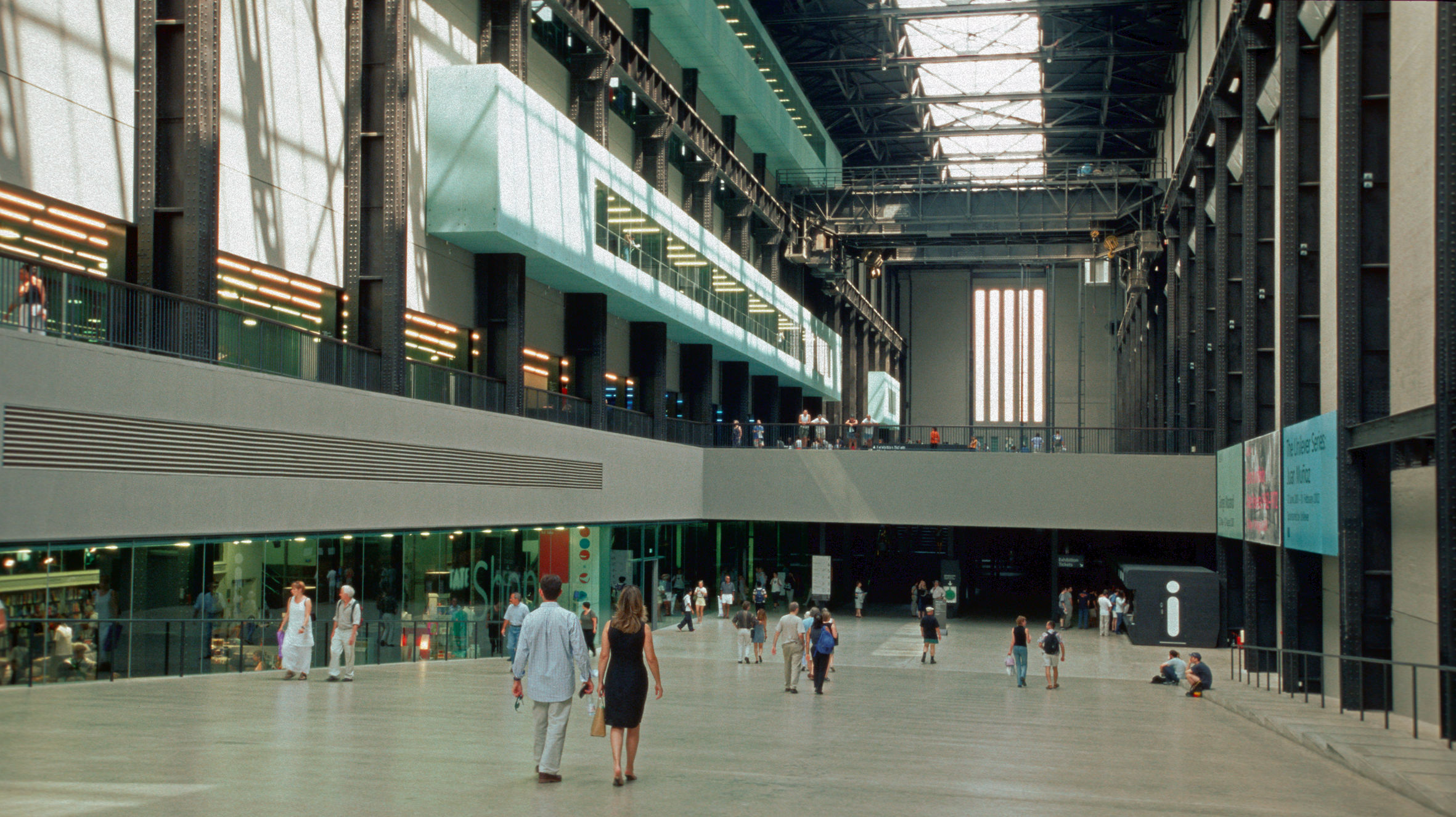
 Are these acquisitions really necessary? If the object is to introduce audiences to art from around the world – and ‘ART FROM AROUND THE WORLD’ is what it is currently advertised on the builders’ hoardings outside Tate Modern – there are cheaper alternatives to acquisitions, known as loans. But as you will have noticed, this spurt of international collecting activity coincides with the tacking of Herzog & de Meuron’s multistorey starship park onto the back of Giles Gilbert Scott’s former power station. The Tate is looking to its international committees and foreign income sources to solve the problem of filling this vast unwanted space on the cheap by shopping in relatively undeveloped markets. But it could shop even more cheaply at home if it was prepared to look at national artists without international reputations.