Category: Editorials

  • The RA summer show in record time

    The RA summer show in record time

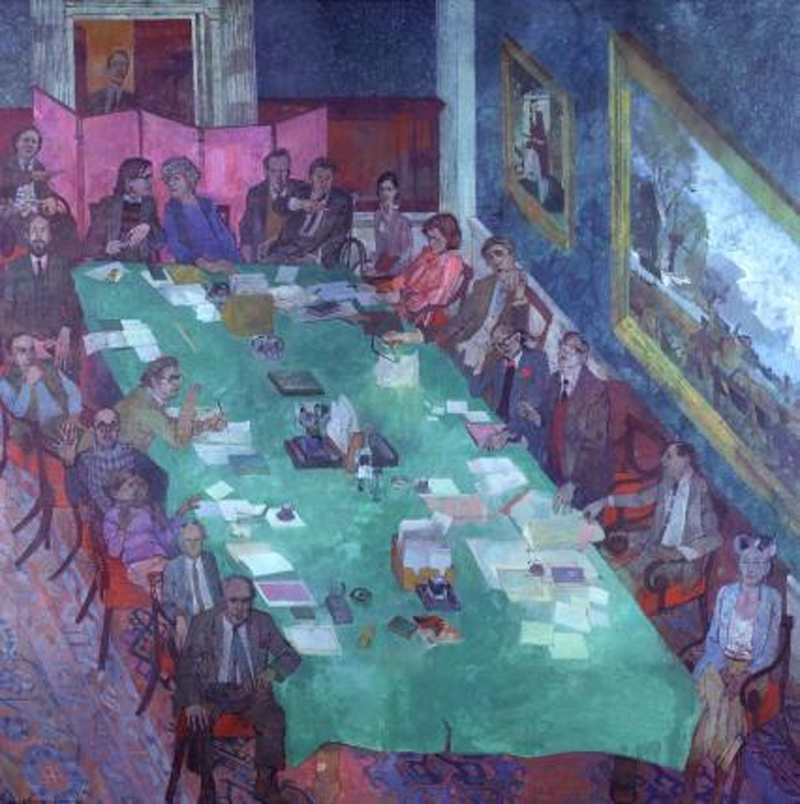
    The Meeting, Royal Academy of Arts by Leonard Rosoman

    Out of respect for one of its recently deceased Academicians, Leonard Rosomon (1913– 2012), the Royal Academy skied one of his best works in the corner of an obscure gallery at this year’s Summer Exhibition (until August 12th). His Committee Meeting, Royal Academy (above), 1979-1984, was on loan from the National Portrait Gallery, where it has probably never been on display. We have in England scores of public galleries and yet is there one with a curator who has the wit to stage a retrospective exhibition of a senior artist like Rosomon? Probably not. For those with an eye on State Art advancement there is no career mileage in such a show, in fact it would probably end any hope of serious preferment. Yet in the last two years alone Tracey Emin, represented in this exhibition by childish scribbles unworthy of even the fridge door, has had three major exhibitions in public galleries. State Art needs a clear-out and re-staffing with individual thinkers.

    Everything in Burlington House this year seemed even more dense and off-putting on the wall than usual, so The Jackdaw’s representative allocated one second on average to each of the 1,474 works before heading off elsewhere in search of art which looked as though it was loved by someone enough to hang it sensitively.

    Highlights spotted at speed were a bold Kiefer and a powerful portrait maquette of footballer Stan Cullis by James Butler, the quality of whose modelling always stands out even when exhibited in sculpture galleries more akin to a jumble sale than an exhibition of serious art. One sculptor phoned the Jackdaw to remonstrate at this shocking treatment and said he would not have allowed his work to be exhibited so contemptuously. Another wrote a despairing unsigned letter saying that the atrocious hanging of the sculpture was no better than most of the trash selected deserved. Everyone else was represented by the stuff they are usually represented by. There will undoubtedly have been other good work hidden away but life’s too short to search it out among such mountains of amateurish material.

    Ah, one interesting development was the removal of the small pictures from the far end into the largest gallery. The irony in this was that the vacated gallery was then used to show one work instead of 250. It was a video of someone scraping out “a modern piece for cello”, of the sort one walks straight past in the Tate. Played this crap by torturers you’d be singing like Placido Domingo inside three seconds, telling them your grandmother was Osama bin Laden’s loyal lieutenant in Eccles.

    Robert Graves
    Epitaph on an Unfortunate Artist

    He found a formula for drawing comic rabbits:
    This formula for drawing comic rabbits paid,
    So in the end he could not change the tragic habits
    This formula for drawing comic rabbits made.

    David Lee

    The Jackdaw June 2012

  • The case for a more – not less – traditional Royal Academy

    First published in The Jackdaw ♯1, September 2000

    …All of this is distant from the reason that the Royal Academy was set up in 1768; namely, in order to provide an Academy, a school, for the training of artists, as well as to give members and hopefuls the fixed target of an annual exhibition to aim towards…

    232 years later, the teaching of painting and sculpture in their more traditional, academic forms has fallen so far into disuse that even the materials that are now used are generally poor because few individuals are left who are capable of recognising good ones and have the energy to complain about matters such as the adulteration of artists’ colours.  The decline in academic art education is visible in virtually every exhibition. Unnecessary, elementary faults of drawing and proportion shout loudly especially when the artist embarks on an ambitious scheme. One may think that such a loss is a perfectly natural sign of times in which art has changed and become thoroughly Serotified. From the weight of coverage received by fashionable, Turner Prize-style art, one could be forgiven for thinking that painters and sculptors are in short supply. The truth is that media coverage of the visual arts misrepresents the true diversity of contemporary art by rarely acknowledging the existence of painting.

    We should remember that a major proportion of art sold in Britain is still of a conventional nature, being works bought with their own money by those requiring pictures for their homes. What Charles Saatchi buys might make the front pages but it is untypical of what the vast majority enjoy living with.

    Many have noticed that the standard of figurative art has deteriorated coincident with the period in which it has ceased to be taught properly in art schools where, depressingly, the blind now lead the blind. The fact that art buyers will always want conventional pictures for their walls must make us consider the need in art education for at least some institutions in which traditional skills are taught properly. They are not being taught properly at the moment. There is surely room for at least one institution that kindles the traditional art crafts, when no one else is doing it.

    The Royal Academy ought to be serving this function. It owns perfect facilities for the task. In a world that recognises diversity in all things, there ought to be no shame attached to helping foster a traditional approach to making art. This is not an argument against the drift towards conceptualism but a plea for one place where traditional teaching takes place and where exhibitions are held featuring the prominent and exemplary contributors to that tradition.

    Alarmingly, the Royal Academy wants to move away from what it perceives as its stuffy image and to come abreast of the times, by which it mean abreast of the ‘cutting edge’. The Academy now appoint Turner Prize winners as RAs in preference to Academic artists of equivalent competence in their field, in order to win cheap praise for being au courant and shedding its moth-eaten image. They invite cutting-edge artists to the Summer Show in order to lend it the imprimatur of the new. The fact that these same artists are exhibiting in every other publicly funded gallery in London and the provinces, to the point at which they monopolise these spaces, seems not to have occurred to the Academicians…

    …New RA President, Phillip King, has also made noises about the need to show “a wider range of artists”, precisely the opposite of what is necessary. The Academy ought to show a narrower range of much higher quality, and certainly not the already over-exposed wheezes of Hirst and Co. The most interesting contribution to the  “modernising” debate was Richard Cork’s in The Times. He wrote: “Potentially the summer show could do a huge amount to make us all aware of what is going on in British art right now.What it ends up doing is giving us a very partial and confusing account.” Presumably he means an impartial show like the Turner Prize or the huge diversity of the exhibition programmes put on by theArts Council when he was that body’s Visual Arts Panel chairman. Cork is the last person the Royal Academy needs lectures from on ‘diversity’.

    Britain needs a specialist art school to rekindle and nurture traditional painting. The natural candidate for this is surely the Royal Academy.

    http://www.royalacademy.org.uk/about/

    David Lee

    The Jackdaw Sept-Oct 2011

  • RA summer exhibition: An institution betrayed

    First published in The Jackdaw ♯71 September 2007: Figurative painter Gary M James on the 2007 RA Summer Exhibition.

    Any outsider who entered figurative work which was not small enough to squeeze into the small south room had wasted their time, money and effort

    I became a Friend of the Royal Academy not long before a painting of mine, Captain Maltravers’ Voyage to the Interior, was hung in the 1980 Summer Exhibition, published in the RA Illustrated and became presenter Russell Harty’s TV pick of the show… In 1990 my River Market was hung in the Summer Exhibition and published in The Illustrated… A worrying development that year was the inclusion of a photograph for the first time… When I raised the issue at a public meeting at the Academy (to general applause) there were wry expressions exchanged on the platform. Michael Kenny said that photography was now regarded as Fine Art. Phillip King (my old sculptor tutor), if I remember correctly, said that he didn’t expect such inclusion to become general, but to his credit Ben Levene said that he was not so sanguine about the development and that it would be Performance Art next…

    In 1991 my Forecast was hung and in The Illustrated again. On Varnishing Day a fellow exhibitor muttered darkly about a cabal of abstractionists taking over at the Academy and warned that things would go to pot. At the time I though little more of it as I’d always regarded abstraction as a useful exercise that all serious artists should explore at some time in their lives. However, used as an end in itself and in eschewing drawing it became the Trojan horse for the anything-and-everything-as-art that took hold in the 1960s.

    Throughout the 1990s we began to see invitations extended to high-profile names, including the yBas to the Summer Exhibition. If their works were often inexplicable to the general public and on occasion quite feeble, their inclusion would at least please the party hacks of the press. And anyway what did “the ladies who lunch”  know about art? In 2003 the open submission was corralled into Galleries VII and VIII … and were wall-to-wall abstraction, with one or two semi-abstracts thrown in. Any outsider who entered figurative work which was not small enough to squeeze into the small south room had wasted their time, money and effort. But at least that room had reverted to its old sell-out figurative self after a few (loss-making?) years devoted to single big names.

    In 2006 we had the infamous headless plinth – definitive proof of losing the plot – and this year we have:

    1. David Hockney saying that British art was going through a fallow period and then taking up a whole wall with an embarrassingly poor 50-panel painting.

    2. A whole gallery given over to a few silly German sculptures,  largely ignored.

    3. A whole gallery given over to invited photography (Next year a photographer RA?)

    4. Tracey Emin made an RA simply for her high profile name.  Has anyone actually noticed her bit of screwed up neon tube in Gallery X yet?

    5. The £25,000 Wollaston Prize given for a small piece of broom handle to another ‘big name’ who scarcely needs or deserves it…

    I am worried and upset by the sight of the Royal Academy being parasitised by fashionable sophistry because it is running scared of repeating another post-Munnings “falling behind the times”. Maybe that gent had it right after all and he could see further than all the vested interests since. The Academy should have stood as a bastion for those trying to swim against the tide of nonsense and a public purposely kept wrong-footed. Not everyone wants to play silly self-serving games. The Academy cannot rely on the art of the past forever for its popular support. In the likes of Tracey Emin I see no Monet for the future. With her and her like now in a position to call the shots, making it up as they go along, the course of the timeless art, founded in communicable skill, will have to find other channels.

    The Jackdaw Sept-Oct 2011

  • RA summer exhibition: State Art is swallowing the RA

    First published in The Jackdaw ♯21, September 2002

    As the cost of non-member submission has increased so the chance of inclusion has diminished owing to the reduction in available room.

    Seemingly unstoppable, the apparently incurable bacterium of State Art continues to spread like a plague into every corner of culture. Like the feared superbug, necrotising fasciitis, which feasts on healthy flesh and for which amputation or extreme excision are the only known expedients for stalling its progress, its touch means certain death to the host. The Royal Academy is State Art’s latest victim. I predict that within ten years the policy and membership of the RA will be indistinguishable from those in State Art-sponsored galleries and organisations with their concentration on skill-less novelty and the slavish worship of new media, neither of which, despite official lies to the contrary, has any audience. Meanwhile, those still engaging with figurative painting and sculpture,  who might reasonably have expected to find succour if not guidance and tuition from the Academy, will be abandoned to eat their cake… The Royal Academy has decided that it must be seen to keep up with the Southwark nouveau. As I’ve stated in these pages before, the tragedy in this is that the Academy, both through education and exhibition, is ideally equipped to nourish those wide areas of contemporary work currently ignored by State Art…

    This year’s Summer Exhibition [2002] was praised by critics for its sparser, tidier hang and the alleged increase in average quality caused by inviting artists who are not members and who wouldn’t dream of submitting to the indignity of an ‘open’ selection which might reject them and which is, anyway, a procedure widely known to be corrupted by nods, winks and backscratches. The Academy should ignore those critics who lampoon the formerly bazaar-like appearance of the annual show, for they perennially miss the point. They criticise it, often justifiably, for the abysmal standard – crummy work which, incidentally, just happens to sell like hot cakes to people who don’t read art criticism – and the weary repetitiveness of the Academicians’ own submissions … This year’s spartan hang meant that many who normally have work accepted lost out. In ten years editing art magazines I have never received so many letters on a single topic as I did on this one.. Good artists wrote that for the first time in decades, and despite submitting their best, they were rejected. As a result, a few whose incomes are already negligible will experience real hardship. Of course, no one has a right to exhibit but the Royal Academy, an institution run by and for artists, surely has a duty to look after artists’ interests.

    Two years ago the Academy stopped producing statistics in respect of the Summer Exhibition, presumable for the sensible reason that they might be used in evidence against them.  Over the last decade there has been a steady erosion in the number of non-member, non-invitee exhibitors. Of this year’s 1,059 works, itself a reduction of around 10% over the last couple of years and just under a fifth over the last decade, 304 were paintings selected from the open, paying submission. The average total entry over the last decade has been between 11,000 and 13,000 works, so what is anyway a small chance of success has been further reduced. As the cost of non-member submission has increased so the chance of inclusion has diminished owing to the reduction in available room. Space has been squeezed by accommodating mini one-man shows…  Another gallery is allocated to honorary RAs from abroad. This usually involves the hanging of signature works by big names who don’t need the exposure: this is a preposterous waste of space.  Then there is the aforementioned new policy of inviting bores from the cutting edge as a genuflection to State Art. Thus are artists’ incomes being sacrificed to the Academy’s desire for fashionability and upbeat critical reception.

    David Lee

    The Jackdaw Sept-Oct 2011

  • RA summer exhibition: Why has that man got no clothes on, Dad?

    First published in The Jackdaw ♯12, October 2001

    Will Harvey demonstrates how the RA Summer Exhibition performs a useful function for those who can’t get their works easily exhibited elsewhere…

    Thousands of paintings are entered for the RA Summer Exhibition. A few squeeze through the jury. Fewer still get past the Hanging Committee and onto a wall. (members – RAs – may hang six works without selection. Non-members can enter three works at £18 each.) Members’ work is hung and any gaps filled from the work that got past the jury.

    One aspect annoyed me this year. Space was given over for non-member celebs, like Hirst and Emin, who don’t have to struggle to get shown in major galleries. They probably didn’t pay entry fees either. If their work had been better I wouldn’t have been so annoyed.

    This year, a painter friend of mine, Peter Kettle, got all three of his paintings past the jury.  One was hung and sold. Llewellyn Alexander took the two that didn’t get hung for their ‘Not the RA’ show. Both sold. Later, someone went to the RA, wrote to Peter and bought another painting. Similar things happened to him last year, and several years before. I saw the weeks of time and work he put into The Glass Bead Game (right). It’s an entirely imaginative work. Pete doesn’t construct something in his studio and then copy it. This one got finished, but he felt something wasn’t right. His wife suggested he put a glass ball on the floor. ‘Make it look as if it had fallen out of the stone,’ she said. It works a treat and neatly illustrates how he works.  Many painters are like Pete. He’s had three one-man shows in London and two outside, with numerous group shows here and abroad. He’s won competition prizes and completed almost a hundred commissions. He’s supported his family partly through painting for thirty years. But I bet you’ve never heard of him.

    How does an artist get noticed? The answer’s depressing: don’t bother with elitist stuff like studying art history or developing painting skills. Instead, get notorious. Working with paint is corny so use maggots, piles of fat, or used colostomy bags. Some big collector might take you on if you pee on felt. You could call it exorcising your abused upbringing. Yeah man…

    The Jackdaw Sept-Oct 2011

  • RA summer exhibition: losing transparency

    First published in The Jackdaw ♯50, July/August 2005

    The RA should come clean about its intentions. It was instituted to help artists not cheat them. Whereas once the Summer Exhibition was a bazaar for the otherwise disfranchised it is now being recreated as a curated exhibition with the usual sly interference from State Art.  One strongly suspects that were the Royal Academy not desperate for cash, the Summer Exhibition would already be an invitation only enterprise. The way for artists to get their own back on this mercenary state of affairs is next year to ignore the call and not send in any works at all.

    The space wasted in the Summer Exhibition is the same this year as last with an entire room given over to Honorary RAs, foreigners such as Baselitz, who is represented as usual by a laughable daub. The likes of Rauschenberg and Tapies don’t need this exposure. And neither does Californian artist Ed Ruscha, who gets a room to himself. Ruscha is an interesting photographer, but a retrospective of his work is currently touring the country – enough’s surely enough. There would also seem to be entire roomfuls of “invited”  artists, always, it seems, the already frequently exhibited ones of the State Art persuasion

    All of this means that those who pay £18 each to have their works considered for entry have a diminishing chance of selection. These willing dupes are shamelessly milked for revenue. Anticipating criticism, the Academy has not this year supplied the usual statistics of entry numbers as against those hung, so that the diminishing chance of inclusion can no longer be easily charted. If artists knew the feeble odds they’d think twice about wasting the maximum £54 as the cost for considering three works for consideration.  Instead of this year’s 9,000 entries (significantly down on previous years, by the way) at £18 each – £162,000 in total – the Academy would be out of pocket.

    The Jackdaw Sept-Oct 2011

  • RA summer exhibition: not all open exhibitions are cheats

    In The Jackdaw ♯8 artist Doug Lowe asked if the Royal Academy Summer Exhibition was a genuine open or an Academicians’ closed shop.

    Has anyone ever worked out the total cost to artists of a big show like the RA Summer Exhibition in time, depreciation of vehicles, fuel, parking, framing, mounting, entrance etc.? It must run into millions…

    Not all open exhibitions are cheats.  Some give seriously good odds that you will get hung if your work is competently executed and shows some creativity. My target is the RA Summer Exhibition which deludes us into thinking we have a good chance of being selected.  Being gamblers at heart (and desperate to boot) we artists naively part with our hard-earned cash, not to mention our precious time which might be better spent working than in exposing ourselves to brutalizing motorway queues and London’s permanent traffic jams.

    We suckers do our sums, calculate the odds and they seem to be reasonable.  So, from all over Britain, we trot along to Burlington Gardens with our treasured efforts. A few weeks later the rejection slip duly arrives, so we trot all the way back again to collect them.  This process reminds me of the Grand Old Duke of York. Has anyone ever worked out the total cost to artists of a big show like the RA Summer Exhibition in time, depreciation of vehicles, fuel, parking, framing, mounting, entrance etc.? It must run into millions.

    What irritates is not so much what the organisers tell us, it is what they don’t tell us. But if we hang around long enough, it slowly penetrates our thick skulls that we are suckers and that we would be better advised to put our paintings into a local art show where we might not gain fame and fortune, but at least we might sell something. Face it fellow artists, the queue in the line for fame and fortune stretches around the globe and the chances of your paintings or mine being selected is much more remote than you think.

    Having had three rejections in a row, I decided to do some calculations. I studied both the 1999 and 2000 catalogues. The statistics for both are similar. Last year about 13,000 paintings were submitted from around 5,000 artists. 1,156 works were displayed. This means that you had an 11/1 chance of being hung – reasonable odds you might think. Not so. Academicians (RAs) are entitled to hang six paintings, as against the rest of us who can only submit three. So most of them do just that. If this is an open exhibition, how is it that the Academicians get twice as many as everyone else? If they want an Academicians’ show surely they have sufficient power within the Academy  (since they run it!) to mount such a self-promoting exercise. Why elbow out no-hopers like me when they are already miles out in front? With their unfair advantage,  Academicians should be barred from the show, let alone be allowed six works each.

    We are told that all submissions are viewed anonymously. This is absurd. How do the selectors manage to choose six Academician’s paintings to our possible three if they aren’t clearly identified? Are they all so distinguished and well known to the selectors that the judging panel can bull’s eye every Academician’s painting submitted without knowing their identity? I doubt it.

    If 5,000 artists submitted works for selection but 93 Academicians’ work were selected this represents just 2% of the artists submitting work. They got in 4.7 works each amounting to 38% of the total exhibits. You might have thought that this leaves space for a mere 7,219 works for the rest of us, but it doesn’t. The actual number from outside is far fewer than this because in order to improve the standard of the exhibition certain artists are invited to show works, a practice which further eats into the diminishing space allocated the rest of us.  This year the Damiens and Traceys are being invited to show by the chief hanger, their  “friend” Peter Blake RA, at a time when these types of trendy artists already enjoy so many opportunities to exhibit elsewhere. This is only the tip of the iceberg. What it doesn’t tell us is how much of the gallery space is given to Academicians. They exhibit 38% of the paintings but take up 66% of the exhibition space, excluding the courtyard (100%). If that isn’t cheating I’d like to know what is. And it doesn’t tell you that the Academicians get the prime spaces like Gallery 3, the biggest and airiest gallery, 86% of the space; Central Hall 100% and Lecture Room 100%.

    So, many fewer than 700 works, 62% of the paintings get stuffed into well under a third of the space. If you’re not getting it, the message is that the Royal Academy is taking advantage of the rabble – you and me – outside the gates.

    Now it starts to hurt: 529 hopefuls get one or two works each hung which represents 10% of submitting artists but now the odds of any one painting being exhibited are extended to 27/1. These odds are bad enough if your paintings are small but if you paint anything bigger than two feet square, you have to fight it out with other artists for 239 spaces. This increases the odds of being selected to 54/1. The National Lottery is more fun and doesn’t cost £18 per work to enter.

    Another gripe, although I have to admit it is not a factor which discourages me from entering,  is the Summer Exhibition as a nice little earner. How about this for a jump start to a show: 13,000 paintings at £18 each totals £234,000.  Not bad as revenue before you’ve even started selling. I guess you have to deduct non-payment of the submission fee,  £108 each, for the privileged Academicians.  [No you don’t. They pay too. Ed]

    It goes on: why do Academicians get capitals for their catalogue entry? And how come 93 Academicians out of a total of around 115 get selected? Presumably the rest couldn’t be bothered to enter otherwise they would have been included as well. This really stinks of establishment backscratching. Does this mean that Academicians from all of the other schools and academies in the UK are obviously inferior? And where does all this leave the self-taught artists of proven ability; those,  incidentally, who can knock spots off some of the hackneyed Academicians whose work hasn’t changed in decades.

    So the arts are like every other sphere of life: it’s not what you know or how good you are, it’s instead all about living in London and being able to press the right buttons to open doors. No wonder so many deserving artists can’t be bothered with any of this and just shut it out and get on with their work.

     The Jackdaw Sept-Oct 2011

  • RA summer exhibition: plus ca change

    PLUS CA CHANGE: In The Jackdaw ♯10, over ten years ago, anonymous artist ‘Trimmer’ responded to the inclusion of guests of the young British artists who are now, coincidentally, themselves nearly all Royal Academicians:

    Effectively, a whole generation of painters has been erased from the art scene, precisely because they hold some principles and adhere to some form of expression and development within their work that is not bounded by fashion.

    As a practicing artist, with work in both private and public collections and a long track record of exhibiting and selling work (since 1985), it is with some trepidation that each year I, like many others, enter works for the RA Summer Show. For many artists this is a good opportunity not only to sell but also to reach a wider audience.

    Over the years I have sold a number of works through the Summer Exhibition and these sales have led to further sales, via word of mouth.  This summer [2001], although all three of my works were not included in The Beard’s  [Peter Blake’s] show, I still have a number of outstanding appointments at the studio with people who want to purchase paintings, precisely because they have seen my work in previous Summer Shows.

    Before making the following rant and in order to check that the works I submitted this year were of a high standard, I deliberately entered works that were made at the same point in time as the last selection of works I entered for the Summer Exhibition. According to my own criteria, the works I entered this year were of an equal standard to works previously selected, shown and sold. So, we know in my case, the paintings submitted were very good. This is not only my rating but, more importantly, the rating of previous selectors of the exhibition.

    However, I know my works were graded as either doubtful or rejected by the selector(s), I, like many others get to turn nasty. This year’s show displays a total disregard, almost a contempt for artists who do not enjoy privileged connections. The decision to include the YBA crowd in the show may have annoyed many RAs, but not half as much as it annoys artists like myself. I now realise that I do not fall into any of the following categories:

    a) I know someone on the selection panel.

    b) I am an elected RA.

    c) My work is included because it could raise the profile of the show and increase media coverage.

    d) I live in LA and did my best work many years ago.

    e) I am an RA student or an ex-RA student.

    f) I am an ex-RA student/RA student who is helping to hang the show.

    g) I have made a small painting in a kitsch style of Princess Diana, or Trevor Brooking, and been lucky to have this work selected for novelty reasons.

    There is now no alternative to painters working in a free sense, to show their work. Painting is in fact dead. Effectively, a whole generation of painters has been erased from the art scene, precisely because they hold some principles and adhere to some form of expression and development within their work which is not bounded by fashion.

    The main cause for this sad state of affairs is the refusal of those in the art world who were nurtured in the 1960s to relinquish control of the precious academy, their mortgage-funding jobs in art schools and their dedication to not walking the line. All very English and boring but nevertheless true and influential in the most debilitating way upon the careers of younger artists, or even established artists who walk a different line.

    One of the most fundamental principles with regard to education, is the transmission of information/knowledge from one generation to another, so that ideas can progress and develop in a rational way. When this process is interrupted, as it has been in UK art schools for the last twenty years, we are left with the current situation, where a group of isolated elders desperately seek credibility among the YBAs, who, to be frank, laugh in their faces.

    The idea that Pop Art still has influence in the art world may seem ludicrous, but the same painter, The Beard [Peter Blake], who headed the selection committee for this year’s summer show simultaneously has two paintings hung at Tate Britain. The notion that these two facts are unrelated is not tenable.

    Corruption/collusion/conspiracy is nothing new but it is very depressing and ultimately wrong.

    David Lee

    The Jackdaw Sept-Oct 2011

  • Can the RA summer exhibition still be considered an open submission show?

    … Painter Patrick Cullen supplies damning evidence that the answer is ‘No!’

    A detailed survey of 2011’s Royal Academy Summer Exhibition reveals that the non-members’ work now represents only 29% of the total exhibition if measured by the amount of wall space it commands. This is in contrast to a figure of 78% estimated for the same show exactly one hundred years ago.

    In 1911 the basic format of the exhibition was the same as now: the RAs could choose to have up to six works hung (still the case), and the public could submit three for consideration (this also remained the case right up to 2008 when the Academy decided to limit to two the number of works eligible for non members to submit). But in 1911 it was seen very much as an exhibition for those non-members. At that time many of the RAs chose not to submit at all and on average they put in 2.6 works apiece as compared with 4 today. (In 1911 just six RAs put in their full quota of 6 paintings, in 2011 44 of the current RAs did so.) Consequently in 1911 87% of the paintings hung in the exhibition were by non-members. We also know from photographs of the time that, although the RAs had the privilege of having their work shown  “on the line” (at eye level), the show was otherwise much less hierarchical and more democratic than today. All exhibitors were treated alike with regard to the amount of space around their pictures  (not much!) and the range spanning the biggest and smallest paintings was much less than is now the case. The bigger paintings were certainly not all by members. Even if we assume that on average the Academicians’ paintings were twice as large as the public’s and given that the RAs had only 13% of the total number of paintings, we end up with a figure of 22% for their share of the wall-space.

    How different today! Not only has the number of paintings by the RAs increased to 40% of the show but they now occupy 71% of the wall-space. The chart summarizes these changes. The figures for 1961 suggest they have been part of a steady development over the past 100 years.

    For ease of comparison this survey is restricted to paintings, prints,  drawings and all two dimensional works hung on the gallery walls  (referred to below as “paintings” for short). Sculpture, all 3D works and all architectural plans and models have not been included.  ‘Hon members’ include all affiliated Fellows, Members and Academicians, plus recently deceased members shown in the exhibition of that year.

    What the chart shows is that the Summer Show has gradually over this period become much more of a showcase for the RAs themselves than it is for those submitting work from the general public (or the  “send-ins”). This is connected to four other changes:

    1. The number of RAs has increased from 70 in 1911 to 80 in 1961 and to 116 today. There are also a lot more honorary and affiliated members exhibiting now as well as invited international artists. Plus the exhibition space has slightly decreased, gallery 11 making way for the RA shop, and the sculpture gallery also lost to redevelopment.

    2. The RAs, whether out of hubris or sheer creative confidence, are submitting much larger works year on year, culminating in the biggest artwork ever displayed at the Academy, David Hockney’s “Bigger Trees”– oil on 50 canvases – in 2007. It is hard to see any reason, other than pure vanity, why Hockney, one of the biggest international stars in the Academy’s firmament with plenty of other arenas to strut his stuff, should choose to crowd out 49 other canvasses at an open submission exhibition.

    3. The RAs are also hanging themselves a lot more generously in terms of space than that which they accord the “send-ins”. An extreme example of this trend is this year’s Lecture Room hang by Michael Craig-Martin often regarded as the Godfather of the YBAs. He has made this a no-go area for non members and though it’s a large room,  the walls are sparingly hung with just 16 works (and two against-the wall sculptures). It is worrying that this trend is being forged by the younger generation of RAs, Tracey Emin pulling off the same trick the year after she was elected when she hung Gallery 8 in similar style entirely with her friends’ work. The result may well be a more  “consistent hang” with each art work benefitting hugely from all the space around it, but it has nothing to do with the spirit of the Summer Exhibition, simply turning it instead into any other mixed show of successful artists that can be seen in galleries, public and private, all the year round. By contrast Gallery 1 (small prints) and the Small Weston Room (small oils) are hung in the salon style with hundreds of little works cheek by jowl. Needless to say 80% of these are nonmembers works. These two crowded rooms account for just 11% of the total exhibition wall space but for over 50% of the works accepted from the general public.

    4. The other side of this coin: the RAs are accepting fewer and smaller paintings from the public send-in. They recently reduced the maximum number of works the public could submit from 3 to 2. This was justified on the grounds that the send-in was getting too large to cope with. In fact it would be truer to say that they wanted to select fewer works and had been doing so for some time in order to allow for the expanded number of RAs, their even more expanded canvases and their desire to be hung more flatteringly. Why, it might be asked, did they not reduce the number of paintings they allow themselves? Either that, or put a limit on the square acreage of canvas allowed to each member.

    It boils down to a question of what the Summer Show is for. The RA likes to boast that it’s the biggest open exhibition in the world, but can it really claim this when over 70% of the walls are occupied by the club members who do not have to submit their work for selection at all? If they gave the show back to the public as it was in 1911, all the indications are that it would be more popular not less.  Sales in the Small Weston Room are, as always, over 85%; in the rest of the show they are more like 21%. Of course the critics would return to lambasting it (apart from Craig-Martin’s room the show still got little praise anyway this year). An open exhibition like this must always be a mish-mash and can never be cutting edge or cool, unless of course it abandons all pretence at being open. The trouble is that the new in-take of RAs who are now in the driving seat (40 of the old guard are now Senior Academicians – 75 or older – and as such lose all voting and selection rights), want the show to become more like Craig-Martin’s Lecture Room not less. The Small Weston Room and the kind of art it represents – conservative, unpretentious, small scale, mostly observational painting – is something whose disappearance they would not shed any tears over.

    The Jackdaw Sept-Oct 2011

  • Culture Select Committee of the House of Commons: evidence

    Culture Select Committee of the House of Commons: evidence

    Culture Select Committee, House of Commons

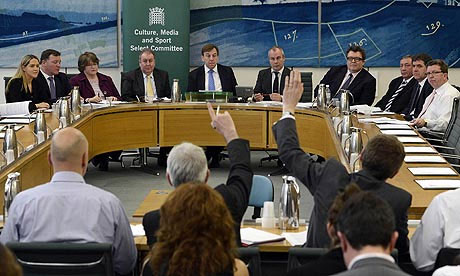
    Having already given evidence to the Culture Select Committee of the House of Commons, the editor of The Jackdaw was asked to justify some of his criticisms in writing. What follows is his further submission to the Committee…

    We were discussing, I recall, the Arts Council Collection, a repository of some 7,546 works (plus 67 more bought in the last twelve months), which has no permanent home, the overwhelming majority of the work (80% according to an ACE employee, 70% according to the Chief Executive of ACE) being at any one time in store. I stated my belief that in times of financial hardship it is imprudent that new acquisitions should be made of work by artists who are either already extensively represented in its own or in other Government collections: for your information, apart from the Arts Council’s these state-owned holdings are most conspicuously the Government Art Collection (13,500 works, plus 75 new works added this year); the British Council Collection (8,500 works, plus 100 new works bought recently); and the Tate (78,000 works, more of whose recent acquisitions below).
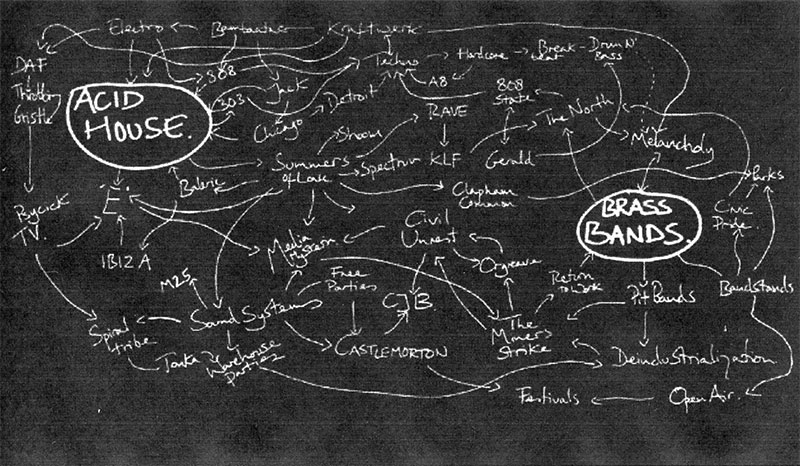
    Jeremy Deller, History of the World

    In the last year the Arts Council has acquired a work by Jeremy Deller (who is currently a serving trustee of the Tate; a gallery which awarded him the Turner Prize in 2004). It is the third work in the collection by the artist. The Tate also already owns five major works by Deller, four of which are not on display. These include his most famous work, a film and installation of the reenactment of a confrontation between police and demonstrators at Orgreave during the 1984 Miner’s Strike – a work funded, incidentally, by the Arts Council Lottery. The Government Art Collection has also this year bought a work from Deller; indeed it is the same work as one of the undisplayed pieces in the Tate’s collection, and also repeats the same Deller work in the Arts Council Collection The British Council owns three works by Deller, one of them being – you guessed it – the same work – History of the World – bought this year by the Government Art Collection and which is also in the permanent collections of the Tate and the Arts Council. Is the public trying to corner the market in this work, for it owns four copies of it? History of the World is, incidentally, a moderately amusing flow diagram relating Acid House music to Brass Bands: I suppose it would be considered impertinent nitpicking to comment that it contains not the merest thread of art. There are also ten works by Deller in the Victoria and Albert Museum. Deller has recently been in the forefront of the campaign by Turner Prize artists to ensure that funding for the visual arts is maintained and, if possible, increased. His support is not surprising really, is it?

    Such duplications are obviously wasteful and indicate more generally that collections might rationalise their purchasing nationally, or at least regionally. How many national collections, each harbouring enormous quantities of unseen work do we need buying works – even the same ones – by the same few fashionable artists?

    You must bear in mind that the Arts Council and British Council collections were both inaugurated to make purchases from artists at the beginning of their careers in order to give them confidence and support and encourage them through the rough period immediately following art college. This seems an estimable use of scarce resources because established artists don’t need help from the state. Or you wouldn’t have thought they did. That laudable policy has been overturned by both the Arts Council and British Council to the extent that they are now acquiring works from a roll-call of the most recognisable and successful brands in British art… Effectively, both are duplicating the collecting responsibility of the Tate.

    Also this year, the Arts Council Collection bought nine works by Wolfgang Tillmans, a German photographer and also, like Deller, a Turner Prize winner and a serving trustee of the Tate Gallery. (Incidentally, why any of our British photographers don’t qualify as a trustee of our principal gallery is bewildering. Mr Chairman, your committee may at some stage decide to look into the fishy resistance of the Tate to having appointed to its Board of Trustees any but Turner Prize winners and nominees.) These nine works were acquired despite the Tate already owning 63 works by Tillmans, none of which is currently on display. The British Council also owns 11 works by Tillmans. Forgive my impertinence, but what is the work of a German photographer doing in the collection of a body whose founding function is to advance the standing of British Culture abroad?

    Another bulk acquisition this year to the Arts Council Collection was five works by Keith Coventry. The collection already has in its vaults 23 works by this artist. The Tate also owns four works, one of which is currently on display, and the Government Art Collection and the British Council own another one apiece.

    I notice in passing that the Arts Council Collection also acquired this year three works by Bridget Riley to add to the 11 existing in the collection. Riley also has 30 works in the Tate (4 currently on display), nine in the Government Art Collection and 30 pieces in the British Council Collection.

    The most expensive purchase this year by the Government Art Collection was the £57,500 paid for Cornelia Parker’s 14 crushed silver-plated objects: her ninth work in the collection. There are already 21 works by Parker in the Tate’s collection (two currently on display), one of which is from the same series as that bought by the Government Art Collection, though it is not on display. Another Parker work, also from the same series, is owned by the British Council among six works in that collection by the same artist. The Arts Council Collection owns a further nine works by Parker, one of which duplicates a work in the Victoria and Albert Museum’s print collection.

    I could continue like this indefinitely. Considerable savings could be made by stopping all but essential purchases and especially those which duplicate acquisitions in other national collections. Indeed, I can see no reason why the any of these four organisations (the Tate, ACE, GAC and the British Council) should make any purchases at all in the next few years because they already own far in excess of what they can ever exhibit.

    The works in the Arts Council and British Council collections which are never shown and never requested for loan should be given to regional museums, or otherwise sold. Additionally, there is no good reason why the Government Art Collection should not be disposed of in its entirety. The public would lose nothing by these disposals and receive positive benefits in terms of savings and capital gains. If ministers wish to borrow works for their offices why can’t they do it from the Tate which has an unseen cache of work five times the size of the Government Art Collection’s.

    Further on the subject of State acquisitions… The next time you hear Sir Nicholas Serota moaning about not having sufficient money to extend the collections of his exponentially expanding empire, please bear this in mind: in the last four years for which there are published records, 2006-2009, the Tate has acquired 2,209 new works. This equates to one new item every sixteen hours for four years. Indeed, in the last five years the Tate Gallery has absorbed more new works than the National Gallery has accumulated in its entire 186-year history – the National Gallery, incidentally, has all its works on display.

    If a moratorium were placed on new purchases for, say, the next five years in all national collections, visitors to the galleries would notice no difference to their experience.

    I wish to reiterate the following points I made to the committee:

    1. The overwhelming majority of British artists would not notice the complete withdrawal of all Arts Council funds allocated to the visual arts because they are considered by the Arts Council to be “the wrong kinds of artists” and don’t benefit from the Arts Council’s existence in any way at all.

    2. The visual arts are unlike any other discipline dealt with by the Arts Council. In drama and music, the concert halls and theatres and the canons performed in them already existed. In the visual arts the Council opened its own galleries, some of them like the Whitechapel limping relics from a former age. These have been most often directed by the AC’s own former employees who are reliably steeped in the ethos of the Arts Council. The Council then institutionalised a new species of what it calls “Challenging Contemporary Art” to exhibit in them. Everyone else who falls outside this conveniently ill-defined phrase is excluded. The Arts Council has thus established an unhealthy monopoly, indeed a tyranny, which excludes more artists and styles than it includes. This derives solely from the personal prejudices of Arts Council employees instead of upon an intellectual openness to excellence wherever it exists on what is a very diverse stylistic spectrum in current art.

    3. If you were today devising from scratch a way of funding the visual arts, you would look at the way the Arts Council does it as an object lesson in how to fail the overwhelming majority of your constituency.

    4. The need to rationalise in some way national and regional art collections first occurred to me in November 2006 when Bury Council auctioned a painting by L S Lowry from Bury Art Gallery in order to plug a gap in its annual accounts of £500,000. The painting sold for £1.4 million and the surplus was apparently used to pay for a library in Ramsbottom. Deaccessioning, as this process of selling works from public collections is clumsily called, is a thorny subject which always causes outbursts of possessiveness among museum people. The truth is that when Bury sold its Lowry and left its walls devoid of a work by this highly popular local artist, there were in public collections within a few miles of Bury 305 works by Lowry which were not on show; these included 13 in Whitworth Art Gallery, 19 in Manchester City Art Gallery and 270 in Salford’s Lowry Centre. Galleries in Preston, Stockport, Bolton, Burnley and Oldham also had works by Lowry in their collections which were not at the time of the Bury sale on display. It is not that there is a shortage of works in public collections by artists like Lowry but that they are unseen in places that don’t apparently currently need them. If ever there was an argument for a centralised, collectivized management of art collections it was highlighted by the sale of the Lowry from Bury Art Gallery.

    5. Possible immediate savings by the Arts Council: withdraw funding from the ICA, which is now functionless and incompetently managed. Remove funding from the Serpentine Gallery. The few London dealers who benefit by having their artists exhibited in the Serpentine should be encouraged to assume running control. The gallery recently staged two exhibitions in one year dedicated to Jeff Koons and Richard Prince. Both these artists are represented by dealer Larry Gagosian who has his own spacious galleries in London which are more extensive than those of the Serpentine. Why is the Arts Council funding a gallery to show works by the world’s wealthiest artists represented by the world’s wealthiest dealer when those artists could just as easily be exhibited in their own dealers’ rooms? In the last year the Serpentine has shown the elderly artist Richard Hamilton, who also has a London dealer and has already been accorded no fewer than three retrospectives at the Tate. Also it has shown the ubiquitous Wolfgang Tillmans, who naturally has his own London dealer and has also recently enjoyed a huge retrospective at the Tate, where he is now safely installed as a Trustee. A quarter of all the money spent by the Arts Council’s visual arts department (£3 million of £12 million) would be saved by allowing both these organisations to sink or swim. The overwhelming majority of the public would notice no difference. And I don’t even mention the Hayward Gallery, which is a laughing stock…

    David Lee

    The Jackdaw Jan-Feb 2011