Category: Comment

  • Building brands, ruining reputations – Laura Gascoigne on the Tate

    Nothing is too squalid for Brand Tate, argues Laura Gascoigne.

    ‘Change the name and not the letter, change for the worse and not the better,’ ran the old wives’ saw on choosing a husband. Nowadays, in the wider world of consumer choice, a change of name is almost always a change for the worse. Whenever a familiar product is rebranded, a deterioration in quality is guaranteed. And when a corporation renames itself, as sure as eggs is eggs (assuming one can still be sure of that) it’s up to no good.

    Last July, there was suppressed hilarity in media circles when multinational accounting firm Ernst & Young announced that henceforth it would be trading under the snappier acronym EY. Unhappily, some in the press pointed out that the initials adopted by the company to “demonstrate boldly and clearly who we are” were confusingly already in use by another entity, the junior beefcake magazine EY! – or Electric Youth!, to give it its full name – a publication equally unafraid to demonstrate boldly and clearly what it is. A typical cover on its website features teen model Sergio Carvajal lifting his Spain 2012/13 Confederations Cup football shirt with one hand while pulling down his pants with the other, alongside the cover line: ‘The beauty and joy of young boyhood’. What’s the male equivalent of nubile? Pubile? Anyway, you get the picture.

    Commentators remarked that it was odd that a firm like EY2 that employs 167,000 people hadn’t done its research before changing its name but not its letters. The reason is, it was in a hurry. The name change came just four months after the then E&Y was persuaded by US criminal prosecutors to reach a $123m settlement with the IRS for marketing tax avoidance schemes that cost the US economy $2bn in lost revenue between 1999-2004. The dodges, dreamed up by a unit called VIPER – Value Ideas Produce Extraordinary Results – included fake investments with names like COBRA – Currency Options Bring Reward Alternatives – for the creation of which four of the company’s magic bean-counters were sent down in 2010.

    A spokesman for E&Y quickly announced that it was “pleased to put this matter from a decade ago behind us”, but unfortunately matters didn’t end there. When top executives from Amazon and Google were hauled before our own Commons Public Accounts Committee last November for a grilling by the terrifying Margaret Hodge as to how they got away with paying almost no taxes, the schemes allowing them to do so, it transpired, had been hatched by er… the erstwhile Ernst & Young. Before people with long memories started to cast their minds back to the collapses of Anglo-Irish Bank and Lehman Bros and to recall the identity of their auditors, a nifty change of name was obviously in order.

    Where’s all this heading? In case you haven’t noticed, Tate Modern’s big autumn exhibition is being marketed under the title The EY Exhibition – Paul Klee: Making Visible. Why, oh EY? Because in July, within days of their name-change, EY signed a three-show sponsorship deal with Tate Modern, publicized in a wince-inducing press release picturing the Tate director and the EY chairman standing shoulder to shoulder with matching business suits and rictus grins, one without a tie (creative industries), one with (creative accountancy). “This collaboration between two internationally-recognised institutions,” the release announced, “has the potential to help build a better working world for their visitors and clients respectively and the communities in which they work.” Take your fingers out of your throat, because it gets worse. It ended with this assertion from the EY chairman: “The arts and services sector can make a significant contribution to building brand Britain.”

    Building brand Britain? I bet Paul Klee had no idea when helping to design a brave new world at the Bauhaus that his name would be posthumously linked with such a preposterous piece of corporate jingoism, and I don’t suppose he’d have been best pleased about it. It’s obnoxious. There may be a respectable tradition of calling lecture series after distinguished scholars, but there’s nothing respectable about flogging a dead artist’s arse to a dodgy firm of accountants and allowing them to brand their initials on it. The Tate would do better to get EY! to sponsor the gents toilets and at least encourage some active philanthropy while they’re at it.

    Fortunately for the survival of old familiar unbranded Britain, there are signs that a rebellion against brandalism is brewing. In September the felicitously named Russell Brand loosed a well-aimed volley at the GQ Men of the Year awards – where he was collecting an award as an ‘oracle’ – when he stood on a stage papered in the logos of the event’s sponsors Hugo Boss and pointed out the absurdity of the fact that German outfitters who supplied uniforms to the Nazis were still trading as a fashion house under the same name, “and the ludicrous necessity for an event such as this to banish such a lurid piece of information from our collective consciousness.” He may cultivate the appearance of Edmund Blackadder’s sexier younger brother, but Brand is more than just a pretty face. He earned his ‘oracle’ award, in spades.

    To the innocent observer, the shocking thing about these you-scratch-my-brand-and-I’ll-scratch-yours relationships is how openly they are conducted. When accepting sponsorship money stolen from the taxpayer, you’d think a public institution would want to keep it quiet. But the Tate is so intoxicated with its own brand that it seems to have lost all sense of propriety. At the risk of turning really green at the gills, visit the Corporate Support page of the Tate’s website and watch it flogging its own arse to prospective sponsors as “one of the best-loved brands in the world… central to the UK’s cultural vibrancy, an agenda-setting arts organisation internationally [which] regularly features in industry round-ups of ‘cool’ and ‘favourite’ brands. Choose a Tate exhibition,” it coos, “and together we can build a package to mirror your brand, ethos and style”. But if Tate is really such a favourite brand, shouldn’t it be in a position to set conditions and bury EY’s involvement in the usual small print? Now that it has rolled over and given EY top billing, every corporate sponsor will expect the same treatment. If anything, their demands will escalate.

    It doesn’t have to be this way. Four years ago the then director of the Fitzwilliam Museum, Timothy Potts, forfeited £80,000 of funding towards the acquisition of Marcantonio Bassetti’s The Dead Christ Supported by the Virgin and Mary Magdalen when he refused to display the Art Fund’s naff new pink heart logo on the label – a logo The Burlington Magazine thought more appropriate to “a mail-order firm for adult lingerie”. Potts agreed to a credit line, just not the logo. “Logos are the currency of marketing and commerce,” he said, “and this introduces a promotional element into galleries that we regard as an unnecessary and unacceptable distraction.” The museum lost the picture but kept its dignity. There were no hard feelings: the Art Fund helped the Fitzwilliam (with Potts still in post) to raise the £3.9m needed to acquire Poussin’s Extreme Unction last year.

    “Economics are the method; the object is to change the heart and soul,” said Margaret Thatcher. When an art institution accepts the currency of marketing and commerce, it risks losing its heart and soul along with its dignity.

     Laura Gascoigne

    The Jackdaw, 2014

  • Mind the funding gap – Laura Gascoigne on NEDs and philanthropy

    It may have been the heat, but in the lead-up to the summer recess accusations of conflict of interest were flying around Whitehall like frisbees. First the PM’s Aussie electioneer Lynton Crosby was outed as a lobbyist for Big Tobacco just as the government announced its decision that plain cigarette packaging represented a danger to public health until proved otherwise, then it was revealed that a trio of Neds advising the government sit on the boards of companies with interests in fracking.

    ‘Neds’, in case you didn’t know, are Non-Executive Board Members brought in to make government ministries more business-like (no, I didn’t know government ministries were glorified boards either). There are 60 of them advising the Coalition, and three of them have been giving off a whiff of shale gas. One of the three, Lord Browne of Madingley, sits within the Cabinet Office as Head Ned.

    Lord Browne has an interesting CV. A former Group Chief Executive of BP (1995-2007), he is now chairman of Cuadrilla, the fracking company whose hydraulic probing of Lancashire was blamed for earth tremors that toppled traffic lights in Blackpool in 2011. With the blessing of our ‘greenest government ever’, Cuadrilla has since shifted its drilling interests to West Sussex. Watch out for belisha beacons in Bognor.

    Browne is a cultivated individual. While at BP, where he developed the company’s arts sponsorship programme, he was a Trustee of the British Museum and he is currently Chairman of Tate Trustees. The perfect person, one might think, for the Art Fund to invite to address a July gathering of art world grandees at the Royal Society of Arts on the theme of A New Age of Philanthropy? in the wake of the Chancellor’s announcement in his Spending Review of a 5% funding cut for national museums in 2015.

    But as Head of the Whitehall Neds and chair of the Tate Trustees, Browne is himself a walking conflict of interest. Had he been sent in by Osborne with the anaesthetic trolley to desensitize the patient in advance of cuts? The nervous tension among the distinguished audience suggested that they had their suspicions, which Browne’s hints about “a new balance between state funding and philanthropy” and the need “to create the right space for private philanthropy” did nothing to dispel. The usual way of creating space being to remove things, Penelope Curtis – on a signal from Nicholas Serota – asked the direct question: “Are you advocating that public funding should be less?” and received the less than direct answer that “the state should be providing for things that are improvements to the state” such as free admission, education, cultural diplomacy and conservation. An attempt at a joke – “Imagine if we outsourced the care of collections to Serco!” – got a hollow laugh. Nor were nerves particularly calmed by Browne’s response to Neil MacGregor’s proposal that philanthropy be taken out of party politics – “How are you going to do that?” – with the free-market mantra: “The Government should probably get out of the way of making choices and let the so-called market get on with it.” Help.

    A stack of Art Fund booklets on the entrance desk explained the tax advantages of Acceptance in Lieu and the new Cultural Gifts Scheme to prospective donors, and Browne talked about the “right incentive structures” and “non-monetary recognition”, even proposing “a period of super-incentives” to ease British tightwads into the pledging habits of rich Americans. He held up the example of Andrew Carnegie, who invested 90% of his wealth in cultural causes during his lifetime, but neglected to mention that in his Gospel of Wealth Carnegie explicitly advised philanthropists against relinquishing control of their money to charities with no guarantee of how they would spend it. He would presumably have bristled at the small print in the Art Fund booklet advising those planning bequests of works that, in the event of the charity’s being unable to present them to appropriate institutions, they could be sold “and the net sale proceeds… used in or towards the purchase of another work of art for a museum or gallery”.

    Super-incentives would not have had no appeal to a man who praised the British system of high inheritance tax by which “the State marks its condemnation of the selfish millionaires’ unworthy life”. Ahem. Philanthropy, in Carnegie’s day, still meant love of your fellow man rather than tax-incentivised amour propre. Even in the 1940s, when the Armenian oil magnate Calouste Gulbenkian offered to leave his Old Masters to the National Gallery in return for tax breaks, he was considered a “slippery benefactor” and refused. Now slippery benefactors are actively courted. If the Israeli shipping magnate Eyal Ofer was prepared to pour another £10 million into Tate Modern’s overextension, who was going to dig up allegations that his late father Sammy sold an oil tanker to a blacklisted Iranian company? This was an Ofer the Tate couldn’t refuse. It has made its Great Bed of Ware, now it must lie in it and not be picky about its bedfellows.

    The trouble is that too many of today’s high-net-worth individuals see ‘non-monetary recognition’ as a way of reversing damage to their reputations. They are not always particularly knowledgeable about or interested in art. Those who are, meanwhile, are making their own arrangements. A new philanthropic phenomenon Browne omitted to mention is the sudden rise in private galleries opened by collectors: four in London in the past six years. Anita Zabludowicz, Alex Sainsbury, David Roberts and Frank Cohen are all philanthropists who slipped the state art net because, like Sainsbury (whose father funded the Sainsbury Wing) they find the public model of patronage “too passive” and want to control what they buy and show. Their galleries may not be quite the ‘spaces for philanthropy’ Lord Browne has in mind, but their motivation is undeniably philanthropic: “to single out contemporary artists who have been left by the wayside,” in Cohen’s words, and “to test art’s purpose outside the marketplace” in Sainsbury’s – something our public galleries can no longer be relied on to do. Plus they want their collections on show rather than in public gallery storage. “It’s not fair on young artists to have their work hidden away,” says Zabludowicz.

    It’s easy to mock DIY magnate Frank Cohen as the ‘Saatchi of the North’, but there’s no denying his artistic enthusiasm. Like the other three DIY galleries I visited, his unpretentiously converted space in the old Express Dairy near St Pancras is a heartening reminder of how things were before the state muscled in on contemporary art. On a Wednesday afternoon three months into the run of its inaugural John Armleder show, mine was the first name in the visitors’ book, but if the public doesn’t share Cohen’s taste in art it’s nobody’s business but his. By the same token Sainsbury can freely confess of his Raven Row Gallery in Spitalfields that “its cultural value is open to question”, since he doesn’t need to justify it to the taxpayer. In the week of my visit the four galleries’ programmes were refreshingly different, representing a free-market ideal of ‘choice’ no longer offered by most public galleries.

    No new age ever dawned by government diktat. If this is a glimmer of a new age of philanthropy, our Ned-led government should wake up to it.

    Laura Gascoigne

    The Jackdaw, 2014


  • The spin of art

    The spin of art

    Michael Daley describes how the main players in State Art have taken spin to a new level.
    Many people remain in awe at the legendary manipulative means by which the political spinmaster, Alastair Campbell, delivered to successive New Labour governments the media coverage they craved. What is not sufficiently appreciated is that compared with art world practitioners of those dark arts, Campbell was an also-ran. Some years ago, when our critical comments on the restoration of a Turner at the Tate were reported in a newspaper, we received a phone call at home from the gallery’s director, Nicholas Serota, demanding to know why we were, as he put it, “so hostile” to his gallery. When we asked why his conservation staff had been less than frank on the radical nature of their restoration, he rang off abruptly, but we knew that he knew that our card had been marked. Discussing the incident with colleagues, we learned that such seemingly intimidating phone calls to critics were common.

    Serota’s thin-skinned combativeness led him to invite the dealer, Jay Jopling, on to a “secret Tate committee” to change then prevalent press coverage of trendy contemporary art. Jopling later disclosed how, to thwart negative accounts, the tabloid press were fed a stream of colourful stories that presented these artists not as incompetents but as larky, larger-than-life characters, who made big waves without ever taking themselves seriously. Arts correspondents were invited to see the “Biggest fish and chips in the world” at a preview of Damien Hirst’s shark tank at which journalists were plied with paper cones of posh French fries. Tate-friendly art critics on broadsheet newspapers set about persuading their editors that attacking avant-garde artists made their papers look down-market and “tabloid”. The ploys worked: instead of incredulous “You call this art?” coverage, newspapers were flooded with entertaining tales of whacky new art world celebs “having a larf” at The Establishment and getting rich to boot. At the posh end of Fleet Street distinguished columnists who wrote critical articles were precisely blocked by editors fearful of “looking tabloid”. The scene was set for British Junk Art to go global – as Christie’s quickly appreciated.

    By neutralising the provocations of public sector artists making their names by spitting in the eyes of the public, those artists were turned successively into household names; art market powerhouses; national treasures; and even “iconic” public mascots fit to meet prime ministers and the Queen. If bigging-up art markets counts as a success, for the individual spinmaster the ultimate triumph is turning institutional calamities into perceived triumphs. In this department the Tate is the clear field leader. It boasts no fewer than a dozen press and PR staff, and no fewer than 16 “directors” when, in reality there is only one – Sir Nicholas Serota, who has honed art promotional skills throughout his presently 26 years-long reign of tenure.

    The most audacious conversion occurred in 2002 at a moment of great crisis at the Tate. As we described here in 2011-12, in 1994 two Turner paintings had been stolen in 1994 when lent to an insecure regional arts centre in Germany (see Michael Daley, “Ransom or Reward?” Jackdaws 99, 100 & 101). The Tate had taken the insurance money (£24m) and invested it so as to be able to buy back the paintings on their recovery. However, on the insistence of a Government Treasury minister, Paymaster General Geoffrey Robinson, the insurers were bullied into accepting less than a third of that insurance money and accrued interest in exchange for the Tate’s right to have the paintings on their recovery. This netted the Tate £22m at the insurers’ expense. It was done, the Minister said, to help meet Tate Modern’s rising building costs. Out of this ill-gotten windfall the Tate paid a £3m+ gangsters’ ransom demand.

    Although the paintings had been sent to Germany on Serota’s personal instruction without an accompanying courier, the task of recovering them was given to Sandy Nairne, the Tate’s Director of Programmes who was responsible for administrative restructuring in preparation for Tate Modern’s opening. Nairne, disappointed not to have been given the directorship of Tate Modern, left the Tate to become director of the National Portrait Gallery. In 2011 he published a remarkably informative book (Art Theft and the Case of the Stolen Turners) on the eight-year-long recovery operation. At one point, with half the ransom paid, one of the Turners had been recovered and secretly returned to Britain. Nairne wanted to release the news. Serota refused on the grounds that by holding back until both were recovered it would be possible to achieve a spectacular publicity coup. Hitherto, Serota said, most of the Tate’s “positive” press coverage had not been real news but “merely promotional material”.

    However, there was a serious threat to a first-ever genuine Good-News Story. As Nairne put it, “…someone had talked to the senior crime writer on the Mail on Sunday. He had heard that the painting was back in London… It was imperative to have help with press inquiries… On Nick’s advice, we brought in press consultant Erica Bolton.” (Readers of Jackdaws 112-115 will recall that Bolton & Quinn Ltd was called in at the tiny Serpentine Gallery to help its five-strong press department throttle imminent press coverage of The Jackdaw’s disclosure that astronomically high salaries were being paid to the gallery’s two directors.)

    The Tate’s top brass were groomed to deflect hard journalistic questions should news of the partial recovery get out. To the straight question “How much has this operation cost Tate?” the ideal answer was to be: “The combined costs over eight and a half years including insurance, travel, legal fees and investigative expensive accounts amounts to just over three and a half million pounds. Tate took on the additional costs for the investigation when it acquired the title of the two works in 1998.”

    This answer (almost identical to one given to ArtWatch UK by the Tate’s then Chairman, Lord Myners) concealed the reality that the “additional costs” comprised the £3.1m ransom payment to gangsters, permission for which had been sought and given at a secret High Court hearing. In response to an imminent threat of exposure in the Mail on Sunday and an already published damaging disclosure by Geoffrey Robinson that the Tate was pursuing connections with a “particularly nasty bunch” of Serbian gangsters, Bolton drafted a press release in November 2000. It read:

    “There has been much speculation over the years about the whereabouts of two paintings by Turner stolen in Frankfurt in 1994. And like the authorities in Germany, Tate has always been interested in any serious information which might lead to their recovery. But currently there is no new information, nor are there any current discussions being conducted. Of course, I remain hopeful that one day the paintings might return to the Tate. Nicholas Serota, Tate Director.”

    On the strictest possible usage, the last point was true: the already recovered Turner had not yet been returned to the Tate – instead, it had been hidden in a commercial store. Nairne does not say whether or not the Tate flatly denied the claims to the Mail but, either way, the subterfuge worked: the well-sourced and accurate story did not appear and the “Genuinely Good News Story” was broken at a triumphant press conference two years later on recovery of the second Turner.

    One of the commonest sources of museum world controversy (and therefore of PR spinning) is picture restoration. Another is attacks on works. On July 20th, 2011 we reported on the Artwatch UK website that the day before two Poussin paintings were attacked at the National Gallery. An artist visitor to the Tate who complained to a warder about people standing in front of paintings while having their photographs taken, was told that this was now allowed because staff cut-backs made it impossible to enforce the gallery’s own rules. Children had been reported treating a Donald Judd work as a climbing frame.

    When a visitor defaced a Mark Rothko painting at Tate Modern with a permanent marker pen on October 7th, 2012 a spokeswoman minimised the attack: “We can confirm that at 15.25 this afternoon there was an incident at Tate Modern in which a visitor defaced one of Rothko’s Seagram murals by applying a small area of black paint with a brush to the painting.” When the work was returned last month after the restoration the spin was different. The Guardian reported that “Tate Modern yesterday revealed the successful results of one of its most difficult restoration projects.” All restorations are spun in such terms. Restorers have been drilled by their trade associations on planting Good News Stories of miraculous discoveries and recoveries made during restorations. (The British Museum, under Neil MacGregor, Serota’s only, if less abrasively prominent, rival-in-spin, has run courses for restorers with co-opted professional arts journalists advising on the planting of restoration stories in the media.) The Tate issued a press release to a Turner exhibition that presented a restoration-wrecked picture, which had lost one of its two steamboats, as the star of the exhibition. On the Rothko incident, Serota duly described the Tate’s restoration team as one of the best in the world but on the laxness of Tate security he was unrepentant: “It is very important for us not to turn into Fort Knox. We are a gallery not a prison.”

    Although Serota’s loyal lieutenants come and go at the Tate (Sandy Nairne, as mentioned, to the National Portrait Gallery, and, in 2010, Stephen Deuchar, the director of Tate Britain, to the Art Fund) they are not necessarily lost to the gallery ideologically or financially.  Deuchar now serves as director of the Art Fund under a chairman, David Verey, who was previously the chairman of the Tate’s board. Shortly before leaving the Tate for the Art Fund, Verey advised Serota to get more funding for already-bought paintings by Chris Ofili, so as to reduce the embarrassing proportion being paid by the Tate for a mass purchase of one of its own trustees’ works.  Serota did so by applying for assistance to the Art Fund – against its clearly stated rules – for a cool £75,000, which he was given under the new chairmanship of Verey. When the hugely embarrassing news of this improper payment broke, Serota offered to pay the money back, but the Art Fund said it could be kept, notwithstanding the breach of its rules.

    When Deuchar arrived at the Art Fund in January 2010, he promptly announced a new ideological broom: money would no longer be used exclusively to help buy important works of art for the nation: “I have ideas for taking the Art Fund [previously known as the National Art Collections Fund] in new directions” – one being “investing in people, alongside objects” (emphasis added).

    At Deuchar’s leaving party at the Tate, Nicholas Serota said to him: “We feel that our friendship to you will be amply repaid.” In January 2010, the Guardian’s Charlotte Higgins noted: “The gallery has just announced that it has been able to buy eight beautiful (if disturbing) William Blake works on paper… with the help of a £141,000 grant from the Art Fund, now run by Stephen Deuchar [who] stepped down as director of Tate Britain in December, with Nicholas Serota, overall director of Tate, quipping that they expected to be the happy recipients of the charity’s largesse. And so, reader, it has come to pass – just a little bit quicker than expected.”

    If the Tate was not disappointed financially, nor will it have been disappointed ideologically as Deuchar pushed at a door already ajar. In 2001 the ‘conceptualist’ Martin Creed was awarded the Tate’s £20,000 Turner Prize for a “work” consisting of nothing other than a device to switch lights on and off continuously. When Madonna handed over the check at the Tate award ceremony, she said: “I want to support any artist who not only has something to say but who has the balls to say it.” Creed seems to have taken her literally: in 2005 he sold 800 variously sized balls to the Scottish National Gallery for Modern Art for £31,500, of which the Art fund contributed £11,500. As the Art Fund puts it today, Creed’s balls had been assembled so as to “roll free for the viewer to interact with.”

    Last year Creed’s prices received a hike: the Art Fund gave the Tate £40,000 to help buy a £122,000 “work” called Lights Going On and Off, the very work with which Creed had won the 2001 Turner Prize. Thus, in little more than a decade, a work which consists of nothing but is now described by the Art Fund as being “widely considered to be the signature work of one of the best known artists of his generation”, has been “saved” for the nation. On top of the money, the Art Fund generates Tate-friendly promotional literature for Creed by publishing an interview with him by Michael Craig-Martin, a former Tate and a present Art Fund trustee.

    On the back of such in-depth, officially endorsed vacuity, Christies feel emboldened to offer another version of Creed’s on-off work at a sale on July 1st with a guide price of £70,000. For this, a purchaser would receive nothing other than a certificate of “authenticity” giving permission, as Chris Hastings reported in the Mail on Sunday (June 8th, 2014), to use the idea. Copyright law holds that it is not possible to steal ideas, only a particular means of their expression or realisation. Anyone buying this work will, therefore, acquire the valueless part – the idea – but not its historically unique original means of expression (at the Tate). As we were quoted by the Mail as saying, this is “only art in the narrow, loopy confines of the modern contemporary art establishment. Christie’s are just selling pretentious junk to chumps who want to buy into ‘cool’”. Christie’s can of course shrug off all criticisms: on this basis the auction house will be able to sell certificates of authenticity on any of Creed’s hundred of works. Any number of people might wish to pay to buy permission to run up and down the Tate’s Duveen galleries, or to screw up A4 sheets of paper, or ring lots of bells simultaneously. State-sponsored art hype might strike many as state-sponsored tripe, but when combined with the hype of art market institutions it produces perfect money-making machines that can extract wealth from notions as ineffably precious as the licensed fictive possession of a past event.

    In May, Stephen Deuchar explained at a Mellon Centre conference that, although founded to buy traditional art forms, the Art Fund would now pursue newer concepts and had “generously funded” a Martin Creed project. As seen, it has funded many already. Coinciding with Christie’s July auction, Creed’s works are running at the Quay Arts Centre in Newport between June and September in a so-called “Artist Rooms” travelling exhibition. This follows another such at the Tate earlier this year which consisted of… lights going on and off. This Artists’ Rooms series of touring exhibitions is specifically aimed at inducting young people “primarily those aged 13-25” into the delights of modernism. Art world PR does not come darker or more blatantly propagandistic than this. The scheme was created with works donated by the dealer Anthony d’Offay and funded by the Tate and the National Galleries of Scotland on the express purpose of “engaging young people with the art of our time [sic] in order to inspire future generations.” Creed was not part of the scheme but, in order to be so, he donated a roomful of works in 2008, including… his lights going on and off. The Art Fund website promotes the present exhibition as: “Bringing together his works…[so as to offer] audiences the opportunity to experience Creed’s witty, joyful vision of the world around us.” That’s as maybe – but the hype does not disclose how much this latest “investment in people” has cost. Creed was given a retrospective show at the Hayward Gallery this year, called “What’s the point”. When asked what the point of the show was, Creed replied that he doesn’t know. Mandarins and auctioneers of the Tate-stream of contemporary art will know only too well.

     Michael Daley

    The Jackdaw, 2014


  • Grayson Perry’s 2014 Reith Lectures – a missed opportunity

    Patrick Cullen explains why Grayson Perry missed an opportunity by avoiding the important issues he claimed to be addressing.

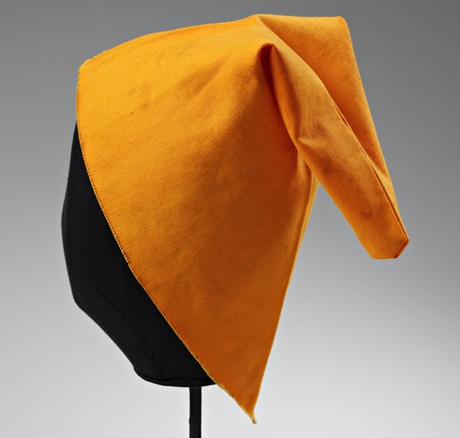
    Grayson Perry was a surprising choice to deliver the Reith Lectures given the list of senior academics, elder statesmen and those at the top of their profession preceding him in the job. One wondered why, when it came to contemporary art it was decided to break with tradition and hand the spotlight to one of its middle ranking practitioners with no track record as an intellectual heavyweight. But many enjoyed the change. Think of the Reith lectures and people tend to think dry, dull and probably pompous to boot. With his pantomime outfit and, in the second talk, brandishing a whip, Perry was anything but boring. The jokes came thick and fast, the lectures were even called “Playing to the Gallery”. Perry may be no John Berger but he’s a lot smarter and more articulate than all those YBAs he is keen to distance himself from. What we lost was any sustained argument about the nature of contemporary art, what justifies it as art and why. More than anything Perry reminded me of a court jester, clever enough to make his audience laugh and to tease the powers that be with the odd dig, yet never forgetting that he is part of this modern day art circus which has been very good to him. He acknowledged this at several points, in a humorous self– deprecating way, encouraging others to join this world that even allowed him, a transvestite potter, into its ranks. A classic court jester moment came in the second lecture (he was even wearing what Sue Lawley described as a jester’s hat). He teased Nicholas Serota (who was in the audience) about the often expressed criticism that Serota’s personal tastes are determining to an excessive degree the nation’s purchases of contemporary art. “Impossible” said the Fool leaping to his King’s defence, he had been to Serota’s home and admired his extensive collection of Cliff Richard memorabilia. It was a swipe but a pretty gentle one.

    Lecture 2 was supposed to be the one where Perry really addressed what art is and what it isn’t and especially the boundary lines between the two. Introducing it Sue Lawley said “Today’s lecture will explore what the boundaries of art are. Can it really be anything we like from a pile of sweets to a soundscape?” This is difficult territory for any contemporary artist wanting to be seen as contemporary. Ever since Duchamp and his urinal the idea of trying to define art by putting boundaries round it has seemed increasingly old fashioned. Perry began by admitting that if you asked people in the art world to define art “there’d be a lot of eye rolling and sort of like – Oh God! – you know – Not that question again. Like it’s been answered … You know there’s a kind of complacent idea in the art world that anything can be art now… We’re in a state now where anything goes… But the thing is I think there are boundaries still about what can and cannot be art…”  I was beginning to warm to his theme. If the art world complacently thinks anything can be art, but Grayson doesn’t agree, perhaps he was going to tell us what those essential qualities are that distinguish art from the merely banal and common place. He informed us that he wanted to establish the boundaries of art a bit like in mediaeval times people marked the territory of their parishes by a primitive process called “beating the bounds” (the title of this 2nd Reith Lecture). Hence the whip.

    Just prior to listing what he saw as the boundaries beyond which things ceased to be art, he paused to imagine how “his friends in the art world” would laugh at him for wanting to establish the limits of art. “But,” parried Grayson rather pathetically, “I want to know when to put my art goggles on. I want to know when – you know – when I’m going to look at something as if it’s art”. This was quite a confession. Only by knowing when to put his art goggles on would he be able to start looking at something “as if it’s art”. The idea that real art might just possibly have the power to announce itself as art because it moved you, took your breath away, was amazingly beautiful or wonderfully thought provoking was not considered. No, Grayson needs to know when to put on his art goggles or he’ll be unaware of what’s in front of him, rather like all those museum sheep who have no idea how to judge a painting unless someone is distracting them via headphones with a lot of facts to reassure them that what they are looking at is indeed important art. I don’t believe for a moment that Grayson Perry is so insecure about his responses to art, so perhaps it was just a cleverly timed piece of humility to allow the audience to identify with him, for in all probability many of them would have been part of “ the headphones brigade”. Now, brandishing that whip, he would tell them how to recognize this thing called art, which even he has difficulty spotting without some special goggles. “Afterwards,” he assured them to much laughter, “you might know when you’re looking at a work of art and not just at some old rubbish”. There would be nine boundary markers or tests to help them in this task.

    Test number one: “Is it in a gallery or an art context?” LAUGHTER. Well, you had to laugh. It’s the equivalent of saying, a few decades ago perhaps, “if you’re not sure if it’s art, has it got a big gilt frame round it?” Or try this one: How do you know if someone is a criminal? Helpful test: are they in a prison? It might just have been an initial bit of farce before the more serious stuff, if so many of his other tests hadn’t turned out to be in a similar vein. Yes, statistically, pieces of visual art are quite likely to be found in art galleries – surprise, surprise – but this tells you nothing about what makes them art, or how to distinguish them from the things in art galleries that aren’t art.

    Test number two: started off as “Is it a boring version of something else?” This might have led into whether art has to be original which would have been a serious line of inquiry, but he left off before he’d started on this one and it morphed into…

    … Test number three: “Is it entertaining? If so it may not be art because art is a serious business.” Perry immediately mocks this test, telling us that it reminds him how the worst thing you can call an artwork is decorative – a bit of a leap that, but no doubt this is a jibe he must at some time have had to contend with himself, unfairly in my view. Then he says: “I think it’s a very noble thing to be decorative”. So we got a glimpse of Perry’s differences of opinion from the dominant art world views on what is proper art. Prejudices he has encountered as a mere potter being another one he touched upon. But these differences featured very little in this light-hearted tour of the contemporary art world’s boundaries. He pursued the idea that a sense of dullness and lack of pleasure, (he cites all those video installations with uncomfortable benches to sit on), might be a sign that we are looking at art. This clearly struck a humorous chord with his audience, but it was beginning to feel like a very unenlightening way of teaching us how to know if a piece of contemporary art merits that appellation. Was it all going to be jokes?

    Test number four: “Is it made by an artist?” This is clearly of no use either since it begs the question of what an artist is. If an artist is defined as someone who makes art but we haven’t yet establish what art is, looking for artists means we’re just going round in circles. Perry offers no new definition of an artist to help us out. Reading between his lines it looks like artists are people that this cosy art world he delights in belonging to, recognizes as artists. These boundaries, far from revealing anything, were beginning to sound like the already established parish boundaries of the self same art world whose judgements about art we wanted Grayson to explain. But there were no explanations, just a series of markers (e.g. – it’s in the Serpentine Gallery, it’s rather dull and it’s by Cornelia Parker, a known artist, ergo it’s probably art).

    Test number five: this boundary marker concerns the question: “Is  photography art?” If Perry had made a stab at a definition of art in the first place he might have been able to say whether a photograph could fit within it. But without ever nailing his colours to any mast he could only make more jokes; e.g. a photo might be art if the people in the photo aren’t smiling. Or: it might be art if it’s bigger than two metres and priced higher than five figures. Plenty of laughs but zero insight.

    Test number six: “The limited edition test.” Another crack of Perry’s whip to indicate another boundary to this thing called art. He points out, as if we didn’t know, that if something is part of an endless edition, it loses some of its monetary value by virtue of the laws of supply and demand, and then goes on to declare that therefore “it’s giving away part of its qualification as art”. He draws this conclusion as if it were obvious and says no more on the subject. Actually it’s not at all clear why, because there is more than one of it, an object should be deemed any less a work of art. Less expensive probably, but why less a work of art? This could have been an interesting discussion and one which would have touched upon many things: the importance of uniqueness for the art world, the problem of multiples, the conflation of artistic and financial worth and the ways by which the latter is protected. The criteria lying behind Perry’s tests were turning out to be uncannily in tune with the vested interests of the contemporary art world. Since Duchamp the notion that anything can be art may well have won the day in theory, but limits and boundaries there must be in order to protect art’s monetary value. Duchamp himself, authorised a limited edition of his urinal (which was originally a standard mass produced one – and an important point about it, being that it was just that). Nearly five decades after the first urinal had been destroyed and when it had become a legendary (but, alas, unmarketable) landmark in the history of the avant-garde, Duchamp, agreed, in total contradiction to the spirit of the original, that ceramicists (i.e. potters Perry reminded us) should hand make an edition of “his” urinal, each of which he personally “validated” as art, whilst excluding all similar extant urinals. There are eleven “genuine” “Duchamp urinals”, each worth somewhere around a million quid, essentially because Duchamp waved his wand at them. (Think about the magical powers invoked here. How gullible the world to fall for such brazen sophistry!). The artificial limit placed on an edition of an art work is a classic case of how the art world establishes its “parish” boundaries for good old financial reasons. Perry probed this not one bit.

    Test number seven: “Who’s looking at it and is there a queue?” More jokes about the kind of people who go to galleries and look at art. If there are a lot of people with beards and glasses and single speed bikes……etc. If so, and if there’s a queue (contemporary art being so popular) there might be some art involved. I laughed along with the audience for I’d long since given up gaining any insight into what the intrinsic qualities are that make something art.

    Test number eight: “The rubbish dump test” Perry explains: “Throw it on a rubbish dump and if people walking by notice that it’s there and say “oh what’s that artwork doing on that rubbish dump?” it’s passed.” For a moment I thought he was on to something. May be, just may be, one defining quality of an artwork is its capacity to arrest you, make you stop in your tracks and gaze in wonder or surprise or even just puzzlement. But no, once again Perry undercut this possible signifier by another joke which got a big laugh: many good artworks would fail this test because the rubbish dump itself might be the art work.

    This time I realised I wasn’t laughing too. It was too near the truth. Yes, it was now official, from no less an authority than the giver of the Reith Lectures: there is no way of distinguishing between art and rubbish, the very thing he had promised to enable us to do. So Perry in effect told us to forget the rubbish dump test, the only one so far I thought of any use. The really sad thing about all this was that so many people – in relation to any other field of enquiry, perfectly intelligent people – thought Perry’s lectures not just funny (they were that), but thought provoking and insightful too. Also sad was the fact that Perry can express views at odds with State Art orthodoxy, but apart from his words in praise of the decorative in art, he kept them to himself.

    Test number nine: “The Computer Art Test” Grayson cracked his whip for the last time. As if knowing he’d really dodged the question with his suggestion that we drew a venn diagram of all his tests and where they met in the middle is pretty well guaranteed to be art, Grayson finally threw in a just about plausible definition of art from a friend of his called Charlie Gere. Gere says that you might be able to distinguish between a piece of web art and just an interesting website as follows: “You know it might be art when it has the grip of porn without the possibility of consummation or a happy ending” Perry then expanded on this: “In other words it’s all about frustrating our urgent need to double click our way to satisfaction whether in the form of a joke, an opinion, a fact, a sale, or indeed an onanistic experience, and to detain and suspend us in a state of frustration and ambivalence and to make us pause and think rather than simply react.”

    Well, well! Here at last, in the final gasps of his lecture, was an attempt at a definition. It begs as many questions as it answers, but at least it’s a start. Had he begun any one of his four lectures with this provocative definition he might have moved on into an inquiry about the true nature of art and why, although quite a lot of things may be art (when manipulated creatively) most things, like urinals, are probably not. At least I’ve never met one that had the grip of pornography but which suspended me in a state of frustration and ambivalence. On the contrary they tend to facilitate double clicking one’s way to instant relief in the form of a much needed bladder evacuation. Perhaps that’s why they’re not art. And perhaps that’s why all those people who claim not to know much about art but who know what they like, would at least recognise when a guy like Duchamp was taking the piss.

    Patrick Cullen

    The Jackdaw, 2014

  • Charity vaunteth not itself … except sometimes

    Friend of the Royal Academy, James Birkin, believes the RA is neither open nor giving enough considering its charitable status; and overly concerned with business.


    It is said that a true friend will speak truth unto power. How sad then that the Friends of the Royal Academy are denied the chance to do just this. Recent correspondence with this writer indicates that the RA does not see the necessity to allow its loyal supporters the chance to meet and thereby influence policy. Were there to be meetings questions such as those below could be asked and addressed. Surely it is right that if the RA receives millions of pounds a year from the Friends and benefactors it should in turn listen to (and indeed act on) what Friends might wish to say.

    The RA is a charity that massively assists the interests of the Academicians who are also ultimately responsible for how it operates. This has been a way of doing things since its founding in 1768. Time and status have together conferred a degree of protection from closer examination. Certainly the impression one receives when visiting Burlington House is that of being admitted as a guest to a St James’s club. Yet this politeness seems also to conceal an exercise of very real power. After 250 years perhaps it is time to ask exactly what is the role of the RA in the 21st century.

    The obvious first answer is education. True to its name the Royal Academy has a school which has a discerning annual intake of 17 or so wholly funded students. The RA’s 2012 report also highlights substantial efforts to involve schools and colleges under the rubric ‘Academic Affairs’. Under this title it is interesting to note the academic facilities also available to Friends. These are generally at a cost and of course, as such, exclude the majority of the public. Whether these are better categorised as fund-raising events  or ‘academic’ is, therefore, not entirely clear. It might be a little unfair, but nevertheless interesting, to note that if there was an intake of 17 full-time students per year for three academic years the school would comprise 54 students. The turnover of the RA per student would then be approximately £39,000,000 (gross RA turnover)/54 = £722,000 per student per year. This takes no account of the unique position of the RA and its other functions. It also relates to turnover not profit, but, nevertheless, it highlights the relative lack of importance of the RA schools in the overall picture. The figure also does not take account of the usage of the schools for external Charity work and education. The RA refers to this in its annual report. However, the degree to which this happens is less clear and should be at least further explained.

    The second answer is that we also know the RA puts on exhibitions. These might be seen as part of the charitable objective of educating the public, although the steep cost of tickets makes one question whether this relates only to a wealthier public who don’t need charity.

    Finally, it confers great honours on mainly British artists by appointing them Academicians. Since the RA has charitable status this raises the question of what degree of concomitant responsibility for the wider artistic community should be placed on this privileged group. Given that the RA takes substantial benefits from the public purse, and is also crucially supported by its Friends, the way it operates is the subject of legitimate criticism.

    Leaving aside benefits such as paying small business rates and no corporation or income tax, in financial terms the RA generates income of over £30 million a year. Were it just an art school it would be horrendously expensive (the private Heatherley Art School in Chelsea, for example, manages a far larger student intake for well under a million). This implies that the justification of the RA needs to be placed on a rather broader plinth than simply the education of artists. It needs genuinely to reach, entertain and educate a wider public. It is undeniable that the RA has a huge fan club, not least amongst those who can afford to visit the shows, but how widespread the support is in other areas is debateable.

    In addition the RA differs from an ordinary school in having to maintain the Grade 1 listed building (which it occupies at the public subsidy of a peppercorn rent). This is clearly expensive but it hasn’t stopped the RA having extensive rebuilding ambitions or prevented pay rises to senior staff well above the rate enjoyed by those elsewhere in the public sector. So one suspects (perhaps as a tribute to the Chief Executive) that financially it is in robust shape.

    It also houses what is effectively an exclusive club of self-selected artists, sculptors and architects – the Royal Academicians (RAs). This small club (80 in number) is highly influential. In view of the financial receipts from outside sources the way it operates needs to be transparent. Sadly, opacity seems to be the tint of the day.

    The most glaring conflict is the enormous promotion of Academicians’ own work by the RA. By definition these are already successful artists. So can the degree by which their work is promoted really be seen as a charitable object?

    Promotion of RAs and their work to some degree is understandable and desirable since the RA needs an identity. What is harder to understand is the degree to which this happens. This leads back to the question of how the ‘club’ relates to the ‘charity’.

    I would venture to suggest that lines of demarcation are needed. Distinct areas of operation seem to be: the legitimate promotion of the RA and its work; the preservation of the identity of the RA; and ensuring that charitable objects have primacy. Then perhaps splitting charitable objects into more specific aims such as promoting the interests of art and artists at a lower level than the RA, educating at school level, educating at degree level, and last but not least  educating (and entertaining) the public. The raising of money to achieve these objectives is of course vital and impinges on all these areas. This raises an obvious further danger that the operation becomes more about raising money than meeting core objectives.

    Most obviously contentious in terms of conflicts of interest is the Summer Exhibition. Academicians can hang six pictures in the show. Having some Academy input might at least preserve identity and lend kudos. But why so many works each? The works can be of any size and are often the largest. It is hardly surprising then that every Summer exhibition in recent years has extensive areas occupied by RAs, thereby squeezing other artists into leftover corners. This unjust imbalance needs to be reduced. This could be done either by substantially lowering the number of works permitted (to perhaps one) and/or to limiting their size.

    The process of selection from non-RA submissions at the Summer Exhibition should also be more transparent. If non-RA artists have been invited to submit, thereby short-circuiting the process of selection, the public should know the extent to which this occurs. It is galling to those who submit to the RA to see that the odds of acceptance have shrunk even further when it is revealed a large number of invitees have been included. For those who follow the usual route of submission, the process of selection of pictures has also perennially been alleged to be tainted with bias. Selection is by definition biased so there are massive problems in creating a more transparent system. No real answer has emerged as to how to deal with repeated prejudices (whether conscious or unconscious). What is achievable is better statistical analysis of the Summer Exhibition. What were the chances of getting in last year? How many invitees were there? How many first-timers were allowed in? How many have been repeatedly selected? More information will bring greater transparency and create more confidence in the fairness of the process.

    The Jackdaw has in previous issues analysed the money received for the Summer Exhibition. The receipts for non-RAs versus RAs is roughly equal. If one factors in the huge imbalances, the RAs do not produce anything near the same income as non-RAs per square foot. Indeed the real instrument for democratisation via purchase is the editioned print. Most of these are sold by non-academicians for reasonable prices. While taking up negligible space they generate substantial income. Of course it is always said that the whole ethos of being hung with Academicians is what gives the unknown artist more status. I would suggest that it is being hung at the RA itself that is the key factor.

    Another key question is how artists are selected for individual shows at the RA? My perception is that living artists recently shown have largely if not exclusively been from the RA or closely connected with it. Presumably any show must be “bankable” as a pre-requisite, but once that is established how are selections made? How are the commercial arrangements managed to ensure the charity receives good value? What chance do other distinguished living non-academician artists have of obtaining such a show?

    The Academicians’ privileges do not stop with the Summer Exhibition or their own shows. On leaving the Summer Exhibition one is met by a shop exclusively selling books and merchandise about or by Academicians. One can even buy a giclée print of work by the late Mary Fedden RA for the outrageous price of £800. This specific item seems to epitomise the conflict between garnering funds and helping educate the public about art and the artist. It is hard to see that selling a giclée reproduction in this way and at such a price can do anything except harm the work of traditional printmakers who struggle daily to educate the public to the subtleties of genuine prints.

    Looking at income of the RA (£39 million in 2012) – the  three most substantial sources are; trading subsidiaries (£15.9m), exhibitions and charitable activities (£8.5m); and from voluntary income (£15.1m), which includes income from the Friends (£8.8m).  In addition Friends’ subscriptions were swelled by a further £1m in gift aid.

    Unlike most other institutions that have a ‘Friends’ arm, the RA is massively dependent on the support of the 93,000 friends. Friends’ income is vital to its survival. Friends receive a magazine and now have access to the recently and expensively furnished Keeper’s House. They are increasingly pampered but are not allowed a voice. If Friends have questions they can contact the Chairman of the friends. The problem is that the “guests of a club” model is a false analogy. The Friends (guests) actually empower (pay the subs for) the club. Without the Friends the RA would have the greatest difficulty in functioning.

    Such a process of separation should bring a re-examination of objectives. For example, is the Summer Exhibition about money or education? Are there other objectives for the Summer Exhibition, such as the helping of lesser-known artists to establish a toe hold or allowing the public to buy affordable art? It would also force an evaluation of how RAs benefit and what they should contribute to the Charity in return. Common to many commercially successful charities, the Academy’s main weakness is the maximisation of profit at the expense of charitable objectives.

    To counter this, the Academy should make efforts to seek out criticism and alternative opinion. Giving the Friends a voice by allowing an annual meeting might be a productive first step.

    James Birkin

    The Jackdaw, 2014


  • Performance before content – Eric Coombes is disappointed…

    Performance before content – Eric Coombes is disappointed…

    …by the frivolity and lack of ambition and academic rigour in the 2014 Reith Lectures.

    Immediately after his predictably rapturous greeting at the first performance, Grayson Perry raised the question of why he was asked to give this year’s Reith Lectures. Well, for the first time in their sixty-six years, they were to be given by a “visual artist”. Could one imagine the BBC not to have chosen a winner of, or at least nominee for, the Turner Prize? Gormley having withdrawn a couple of years ago, how many remotely entertainable candidates lay in that small heap of the capriciously favoured? “Professor” Tracey Emin?  Damien Hirst? Even the BBC might have balked at the near-catatonic inarticulacy of a Martin Creed. But Perry vacuously claimed that his selection was explained by his being “a practising artist” – which, in reality, was not even a sufficient condition of eligibility.

    This limitation of the field of candidates was not, of course, mentioned. Does inadvertency, naïvety or cheek account for his drawing our attention to another factor a few minutes later, when he said “… anybody can have a life in the arts ­– even me! An Essex transvestite potter … the mafia has even let me in”?  As he proclaimed this, dressed and painted in a flamboyant caricature of femininity, Perry basked in the sycophantic admiration of that “mafia”, including such luminaries as Nicholas Serota. In a video clip, we glimpse the Lord Patten, laughing with respectful indulgence. Was Perry, brazenly, knowingly but deniably, mocking the ideological conformism of his audience? Far from erecting an obstacle to advancement, his ostentation of social and sexual deviance augmented his value for an establishment delighted to advertise the orthodoxy of its ideological commitment to “inclusiveness”. He is surely far too intelligent not to understand this.

    This is not to say that he was or is acting out a pretence. I have no reason to suppose that he exaggerates his compulsion to indulge in cross-dressing, either for the purpose of publicity, or to exploit the politically correct fashion that inverts the cruelty towards deviance often prevailing in the past. There is neither reason nor need to question his own account of his idiosyncrasies. But a pretence that matters very much lay in the BBC’s affecting to suppose a series of pantomime acts to be the vehicle of serious thought. There is no surprise in the corporation’s colluding with that dispiriting regime of compulsory frivolity, which everywhere imposes itself. But the Reith Lectures have had a special symbolic significance in upholding the BBC’s claim to “enrich the intellectual and cultural life of the nation”, despite the tinyness of their contribution to its total output. They constitute a significant test of the corporation’s commitment to its responsibilities. Previous lecturers have been a somewhat mixed bunch, and, as well as very eminent thinkers, the list includes some whom the criterion of intellectual integrity might have excluded. And one wonders about obvious absences, such as Isaiah Berlin or Ernst Gombrich, whether they were ever invited. Nevertheless, there seems to have been, hitherto, a serious effort to recruit serious thinkers – even if, in some cases, their seriousness might be questionable. There has, of course, been a relaxation of tone in recent years, the talks being given before live audiences and sweetened by the familiarity of their compère, Sue Lawley. But their presentation for the first time this year as pantomime suggests that the assertion of the high-flown sentiments in the foregoing quotation is the bluster of pretence.

    The background to this pantomime is the dominating cult of celebrity, which now draws everything into its moral ambit, where the very notion of an argument’s requiring an attention span longer than a five-year old’s becomes an elitist affront to the general public. With its huge resources, the BBC has not only the duty, but also the capacity to resist this dominance. The blame for the debacle of this year’s Reith Lectures therefore falls squarely on the BBC and, of course, on the state-art establishment to which it complacently defers. Perry himself, like his largely fawning reviewers, was probably unaware of how far he was out of his intellectual depth.

    What was said in the “lectures”?  Many matters connected with the visual arts – practical, sociological, financial etc. – were raised, often autobiographically, and usually flippantly. Specific observations were sometimes shrewd, but never enlightening to the undeluded; and no path of consequentiality led from one to another. Essentially, there was no argument at all, although individual points of unconsummated discussion were half identified by confused gestures. And the failure to take the slightest trouble to get things right, would – or would not that long ago – have disgraced a sixth-former.

    One illustration: In the first “lecture” he announced himself to be “very sceptical of the idea that you can find a kind of empirical way of judging quality, particularly in art”. How bizarre! Would we say of a sonnet by Shakespeare, or a painting by Turner, that it achieved “high quality”? Are these samples of a commodity? His “scepticism” amounts to doubting that there could be non-aesthetic criteria, readily and “empirically” applicable, by which to determine an aesthetic judgement. Who exactly has ever held such an “idea”? The manifest impossibility of such criteria has standardly been taken as central to the philosophical discussion of aesthetic judgement. His confusion here exemplifies a characteristic inability of the uneducated to understand that there is a distinction between empirical and conceptual questions (a distinction that may not be easy to make in a particular case). To be “sceptical” about the existence of such criteria is a little like being “sceptical” about the possibility that two plus two equals five. Since it is not the kind of thing about which further information might show us to be mistaken, it is idle to fuss about purported practical examples. Nevertheless, we should perhaps note that it would be difficult to imagine anything better chosen to illustrate his state of confusion, or his failure to get things right, than his main example of the supposed acceptance of such “empirical” criteria. This was the content of the “Venetian Secret”, a notorious hoax played on Royal Academicians in the late 18th century. But the “Venetian Secret” did not even purport to offer criteria of aesthetic judgement, being concerned only with the technique of painting.

    To the extent that a unifying theme can be discerned, it was identified in the toe-curling words of the embarrassingly unembarrassable Sue Lawley, introducing the third “lecture”.  “So far we’ve tried to assess the nature of what art is”.  Oh dear.  What is art?  A dauntingly big question one might think. Or possibly a small and unimportant question. If a genuine question at all, it is a philosophical question, and the questionability of its genuineness might itself raise philosophical questions, as could the question of whether, if genuine, it is big and grand or small but noisy.

    Such big (or small) questions have, together with their gratuitously assumed burden of objects and practices, entered and colonized the world of state art, as if the philosophy of art – or rather, one part of it, eccentrically construed – were central to, or even constitutive of, the work of artists, qua artists. It is not obvious why competence in this subject should be conferred by the practice of art, nor why it should purport to feature as central to the education of art students, as if directly relevant to artistic practice; rather than arising, if arising at all, in a complementary area of study, established to enhance the humane benefits of that education. When that still happened, these matters were sometimes in the hands of the intellectually competent.

    One consequence of the comprehensive destruction of our system of higher education in the visual arts, from which Perry emerged as a graduate, is a glut of people who deludedly suppose themselves competent in matters entirely beyond their intellectual scope. In the second “lecture” Perry asserted “anything can be art … but I think the boundaries are sociological, tribal, philosophical and maybe even financial.”  Well, can anything “be” art or not? What does that mean?  Does one and the same thing become or cease to be “art” according to whether it falls under the jurisdiction of one or other of this strange ragbag of disparate conceptual regimes? Or is this just a confused way of noticing the obvious point that what is accepted, valued or promoted may vary with circumstances or interests? In this “lecture”, Perry did not notice himself making two crucial but eminently challengeable assumptions: first, that to ask what is art is equivalent to asking how to determine whether some object is a work of art; and secondly, that such a determination would be a matter of definition, or decision procedure, to establish the boundary of a category.  Those assumptions provided Perry with his title “Beating the Bounds” and hence with his pantomime prop, a riding crop, which he brandished at intervals to signify “beating” at some supposedly significant “landmark” on the boundary of art.

    This amused an easily amused audience; but it was hardly enlightening. First: the concept of art cannot properly be considered without some attention to other arts besides the visual, even if the latter is one’s main concern. Secondly, the concept of art is a mental capacity which we exercise in certain kinds of human activity: it is not primarily a principle for categorizing objects in the world. The question of how objects are identified as works of art, if interesting at all, is interesting only if it throws light on that capacity – and that cannot be simply presupposed. And thirdly, though widely assumed, the notion that we grasp a concept only if we can adequately define a corresponding word, or precisely determine the boundary of a category, is fallacious. A distinguished philosopher suggested that it should be dubbed “Socrates’ fallacy”. With much of human life, especially in the arts, it is the central areas that matter: the boundaries are often indeterminable, precisely because their determination is unimportant.

    There is a large philosophical literature on these issues, only some of which is difficult. But the foregoing points are very simple; and although they might not occur spontaneously to every educated person, they would be encountered in the course of a modest dip into that literature, which is enjoined – one might have supposed – by the responsibility of maintaining the intellectual standing of the Reith Lectures. But Perry is not an educated person. I hope that this is not interpreted as a sneer, for I have a good deal of sympathy with him. To learn about his appalling childhood and abusive upbringing – recounted without self pity – is to admire him for defeating the power of conditions which deprived him of most of what we normally take to be needed for healthy mental growth. (I assume that the published account is essentially truthful.) Despite those squalid circumstances, he gained a place at one of the most successfully academic schools in the country, and, for a while, did very well. He is certainly not stupid.

    But these “lectures” exhibit, in some respects, the limitations of an intelligent but previously uneducated first-year student: inability to sustain argument, or even to understand what it would mean, or the need, to do so; complete unawareness of important distinctions; and so on. They also betray that ignorance of one’s own ignorance which imprisons the minds of many beginning students and prevents their progress – an imprisonment from which, of its nature, it is hard to escape, since awareness of the need to escape is absent. It is, of course, impossible here to consider why much of alleged “higher education” not only fails to deal with this problem, but in many areas actually aggravates it – perhaps by continuing that practice of systematically flattering intellectual immaturity which, especially in the arts, appears to constitute a significant part of secondary schooling. The intellectual level of this year’s Reith Lectures surely reflects the diseducation Perry received in the chaos of fraudulence which has engulfed “higher education” in the visual arts.

    And they betray not in content, but in form, the destructive effect on humane discourse of the crass utilitarianism destroying us, which can understand only linear explanations, in which everything is reduced to something other than itself – something simpler and grosser.  In his supposed tour of art’s boundaries, Perry considered not what art is, but only which “art” is most promoted, sold or otherwise rewarded, or what is, for any reason, accepted as art. (And if this is held to be a false distinction, then that needs to be argued.) He was, perhaps, not so much the fraudster in this ridiculous pantomime of pretence, as the contentedly defrauded – the victim of what we laughingly call “higher education” and of the BBC’s irresponsible frivolity.

    Eric Coombes

    The Jackdaw, 2014

  • Why shit can never be art – painter Patrick Cullen contests the commonly held view that a relic of an idea is a work of art

    If any Jackdaw readers were still in doubt about just how rigged the contemporary art market is after numerous articles on the subject, many from the editor, then Phil Redman’s piece “The Crap Art Market” (The Jackdaw, no 108) should have put the matter beyond doubt. So I take all that as read. Less obvious is why the domination of that market by a cartel of a few large players means the only kind of art that benefits from their attentions will be crap. All art, from the least worthy, through to the mediocre and moderately good, and on to the truly excellent is capable of being hyped and having its value ramped up in a rigged market. It is by no means clear why such investors would only be interested in inflating the value of crap art.

    We need to look at the supply side of this market. If the contemporary art scene has more than its share of rubbish art, why are so many so-called artists supplying it? The obvious answer is easy money: the corrupted market, with its over-emphasis on novelty and sensationalism, has opened the doors to all kinds of chancers and charlatans who are simply seizing the opportunity to make a quick buck. I think this is too glib and the reality more complex.

    Deep down in the psyche of every artist is the desire to create something valuable – not initially in monetary terms though this may later serve as confirmation of the achievement of this desire – but intrinsically valuable, and to create it, like the spider’s silken web, out of nothing but him or herself. Freud saw very early signs of artistic ambition in the over-evaluation that the infant playing with its faeces makes of its precious productions. It is a deeply narcissistic and omnipotent yearning and probably accounts for a certain unworldly and childlike quality that has become part of the artist stereotype. If however such ambitions remain at this level they are doomed, since to succeed artists must reach out to the world and draw inspiration from things other than themselves. Only in this way will they have something of value to reflect back to the world, which in the end will be the measure of their success. (Tracey Emin with her almost entirely self-referential oeuvre must be living proof that this uncontroversial statement no longer applies at the lunatic top end of the contemporary art world). Yet the desire to be an alchemist, creating something highly treasured – be it art or gold – out of mere paints or base metals remains at the core of the artistic endeavour. And the same is true for writers and composers: mere words and notes replacing the painter’s pigments. Artist, writer and composer all soon learn that alchemy doesn’t happen by magic and that hard work, fine tuning of skills and an engagement with the world will all be necessary for colours to enthral, notes to sing and words to tell a story. But what happens if the market doesn’t demand art that enthrals? What if the market’s over-riding requirement is novelty and surprise and being different at all costs? If nobody is demanding excellence, there will be a race to the bottom in both senses of the word.

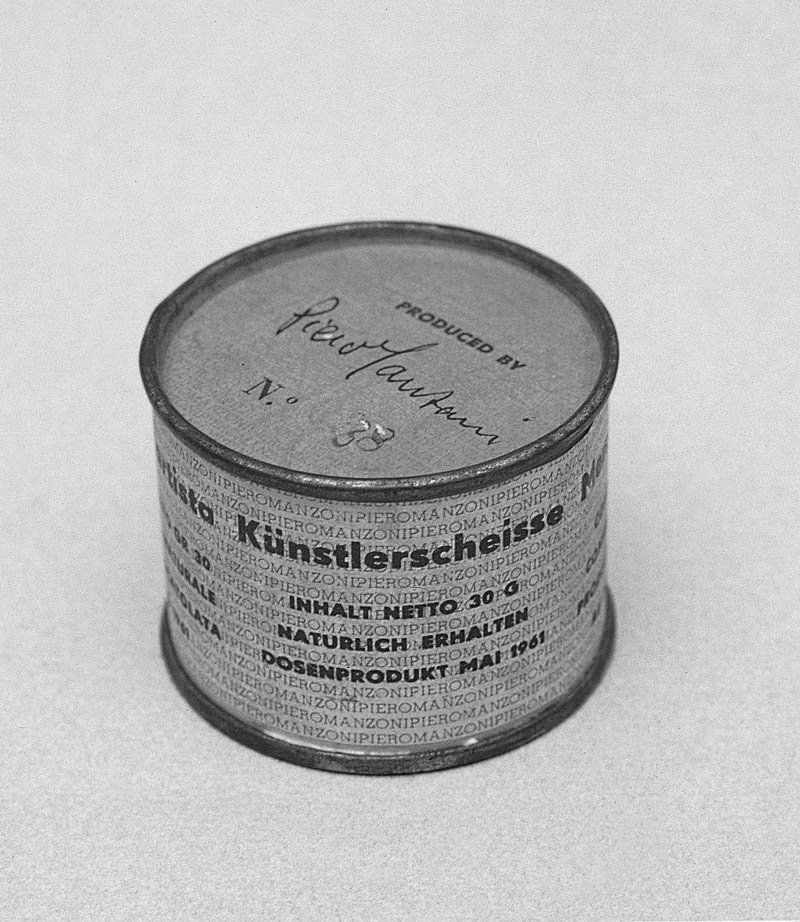
    In 1961 the Italian artist Piero Manzoni famously exhibited a tin of his own faeces entitled Merda d’artista, translated on the tin in English lest the cadences of the Italian language left anyone in doubt about the bluntness of his intentions: Artist’s shit. He priced his faeces according to their equivalent weight in gold. Had he simply evacuated his bowels on a gallery floor he would almost certainly (in 1961 at least) have been thrown out as a mere exhibitionist and public nuisance. But by canning his shit he created just enough distance from the vulgarity of his conceit and, even more importantly, created an object which could be traded as a work of art. Untreated human ordure might have stumped even the most Duchampian of curators and dealers, but a can of shit, especially when produced in an edition of 90 – smart that, even with its weight in gold, one motion would hardly have made Manzoni wealthy – gave the critics plenty else to write about other than whether shit can really be art. Otherwise, back then at least, the answer might just have been a resounding “No”. On the other hand, mass production, irony, contextualization, valuation, the gold standard, alchemy and so forth all became legitimate talking points which could imbue the cans and their contents with artistic significance. Yet the original impulse behind the “work” remains the same: Manzoni was challenging the world to accept his excrement as a work of art, the very thing which Freud suggested lay at the root of many artists’ earliest motivations to pursue a career in art. Freud would have enjoyed too the Oedipal overlaying to this story. Manzoni claimed that what had prompted him to create the piece was his father’s taunt that his work was shit. Recently one of Manzoni’s tins sold at Sotheby’s for £97,250, seventy times its weight in gold. They have become collectors’ items and are held by many national museums, including the Tate (which bought its tin for £22,300 in 2002).

    One has to hand it to Manzoni. With one simple gesture he became a far more renowned artist than before, made himself well off, and by that success produced a strong rebuttal of his father’s insult. But crucially it was a gesture. To some a witty and succinct gesture, to others an infantile one, but a gesture none the less. If it is deemed a clever and profound enough gesture to be regarded as a work of art, then its status as an artwork has more in common with a performance piece, a stunt or a comic sketch. The context is all. A can of shit unmitigated by some action can only ever be shit. Placing it in a gallery and linking its price to its equivalent weight in gold is the meaningful, possibly artistic element. This action, this gesture is no more and it should be stressed no less a work of art than many stunts or comic sketches which leave no marketable art object behind. It is also less a piece of visual art than a comic sketch because one does not have to have seen either what Manzoni did, or the can of shit itself, to “get it”. The art work, if we concede it to be one, is a purely conceptual work, entirely dependent on the profundity of the artist’s gesture for any evaluation of its merit. A blind person could equally appreciate the wit and significance of Merda d’artista as a sighted person. Since the art lies in the gesture, the can of shit itself is not the art work but merely a relic or prop reminding us of it. To treat it as otherwise, to exhibit it in a museum for people to look at as an artwork and to value it at many times its weight in gold is to collude with a kind of fetishism.

    We may be fascinated by the original scores of Mozart or Beethoven’s music but we go to a concert to hear what they wrote because their art resides in sound. Looking at the original manuscripts does not, any more than looking at a newly printed copy of the score, give us that experience. The manuscripts, like Manzoni’s cans, are art relics albeit of much greater artistic achievements. We go to a museum to look at a great modern masterpiece like Picasso’s Guernica because only by looking at it have we any chance of “getting it”. But a conceptual work that functions on the level of a gesture can be fully appreciated (or despised) without being seen at all. To exhibit the ghost of that gesture in a museum alongside artworks that are truly visual experiences is to confuse two entirely different animals. Giving them equal status as works of art is to further confuse the public, already largely persuaded that art can be anything that an artist chooses to call art. The tautologous absurdity of this idea ought to be enough to prevent its rise and rise, but it continues to make headway and is close to becoming accepted by vast swathes of the populous. Grayson Perry’s Reith lectures, well received by Radio 4 listeners it would seem, takes this nonsense as a given. Saying that art is anything an artist calls art simply shifts the problem of definition on to what is an artist. Since an artist is someone who makes art (but art can be anything the artist says it is), we’re no further on. We arrive at the nonsense of everything being art and everyone an artist, at which point both words become quite meaningless.

    I’m not arguing that a good case cannot be made for regarding what Manzoni did as art. It strikes me as being a wittier and cleverer piece of conceptual art than many. My point is that the art happened in 1961 and the can of shit is but a relic of that event, and relics should not be confused with living art works. A great Rembrandt self portrait is as potent today as the day it was painted. It isn’t the relic of an idea Rembrandt had three and a half centuries ago. It is that idea, an entirely visual one, and one that can only be appreciated by looking at it. Whereas the exact appearance of Manzoni’s can matters hardly one jot to the strength or weakness of his idea. Yet it is in the interests of the market, and the artist, to fetishize the object in order to make money out of it. In this sense it is a con and its artistic status spurious.

    The same applies to Duchamp’s bog-standard mass produced urinal. If there was art involved, it was in what Duchamp did with it. The art, if any, lay in the audacity of Duchamp’s submitting it for an art exhibition, turning it upside down, calling it Fountain and signing it R. Mutt. If this series of actions are felt by enough people to be profound, thought provoking and witty enough, then for them at least Duchamp’s stunt is a piece of art. The urinal remains just that: a urinal. It cannot itself be magically turned into an art work because an artist points at it and says it is. This is omnipotent and magical thinking of the most primitive kind.

    It is rather remarkable how much conceptual art, and likewise its fore-runner “found art”, as well as much other contemporary art, mirrors the alchemist’s dream of magically turning the basest of materials into gold. Often, as with Manzoni, this involves crap itself. Many others reference faeces and urine more obliquely. Since Duchamps urinal we’ve had Warhol’s “Oxidization Series” (involving urination), Gilbert and George’s “Naked Shit Paintings”, Helen Chadwick’s “Piss Flowers”, Andrea’s Serrano’s “Piss Christ”, Paul McCarthy’s “Shit Face Painting”, Chris Ofili’s use of elephant dung and Martin Creed’s “Body Docs” – videos of people defecating and vomiting – to name but a very few. Fortunately we have been spared Damien Hirst’s plan to cast an enormous turd in bronze, (why not gold, Damien?). But may be we’ve still got it coming to us. Even more common is the use of rubbish to make art, giving rise to a whole genre of art known as trash or junk art. A great many other contemporary artworks include rubbish or detritus. Tracey Emin’s unmade bed with its used tissues, condoms and discarded underwear is a good example as well as being a classic case of “it’s art because I say it is and I’m an artist”. We’ve moved from the realm of the nursery and any special pleading for the value of poo-poo, to that of adolescence. A cartoon at the time had an exasperated parent yelling at his teenage daughter and her unmade bed “I don’t care if it’s art, make it!” Which goes right to the point: Emin wants us to accept her messy adolescent life (represented by her bed) as art without her having to make anything.

    As with Manzoni’s Merda d’artista the use of faeces or rubbish does not preclude a work from being art. This must in the end depend on the skill with which such materials are employed and the depth of feeling and intellectual rigour that informs the finished art work. What I am suggesting is that the unconscious motivation that underlies the artist’s preference for such materials with their potential to generate quick publicity, as well as the penchant for found objects or “ready mades” is likely to be a wish to magically transform shit into art. The clues are in the puerile feebleness of so many of the ideas behind such art and the childish need for instant attention they so often betray. If Freud was right that at the deepest level of motivation artists were once infants playing with their poo and imagining it to be precious, none of this should surprise us. If the art market colludes with these primitive omnipotent fantasies by overvaluing infantile impulses and stunts, artists will surely supply it with crap.

    Patrick Cullen

    The Jackdaw, 2014

  • The importance of being Erno – Eric Coombes questions the reputation of a Brutalist architect

    The importance of being Erno – Eric Coombes questions the reputation of a Brutalist architect

    Sometimes material appears in a “serious” newspaper which—even in our  current cultural condition—is at an astonishingly low intellectual level to come from the prominent “authority” who wrote it. Disagreeable though it is, perhaps one should occasionally draw attention to such material, and subject it to closer inspection. Those who can bear to do so, should read Stephen Bayley’s article in the Daily Telegraph about Ernö Goldfinger’s Alexander Fleming House (now renamed Metro Central Heights), which can be found online at:

    http://www.telegraph.co.uk/culture/art/architecture/10171321/Look-away-Prince-Charles-Goldfingers-Tower-is-wonderful.html

    The quotation from it on p.43 of the Sept/Oct issue fails to convey the scale of the self-important imbecility displayed in the article as a whole.  It begins with a baffling non-sequitur. Having invoked the Japanese notion of “wabi-sabi” (roughly, a spiritual quality conferred by the patina of aging), he continues

    “To be aware of wabi-sabi is to be aware of the language, even the poetry, that mute buildings and dumb things speak.  Until recently, few people thought fine Zen thoughts while passing through the grimly urban and diesel toxic Elephant and Castle in south London. Now we all can. Indeed, will.”

    “Until recently”! By virtue of what power, on what recent occasion, have casual passers-by suddenly been granted this momentous epiphany, which they not only “can” but “will” experience? Is it the power of Bayley’s own eloquence in the article itself? If not, it must be the event of the building’s being listed by English Heritage, which was also the occasion of Bayley’s article; for no other reason is given to expect the rapid transformations of human experience which would justify this astonishing claim. Must we, then, according to Bayley, attribute to English Heritage powers we had not dreamt of its having, powers of a supernatural or, at least, sacerdotal character? Or is English Heritage held in such popular esteem by all those thousands of people moving through that “grimly urban and … toxic” environment every day (some slight relief here in observing Bayley’s immersion in fantasy to be less than total) that the wisdom of its pronouncements fills their minds, and is received so eagerly and uncritically as to transfigure and regulate their perceptions?

    Bayley’s claims are supported by nothing whatsoever but the assumed authority of the workings, or rather lurchings, of his own mind. The entire article consists of mere assertion and egregiously transparent non-sequiturs. What exactly, for instance, is the argument supposed to be in the following?

    … his Trellick Tower in Notting Hill and its twin sister Balfron Tower in Poplar (already listed) are hatefully remembered icons of infamy for those who lazily condemn all modern architecture as heartless and inhumane. Yet a thoughtful appraisal reveals as rich a variety of historical sources in their design as you would find in Vanbrugh: the bravura Futurism of Antonio Sant’Elia, the bold shape-making of Auguste Perret and the structural theories of Le Corbusier, for example.

    Whether or not Bayley has correctly identified them, and whether or not the richness of their “variety” is comparable with what we find in Vanbrugh, why should the discovery of “historical sources” for Goldfinger’s designs have the slightest tendency to establish that the buildings are not “heartless and inhumane”? Is a lack of “historical sources” a necessary condition for a building to possess these regrettable attributes? Would it be impertinent to ask Bayley where he finds grounds for that principle, other than at some chance place where his mind was brought by its randomly veering motions, and came briefly to rest? Not to overstate the point, the principle is not self-evidently true. Since the absence of “historical sources” is unknown in architecture, or even in “architecture”, it entails the intriguing conclusion, which is not—shall we say?—intuitively convincing, that there can be no such thing as a heartless or inhumane building.

    Bayley claims that the listing of Alexander Fleming House “recognises several important things. For example: the fragility of prejudice, the permanence of concrete (which if we are honest, weathers very beautifully) [sic] and the way the solemn gravity [“overbearing joylessness” would come closer here] of great [sic] architecture transcends the spiky little fits and pricks of temporary taste.” Here again we have pure unsupported assertion.  But of what exactly? What does it mean to “recognize” the permanence of concrete?  Was that permanence in doubt, and would such a doubt be allayed by listing the building, any more than listing it would oblige concrete to “weather very beautifully”? How on earth does the listing “recognize” the “fragility of prejudice”? In what sense can prejudice (as the word is now commonly used) be fragile, rather than merely wrong? If this means anything at all, it means that the adverse judgement of the building is wrong, and must be dismissed as prejudice. What is here implicitly alleged to be prejudice is, in fact, the judgement of most people who are aware of the building, including those who have had the misfortune to work in it; and, far from being “fragile”, that judgement appears to remain remarkably robust and stable.

    It is, in any case, unclear, to put it mildly, how far praise of this kind is consistent with the statement that “Alexander Fleming House is confrontational, exactly as its architect intended it to be.  But it was designed as a manifesto, an idealistic statement.” Surely this means that, whether through the beauty of its weathered concrete or in any other implausibly supposed way, it was never intended to please those forced to endure its presence in our capital city—still less to engender the “mystical” experience of “Wabi-sabi”. And this raises a crucial question, never answered or even recognized by the likes of Bayley, who, by carefully ignoring it, aggravate the impotent rage of so many people, when they contemplate the state of our cities and towns: by what moral authority are the Goldfingers, or any of the ego-maniacs practising as “architects” today, licensed to transform huge areas beyond recognition, with enormous oppressive buildings?  Who decreed that the public should be permanently confronted with manifestos that they have never asked to see, but should be forced, repeatedly, to read?

    Are these manifestos au fond religious or quasi-religious?  This thought could lead us, finally, to notice one curious passage, which is extraneous to the main topic, but may nevertheless be significant.  Having emphasized that Goldfinger was “not plagued by any lack of personal confidence”, Bayley adds that “[h]is personal sense of self-worth was practically enhanced by marrying the heiress to the Crosse & Blackwell soup fortune.” Now the wealth of a spouse is not usually regarded as a matter for regret; but this seems to imply not merely that Goldfinger, like most of us, preferred to have more money rather than less, but that he regarded wealth as constitutive of virtue—that he worshipped at the altar of Mammon. This most corrosive of all idolatries, is now a dominant cult (perhaps to an unprecedented extent), which spreads its poisonous doctrines widely, finding many followers among the powerful in all walks of life, including those in government at every level. They worship with dementedly implacable conviction, apparently believing that everything, including personal merit, can and must be assessed in monetary terms. Nowhere do we see this more plainly and forcefully symbolized than in those gigantic temples of Mammon which loom threateningly over once agreeable streets, their repulsive ugliness embodying the ugliness of what they signify. Here, then, Bayley touches, no doubt inadvertently, on an important point, which is caught in a brief flash of indirect illumination. The spoliation of our towns and cities is imposed by the brute power of large property companies, against which local communities are almost defenceless, which have the planning system blatantly stacked in their favour, and which corrupt government, both central and local. Almost limitless, their financial resources are used, one might say, to satisfy both the greed and the vanity of the architects they employ, as if those vices were clearly distinguishable. But the contemporary world of big business, where predatory property developers are in league with big architectural practices (and ruthless lawyers), must cultivate an atmosphere in which merit is identified with the possession of wealth, or the ability to gain it. This is what Bayley suggests, presumably unintentionally, about Goldfinger.  In the church of Mammon, refined distinctions of morality are otiose: the virtues of greed, vanity, arrogance and ruthlessness become inextricable, as they coalesce in the righteousness of ego-mania and megalomania. Our cities and towns have become arenas for the display of zeal in the service of Mammon.

    Even I was surprised to find such drivel, written by a well-known figure, published in a supposedly “serious” newspaper.  I would challenge anyone to find, in the entire article by this alleged critic, anything that could be considered criticism. There is no attempt to discuss Goldfinger’s building in a way that might help the reader to see it as Bayley thinks it should be seen. All is assertion and non-sequitur.

    Postscript

    I was not quite sure how to take The Jackdaw’s own remark about the listing of Alexander Fleming House under News on p.34 (Sept/Oct issue): “Like it or not it is among the great buildings of the New Brutal style and deserves to be preserved.” Is that “great” as in “great painting”, “great poem” or “great mind”? Or “great” as in “great crime”, “great fool” or “great mistake”, where “great” means something like “notable example of its kind”, irrespective of whether that kind is itself good, desirable or admirable? The building is certainly great in the latter sense, and buildings are now, apparently, listed merely on the grounds of their exemplifying some episode of cultural or social history which is of interest and which they record.    One wonders how far the principle might be taken.  Already a zebra crossing has been listed because of its association with the Beatles.  Is a city a museum? Do we regret, for example, that no one had the foresight to insist on parts of the East End of London remaining in conditions which would have continued to foster squalor, disease and infant mortality? Those conditions are undoubtedly a matter of historical interest; but documentary and visual records of them are surely enough. Far from wanting to wipe New Brutalism, or any other manifestation of architectural insolence and crassness from the record, I think it should be fully recorded, if only as a warning. But I fail to understand why that should entail its continuing to deface our towns and to blight the lives of those forced to endure its oppressive presence.

    Eric Coombes

    The Jackdaw, 2014


  • Frieze – state art’s closed shop: artist John Keane exposes a cabal

    Frieze – state art’s closed shop: artist John Keane exposes a cabal

    In 1986 I did a large painting which I called The Emperor’s New Pose and was subtitled The Importance of Being Important. It poked fun at art market darlings of the time, such as Julian Schnabel and Georg Baselitz, and included felt that I had stolen from a Joseph Beuys installation at the Anthony d’Offay Gallery, London.

    Now, more than a quarter of a century later, the excesses of the 1980s look paltry by comparison, and the art market has multiplied to proportions then unimaginable. With the increasing polarisation of wealth distribution since then, the apex has become more and more removed from the base of an increasingly distended pyramid. As with society itself, so with the art market, and nothing has exemplified this more graphically than the Frieze Art Fair.

    Although as a practising and exhibiting (though not at Frieze) artist I am inevitably implicated, I cannot help but have profound misgivings about this world whose margins I inhabit. The commercial art world has always had an unpleasant whiff of bluster and disingenuousness, but as the pyramid has expanded and distended, the high end has provided a kind of currency for mopping up the excessive disposable income of a super-rich international élite who may be seeking alternative, less vulgar trophies with which to display their wealth than yachts, Ferraris and Louis Vuitton.

    It is therefore unsurprising that enterprising brokers in the form of gallerists have emerged to service and exploit this concentration of wealth. Enjoying a certain amount of inscrutability, contemporary art has been an ideal vessel to absorb this wealth in need of a home, and as the alchemists of old relieved the greedy of cash in the pursuit of turning base metal to gold, so galleries now can transmute art into objects of desire, whilst at the same time cleverly conferring both a cachet of cool and membership of a social élite onto their clients. The somewhat inscrutable nature of some aspects of contemporary art complements this, since it often requires validation by cognoscenti of impeccable repute, and this is where museums and curators fulfil their invaluable role.

    These museums have assumed the status of latter-day cathedrals, whilst curators and directors form the high priesthood who confer ‘importance’ with their patronage. Uniquely amongst the arts, reputations of artists are determined by a limited number of individuals (see the Art Review Power 100). Collectors and gallerists will look to these institutions to reinforce the reputations of artists they collect by purchasing and exhibiting their work (or appointing them as a trustee). And whilst these collectors bask in the perceived generosity of lending to museum exhibitions, they may also draw satisfaction from the resulting enhanced value of their investments.

    It may be argued that it was ever thus, and that artists have always enjoyed a somewhat unsavoury relationship with wealth and power. That may be true, but it is still not a pretty sight. And in these days of ever-more obscene disparities of wealth, the fact that art provides such a public forum of ostentation makes it even more ugly.

    I have never felt comfortable at art fairs, and it is some years since I have visited Frieze, not only balking at the outrageous admission price, but, if truth be told, also from a twinge of resentment. This is, after all, a club to which I cannot belong, having been represented for the last 25 years by a gallery which has been consistently excluded on the grounds, I imagine, of not being hip enough. In fact the gallery was told that they could save themselves the trouble and cost of application, as there was not a chance of being offered a stand.

    As I watch the Tate video of Nicholas Serota, director of the Tate for nearly a quarter of a century, with his retinue of acolyte curators, domestic and ‘international’, scurrying through Frieze as though it were the Harrods sale, a few seconds ahead of the oligarchs in their dash for ‘important’ work, my heart sinks. They have £150,000 (not much, I admit) provided by the Outset/Frieze London Fund to Benefit the Tate Collection to acquire works for the national collection – works that have been selected by commercial galleries that have been selected by Frieze Art Fair. What sort of way is this to acquire art that will be in the national collection for ever more? Is there not a conflict of interest in Tate endorsing the work of artists in an art fair, where by virtue of that very endorsement their value will be immediately enhanced?

    Outset, the charitable fund secured from donations from wealthy art collectors, profess a remit of collecting ‘challenging’ work, a patronising term if ever I heard one. Who, I wonder, is challenging the decisions of this élite cabal?

    John Keane’s work concerns important aspects of current affairs: www.johnkeaneart.com

    John Keane

    The Jackdaw 2014


  • Disobedient Objects – Edward Lucie-Smith at the Victoria and Albert Museum

    A dwarf’s hat, as worn by 10,000 protesters at a 1988 march against communism in Poland

    It is understandable that, in current circumstances, major arts institutions should try to ally themselves with the more anarchic, contrarian elements in contemporary culture. Perhaps this is especially true of those dealing with the contemporary visual arts, committed as these still are to the myth of ‘avant-gardism’. One problem that immediately presents itself, of course, is that this myth is not itself contemporary – it is rooted in the very earliest years of the century before ours, and first blossomed before the outbreak of World War I. The myth has become so diversified in the course of more than a century of growth that what is indisputably avant garde today has become very difficult to define. One man’s ‘avant garde’ can easily be his neighbour’s idea of ho-hum, follow-my-leader conservatism.

    Another problem, allied to the first, is that the history of the 20th century avant garde was rather specifically a history of élites. Avant-garde artists relied on élite patrons for financial support – independently wealthy, high status individuals who were conscious of the fact that their championship of the radically new distinguished them from the mass. There is also the fact that the now-classical avant-garde art movements initially embraced right wing politics more enthusiastically than they did left wing ones. This was the case with Italian Futurism, the most publicised of the early avant-gardes. Later, when avant-garde artists began to identify with the left, it was nevertheless would-be mass movements, Nazism and Soviet Communism, which were particularly hostile to avant-garde art. When Surrealism tried to sustain an alliance with Communism, the relationship was always extremely uneasy.

    Disobedient Objects at the V&A (until February 1st) shows that this uneasiness has not gone away. Housed in one of London’s most important museums, its organisers have gone to some lengths to emphasise its democratic status. It is free entry, like the rest of the permanent collection (but unlike the other special exhibitions the museum offers as part of its regular programme), and it has been given an unusually long run – six months in all.

    What it offers is an anthology of objects connected will all sorts of anarchic projects, from the anti-nuclear protests at Greenham Common in England, to the Mothers of the Disappeared in Buenos Aires – all challenges to some kind of existing status quo, made in many different contemporary societies and national entities, democratic and non-democratic. Most of the objects concerned would not normally be classified as art, or even as craft or design. In fact, what one has here is a kind of religious treasury – the holy relics of a number of recent episodes of social agitation, some of which succeeded in their aims and some of which failed. If Christ had lived in our own times, it wouldn’t be surprising to find a relic of the True Cross as part of the display – always remembering that this now sacred item wasn’t, and was never intended to be, a work of art, despite the numberless times it has since been depicted in art. I say this in the full consciousness that, to anyone who reads the Gospels carefully, the texts do in fact seem to advocate a radical egalitarian revolution in society. This despite the famous verse that tells the convert to: “Render unto Cesar the things that are Cesar’s, and unto God the things that are God’s.”  [Matthew 22:21].

    The introduction to the catalogue, by the two curators, Catherine Flood and Gavin Grindon, shows a queasy consciousness of this situation. On the one hand they say:

    “The position of this project, both ‘within and against’ an institution, emerges principally from careful attention to these objects [included] and their own and their own instituent power.”

    On the other they declare:

    “Exhibitions are moments of collective meaning-making. Bringing these objects and histories together, and presenting them to an audience that never encounters them outside the mass media, makes the museum a site for difficult questions and tests it claim to be a public space.”

    The phrase that betrays something here is “never encounters them outside the mass media”. The assumption seems to be that what is experienced within the sanctified space of the museum must necessarily be superior to the same thing experienced outside it. In other words, the official framework, just because it is official, offers a validation unobtainable in the non-official circumstances in which these ‘disobedient objects’ were first made. This paradox is a step too far. The objects concerned have, on the whole, no aesthetic value. They may have had force within the very specific contexts that provoked their production. But not here. They are dead fish on a slab. In an interview given in conjunction with the show, Catherine Flood claimed that the items displayed had not been ‘museumified’ – her word, not mine. I beg to differ. That is exactly what has happened.

    One reason for this is the kind of public that great museums attract. They like to pretend that they are for ‘everyone’, and this is indeed why, in democratic Western European societies, they are given large sums of taxpayers’ money. Any observant person knows, however, that this ‘everyone’ is not completely universal. Museums attract the kind of citizens every democracy would like to have, perhaps to the exclusion of other, more difficult cases. They pull in the bien pensants – people who get a nice glow from the idea of going there. Certainly not the bulk of the truly disadvantaged, the real outsiders. They get a much higher proportion of middle-class visitors than working-class ones, though this distinction is slowly breaking down.

    Where immediate, visceral access to the ideas being put forward in the show is concerned, the mass media win the contest, hands down. They know how to hit the public in the gut, and they operate in a fully public arena. You run up against them in your daily life, whether you want to or not.

    What the museum does here is to try to organise the ‘disobedient’ material to make it palatable to the kind of visitors museums already get. Having heard about the show, you have to make the decision to go, even though you don’t have to pay a fee for the experience. Which means, in turn, that your mind is probably made up about the ideas it puts forward, long before you arrive.

    As it happens, London has already seen a rather similar exhibition – Mark Wallinger’s Turner Prize-winning exhibit at Tate Britain in 2007. This, entitled State Britain, was a meticulous reconstruction of the ‘Peace Camp’ set up by the late activist Brian Haw in front of the Houses of Parliament, in protest against the Iraq War, and subsequently dismantled by the police because it contravened a hastily passed law against “unauthorised demonstrations within a one kilometre radius of Parliament Square”. Much play was made with the fact that the site of the installation within the museum building also seemed to fall within the forbidden zone. However, as the critic Tim Teeman, writing in The Times, remarked, “moving Haw’s protest from the street to the hallowed hush of the Tate denudes it of rawness and energy. The riot of colour, the anarchy of words and images, are dimmed; the weatherbeaten plastic coverings aren’t flapping in the wind anymore, but listlessly reflecting gallery spotlights.” He concluded by asking: “Does it ask new questions or challenge our preconceptions?” And answered his own query: “No, it merely confirms the liberal consensus.” This is exactly what has happened at the V & A, the second time round.

    In fact Disobedient Objects is a very good example of that hallowed middle-class liberal pastime – preaching to the converted. It claims to be radical and is in fact deeply conventional and self-congratulatory. It won’t change anyone’s mind.

    Edward Lucie-Smith

    The Jackdaw Nov/Dec 2014