Category: Comment

  • Dick French: On The Town – January 2017

    “For we know it’s right, it’s in black and white, and it’s written down in his diary.”

    The immortal words of Benny Hill came to mind as I purchased the complete set of Samuel Pepys’s diaries for fifty quid. This pleased me exceedingly as such a set can usually cost – the venality of bookmongers being so great – well over a hundred. In an old box outside the same shop I discovered a full set of Reginald Perrin videos for just £2. “I didn’t get where I am today without rummaging around in old boxes.”

    Up very betimes and to my workroom and then by omnibus to the alehouse in St Martin’s Lane for my morning draught. By and by comes Mrs Cravat and Calamity Jane. The daughter, a comely wench who weareth the lipsticke, is a rug muncher withal, so dalliance is ill-advised. She runs an alehouse on Warren Street clept The Smugglers and is needed become so tattooed that she resembles a very privateer herself. They provide there a cocke-tail called The Black Spot of rum coffee, sassafrass and jaggery – a vicious little nip. They dined upon neat’s tongue and an udder which did please them exceedingly. But I demurred as my appetite is grown delicate betimes and doth not revive until the evening.

    Returning to my workroom I continue my series of diverse, lewd, impious and obscene drawings, representing men and women in the act of carnal copulation.

    I pondered awhile on that cunning jade Miss Prickens, whose proclivities are the talk of both Whitehall and Covent Garden. She hath abilities beyond those of most women and is said to perform The Whirligig. I decided to send her a message by my boy, e’en though I knew she would be busy.

    To Hampstead to purchase art materials. Whatever happened to Bird and Davis of Kentish Towne? I went there one morning and they had disappeared. The art shop in Hampstead provides carrier bags bearing the legend “Let’s fill this town with artists!” What a horrible thought.

    Just downhill from the art shoppe is an alehouse, The Flask. I was enjoying a morning livener of winter warmer when I noticed that a new beauty salon had opened across the way. It advertised “wart and verruca removal”. I had no idea the good folk of Hampstead suffered such low afflictions. So much for the Chalybeate spring waters… obviously not all they’re cracked up to be. And so I begin to learn modern expressions.

    Down river to Bankside, there to attend an exhibition of curious art pictures in a converted power station. They are by an American fellow, Robert Rauschenberg. To enter this show one must part with £15. I could hire an able bodied seaman at 21 shillings a month for well over a year for this exorbitant sum. A socialite with a finger in many a pie, and a bugger withal, Rauschenberg could not fail, nor did he. The paintings are a congeries of sundry miscellaneous rubbidge, two of which, Charlene and Gold Standard, I liked exceedingly. That latter incorporates a small dog of the sort to be found on record labels. Yellow overall; and projecting some distance from the wall and across the floor. Charlene is mostly a red piece with a segmented circle in the top right hand corner. Both works look much better in photographs, the cheap paint having deteriorated unpleasantly.

    In another room a collection of drawings with not a line in sight. Instead they are transferred from newspaper cuttings with the aid of lighter fluid. They are said ‘to deal with’ Dante’s Inferno. This technique has for decades been used by schoolchildren and I remember it being much discouraged as lazy.

    A most amusing piece is a large shallow tank filled with streaming and occasionally erupting sloppy clay. It reminded me of the snood of porridge looked after lovingly by Adam Lambsbreath in Cold Comfort Farm. “Nat nay nivver say that Robert Poste’s child and to think that I cowdled thee as a mommet.”

    A number of ballet performances are displayed on televisions. The dancers are trolloping about with umbrellas stuck to their backs. I found them unbearably ‘artistic’ and whimsical.

    He did some amusing things with corrugated cardboard but over a long career there was very little development. He finished as he started, a respected member of the institutional avant-garde, and he never drew a line.

    I forgot to mention that on my way to the show I was looking forward exceedingly to the “iconic upwardly soaring escalators” about which I had read so much, and I was not disappointed. Up they soar and down they swoop, although swoop is a misnomer as progress is effective but stately. On my final descent I lighted on the basement, a cavernous space of great cacophony and flashing lights. By and by I realised I was in the midst of a prodigious thunderstorm, but without the wetness thereof and it did please me to wander about up and down.

    Back over the bridge and up to St Paul’s to catch an omnibus, but the traffic so bad that I light on Ludgate Hill and proceed on foot to St Martin’s Lane. Pausing by and by at an ale house in Bull Alley to meet Mrs Bagwell where I had great enjoyment. “Apres avant toccado les mamelles que erant ouvert como siempre, she made shift to fudle mi cosa, but I demurred, it being too publique. ‘Some other time Mrs Bagwell. I am after all in charge of the Royal Navy’. ‘Oh rum bum and concertina!’, she cackled as she flounced off to the company of a bunch of knaves in the next room.

    On betimes to The Salisbury where talk was of that impertinent prating coxcomb Widow Twankey. I would happily see him in the ducking stool were it not that he would probably enjoy it. It would make a good television programme withal, introduced by that tedious pricke Melvyn Barg. Picture the scene. On the banks of the Thames, strapped in with the chair raised to its highest extent, his still dry party frock is caught in a gust of wind and, flying up, reveals a pair of crisp Y fronts. Perry, his secret revealed, is mortified and begs to be released, but it is too late, the beam is already descending.

    Bob Rhodes, artist, friend and dandy has just written to say he is dying of brain cancer and has three months. An unusual man, the like of whom I’ve never met before or since, his sartorial ideal was the striding figure on the Johnny Walker label to which end he always wore tight white trousers and a red crushed velvet long jacket and a neckstock. I was always jealous of his buggers’ grips as I’ve never been able to grow them. I’ve written before here about The School of Pubism which flourished at Sheffield Art School in the mid-’60s. Bob Rhodes was King of the Pubists. The things he could do with chammy leather, kapok and a bit of gloss paint would make your eyes pop out. It was like a desecration of Pop Art. The greatest compliment in those times was for an observer to say “Ooh that’s really sick!” Later on he turned to sculpture and then a series of constructions based on Art Deco cinemas. Some of these were painted Day-Glo pink on the back so that on a white wall they seemed to be hovering in a halo. After moving to Ironbridge in Shropshire he turned his attention to Coalbrookdale. He was keen on the idea that the power station at the end of the gorge created a micro-climate. Whatever its theme his work was always meticulously well made. A later theme was of ruined holiday resorts evoking scenes from J G Ballard.

    A curious thing about Coalbrookdale is that the people who live there have mining rights to their gardens. Bob was rather proud of this, but as far as I knew he never took advantage. He never married but I remember a series of unusual and sometimes spectacular girlfriends, one of whom he kept in a hut in the garden.

    Bob was a champion gurner though he never used a horse’s collar. He always cracked up the opposition by dribbling. I’ll never forget his 21st birthday party when he drank 21 whiskys and ended up in the model’s dais with just his foot poking out. A conscientious tutor, Dave Smith, noticed the problem and took him to the hospital to have his stomach pumped. He was back in the pub by 8.30.

    Bob was also an intrepid potholer. I remember once, deep under Stoney Middleton, dragging him out of a sump on the end of a piece of clothes line. (A sump is when the roof dips down under the water and you go through it hoping to find air on the other side.) Having a carbide lamp on the front of his helmet, he was the best equipped. We were all so ill-kitted it’s a wonder any of us survived.

    Dick French
    The Jackdaw, Jan/Feb 2017
  • Dick French: On The Town – November 2016

    Well done Fabienne Jenny Jacquet for her Easel Words in the last issue. She writes very clearly, which is rare for an artist. She is concerned with artists and their dealers’ demands for a neat visual package and a personal ‘brand’. I liked her piece very much. I don’t bother with dealers these days. If anyone is interested in my work I’m quite easy to find. Just ask in Bradley’s Spanish Bar or you could try and see my agent Gregorio who has an office next door … but be warned he’s a very busy man. Madame Jacquet’s paintings look quite interesting. They seem to be knifed on. I must try to get to see them properly. Sock it to the spivs madame. I deeply resent handing over half my hard-earned to some wide boy who runs an art shop.

    To Fortnum and Mason’s to purchase some Gentleman’s Relish. I’m running low and Christmas is coming. On the way I met Dirty Harry in The Chequers. He reminded me that there was a big art show going on in Fortnum’s, the collection of ‘Saatchi of the North’ Frank Cohen, so we popped in. The door was opened by a friendly Irishman in a top hat who explained that the collection was distributed throughout the store on all floors. It was an interesting but puzzling display, but then I’m always saying that.

    How can someone who has bought Edward Burra with his idiosyncratic draughtsmanship, wit and mischief possibly be interested in the feeble, self-important gesturings of Howard Hodgkin? There’s also a creature called Charming Baker extensively represented, whose sculptures must be made for middle-eastern clients – they’ll look good on the dashboard. The ‘Geometry of Fear’ sculptors are also here in force, Armitage, Chadwick, etc.. They seemed to blend into the background.

    The best things were the Burras, especially a magnificent gloomy pub scene from 1946. You can feel the damp and foggy chill and a bit of reeking warmth from the gas stove. Burra himself seems to be standing at the bar as a flame-like ghost floats off towards the left, probably one of those ‘free gifts’ he’s turned to advantage. I’m sure it’s a self-portrait although the nose suggests otherwise.

    I’m also totally baffled by the inclusion of Marc Quinn and his ludicrous travesty of Degas’s ballet dancer. I can only assume that Cohen has a team of advisors, as there is no indication of a personal ‘eye’. It’s a bit of a rag bag really, or, as Edward Burra would say: “It’s all a proper cunt and no mistake dearie.”

    I managed to find the Gentleman’s Relish but these days it comes in a lovely blue porcelain pot at £16.50 a go, and it’s now called Fortnum’s Relish. I wonder if they still do it in Sainsbury’s.

    There were also three paintings by William Roberts that were worth looking at. A chap I once knew who had a small collection of W. Roberts used to say of him, “poor fellow, the world’s passed him by”. He also had a hideous late Picasso hanging over the mantlepiece. It was a cavalier smoking a pipe about five feet by four. I advised him to flog it off while it was still worth something. I’ve not been asked back. Picasso has been highly regarded and sought after for over a hundred years. It can’t go on forever. The tedious old clown will surely be rumbled soon. Don’t forget what happened to Lord Leighton. “But Lord Leighton had a revival” I hear you say. He also had a romantic sensibility and a true appreciation of form.

    To the Royal Academy to see the Abstract Expressionist show. Pride of place is given over to the murderous, shirtlifting old cowpoke Jackson Pollock. I was surprised by the condition of Blue Poles. The last time I saw it was in his retrospective at the Tate 20 years ago and it looked dreadful, the colours not so much faded as intensified in crudity. The colours are paradoxically much more agreeable now. It must have been restored, some task I imagine, or maybe it’s the Aussie air. The cheap cotton duck had yellowed and cracked.

    There was an enormous oriental fellow in a heavy black overcoat and a homburg hat, his arms extended towards it, palms to the painting. I just had to see him from the front. His eyes were tightly shut and he resembled Odd Job in the James Bond film, the chap with the lethal bladed hat brim. I’ll never forget that. It was a perfect example of how people can become deluded by reputation. “It was the vibes man, the vibes.” Oh shut up.

    Blue Poles (opposite), now highly regarded, was considered a failure by Pollock, a retrograde step from what many considered the groundbreaking black and white paintings of his previous series. It was a collaboration. He called in Barnett Newman and an Irishman called Tony Smith. The ‘poles’ were applied by a six-foot length of four by two. Apparently he was anxious not to waste the expensive Belgian linen. Well it doesn’t look like Belgian linen to me. Using oil-based household paint on raw cotton duck, as he invariably did, it’s a wonder they haven’t rotted and fallen apart.

    Most of these pioneering, free-spirited artists were in thrall to Clement Greenberg. This is odd because Greenberg’s qualifications as an art guru were very slight – a summer session at the Art Student’s League and a few lectures at the Hoffman Institute. Previously he had worked on the Partisan Review, trying to make a name for himself in the literary world, in which he was regarded as pompous and intellectually mediocre. He was a posturing fraud but they hung on to his every word. It is said that he’d walk into an artist’s studio, look at a painting and declare “You can’t do that!” And they actually stopped doing it!

    He it was, who conferred the mantle of “greatness” from time to time, on this one or that one. At first Pollock was the man, but his time on the sunlit uplands was surprisingly brief. After a couple of years they all turned against him. That article in Time magazine put everybody’s back up. He became a ghastly bore from whom everyone wanted to escape. Poor man. Whatever you think of his work or his behaviour he was deeply serious.

    There’s a story that all his life he urinated in the sitting position, like most women, and another story about how he pissed into the fieplace at a swanky art party. I hope he didn’t do that sitting down.

    Numbering the paintings was also a Greenberg idea, the problem being that the numbers were not consecutive but picked at random. Then Greenberg changed his mind and proposed titles. Hence Lavender Mist … (‘Sorry about last night darling I must have been a bit lavender.’)

    Greenberg was a Marxist with a belief in the historical inevitability of artistic progress, or was he just flying a kite? Maybe a bit of both, but a sly boots if ever there was one. Someone described his approach as ‘puritanical nonsense applied with Talmudic intensity’. It was all to do with the ‘integrity of the picture plane’ you see.

    There are seven paintings by Rothko in the rotunda and although I didn’t have an epiphany I liked three of them very much, the dark, close-toned ones with the glowing bass lines. Rothko was another one of those ghastly bores who became shunned.

    A stellar bit of hyperbole in the catalogue about Clyfford Still … “The upright living being and spiritual transcendence. Its nemeses are the yawning abysses – by turns molten and glacial which interlock with his upthrusts. An almost Manichean play of luminosity and darkness heightens this dramaturgy, intensified by Still’s scabrous surfaces.” Nice. I like that ‘upthrusts’.

    De Kooning’s paintings have something which sets them apart from the others. You sense a compositional ability and draughtsmanship, particularly in his ‘Women’ series, although the best of these are not included. They’re very strong but he went off badly in the 1960s becoming pale and wishy-washy, chalky abstract landscapes with no tonality.

    There’s a sense of ‘The All American Boy’ about this period and almost everything that came afterwards. An inability to draw was elevated to a virtue along with scorn for the sensuous application of paint. But look back fifty years to George Bellows and the Ashcan School of New York painters and they could draw beautifully and paint as well as any European. What came after this was, of course, Rauschenberg, Johns and Pop Art. That’s historical inevitability for you.

    It’s also interesting that the fashion for ‘tough guy’ artists crossed the Atlantic. We don’t have cowboys in England but at the Royal College of Art in the ’60s there was a fashion for behaving like an East End gangster. Elective mutism or self-imposed thickness was common, along with the sophistry that led to conceptualism.

    Dick French
    The Jackdaw Nov/Dec 2016

    www.frenchonpaper.tumblr.com
    www.vimeo.com/12538534

  • Dick French: On The Town – September 2016

    There’s a room in my flat that I rather grandly refer to as ‘The Library’. About 20 years ago I had it fitted out with shelves up to the ceiling with nicely boxed-in corners. It’s painted deep red. For a few years it looked splendid, then it gradually started filling up with junk. Now it’s waist-deep in motorcycle parts, leather trousers, helmets, exhaust pipes and tins of oil. I’ve been trying to excavate it recently as my son has gone off to work in New York, and now the whole flat resembles a junk yard. The book I’m trying to find is the collected writings of Sir Thomas Lawrence. So far I’ve had no luck. I remember it was dark green with faded gold lettering and quite thick. The reason I’m keen to find it is the exhibition Painters’ Paintings at the National Gallery. The great treat of this show is a preparatory drawing by Carracci for The Loves of the Gods, A Woman Being Carried Off by a Sea Monster, which used to belong to Lawrence. It’s such a fantastic piece that I’m sure he must have written about it at some length. What condition was it in before he bought it? Was it rolled up or crumpled? Where did he get it from? How much did he pay for it?

    When I find the book I’m going to be like Lieutenant Columbo when he started to whistle ‘This old man…’, but until then I’ll just consider the exhibition, which is interesting but puzzling.

    How could such a great draughtsman as Degas have lived with Cézanne’s cack-handed Bather with Outstretched Arms? The universal veneration offered up to Cézanne has always been a mystery to me. He did some lovely still lives, but get him away from the fruit and veg and the wonky bottle and jug and he’s just dreadful. Matisse owned a horrible small Cézanne of three bathers, quite ill drawn and formless – viridian, yellow ochre and navy blue. Lucien Freud also lived with a nasty little number by Cézanne, L’Après midi à Naples. Freud’s own self-portrait in this show was dismal. Thick paint, once it is dry should never be painted over. It made me itch. Lord Leighton had a dubious small Tintoretto and Van Dyck had a wonderful Titian.

    Well, so much for art.

    I wandered up to the National Portrait Gallery to see ‘The Beep’. It’s worse than ever this year. The most revolting thing of all was a photo-realist job of Andrew Motion. Motion is an unfortunate name for a poet but it’s a good description of his portrait, and from the little I’ve read of them, his verses as well. Oh, and I nearly forgot. After the Painters’ Paintings show I popped upstairs to see the Humbrol bloke from Coventry and his woodscapes. To paraphrase Richard Dawkins: “This exhibition fills a much-needed gap.”

    After another search of the library I’ve accepted that Sir Thomas Lawrence is no longer there. It’s funny how books go missing. It can be of hardly any interest to anybody but in the process of looking I’ve discovered a few old favourites: The Biggles Omnibus and a fat book of Maigret stories (illustration: Jean Gabin as the sleuth). I’m looking forward to reading these again. A few years ago Penguin started re-publishing some of the early Maigret stories and I didn’t find them all that interesting. In those early pieces Simenon had yet to discover the importance of digression which is one of the great pleasures of his later stories. I’m really interested in what Maigret had for breakfast, whether he has a demi-blanc with his croissants, and I love the way he is always sending down to the Brasserie Dauphine on the Quai des Orfèvres for beer and sandwiches when he’s in the middle of a long interrogation.

    Back to the Humbrol Man. At no point during his rather complicated tree pictures does he take advantage of a slip of the brush. Nothing is allowed to enliven his initial intention. You will search in vain for the “free gift”, and they would have looked much better on wood. The interesting piece among his life drawings was one of Aphrodite at the Waterhole, Tony Hancocks’ great sculpture from The Rebel.

    A large, shell-off crustacean with a head-mounted penis emerges from Barry Humphries’ left sleeve. It’s heading for the Dame’s face with her mismatched eyes. I am of course attending the new exhibition of David Hockney’s portraits at the Royal Academy. Hockney should be congratulated for making a little go a long way. I suppose it’s his Yorkshire thrift. Squeeze out the shrimp paste and mix it here and there with a bit of white. It should be called The Prawn Show. He has an electric motor to make his easel go up and down and employs a “studio manager”. Maybe I should get one ­– that must be where I’ve been going wrong. He even has someone to squeeze his tubes – and that’s not intended as a double entendre. He’s quite good at shoes. I think these portraits are meant to be seen as an ‘installation’ and not individually ‘interrogated’. It’s just as well. Hockney is another painter who has never let a happy accident enliven his pictures. What a plodder.

    But who am I to slag off a national treasure. Well, I suppose it’s because I’m so bitter and twisted I recommend a good slagging off. It’s much more fun.

    A few years ago an artist and good friend of mine, Whingeing Loser in fact, wrote a critical piece about some aspects of the art business, which he showed to someone connected with his local arts council. “You do realise,” this worthy said, “that if you publish this your career will be over.” To which my friend replied, “What career?”.

    Thus was born The Dreadnoughts, we who will slag off anyone. Fear us, we are the future.

    Now, some notes on my recent beauty panels…

    I like to have things unfinished and go back to them later, sometimes years later, and then I know exactly what to do with them. It’s a good way of avoiding the demon of preciosity which can creep up on you and has a paralysing effect.

    Every 20 minutes or so I like to take a break, wander into the front room, see what’s going on in the street. Check how the sukebind is coming on. It’s slow to flower this year but the beans are doing well.

    I do a lot of work from the video screen these days. You have to work fast because if your equipment is anything like mine it jumps after about ten minutes. It’s just like working from life without the chalk. I get a lot of films from my friend Kenny, who runs an exotic shop on Goodge Street, and I’ve done a fair bit of ‘Gonzo’ stuff but I find it rather formulaic. I prefer the transitional movements when the figures are moving between partners and may be a bit off-balance. It would be hard to capture any other way except through photographs but that means you are using someone else’s choice – by stopping the films the choice becomes your own.

    I’ve been working on my men recently ever since Laura Gascoigne described mine as ‘cyphers’. I think she was right but they’re much better now. I got into this way of working because I like to draw the nude, but my nudes have to be doing something. I can’t stand pictures of some poor woman shivering by a radiator.

    In the past the use of nude models served to illustrate mythological themes but those times are long gone. So what, I ask you, do people do with their clothes off? I recommend that you pop along to Kenny’s and discover some rare and wonderful things.

    Dick French
    The Jackdaw Sept/Oct 2016

  • Dick French: On The Town – July 2016

    Who now remembers the fashion for wearing your trousers backwards? It was all the rage in Camden Town about ten years ago. They had to be the very baggy “gangsta” variety. You rarely see it nowadays. So fashion changes… except in the Art World, which has been stagnant for fifty years.

    I’m looking forward to seeing the new film about Florence Foster Jenkins. It occurs to me that you could make a similar film about Tracey Emin, although there are some who claim to detect real merit in her produce. To paraphrase Boswell: “To think we are the dupes of a common strumpet.”

    To Davies Street to see the exhibition of large drawings by Jenny Saville. The man on the door wouldn’t let me in because the artist was being interviewed for the telly. “Come back in half an hour,” he said.

    It was pissing down and although I had an umbrella I was moistening sideways. I was tempted to give up and take the bus to Bradley’s when I noticed a pub at the top of the street. It’s to be avoided – £6.50 for a pint of nothing special.

    The Gagosian is completely glass-fronted and you can see most things from the street except smaller pictures in a rear gallery and an inner sanctum where the posh totty file their nails. I asked for a price list. “Which particular one are you interested in, Sir?” “I don’t want to buy one. I’m just curious.” “Oh, we can’t possibly divulge that kind of information to the general public.” I bet they can’t.

    Saville can certainly draw. There are some beautifully rendered hands, but she still hasn’t learned to “kill her babies”, as they say in scriptwriting. So what you get is a palimpsest, a collection of “good bits”. Or is she just trying to make them look more “artistic”, as I feel she was doing years ago by embellishing her nudes with diagrams.

    Muse on a Stool I liked. A single image, great knees … but generally there was too much fudging and smudging. I wonder if she ever saw the drawings of the Carracci brothers which were on show at the National Gallery in ’96, The Loves of the Gods. Large scale drawings are rare. In the old days they were pricked through and blown with charcoal in preparation for the finished work, and then perhaps discarded. The Carracci drawings were beautifully restored and are far superior to the finished frescoes in the Farnese Gallery in Rome. This is often the case, as Delacroix was always pointing out.

    Nowadays the ability to draw is often referred to as ‘mere facility’. It’s good to see that Savile’s pushed on without abandoning her natural talent. I admire her work while at the same time feeling a bit sorry for her. It must be dreadful to be within the clutches of the Trump of the art world. I’d hate to be making money for that bastard, but then I’m so noble and we artists live for beauty alone, as Edward Burra so memorably said.

    Looking for an opportunity to vent my spleen I decided to have a look at the Koons exhibition at that cunning little peasant’s place. On the way I popped into the Salisbury and met Mrs Cravat and her daughter who reminded me that there was a one-day show of Bacon’s paintings on Lexington Street. A no-brainer, so we trolled up to Soho via the French. What a curious show it was. Scrappy things from the early ’50s to the ’80s. Beautifully framed, as always. The most unusual piece was an army of stick men marching under the supervision of a giant polar bear or shaggy dog. Mrs C’s daughter thought it looked like a giant tooth and called it a ‘molar bear’.

    There were some nicely observed cornadas, or matador’s wounds, which usually occur in the groin or upper thigh, giving Bacon an opportunity for some soft focus pricks. He’s good at them. As always with late Bacon the canvases were unsuitably large for the motif.

    I’m still an admirer but I wish he’d packed it in around the late ’60s. I suppose it’s difficult when people are chucking money at you. My favourite Bacon has always been what is called The Guggenheim Triptych of 1962. I’ll never forget the last time I saw it reproduced in a Sunday Times colour supplement. I’d never seen or felt anything like it and I can still look at it with complete fascination.

    In the later works he doesn’t seem to have a clue. There’s even a sense of desperation … all that silly letraset, the arrows and the habitual spunk shot to finish off. And what about the cricket pads?

    The most important thing about Bacon was that he occasionally produced work of enormous interest over a period of four decades. Most artists manage about ten years and then go into full production. A young chap in Bradley’s recently asked me if I was retired. I explained to him that I was an artist and artists never retire, they just get worse and worse without noticing.

    These ‘Pop Up’ shows are becoming all the rage. I recently took part in one on Old Queen Street (!). It was well presented in a large office block. Invitation only or £25 at the door. There were lots of exotic cocktails and the food was excellent ‘for them as likes eating’. It was only on for one night and nobody sold anything. Caspar Hornack, one of the organisers, paid me an enormous compliment.

    “Dick”, he asked, “did you ever go to art school?” So it was worth it.

    From Haydon’s Diaries: “Sir Joshua used to say that there was nothing more injurious than the pursuit of health. What are the consequences of following books on health? You find you have been doing wrong all your life. You must break up the habits of fifty years and live the remaining twenty in vain longings, which must not be gratified according to your new system, and in all probability you die at the end of ten because you have been undoing all that brought you to fifty.”

    Haydon was always campaigning for state assistance for art. If only he’d known where it would lead. Be careful what you wish for. Like Bacon, Haydon was a sporadically brilliant artist, suffering bouts of crippling insanity made worse by being out of his time. “The nipple should always be a little above the centre. In Rubens and common nature it is below, which gives a flabby, infirm look.” How true that is, how very true.

    A walk through Hyde Park. I was on my way to the Serpentine to see paintings by Alex Katz, who is highly regarded in America for some reason. I’ve only ever seen one in the life, at the NPG. It was of that fashion woman with a helmet on. Dreadful. It was a Monday and the gallery was closed so I walked along the lake. I remembered the Rolling Stones concert in 1969, and I thought of Pete Brown and his Battered Ornaments, possibly the worst band I’ve ever heard. At college we often used to take the afternoon off and go boating. I always think the best work is done in the mornings.

    There’s a swimming area on the Serpentine cordoned off by a floating barrier. I was once rowing down with an old friend when a girl ducked under the barrier and swam up to our boat. She was wearing a yellow bikini. After chatting for a while as she clung on to the side, she hauled herself out of the water and into the boat. Her top came down, as I’m sure she knew it would – it was 1969. She told us about her life as the ‘kept woman’ of what she called a ‘sugar daddy’. At night she worked as a bunny girl in the Playboy Club. We pulled into the bank under a weeping willow. It’s not easy in a rowing boat. Is this beginning to sound like Tape’s Last Krapp?

    It seems I’ve been thwarted twice to see two of the most “banal, trite and meretricious” artists of all time. I got that expression from a Temperance Seven programme around 1962. It comes in handy from time to time. I was just reading that “Whispering” Pete McDowell had died. He was their vocalist and always sang through a megaphone.

    It’s an expression that could usefully apply to this year’s RA Summer Exhibition. Out of 1,240 exhibits I liked two of them, a beautiful small Bernard Dunstan and a curious metal rocket called Woodburner by Guy Allott. Andrew McIntosh’s caravan was all right and Anthony Eyton was well worth looking at. There were two execrable prints by Biffa Bacon’s mother at £1,100 each, in editions of 100. What can you do with a deluded creature like that? The purpose of a drawing is to define form and suggest space, both of which are extremely difficult. Her drawings do neither of these things.

    And I think that Anselm Kiefer is rather a pompous little man. Trademark stuff, although I liked his rusty submarines last year.

    Few voices are raised at the parlous state of the art world. I can’t understand it. As Philip Larkin wrote: “Why aren’t they screaming?”

    Dick French

    The Jackdaw Jul/Aug 2016

  • Whodunnit? Who cares…

    Certificate of authenticityQue barbaridad! You lend two of your best Boschs to a municipal gallery in a two-horse town in Holland that happens to be the artist’s birthplace, and how do they thank you? By reattributing the works to ‘follower of’ and, furthermore, downgrading a third painting in your collection that you didn’t even lend them.

    A public spat broke out in November between the Prado and the Noordbrabants Museum in ’s-Hertogenbosch after the Dutch curators of the Bosch quincentenary exhibition, which closes in May, refused to revoke the verdict of their catalogue raisonné that the paintings in question – one of them presciently titled The Cure of Folly – were later works by followers. Having spent nine years on their research, Hieronymus’s Homeboys were not about to back down. Let the Spaniards send in the Duke of Alva to recreate Brueghel’s Massacre of the Innocents, the Bosch Research and Conservation Project would be waiting for him. In February, ten days before the show opened, the Prado withdrew the loans.

    If it was any consolation, the Prado wasn’t alone. The directors of Ghent’s Fine Arts Museum and the Municipal Museum of Saint-Germain-en-Laye were also left weeping into their beer after the Dutch researchers’ axe fell on their ‘former’ Boschs. Staff at the Groeningemuseum in Bruges, on the other hand, were popping champagne corks at the BRCP’s judgment that their Last Judgment, previously ‘workshop’, was the genuine article.

    In the game of attributions it’s swings and roundabouts, and scholars sometimes seem to enjoy the ride more than the pictures. The catalogue for the Royal Academy’s current exhibition The Age of Giorgione is largely made up of lists detailing what painting was attributed to whom, by whom and when, and who has since deattributed and reattributed it. As whodunnits go, it lacks dramatic interest. Reattributions that raise scholarly temperatures only tend to bore and confuse the general public. Pity the poor magazine sub who had to email me on Easter Saturday morning to ask why my exhibition review attributed The Goldman Portrait to Titian when the National Gallery of Art in Washington, which owns the picture, says it’s by Cariani. For the time being, I summarily informed him, it’s by Titian.

    Only four works in the RA show are now ‘securely’ attributed to Giorgione; where once connoisseurs counted thousands of Giorgiones, a few handfuls remain. Rembrandt has fared proportionately better. During the Rembrandt Research Project purge conducted by Horst Gerson in the 1960s the world’s Rembrandt stocks fell from over 600 to 240, since when the total has crept back up to around 350 under Gerson’s more emollient successor Ernst Van de Wetering. It must be nail-biting for Rembrandt-owning nobs never knowing who a picture will be by when one wakes up in the morning. The Duke of Devonshire cleverly offloaded his Old Man in an Armchair onto the National Gallery in 1957 a decade before it was purged from Gerson’s catalogue raisonné. The picture has since featured in the gallery’s Fakes and Mistakes show in 2010 though not in Rembrandt: The Late Works in 2012, despite a reprieve from Van de Wetering. But a recent lucky winner in the Rembrandt stakes has been Buckland Abbey, where a Self-Portrait condemned to the stores after a thumbs-down from Horst recently scrubbed up so nice that Van de Wetering has relabelled it authentic. “It’s now so much easier to appreciate it as a Rembrandt,” purred the National Trust’s curator of pictures and sculpture in 2014 as the painting’s value appreciated by tens of millions.

    You win some, you lose some. Unfortunately, what creates employment for art historians also makes work – and pots of money – for lawyers. In the case of works in public collections that cannot be sold, changes of attribution are relatively harmless – museum curators can sit in their ivory towers idly wondering whether to de- or not to de- one another’s Rembrandts without fear of reprisal. But as Joseph Duveen discovered in 1921 when he was taken to court for dismissing Harry and Andrée Hahn’s La Belle Ferronière as a counterfeit, in the case of private collections it’s a different story. Hit a millionaire in the pocket, and it hurts. It may be no coincidence that the word ‘attribution’ is an amalgam of ‘attrition’ and ‘retribution’: when private collectors have pictures deattributed, they sue.

    In the modern art market where counterfeiting is child’s play, litigation is now rife. In 2009 Joe Simon-Whelan sued The Andy Warhol Foundation after its authentication board twice rejected his Red Self-Portrait on the rather surprising grounds that it was identical to ten other Warhol self-portraits. After the case had dragged on for three years and cost $7 million in legal fees, the foundation took the sensible precaution in 2012 of disbanding its authentication board, saying it would rather give money in grants to artists than fees to lawyers. The Keith Haring Foundation promptly followed suit, with the Jean-Michel Basquiat Foundation close behind.

    In the absence of an authentication board, where is a poor millionaire collector to turn? Sympathetic to the plight of the helpless, in November of last year a self-styled expert with the plausible name of Richard Polsky set himself up as a one-man Warhol authentication service. For a fee of $2,500 and a signature on a no-sue agreement, Polsky promises to provide wandering Warhols with a provenance, or not. The way he looks at it, someone’s got to do it. “If people are afraid to say what’s real and what isn’t, what sort of art market do you really have?” The market’s answer is a flourishing one. In the four years since the authentication board’s dissolution, sales of Warhols have generated more than $2 billion.

    In this climate of fear, independent experts less public-spirited than Polsky are becoming understandably loath to give opinions. For the authenticator, attribution is a two-edged sword – approval of a work that is then deattributed after changing hands for multimillions is as likely to land them in court as initial rejection. Windy scholars are adopting the pose of the wise monkey, carefully leaving catalogues raisonnés unfinished out of fear that collectors will sue when their works are omitted.

    Authentication, when you think about it, is a funny idea. How do you make something authentic by saying so? Ann Freedman, former director of the now defunct Knoedler Gallery in New York – currently the subject of a suite of lawsuits brought by disappointed collectors of Abstract Expressionists painted by a pensionable Chinese artist in Queens – maintains in her defence that she always consulted experts, among them a former curator at the National Gallery of Art and the author of the Rothko catalogue raisonné. She suggests that victims keep a sense of proportion. “Let me be clear, this is about works of art,” she told the April issue of The Art Newspaper. “I didn’t slay anyone’s first-born. We have to have some perspective on suffering”.

    What’s the cure for this folly? Putting the picture before the artist. When all the attributions are said and done, the picture is what the owner is left with. If every picture was valued on its visual merits, all bets would be off and the art market would stop being a casino. And scholarly catalogues might teach us something more interesting than which scholar thought which artist painted what picture at what point in time. Attribution shmattribution. Whodunnit? Who cares.

    Laura Gascoigne

  • Sense and Sensibility

    HalfordsSo it’s goodbye Cornelissens hello Halfords.

    Laura Gascoigne parks her brush and tries to follow the instructions for flatpack art, but has the picture upside down

    It’s a dull job being a customs officer, sitting on the border twiddling your thumbs until the next teenage drugs mule comes along. So it must have added to the gaiety of nations when in 2010 the EU Commission passed a ruling imposing full VAT import duty on electrical components and household appliances used in art. Henceforth disassembled light tubes from a Dan Flavin sculpture would be charged full whack at 20% of the work’s value instead of the preferential ‘art’ rate of 5%. It might be art when assembled in the gallery, ran the argument, but disassembled in transit it counted as light fittings. Sic transit gloria artis mundi.

    The wheels of the European Commission grind exceedingly slowly, but they’d better sort this one out before it causes tailbacks at Dover while fine art carriers loaded with DIY supplies discuss the finer points of art theory at Customs. Outsider artists have always used materials from hardware stores – nail mosaics are a popular genre, and a sealant Jesus sold a few years ago for £750 – but now that the definition of ‘found object’ has been extended to objects found in the aisles of Wickes, the DIY aesthetic has official sanction.

    We should have seen it coming when Jim Lambie was given planche blanche in 2003 to cover the floor of the Duveen Galleries at Tate Britain in trippy stripes of multicoloured vinyl tape. The previous year, the Taiwanese artist Michael Lin had carpeted the Palais de Tokyo in Paris in giant pink flowers inspired by Taiwanese embroidery. Since then the flooring contractors have been gaining ground, and commercial galleries are now entering the market. Two years ago the Alan Cristea Gallery transformed itself into a flooring showroom with the site-specific installation D.I.Y by Richard Woods, who covered walls and floor “in his trademark vibrantly-coloured and exaggerated wood-grain motif… installed as parquetry”. Naffness being a key ingredient in the DIY aesthetic’s demotic appeal, there is now apparently an art market for parquet.

    When Martin Creed clad the walls and floors of the downstairs toilets at the London Library’s new Mason Yard extension in his trademark vibrantly-coloured patchwork of marble tiles, I suspect he didn’t do the grouting himself, belonging as he does to the ‘You Do It’ YBA boomer generation. Today’s austerity generation of DIY strivers is more hands-on. For the tar and rubber paintings in his exhibition Freedom of Assembly at White Cube, Bermondsey (until July 5th), African American social practice artist Theaster Gates conscientiously developed “good roofing strategies… to arrive at painting or at least to get to the essence of roofing.”

    The aim these days is no longer for a high-tech Hirstian finish designed to appeal to billionaire collectors, but for a low-tech Bodgit & Scarper look – an abject object – worthy of exhibition in a socially responsible public gallery. It’s one in the eye for modernism’s utopian belief in the transformative power of functional form. As Ralph Rugoff said of the 30 international artists in the Hayward Gallery’s 2010 exhibition The New Décor, “what unites them is their ability to transform objects we associate with the everyday – a bed, a shelf, a lamp – into something uncanny and compelling [so as to] open up the discussion about interior space… with interpretations ranging from the absurd to the abject to the lyrical.”

    In this context, the lyrical tends to take the form of nostalgia for the bright new dawn of the post-war DIY movement. Today’s social anthropologists may claim that self-assembly furniture puts the contemporary male in touch with his hunter-gatherer roots – apparently it’s a stag night ritual in Sweden for the groom to bid a final adieu to bachelordom by assembling a piece of IKEA furniture – but wrestling a flat pack to the ground in a drunken stupor is a piece of piss compared with the challenges facing the original DIY pioneers. Their frontier spirit was celebrated in Untitled: Simparch, a 2005 exhibition at Tate Modern in which a group of American artists used instructions from the 1960s popular manual Plywood Working for Everybody to produce a range of exhibits from a ‘Fishing Tackle Cabinet’ to a ‘Storage Headboard’. The Tate described these objects, unfairly I thought, as “elements of an affluent, post-war vision of suburban domestic living” whose need was “fuelled by the ownership of material goods rather than basic necessity”. It seems to me that a fishing tackle cabinet is a must-have accessory for any hunter-gatherer, ditto a cupboard for storing trophy heads.

    But seriously, can this stuff be considered art? Those with doubts on the subject may be reassured to learn that amongst Franz Kafka’s early works was a volume entitled Accident Prevention Regulations in the Use of Wood-Planing Machines, dating from the author’s formative period in ’elf and safety (during which he is also said to have invented the hard hat). A Kafkaesque edge of surrealism is what most DIY artworks appear to aspire to. In 2003 the artist-run gallery Cubitt, at the cutting-edge of plywood as of so much else, hosted an exhibition cheerily titled HEY PRODUCTION! that took its cue from another pioneering handbook, Victor Papanek and James Hennessey’s Nomadic Furniture (1973). The show was organised by the self-styled Copenhagen Free University, a Danish outfit specializing in disseminating “forms of knowledge that are fleeting, fluid, schizophrenic, uncompromising, subjective, uneconomic, acapitalist, produced in the kitchen, produced when asleep, arisen on a social excursion – collectively”. They may have missed the passage in Kafka’s handbook warning against operating machinery when asleep, but fortunately no injury seems to have resulted.

    It’s fair to say that, apart an unhealthy obsession with subverting sideboards and debunking bunk beds – The New Décor included a bed shaped like an LA freeway overpass by Cuban carpentry collective Los Carpinteros – the DIY art movement does no real harm. All art is Do-It-Yourself, after all. If you’re alone in your studio, who else is going to do it? And functional failure is something every artist is familiar with. As the Swiss sculptor Urs Fischer put it in an interview: “As soon as I start to work with materials, things go wrong.” Still, when Baudelaire defined ‘modernity’ as “the ephemeral, the fugitive, the contingent; the half of art whose other half is the eternal and the immutable,” he wasn’t thinking of plywood, he was thinking of paint, a medium in which an eternal and immutable record of the ephemeral and fugitive can be trapped. DIY art is a whole other ball game: it makes a fetish of the fugitive and laughs at eternity. In Baudelaire’s artistic terms, it’s a game of one half.

    On this year’s Turner Prize shortlist is a collective of designers and architects calling themselves Assemble who “embrace a DIY sensibility”, according to the Tate. They’ve been nominated for their work with local communities improving a rundown estate in Toxteth, Liverpool and ‘rethinking’ an adventure playground in Dalmarnock, Glasgow. Adrian Searle predicts that making the world a better place through DIY efforts “is something artists… are going to have to be doing a lot more of in the coming years”. He may have a point, but it’s a limited one. DIY efforts can turn pedestrian dreams into reality, but only art can turn pedestrian reality into dreams.

    Laura Gascoigne

  • Overkill: art rising from the dead

    aurel_schmidt_body_swallows worldThings have gone rather quiet on the mortality front since queues stretched around the White Cube block in Mason’s Yard for a sight of Damien Hirst’s £50m sculpture For the Love of God. In those days of skulls and diamonds, Paul Wilks wrote a letter to The Jackdaw lamenting the morbidity of contemporary art, wondering why two horrific world wars had produced “art infused with LIFE” while a record period of peace and prosperity had left a legacy of art obsessed with death.

    He had a point – there was a lot of it about. From Ron Mueck’s Dead Dad and the Chapmans’ Hell to Sam Taylor Wood’s time-lapse films of decomposing fruit and furry animals and Marc Quinn’s endless stream of Blood Head selfies, the art world mood music of the turn of the century was the bells of hell going tingalingaling and the tills chachinging. In those halcyon years of boom before the bust, vanitas, vanitas, all was vanitas. Since then, however, things seem to have moved on. Sam Taylor Wood has graduated from death to sex and Marc Quinn, for his new exhibition at White Cube Bermondsey (until 13 September), has turned his attention from reflections on his own mortality to wider considerations of time and tide in big lumpy sculptures of Frozen Waves à la Maggi Hambling.

    While it’s still too early to speak of a full recovery, the morbidity does seem to be receding. We’ve heard less from the media about that ghoulish reincarnation of Joseph Beuys, Gunther von Hagens, still trotting his plastinated corpses around the globe, and there’s been mercifully little mention of his Russian fellow-ghoul Andrei Molodkin and his plans to boil down human volunteers into oil. Either the volunteers got cold-pressed feet or Molodkin dropped off the media radar. Either way, it seems to confirm the surmise that economic hardship promotes positive art. Good news for Greece, where we can now look forward to a revival of the Age of Pheidias.

    Meanwhile back in Blighty Charles Saatchi – the former financier of the YBA death merchants who made possible The Impossibility of Death in the Mind of Someone Living – has been bucking the trend with a silly season exhibition Dead: A Celebration of Mortality at the Saatchi Gallery, timed to publicise the launch of his book of the same title. Bound like a mini-tombstone between fake marble covers with incised gold lettering, this tasteful little tome relays a selection of the Evening Standard newspaper columns in which Saatchi has been jotting his weekly musings on life and death in that strangely disjointed style that makes you think of a clerk in a green visor tapping away at a vintage telegraph machine. Either that or it makes you wonder whether there might not be some connections missing in his brain.

    All the same, he does have a tinder-dry sense of humour (though if he’s advertising for the next Mrs S, ‘DSOH’ may not be enough to swing it) and his chapter headings are chuckle-worthy. Some are laugh-out-loud funny in a Seth MacFarlane cartoonish sort of way – ‘Run Over by Your Own Car, Driven by Your Own Dog’. Some are on the Goyaesque side of macabre – ‘The Answer to Population Expansion and Food Shortages: Eat Children.’ Some are sensibly practical – ‘If You Want to Murder Your Spouse, Use Arsenic’ (don’t throttle her in public). Some are Jesuitical – ‘Get to Heaven an Hour before the Devil Knows You’re Dead’ – and some disarmingly self-mocking – ‘Are You Being Bored to Death by this Book?’

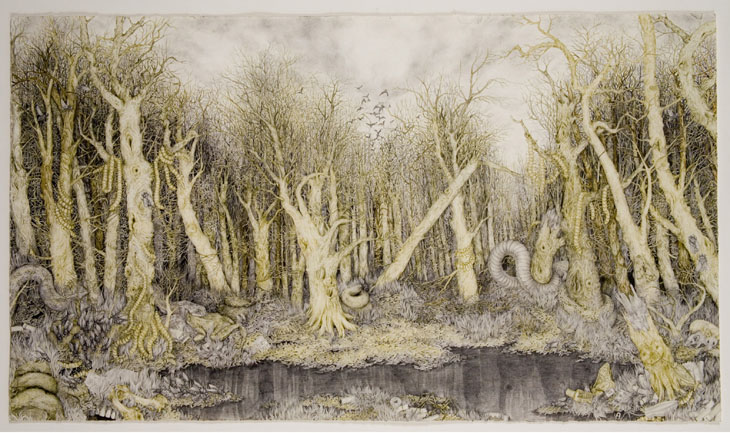
    This is what Saatchi is good at: the attention-grabbing one-liner that sells the product. Like his ES pieces, his exhibition was a string of loosely associated thin ideas. He collects art works like he collects facts, in bulk, and presents them in a similarly disconnected way, without argument. One gallery contained photographs of Russian mafia graves, a bomb in a suitcase and a floral tribute made of scrunched-up copies of the Daily Mail stained with blood and tea. Another displayed a pillar formed of resin casts of dead mice, a fake stuffed skunk in a museum case and a pair of genuine animal skins of a cat and dog. A third was a morgue of grotesque human dummies made of urethane wax, old sweaters and bandages, littered around in a range of abject poses. The only exhibit anyone lingered over was Body Swallows World (2006), a truly terrifying drawing of a forest of creepy crawlies by Aurel Schmidt that made Richard Dadd look like Grandma Moses and the Chapmans look ham-fisted. Otherwise, far from striking mortal terror into visitors (most of whom were too young to have begun to think of death) the tone of the exhibition was as insouciant as the small boy leapfrogging a tombstone in the vintage photograph outside the entrance.

    My father used to tell a story of a 19th century actor whose onstage deaths were so convincing that the audience would clamour: “Die again, Sam!” and he would oblige. The trouble with Dead: A Celebration of Mortality is that the clamour for its brand of snuff stuff has died down. Almost all the work in the show was pre-financial crash and to post-recessionary eyes it looked like death warmed up. Today’s audiences may not have lived through two world wars, but the past seven years have been no party and they want art which, if not life-affirming, has a bit of depth. Young artists have stopped making schlock art about death and older ones with any sense have grown out of it. The former YBA Mat Collishaw – who came to fame with the gory Bullet Hole shown at Freeze and now in the collection of the Saatchi of the Southern Hemisphere, David Walsh – has progressed to subtler meditations on mortality in his 2013 series of photographic still lifes, Last Meal on Death Row.

    One essay in Saatchi’s book tells the cautionary tale of American news anchor Christine Chubbuck who shot herself on screen in 1974 in protest at her channel’s obsession with gore. There’s only so much death a body can take. Even Damien Hirst, whose obsession with mortality may well be genuine, has stopped trying to flog a dead horse – with or without golden hooves – and started looking on the bright side of the life cycle. It began with that hideous series of Fact Paintings (2005-6) painted from photographs of the caesarian birth of his third son Cyrus and has continued in The Miraculous Journey, the recent sequence of equally hideous bronzes of developing foetuses commissioned as street furniture by the Qatari Royal Family in the run-up (they hope) to the 2022 Doha World Cup. Ironically, this is one case where funerary monuments to dead Nepalese workers might be more appropriate.

    Washed-up celebrity artistes end up in Vegas; washed-up celebrity artists end up in Doha. It’s no coincidence that both are deserts. On home turf, meanwhile, Hirst is following in the footsteps of his old patron Saatchi and seeking a new form of artistic immortality as a philanthropic museum owner. His free gallery in Newport Street, Lambeth, opening in October, is being built to house his morbidly titled Murderme Collection, but its inaugural show will be a life-affirming exhibition of paintings by his old adversary John Hoyland. Cheer, up everyone! There may be life after death.

    Laura Gascoigne


  • … Where’s the sense in multisensory art?

    Tate-SensoriumIt used to be known as ‘synaesthesia’; now ‘crossmodal perception’ is the scientific term for the ability of one sense to stimulate another. Experiments by Oxford University psychologists and researchers in New York have found links between reactions to sound and smell in the part of the brain known as the ‘olfactory tubercle’. It may sound like a plug of mucus in a brass instrument, but apparently it’s highly sensitive. When one researcher banged his coffee mug down next to the laboratory mice whose olfactory reflexes he was testing, their smell cells jumped.

    Artists, always looking for new angles, have played with crossmodal possibilities for years. But while modern artists like Kandinsky and Klee focused on art’s relationship with music, postmodern artists have developed a less salubrious interest in smells. At the Whitechapel Gallery’s groundbreaking exhibition This Is Tomorrow in 1956, Richard Hamilton installed a strawberry-scented carpet. That was yesterday, and things have moved on. In 2008 the Reg Vardy Gallery in Sunderland devoted a whole exhibition, If There Ever Was, to the fifth sense, regaling visitors’ nostrils with the aroma of the last meal of Death Row prisoner Jesse Tafero and claiming to reproduce the scent of the sun by heating the seven earth metals from which it is composed to melting point. In 2010 specialist fragrance artist Clara Ursitti subverted nasal expectations at Tatton Park Biennial by infusing the upholstery of a Nissan Sunny with the designer perfume of a Rolls Royce Silver Cloud, and in April this year, for the odour-themed exhibition I’m Here But You’ve Gone staged by the Fiorucci Art Trust in a Sloane Avenue townhouse, Mary Ramsden sprayed a black and white room with the scent of Panda Sex. I can’t give a nosewitness account, but according to a report in the Evening Standard it smelt of baby wipes and posh candles. If that’s what turns pandas on, it’s no wonder they have difficulty breeding.

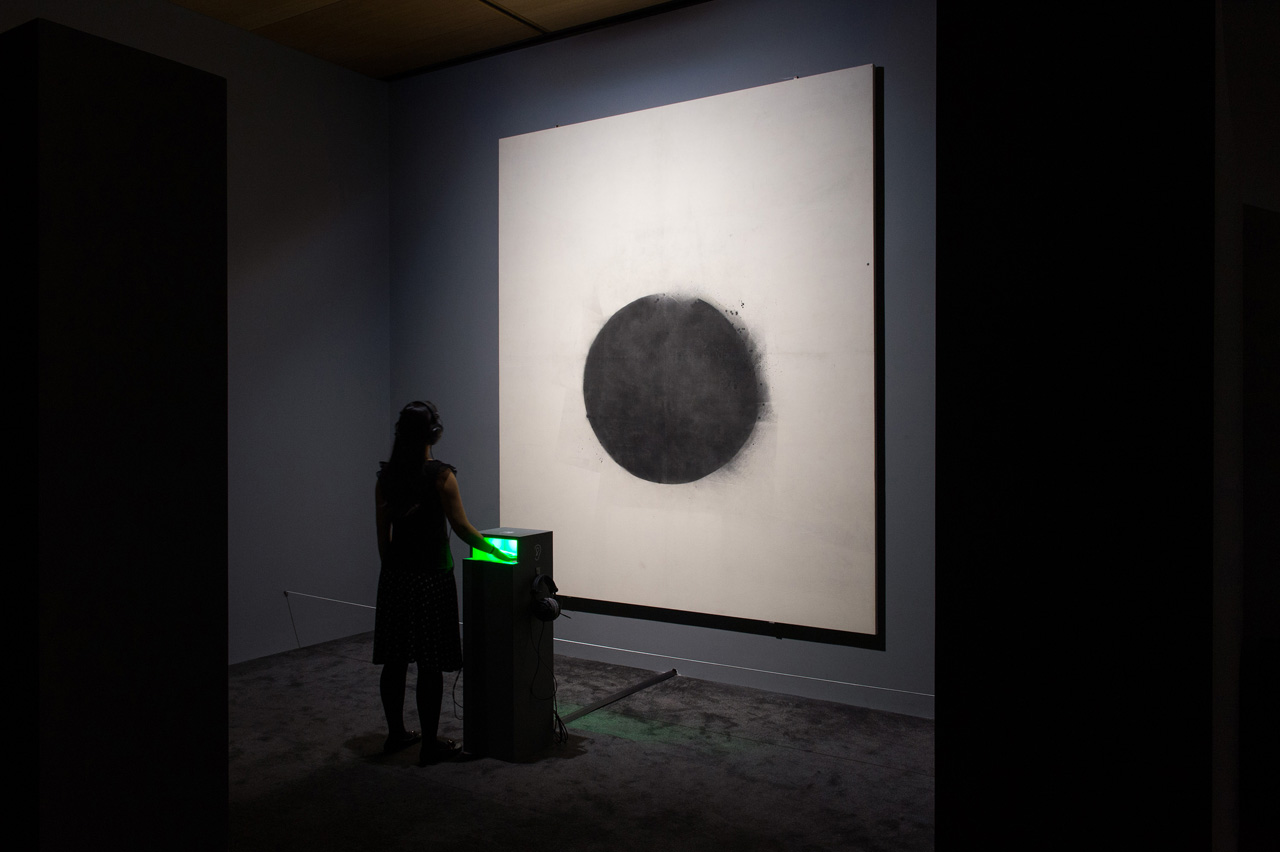
    Now public galleries struggling with the problem of ADHD-afflicted visitors who’ve lost the ability to focus on one thing at a time are hoping crossmodality could be the answer. Last summer at Tate Britain the special exhibition Tate Sensorium offered visitors a multisensory tour of four paintings from the collection – Richard Hamilton’s Interior II, John Latham’s Full Stop, David Bomberg’s In the Hold and Francis Bacon’s Figure in a Landscape – with added bells and smells. The experience of Hamilton’s Interior, for example, was aurally enhanced by the sound of clacking heels on 1960s parquet and distant traffic noise, while wall dispensers diffused the odours of furniture polish, hairspray and glue. (Or so we were told. All the scents in the show smelled to me like stale air-freshener, not surprisingly considering their creator trades under the name of Odette Toilette.) The sense of touch was tickled in front of the Latham by an ‘Ultrahaptics’ device using ultrasound waves to puff spurts of air, and the sense of taste in front of the Bacon by a ball of chocolate that exploded in the mouth into a gritty mix of edible charcoal, cocoa grains and sea salt, evocative of Bacon’s dingy earth palette but rather more exciting.

    As we listened, sniffed, felt and munched our way through the darkened rooms, our reactions were recorded on wristbands using lie detector technology to measure electrodermal activity through perspiration. The trouble was that the technology had no way of telling what exactly was getting us in a sweat. At the exit we were handed readouts of our reactions to the different works. My personal graph traced a level line of phlegmatic indifference to Hamilton, Latham and Bacon – without a blip for the chocolate – but went completely haywire in response to Bomberg. This led the Sensorium to conclude that my “strongest physical reaction was to sound and smell within The Hold”. It didn’t entertain the possibility that my excited response might have been to the visual stimulus of the painting, the only one of the four works selected to reward sustained optical exploration.

    There’s a growing assumption in our multimedia age that looking at pictures is no longer enough. In the 17th century, when artists painted Allegories of the Senses, viewers were supposed to use their imaginations – the sight of the poopy baby’s bottom in Jan Miense Molenaer’s The Sense of Smell was expected to do the business on its own. Now post-modern literalism expects more. Yet which seems funkier, the rumpled sheets on Sickert’s iron bedsteads or the real ones on Tracey Emin’s My Bed, reduced by years of conservators’ condition reports to a state of artificial deinsemination?

    On the evidence of the Tate Sensorium, the senses of smell, taste and touch contribute little to visual enjoyment. Hearing is a different case, as we know from film scores, which raised my hopes of the National Gallery’s summer exhibition Soundscapes for which six composers, sound artists and recordists were commissioned to write soundtracks to paintings of their choice. A problem with sound, of course, is that to appreciate it you have to keep quiet, which gallery visitors – unlike concert or film audiences – aren’t obliged to do. The calls of the raven, cuckoo and Lapplanders’ ‘yoik’ supplied by David Attenborough’s sound recordist Chris Watson as an undercurrent to Akseli Gallen-Kallela’s Lake Keitele would have been wonderfully atmospheric if not regularly drowned in waves of chatter every time the gallery doors were opened.

    Not all the soundtracks were as evocative as Watson’s. The melancholy sawing of Susan Philipsz’s Air on a Broken String, played as an accompaniment to Holbein’s The Ambassadors on a violin with a string missing, was as maunderingly self-indulgent as her 2010 Turner Prize entry and – apart from the knowing reference to Holbein’s broken lute string – had no connection with the picture. The other sound artists Janet Cardiff & George Bures Miller chose a more appropriate accompaniment to Antonella da Messina’s St Jerome in his Study in Guillaume Dufay’s early Renaissance composition Vergine Bella, but then managed to completely upstage the painting by installing a large wooden model of Jerome’s study in the centre of the room and relegating the original to a corner. Digital remix artist Jamie xx had a decent stab at replicating the pointillism of Theo van Rysselberghe’s Coastal Scene with pullulating electronic rhythms, and classical composer Nico Muhly’s theme for bells and viola da gamba was a harmless complement to The Wilton Diptych, but the only unqualified success was Gabriel Yared’s score for Cézanne’s Les Grandes Baigneuse. Yared is a film composer who knows his stuff. His orchestration for soprano voice, clarinet and tinkling piano vividly evoked the shifting light and leaves of a sylvan glade, while his repeating doo-whump figure in the cello supplied a thumping bass for the bottom-heavy bathers. The fact that the painting is the size of a wide-screen TV helped.

    Soundscapes was an interesting experiment, but was it successful in making people look at the paintings? Here’s a conversation The Jackdaw’s sound recordist overheard in the ladies’ toilets.

    Girl 1: “Did you go to the cinema?”

    Girl 2: “What cinema?”

    Girl 1: “The one with the film where all the artists talked about their

    work?”

    Girl 2: “Oh no! You mean I missed the main thing?”

    Laura Gascoigne

  • Art under kleptocracy


    Another month, another book on the contemporary art economy, this time from an overlooked perspective. The New Economy of Art, a joint publication by DACS and Artquest, looks at the art market from the POV of the average artist. Not surprisingly, it finds plenty to puzzle over.

    The conundrum it addresses is clearly set out in the preface by editors Gilane Tawadros and Russell Martin. “The art world is in crisis,” begins the first paragraph; “The art world is in the best shape it has ever been,” begins the second. The question of how these conflicting statements can both be true at the same time – “the disconnect between how artworks gain financial value even while their makers are poorly, or hardly, paid.” – is the mystery the authors of its six essays try to solve.

    Two weeks before the book came out, Christie’s New York achieved an all-time auction record for its November postwar and contemporary art sale, in which a Warhol Triple Elvis hit the jackpot – kerchung! – at £51.6m – and a row of Four Marlons paid out a further £43.9m. Both, appropriately, had previously hung in a casino in Aachen. The result was hailed by international head of post-war and contemporary art Brett Gorvy as confirmation of “a virtuous cycle of confidence in the art market”. Another season, another reason for making whoopee.

    On the other side of the art market, meanwhile, a more vicious cycle is in operation. The book’s authors quote the usual dismal statistics. It’s depressing enough to learn from the 2011 survey by the Centre for Intellectual Property, Policy and Management at Bournemouth University that UK artists earn a median wage of £10,000 – unchanged for 20 years – without discovering that the statistic includes designers, illustrators and photographers, and that the top 7% earn 40% of the total. Artists now officially rank as ‘marginalised makers’, a marginal constituency politicians aren’t fighting over. The economist Alan Freeman quotes figures showing our ‘creative economy’ growing faster than any other UK production industry, employing 2.5 million people and accounting for 5.2% of gross value added – but take out all the advertising, marketing, fashion, IT and other people he counts as ‘creative specialists’, and the fine artists are still scratching around on the margins.

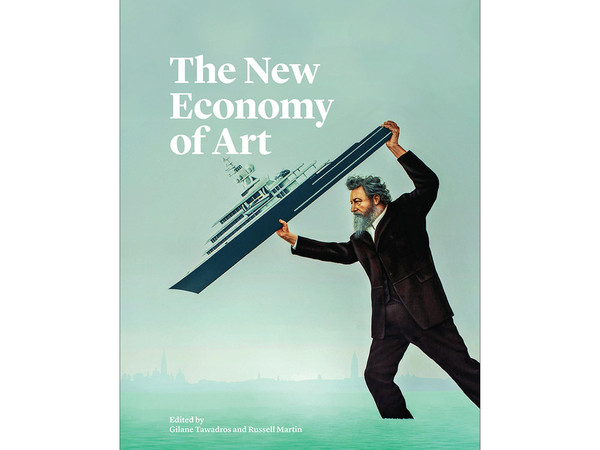
    The book’s cover reminds us that there is nothing new in this. It reproduces Jeremy Deller’s mural from the 2013 Venice Biennale picturing William Morris as a Victorian Poseidon hurling Roman Abramovich’s superyacht into the Venetian Lagoon. The mural’s title ‘We sit starving amidst our gold’ encapsulates the argument at the heart of the book while reminding us that Morris said it all before, and better. Compare Freeman’s dewy vision of a creative utopia “in which shared values, achievements, hopes and aspirations replace brute greed to lay foundations on which the true individuals of the future can confidently build the new worlds of their choosing” with this trenchant passage from Morris’s lecture Art Under Plutocracy: “So long as the system of competition in the production and exchange of the means of life goes on, the degradation of the arts will go on; and if that system is to last for ever, then art is doomed, and will surely die”. Only the substitution of association for competition, believed Morris, could “give an opportunity for the new birth of art, which is now being crushed to death by the moneybags of competitive commerce.” In the war of words, Morris wins hands down.

    Still, the book contains material which, if not revolutionary, is astonishingly inflammatory for a publication part-funded by the Arts Council. Have they read it? It has a quiet way of dropping bombshells. One is the casual mention by management consultant Keir McGuinness of the apparently generally accepted practice whereby “the decision of whether a [public] gallery will take a show or not depends upon whether you [the artist’s dealer] will make a financial contribution and the person who makes the largest financial contribution gets the shows”. Another is a statistic cited from AN’s recent Paying Artists report that “71% of artists receive no fee for publicly funded exhibitions and nearly 60% do not even have their expenses covered”. This against the background of an international art industry which, arts consultant John Kieffer points out, has a turnover of just under £40bn, with the UK’s market share of 20% amounting to three times the combined budgets of the English, Welsh, Scottish and Northern Irish culture departments.

    But the real eye-opener is the essay by curator Lynda Morris. Born in 1947, Morris is old enough to remember the heady days of the 1960s when a newly international avant-garde was promoted by dealers who were themselves artists, lived like artists on air and were perceived as having ‘moral authority’. What an antiquated concept that now sounds. After reading Morris’s analysis of the process whereby the present nexus of curators, industrialists, bankers and property developers took control of the art world, it seems to belong to another era.

    Morris pinpoints Thatcher’s appointment of Richard Rogers as chair of Tate Trustees in the 1980s as the start of the cultural ascendancy of architecture over art. “It was the moment in late Thatcherism when the State no longer provided social housing and, instead, the national lottery, a new arm of the gambling industry, enabled museum directors and their trustees to start to plan Palaces of Culture.” A proposal to regenerate derelict buildings for low-cost studios, housing and artist-led galleries put forward by officers of the then Arts Council of Great Britain – in association with artists’ collectives ACME and SPACE – was kyboshed by property developer Peter Palumbo, who as chair of the ACGB from 1988-94 presided over the drafting of the rules for National Lottery funding, including the ‘subsidiarity’ clause ensuring that money is allocated only to new projects and thus funneled towards developers and architects rather than artists. Artists are wonderful at sprinkling the fairy dust that turns urban wastelands into developers’ goldmines, but once the gold has been extracted the fairies can piss off and take their dust elsewhere. Prices for a ‘premium apartment’ in Neo Bankside, the new residential development overlooking Tate Modern designed by Rogers Stirk Harbour – formerly Richard Rogers Partnership – start at £4.5m.

    “We seem to have drifted from a market economy to a market society,” comments John Kieffer. It’s a form of society Margaret Thatcher would have recognised, but not William Morris. “It is this superstition of commerce being an end in itself, of man made for commerce, not commerce for man, of which art has sickened,” he wrote in Art under Plutocracy. Art under kleptocracy has brought no improvement. It has been left to President Xi Jinping to uphold moral values, warning Chinese artists last October not to follow the “stench of money” or “lose themselves in the tide of market economy” which the rest of the People’s Republic is happily riding.

    Are artists and Gordon Brown now the only people on the planet still expected to possess a moral compass? That could explain the disconnect highlighted by this book. If our market society is wholly reliant on artists for moral orientation, it has good reason not to seduce them with the stench of money, ie pay them. You could almost call it a virtuous cycle.

    Laura Gascoigne  

    The New Economy of Art, edited by Gilane Tawadros and Russell Martin, published by DACS, £14.99


  • Champagne feminist

    Sixteen years ago, I wrote an article for a short-lived women’s art magazine called Make responding to a complaint on the letters page that only childless women could succeed as artists. Off the top of my head, I immediately thought of half a dozen artists who disproved this rule and I interviewed them for a piece called A Woman’s Work. They included Shani Rhys-James, Evelyn Williams, Susan Wilson and Sarah Raphael. A quote from Raphael, who had just had a third child, appeared to clinch the argument: “Motherhood is such an overwhelming purpose that it has to be very powerful, the urge to do the other thing. It cuts the crap. I just haven’t got the time to sit around wondering what sort of artist I am. The kids get their trainers, that’s the main thing. I think it’s horseshit, personally, that you can’t be both.”

    Gender studies have since moved on, along with definitions of mother and womanhood. We’ve had handbags at dawn between David Furnish – or was it Elton John? – and Domenico Dolce – or was it Stefano Gabbana? – over the dress designer’s suggestion that men can’t be proper Italian mammas, and Germaine Greer has been sent into purdah for refusing to recognise transgender women as women. This throws up some interesting artistic questions. If Caitlin Jenner re-reinvented herself as a woman artist, would she produce women’s art? Given that artists draw on their life experiences and Jenner’s, up till now, have been a man’s, her artistic perspective ought to be male. But who knows? These days there’s really no way of telling until s/he is imprisoned for violent assault, when a decision can be made according to the gender of the prison.

    It’s legitimate to talk about ‘women’s fiction’ because women buy it, but is it invidious to talk about ‘women’s art’ when the vast majority of collectors with disposable incomes to spend on art are men? (Interestingly no one talks about ‘gay art’, perhaps because if you removed all the homosexuals from art history it would knock a huge hole, so to speak, in the male art pantheon.) We live in an increasingly touchy world. Such are our sensitivities on gender issues that some in the trans community – smaller than the community of giant pandas, but more visible – are calling for gender specification to be dropped from official forms. Since one of the presumed points of official forms is to ensure fairness, others in the feminist community have complained that this will make it harder, all things being unequal, to monitor sexual equality. No sex, no equality – we’re British.

    It hardly seems worth getting one’s knickers in a twist when all the data on gender collected to date has had no visible impact on the only significant measure of equality, the pay packet. But now women artists have found a surprising champion in Charles Saatchi. The wife-throttling philanthropist has chosen to mark his gallery’s 30th anniversary with Champagne Life (until March 6th), an exhibition of 14 emerging women artists from around the world. In the wake of the gallery’s recent series of exhibitions of contemporary art from Africa and Latin America, Russia, Germany, the Middle East and China, comes a show of art from the planet Venus. Any Martian glancing through the recent programme might be forgiven for thinking the female sex was a foreign country.

    Aware of the problem, the show’s publicity stresses that it “does not offer an overarching vista of ‘female’ artistic practice, nor does it presume to state that there is such a thing”. There are plenty of people around, however, who assume there is. Most wouldn’t dare go as far as Brian Sewell and claim: “There has never been a first rank woman artist. Only men are capable of aesthetic greatness”. But Sewell did agree with the Make magazine moaner: “Maybe it’s something to do with bearing children.”

    Historically, this was obviously true. Greer’s The Obstacle Race is a catalogue of female artistic ambitions hobbled or snuffed out by childbearing; between domestic commitments to children, husbands, fathers and brothers, a woman’s work as an artist was never done. Equally damaging, in her view, was the imitative hero-worship squandered by women artists on male teachers or husbands – or both, in cases where love-struck women students married their masters. “The artistic ego is to most women repulsive in themselves, and compelling in men,” is Greer’s analysis of the situation. Or as Degas put it to Suzanne Valadon: “You must have more pride.”

    Male ‘aesthetic greatness’ often goes with showing off; the problem is that the public can’t tell one from the other. Not being natural show-offs, women artists are too easily diverted from the self-satisfaction of making reputations by the deeper satisfaction of making things. “No artistic success has given me as much pleasure,” said Liubov Popova, “as the sight of a peasant buying a length of material designed by me.” The artist of ambition, argues Greer, “must have a masterful attitude not only to his subject, but also to the beholder whose attention he claims”. This, she suggests, is why women have tended to work small.

    Not any longer. There are no small works in Champagne Life, with the exception of two little heads hanging amongst Jelena Bulajic’s monumental portraits of old women. Still in her 20s, this young Serbian artist – who had two paintings in last year’s RA Summer Exhibition – is something of a prodigy. Although shortlisted for the BP Portrait Award, her magnified grisaille faces showing every wrinkle are not photorealist: from close to, they break down into pointilliste confections of marble dust, ground granite and limestone, kaolin, graphite and charcoal. In terms of technique, most of the paintings in this show ­– from the densely patterned mythological images of American Mequitta Ahuja, executed in acrylic, coloured pencil, oil, watercolour and wax crayon on vellum, to the nude body landscapes of Korean Seung Ah Paik, with their perfect nipples stippled in pigment sealed with rabbit skin glue – are in a different class from the slapdash efforts of the mostly male artists in the gallery’s recent Pangaea exhibitions. These women artists take a pride in their work: they like making things.

    Is it patronising of a male patron to stage a women-only exhibition? The Tate has been promoting women’s art, but only through safe solo shows of established artists. Saatchi, meanwhile, has brought together 14 strikingly different young women artists in a group exhibition whose effect, intentional or not, is to blow the idea of ‘women’s art’ out of the water. Yet on the most basic measure of equality – money – art by women still ranks a distant second. In 2014 the holy cow of American modernism, Georgia O’Keeffe, broke auction records for a woman artist with the sale of Jimson Weed/White Flower No 1 for $44 million at Sotheby’s New York; the following year Picasso’s Women of Algiers sold for almost exactly four times as much at Christie’s. It puts the 20% gender pay gap in the workplace into proportion.

    One glass ceiling leads to another. As long as the art market is dominated by male collectors on whom a sniff of senescent Picasso acts like rhino horn, nothing’s going to change. Saatchi’s gesture is welcome, but any celebration would be premature. Until women’s work commands equal prices, the champagne can stay on ice.

    Laura Gascoigne