Category: Comment

  • Laura Gascoigne: The Art of Mixology – January 2018

    Laura Gascoigne
    January/February 2018

    You get a better class of junk mail in Hampstead. Recently a ‘stiffy’ (in the polite old-fashioned sense) arrived from something called ‘The Restory’. From its sober shade of indigo with silver lettering I guessed it announced the opening of a restaurant in a former rectory, but no, it advertised an “on-demand shoe and handbag restoration service”. What an off-demand shoe and handbag restoration service might be one dreads to imagine. “Oi! Stop that restorer, he’s got my handbag!” “Honest, officer, I was only going to restore it.” “Well, kindly restore it to the lady now, before I take you into custody.”

    It gets better. Inside was a salmon-pink and silver £20 voucher and the artisan’s statement: “The Restory is an integrated team of specialists brought together from all over the world to ensure your items are in the most capable and passionate hands. Our team disrupts, challenges and innovates in our craft to develop the most advanced solutions to seemingly impossible problems.”

    Where is all this heading? In the direction of another Restory that recently supplied an advanced solution to a seemingly impossible problem, not just satisfying the item’s owner but making him hundreds of millions of dollars. The problem? What to do with a knock-off Leonardo that had changed hands for £45 in 1958 as a copy after Boltraffio and was so badly worn and restored that its very brand was in question, like a vintage Chanel bag missing its interlocking ‘Cs’. The advanced solution? First put the picture in the capable and passionate hands of veteran conservator Dianne Dwyer Modestini and let her spend six years giving it a makeover, then – and this is the disruptive, challenging and innovative bit – put it into a post-war and contemporary art auction at Christie’s New York, rather than old master sale where it would have been handbagged by experts.  

    Challenge and innovation on their own are no longer enough. Now it’s all about disruption: stripping away any historical context that might put the viewing and the buying public off. If you whooped when Penelope Curtis restored chronological order to Tate Britain’s collection displays, prepare to weep as Maria Balshaw disrupts it: “We’re going to rehang the collection telling the story from the point of the London where we are today,” she warned the FT soon after her appointment. Instead of seeing the present as a product of the past, we’re now supposed to judge the past by the standards of the present. The autumn exhibition Legacies at New Art Gallery Walsall, for example, considers “the ongoing legacy of JMW Turner through the lens of contemporary art”, roping him in with a huddle of artists under the Tate umbrella on the catch-all pretext that he “challenged accepted conventions in art”.

    Of course it’s obvious that, living as we do in the present, we can only consider the past through its lens. Still, a bit of context never did any harm – it’s not essential to the enjoyment of historical art, but it deepens it. One reason why the new breed of non-art historian gallery director wants shot of it is insecurity; they don’t like feeling inferior to their curators. But there’s another more worrying reason connected with the market. For those in the business of flogging art, a mix of old masters and contemporary artists has the beneficial effect of presenting contemporaries as masters in the making.

    I won’t deny that mixing it is refreshing: what makes Frieze Masters so enjoyable is the gathering of dealers in art from six millennia under one tent. One of those dealers last year was Axel Vervoordt, the Belgian collector and ‘timeless interior designer’ who launched the fashion for art mixology in the noughties with a series of exhibitions at the Venice Biennale and has just opened his own ‘cultural complex’, Kanaal, in Antwerp. “I wanted to make Chronos into an artist,” was his poetic description of one exhibition, “to place the emphasis on the atemporal. For example, certain Egyptian and Bactrian pieces that date back 4,000 years pass for contemporary. And underlying this was the question of whether it is important to know by whom and when something was made.”

    There is a respectable Renaissance tradition for this sort of time travel, but by whom and when something was made becomes important when money is involved. Art mixology is a seductive cocktail that can easily unsettle a weak head. In salerooms it is far more effective than bubbly at making bidders lose count of zeros, as Christie’s New York discovered in 2015 when they threw together a bunch of random lots by artists from Claude Monet to Urs Fischer under the theme of “artistic innovation inspired by the past”. The sale achieved auction records for 10 works, including $141.2m for Giacometti’s Pointing Man – making it the most expensive sculpture ever sold at auction – and $179.3m for Picasso’s Les Femmes d’Alger – making it the most expensive work full stop. “Christie’s will continue in years to come to innovate more sales concepts that inspire the art collecting public,” crowed Jussi Pylkkänen, Christie’s global president and the sale’s auctioneer. You betcha. Two years later, they came up with a sales concept that netted $450m for a duff Leonardo. 

    We’re used to auction houses making silly money from modern masters, but making imbecilic money from old ones is something new. Before the advent of Leonardo’s Salvator Mundi the auction record for an old master stood at the £49.5m achieved by Rubens’ Massacre of the Innocents in 2002. To the new generation of collectors an Old Masters sale is about as sexy as a slave market of octogenarians. But despite his personal resemblance to Chronos Leonardo is an exception, largely thanks to Dan Brown – “as fascinating as any bestselling thriller” was how a Christie’s promotional video trailed the Salvator Mundi – and an escort of Warhol’s Sixty Last Suppers had a further rejuvenating effect. Plus it helped that the National Gallery had given the picture one of the best shop windows in the world by including it in its 2011 Leonardo exhibition, where it stuck out like a sore thumb (though the thumbs are two of the best things about it). Nicholas Penny and Dan Brown both deserve a commission.

    “What remains of a Rembrandt torn into four equal pieces and flushed down the toilet?” asked Jean Genet in an essay of 1967. What remains of this Leonardo? Not a lot. The painting “has endured some wear and tear over the centuries,” a spokeswoman for Christie’s conceded to The Art Newspaper before the sale, “but many of the most important elements – the blessing hand, the orb, Christ’s vestments, the curls in his hair – are remarkably intact.” All you can say is: “Nice curls, shame about the face”.

    When a conservator devotes six years to restoring a picture that the original artist painted in a few weeks, the work is arguably more hers than his. So what am I bid for this Modestini? Without a recognised offence of ‘inappropriate retouching’, the line between restoration and fakery is as blurred as the Salvator Mundi’s face. As for the line between disruption and corruption, that keeps getting thinner and Leonardo’s crystal ball offers no hope of improvement. To quote Tom Phillips’s epitaph on Van Gogh: “Auctions speak louder than words”.

  • Laura Gascoigne: The Art Police – November 2017

    If you’re thinking of committing an art crime, now’s your moment. In June budgetary pressures forced the ‘temporary’ closure of the Met’s Art & Antiques Squad and the transfer of expert staff to the Grenfell Tower fire investigation, and there’s no knowing when, if ever, they’ll be back. So it’s bye-bye blue light, hello green light to thieves, fakers, fraudsters and traffickers of looted antiquities who fund the terrorism the rest of the Met is struggling to combat.

    But it’s not the end of art policing; while the official force has been disbanded, unofficial forces are taking over. Alexander Adams’ article New Order in the last issue was a cogent analysis of how the enforcers of the new identity politics are effectively policing public exhibitions. Since his report there have been further developments in the case of the Dakota Elders v Sam Durant, whose sculpture Scaffold was removed from Minneapolis Sculpture Garden after complaints that as a non-Native American he had no hereditary right to refer in his work to the hanging of 38 Dakota Indians by the US Army in 1862. Initially condemned to be burnt, the dismantled Scaffold will now be buried in a secret location. Meanwhile poor old Jimmie Durham, who has spent a lifetime trading on his Native American ancestry, has been denounced by a group of snooty Cherokees as a fake for not being a registered member of the Cherokee Nation. Once an art degree was qualification enough to practise art; now you need registration with your tribe or ‘subset’.

    On this basis, only pure-breed something-or-others should be allowed to make public statements, artistic or otherwise, on questions of race. As a half-Italian, quarter-white-West Indian, quarter-Northern-Irish crossbreed I would probably be wise to keep my trap shut but I’m congenitally incapable, so here goes. First off, I would like to point out to these purblind purists a perennial problem with questions of heredity. Who among us can actually prove our bloodlines? Which of us really knows who our fathers/grandfathers/great-grandfathers were? Only our mothers/grandmothers/great-grandmothers could tell us. Are we going to dig all our ancestors up and DNA-test them before presuming to make art about them?

    Racial purity is not the only thorny issue in a field where so many subsets disadvantaged in terms of gender, transgender, whatever – it can’t be long before the LGBT contingent have commandeered all the letters in the alphabet – have axes to grind. For the moment different factions are content to share the benefits of affirmative action with other ‘minorities’. (Don’t you love it when women get classed as a minority?) But believe me, they’ll soon be scrapping like ferrets in a sack over the dismembered body of White Male Art.

    Of course it’s true that WMAs have had it all their own way for far too long and, yes Guerilla Girls, if women don’t have to be naked to get into the Met, that’s progress. But can positive discrimination in the present reverse the injustices of the past? Nearly all the art preserved in our museums was painted, carved or moulded by men for men, a historical fact that retrospective action cannot change. Maria Balshaw has been making appropriate noises about adjusting the historical gender balance in the Tate Modern by acquiring a Frida Kahlo – an expensive price to pay for a minor tweak – while in Tate Modern’s contemporary displays Frances Morris has already established parity between the male and female artists represented. For the moment, the reach of the levellers has not extended beyond contemporary art, a few misbegotten historical statues excepted. That’s a can of worms I won’t open here, except to agree with Lionel Shriver’s recent observation in the Spectator: “Applying today’s demanding standards of rectitude to previous generations – requiring all past notables to have embraced racial equality, feminism, disability rights, anti-colonialism, non-smoking and gender-fluidity means pulling down virtually every statue standing.” (I would also like to plead that if male memorials are to be replaced with female ones, can they please not be ‘sculpted’ by Gillian Wearing.)

    What started me on this subject was being asked to write about two historical male artists who were lamentably far from meeting Shriver’s criteria. First Ernst Haeckel, the 19th century German biologist and illustrator whose breathtaking watercolours of marine invertebrates helped to launch Art Nouveau and are the subject of a new book from Taschen. Haeckel’s paintings were astonishingly beautiful but his views on race were shockingly objectionable. Should we allow this knowledge to cloud our appreciation of his art?

    Second Amedeo Modigliani, the subject of Tate Modern’s blockbuster winter exhibition. The problems the Guerrilla Girls may have with his nudes are the least of it. This was a man who threw one of his muses, Beatrice Hastings, through a window and dragged another, Jeanne Hébuterne, by her plaits (a fate avoided by the gamine Hastings, who had short hair). Think about it: a known abuser of women given star billing at an institution that claims to be levelling the gender field. Here we have ‘the most popular modern art museum in the world’ virtue-signalling with one hand while virtual pussy-grabbing with the other. Does its right hand not know what its left hand is doing? No, not while its left hand is counting the takings, because it’s blockbuster exhibitions like this that fund the virtue-signalling.

    How long before the identarian art police wise up to this fact and start picketing non-compliant exhibitions of historical art? True, they’d need armies of pickets because there are almost no historical WMAs in the top rank of crowd-pullers who are without sin, and some are offenders on multiple counts. Take Gauguin, the subject of Tate Modern’s moneymaking blockbuster of autumn 2010. Child abuse: check. Cultural appropriation: check. Passing on the clap to healthy young women: let’s not go there.

    The difficulty here is that art is funky. If the Tate examined its conscience it would have to confess that misbehaviour adds to an artist’s appeal. How else did the bad boys and girls of Britart awaken public interest in the Turner Prize? Since the subset-appeasers took over running the show, it’s become so boring it has had to be exiled to Hull. Sooner or later our publicly funded galleries are going to have to face up to this conflict of interest because, as night follows day, where positive discrimination leads negative follows.

    Art has a long and venerable tradition of pretending to serve morality while undermining it; our Victorian ancestors led the world in double standards and we should learn from them before it’s too late. Step one in confronting censorship is to separate the art maker from the art. To quote Liz Taylor, who had experience in these matters: “The problem with people who have no vices is that generally you can be pretty sure that they’re going to have some pretty annoying virtues.” Virtuous people need to be kept away from art, from its production and, ideally, from its management. With the exception of a few monochrome canvases, art has never been whiter than white. Should galleries be ‘safe spaces’? Hell no! Virtue-signalling holds up a false mirror to the messy reality art is supposed to reflect. In the immortal words of the love-struck millionaire to the gender-fluid Jack Lemmon in Some Like It Hot: “Nobody’s perfect”.

    Laura Gascoigne
    The Jackdaw Nov/Dec 2017

  • Laura Gascoigne: Tangled Web – September 2017

    “Why is there so much sewing?” demanded The Art Newspaper’s Christina Ruiz after visiting Christine Macel’s exhibition at this year’s Venice Biennale. “I get it: domestic work, women’s work, is important and undervalued. But is it in itself art? No it is not.”

    There was a time when so-called textile arts were prized above all others; when first unveiled in 1519, Raphael’s tapestries for the Sistine Chapel threatened to eclipse the fame of Michelangelo’s ceiling. But in the 18th century tapestry began to feel fusty as audiences warmed to the immediacy of paint. A work’s value no longer resided in the price of the wool, the skill of the weavers, the total hours spent in production and associated cost, but in the artist’s touch, the signature of authenticity that connected audiences with the creator of the work, usually male.

    In the 1980s, when Rozsika Parker wrote The Subversive Stitch, she pinpointed “the separation of the craft of embroidery from the fine arts” as “a major force in the marginalisation of women’s work”. But on the coattails of conceptualism, ‘women’s work’ has come back from the margins. Since the personal signature of the pen or brush fell under suspicion the needle has returned, not always in the hands of women. While the women are bent over their embroidery frames, the men are stealing the limelight, à la Raphael, with tapestries woven by others to their designs. Chris Ofili’s Weaving Magic has just been the focus of an exhibition at the National Gallery, and there are more tapestries than pots in Grayson Perry’s The Most Popular Art Exhibition Ever! at the Serpentine Gallery (until September 10th).

    If Hockney wants to keep his place as top national treasure, he’d better put down his iPad and pick up a needle. Tapestry, embroidery, knitting, crocheting are all back in the frame and proving highly popular with a public tired of the self-conscious cack-handedness of so much contemporary art. This is art like granny used to make, sweet as apple pie and absolved of the obligation to be serious. From Vidya Gastaldon & Jean-Michel Wicker’s knitted octopus, titled Sex Is Good (1999), shown in Tate St Ives 2013 exhibition Aquatopia to Shauna Richardson’s three 9m lions, crocheted from 36 miles of Swaledale wool and displayed in a glass cage at Twycross Zoo in 2012 as part of the Cultural Olympiad, it’s all a bit of folksy fun.

    Naturally, education departments love it. Imagine the jollity at The Exchange in Newlyn in 2010 when artist Jonty Lees donned a Montgolfier flying helmet and goggles to lead a sewing circle and basket-weaving group in the construction of a full-size hot air balloon. The following year the Science Museum went one better and got participants in its Stitched Science weekend to create an entire Solar System Art Installation from ‘various fibre arts’. True, the results looked a bit of a mess, but sew what? Fibre arts have therapeutic benefits. According to the organisers of the Crafts Council’s ‘cinema knit-along events’ in 2012, “knitting has been proven to enhance cognitive development in children, and well-being in both children and adults.” Sew there.

    It’s not all child’s play: serious issues can be addressed with needles. ‘Political statement knits’ by Lisa Anne Auerbach were a highlight of Wasteland, an exhibition of young Los Angelino artists at the Mona Bismarck American Centre in Paris last year. More ambitiously, at the Minories Gallery, Colchester in 2015 Clare Sams’s installation Knitting Fever recreated the devastation caused by the 2009 floods when a wool shop of that name in Cockermouth spilled its guts through the Cumbrian town. The gallery complimented the artist on using a process “stereotypically viewed as a feminine past-time [sic]” to represent “cataclysmic forces not normally associated with the practice”. Sams’ ‘total knitted environment’ looked a little twee for a cataclysm – acts of God produce more dramatic results than needlework – but she wasn’t going to let that stop her, having already knitted her way through the Hackney Riots and Guantanamo Bay. No knit-wit she.

    Other artist-knitters are not so outward-looking or gender-neutral in their choice of subjects. Given the vogue for ‘bedroom painting’, bedroom knitting was almost bound to follow and, sure enough, in 2012 the Polish-born New Yorker Agata Olek transformed Tony’s Gallery in Brick Lane into a crocheted replica of her boudoir, with walls and floor emblazoned with explicit texts from former lovers. “It is not just another apartment installation,” she assured Metro, “it is the reflection of life, love, trust and lust in current time.” Its tear-jerking title I do not expect to be a mother but I do expect to die alone was a quote from, you’ve guessed it, the queen of the misery stitchers, Tracey Emin. But no artist has taken intimate needlework quite so far as Casey Jenkins in her 2013 performance Casting Off My Womb, in which she knitted a menstrual cycle-length scarf from skeins of wool secreted in her fanny. The work, she told The Guardian, was “primarily about casting off the need for validation from external sources” and “forging a path of self-determination in the face of society’s expectations”.

    Maria Balshaw would say aye to that. Unlike Christina Ruiz, she congratulated Venice Biennale curator Christine Macel in The Art Newspaper on doing “a really good job in challenging some of the gender stereotypes around textiles,” singling out male artist David Medalla for praise for his participatory work A Stitch in Time, first shown in 1968. Medalla’s early lead in removing the sexual stigma from stitching may have laid the ground for the Crafts Council’s 2004 exhibition Boys Who Sew, at which Fernando Penteado established the butch credentials of needlework with a display of samplers embroidered by tattooed inmates of Wandsworth Prison. Since then the social enterprise Fine Cell Work has climbed on the prison wagon and trained 300 prisoners in 20 gaols to spend their lock-up time productively embroidering cushion covers. There’s precious little bunce in it for the lags, but more job satisfaction than stitching mailbags.

    It’s no discovery that men are nimble-fingered (not a lot of people know this, but the young Malevich upset his father with his unhealthy aptitude for Ukrainian cross-stitch). The danger for women of challenging gender stereotypes around textiles is that male artists will seize the initiative. Not content with getting tapestries woven to their designs, brothers are doing it for themselves. In Art Now at Tate Britain in 2010 Andy Holden showed The Pyramid Piece, a 10ft-high knitted replica of a chip off the Great Pyramid of Cheops that he had illegally smuggled home from a family holiday to Egypt at the age of 12. Along with its benefits for cognitive development, knitting is obviously a good way of assuaging guilt.

    The main drawback of needlework, for unreconstructed individualists, is its inflexibility as a means of expression, which is why most attempts to employ it as one, Tracey Emin’s included, have been sew-so. The notable exception is Mr and Mrs Pope, Knitted, Shrunk and Hung (2012), a truly heart-wringing piece of work that – sorry girls! – was created by a male sculptor, Nicholas Pope, with his own fair hands.

    Laura Gascoigne
    The Jackdaw Sept/Oct 2017

  • Laura Gascoigne: It’s Not The Winning, It’s The Making Art – July 2017

    Last month a new sort of museum opened in Sweden. The brainchild of psychologist Dr Samuel West, the Museum of Failure in Helsinborg is an unnatural history museum of commercial fossils, a repository of innovative products that flopped. “The majority of all innovation projects fail,” its website announces cheerfully, before expressing the hope that showcasing “interesting innovation failures” will “provide visitors with a fascinating learning experience” – assuming people learn from other people’s mistakes. Its collection of 60 failed products from around the world include the Bic for Her (more of a misconception than an invention); Harley-Davidson Perfume (a dumb idea when, as every biker’s moll knows, gentleman riders prefer a dab of Castrol Power 1 behind the ears); and a medical instrument called the Orbitoblast Lobotomy (which we can thank our stars never made it into the NHS supply chain, as it sounds like a seriously bad trip). As for Colgate Beef Lasagna, it speaks for itself.

    What provides a “fascinating learning experience” for would-be Dragon’s Den contestants offers a salutary and rather comforting example for artists. Because if the majority of all innovation projects fail, the vast majority of artistic projects are doomed to extinction before they’ve even left the drawing board. If success in art is measured by public recognition of an artist’s work, then 99.9% of artists are serial failers and should, by any normal reckoning, be in another line of business.

    Unsurprisingly, the man who would abolish America’s National Endowment for the Arts understands the problem. According to the wisdom of Donald Trump, “A lot of people don’t like to win. They actually don’t know how to win, and they don’t like to win because deep inside they don’t want to win”. One might not expect this level of perspicacity from Trump, but you don’t get to be the artist of the deal without a modicum of psychological acuity. In the case of the other sort of artist – the artist of the non-deal, if you like – a ‘lot of people’ means almost everyone.

    What is wrong with artists? Or, looked at another way, what is right with them? Unlike the general population of downtrodden drudges who cling mindlessly to a belief in the survival of the fittest, artists are highly adaptable creatures. Their work may be headed for the landfill fossil layer but they persist in looking on the bright side of extinction. It’s an attitude that, after the last financial crash, prompted a number of artist-led projects pointing out the plus side of failure. Kettle’s Yard led the way in June 2009 with a one-day symposium ‘On not knowing: how artists think’, which examined “how artists formulate strategies of not knowing and use the states of ignorance, doubt, block and failure within their decision-making process.” For those whose decision-making back-up systems also failed, in 2010 the South London Gallery proposed a final solution of dumping their work in Michael Landy’s Art Bin and becoming part of “a monument to creative failure” to be buried, with due ceremony, in a landfill site.

    This was too negative for Manchester’s Cornerhouse, which came up with a more positive offer. Their 2010 exhibition Unrealised Potential, curated by the interestingly-named Mike Chavez-Dawson, presented a selection of artists’ unfulfilled proposals to gallery visitors and offered the rights to their realisation for sale. Whether any business resulted is unclear. Some of the ideas were certainly appealing, though logistically challenging. The one I liked best was Simon Paterson’s International Heroes, a foreign exchange programme for equestrian statues whereby town squares could swap their resident stiffs on horseback for stiffs on horseback from other town squares – a farsighted if impracticable idea that, post-Brexit, would have added greatly to the gaiety of nations while proving that Britain always remains open to stiffs. Slightly more workable was Harry Hill’s proposal, in a follow-up exhibition at Cornerhouse in 2011, ‘To recreate George Cruikshank’s The Worship of Bacchus using known alcoholics’, though it would have called for greater organisational skills than your average piss-up in a brewery.

    Unrealised Potential was a nice enough thought, except for the fact that, as Trump could have explained to Señor Chavez-Dawson, realising potential runs counter to the whole spirit of failure. To the committed loser, ‘Here’s one I failed to make earlier until someone else came along and did it for me’ sounds like a total cop-out. It violates the core principle of resistance to society’s prevailing winner-takes-all philosophy that portrays the whole of life as a sweaty-palmed race to the top in which the victor pips the vanquished to the post by a fraction of a second and thereby feels entitled to the spoils – a philosophy mistakenly modelled on the Olympics.

    No surprise, then, that London 2012 brought an artistic backlash from believers in the benefits of failure. While Frieze Projects East commissioned Sarnath Banerjee to plaster East London with billboard-sized cartoons of sporting disaster, the Café Gallery in Southwark Park – a charitable underdogs’ home for artists no one has heard of – put on Backwards Man, a group exhibition of artists who “harness the dichotomies of success and failure, knowing and unknowing… using failure as a complementary force to disrupt [their] work and give moments of uncertainty which skew the perspectives and stretch the imagination”, and are typically followed by bursts of profanity and exits to the pub. In the case of Alex Crocker, they resulted in “a bad alchemy… wonky and drunken. Vessels became figures and figures vessels” – remember Father Jack and the Toilet Duck bottle? – while in the work of Kate Grobey we were told that “mismatched body parts and distorted poses shift about, persisting in spite of themselves.”

    Persisting in spite of themselves is what failures do, unlike successes who persist in spite of everyone else. It’s part of the charm of the confirmed loser, and a large part of artistic genius consists in knowing how to capitalise on it. If it hadn’t been for Giacometti’s endless admissions of failure the public would never have taken him to their hearts. It’s not true that everybody loves a winner. It may seem like that while the champagne flows, but the truth (sorry Trump) is that losers are usually more likeable in their lifetimes and always more likeable after their deaths. If Van Gogh had sold more than one painting in his lifetime, would his personality hold the same appeal for posterity? In life he was smelly, argumentative, wonky and drunken, the very definition of a loser who didn’t like to win and deep inside didn’t want to. In death his failure made him a huge success.

    Before Brexit turns the Channel into a cultural chasm, we British losers could learn from our continental brethren who understand how to do failure in style. Take the French artist Jules Berthier, who elevated failure to the ‘art of fiasco’ with his 2007 nautical installation Love-love in which he sailed a broken yacht with a wonky keel at a permanently sinking angle of 45 degrees along the coast of Normandy. Bravo, Jules! With a post-Brexit recession in the offing and the lowest productivity figures of any leading western economy, we can look forward to a resurgence of the art of failure. Sod the productive strivers, hail the creative skivers! It’s not the winning, it’s the making art.

    Laura Gascoigne
    The Jackdaw Jul/Aug 2017

  • Laura Gascoigne: Do You Want Ice With That? – May 2017

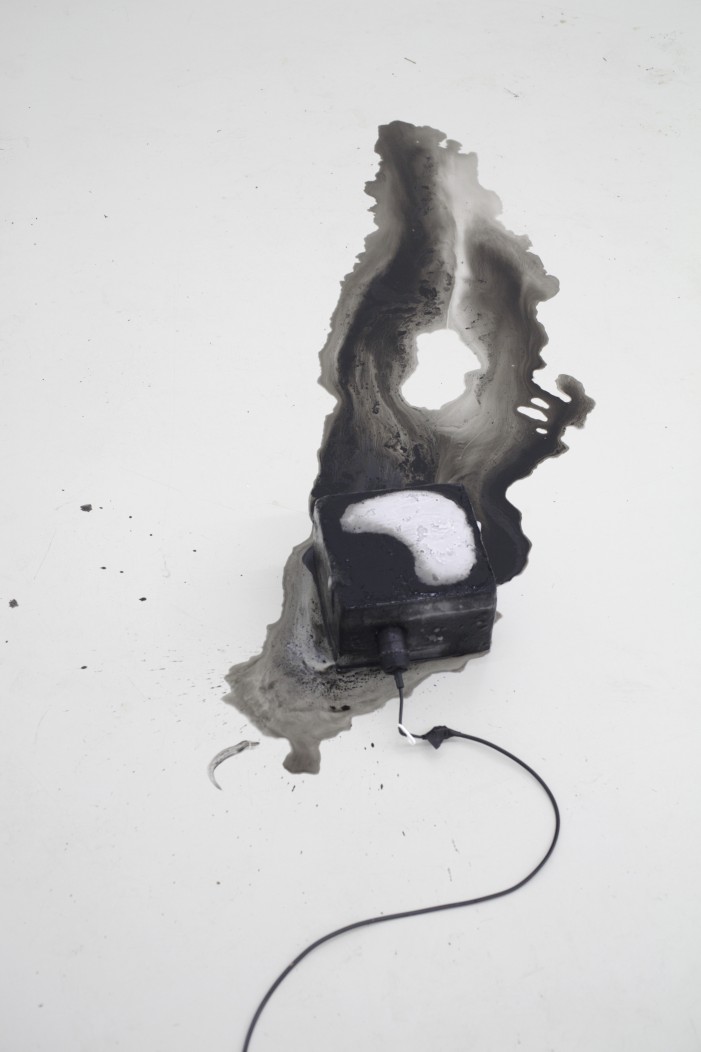
    Kitty Kraus – Untitled http://www.galerieneu.net/artist/kitty+kraus/1544

    Ever since Anya Gallaccio made her name by exhibiting an ice block called Intensities and Surfaces in an East London pumping station in 1996, I’ve been monitoring the advance of ice through the contemporary art world, where it seems resistant to climate trends prevailing elsewhere. While the polar ice caps recede, the phenomenon of ice art only grows.

    I wouldn’t mind if a) against the artists’ professed intentions, this didn’t actually contribute to global warming, and b) the ice wasn’t usually engaged in lecturing its audience in an uncool way. I remember grumbling at the time of Gallaccio’s exhibition that if I was going to hear from an ice cube, I’d rather it addressed me from a gin and tonic. Little did I suspect that over the next two decades I’d be on the receiving end of a chorus of sermons from ice cubes, not one of them accompanied by so much as a zest of lemon.

    The big attraction of ice to conceptual artists is that the medium is the message, and the message is obvious. Conceptual art simply adores the obvious, and so it has taken ice to its bosom where, as with climate change, a cool start has been followed by accelerated warming. Here is an easy-reference 20-year calendar to prove it.

    1997 – Francis Alÿs pushes an enormous ice block through Mexico City until it shrinks to a cube, then instead of popping it into a Tequila Ponche, like any normal hot and thirsty Mexican, he christens it Paradox Praxis and declares it “an allegory about failed modernisation strategies in the region”. Que?

    2009 – Andy Goldsworthy cuts a circle of ice in a frozen river with a rope compass and lets it float away. “The circle was locked and then, suddenly, it was joyously made free to move and rejoin the flow,” he declaims poetically, before skipping off like Fotherington-Thomas.

    2010 – Karl Lagerfeld, scenting frost on the fashion breeze, imports a giant iceberg as the centrepiece of his spring Paris catwalk show for Chanel.

    2011 – Kitty Kraus, in a group show of international artists “who explore ideas of flux and ephemerality” at Manchester Cornerhouse, shows a block of inky water with a light bulb at its centre. Titled Untitled, it melts onto the gallery floor creating “topographical patterns that viewers must navigate around”.

    2012 – Neha Choksi, an artist drawn to “scenarios of erasure, exhaustion, detachment and disappearance”, creates Iceboat, a film of herself rowing across a lake in a frozen boat until it melts.

    2013 – The Holy See climbs aboard the freezer truck, installing a refrigeration unit in its debut Pavilion at the Venice Biennale to keep a painting by Lawrence Carroll on ice.

    2014 – For the Liverpool Biennale Norma Jeane installs a solar-powered ice-making machine in the Old Blind School, which – for want of July sun in Liverpool – leaks. In October, coinciding with the publication of the IPCC’s Fifth Assessment Report on Climate Change, Olafur Eliasson arranges 12 blocks of ice in the form of an Ice Watch in Copehagen’s City Hall Square. Cut from the Nuup Kangerlua fjord in Greenland, the blocks’ total weight of 100 tonnes is equivalent to the amount of inland ice currently melting every hundredth of a second. “As an artist I am interested in how we give knowledge a body,” explains Eliasson. “What does a thought feel like and how can felt knowledge encourage action?”

    2016 – In Granary Square, King’s Cross Alex Chinneck erects a Christmas tree – complete with lights – contained in a 7m ice cube. Titled Fighting Fire with Ice Cream, it poses no risk to the station’s power supply as it is actually made of clear resin rather than water, and the pool that accumulates on the ground around it – which revellers presumably have to ‘navigate’ – is made of wax.

    While on the subject of melting ice caps, it may interest you to know that this year’s Venice Biennale will see the launch of an exhibition of highlights of something called the Antarctic Biennale which, under the patronage of UNESCO, advertises itself as ‘developing Antarctica’s cultural potential’. Tell that to the penguins. Its most prominent partner is Kaspersky Lab, a Russian global cyber security company based in Moscow. Smell fishy? It is. As it happens, Kaspersky Lab has just been named as one of the companies with ties to the Kremlin that paid Michael Flynn a sledload of cash for a speaking engagement in Washington. You want ice with that, or would you prefer oil and gas? Kaspersky is not the only greenwash merchant dealing in ice art. In 2015 Rolls Royce commissioned Isaac Julien’s glacial video installation Stones against Diamonds, set among the glistening ice caves of Vatnajökull in Iceland. No doubt BP is even now planning something. Ice art is not as transparent as you’d think.


    Gallaccio wasn’t the first to make art from ice; she trod in steps already dinted by 1960s masters Gyula Konkoly, Allan Kaprow, Ian Baxter, Rafael Ferrer and Paul Kos. More memorably, perhaps, in the 1970s naked cellist Charlotte Moorman performed avant-garde compositions by Jim McWilliams with a melting instrument between her legs and Serbian ice queen Marina Abramovic, in a performance titled The Lips of Thomas, cut her stomach with a razor before prostrating her naked body on a frozen cross – a display of sang froid that provoked a homage from Lady Gaga, who stripped off and wrapped herself around an ice block in 2013 in a fundraising drive for an institute of performance art.

    There is no new thing under the sun, quoth Ecclesiastes, and in the matter of ice art the hole in the Antarctic ozone layer doesn’t seem to be helping. Heather Phillipson has done her best to inject a bit of novelty with her knickerbocker glory sculpture, THE END, for the Fourth Plinth, intended as “a monument to hubris and impending collapse”. Unfortunately by the time of THE END’s unveiling in 2020 the collapse will probably have happened and a pool of sticky cream with a cherry and a dead fly floating in it will seem a more fitting monument to hubris – which, with the pace of modern life, is faster-acting than in Ozymandias’ day. When we’re frozen out by Europe and the rest of the world, Phillipson’s Mr Whippy vanitas will leave us cold.

    The fact is that while variations on vanitas painting are endless, the creative possibilities of ice and cream are limited and were long ago exhausted by the Italians. Often it takes the imagination of a non-artist to realise the transformative potential of a non-art medium. In the winter of 2012 in China’s north-eastern city of Jilin, Wen Hsu, a 58-year-old tenant dissatisfied with the compensation on offer for his vacation of a condemned apartment block that had been his home for 35 years, made his discontent visible by opening a window in his 7th floor flat, turning on the taps and leaving them running. The result was a spectacular icefall down the building’s façade that collected in a frozen wave on the pavement below. No mere artist ever produced such a thing of beauty from solid water or achieved such a practical result. Media coverage shamed the developers into improving their offer, an instance of felt knowledge encouraging action.

    Laura Gascoigne
    The Jackdaw May/Jun 2017

  • Laura Gascoigne: Tainted by Experience – March 2017

    When the former controller of BBC Radio 3 John Drummond published an autobiography in 2001, he called it ‘Tainted by Experience’ – an ironic reference to the reason given by a Birtist suit at the Beeb for his being ‘let go’ a decade earlier. I haven’t read the book, but the expression was used by William Varley in a positive sense to describe a group of mature artists showing at Northumbria University Gallery in 2011, and it stuck in my mind. As it happens, Northumbria University Gallery is now itself under new management since its director of 38 years’ standing, Mara Helen Wood, was ‘let go’ by the university executive for being similarly ‘T by E’, as reported by Varley on these pages last year.

    Following the revolt of ‘the people’ against ‘the experts’ currently convulsing western democracies, we face the prospect – daunting or exhilarating, depending which side of the populist fence you’re on – of an expert-free future. If this is a revolution, as some people seem to think, then post-modern art has long been in its vanguard. Ever since Marcel Duchamp (or Baroness Elsa von Freytag-Loringhoven, take your pick) pissed on the art experts with Fountain in 1917, expertise in art has been a dirty word. This causes particular problems for avant-garde painters, since paint, unlike sanitary ware, is an impressionable substance that too readily absorbs the taint of experience. As a measure of contemporary artists’ desperation, an exhibition of young Canadian painters at Pippy Houldsworth in 2008 was titled Learned Helplessness.

    The fashion for bedroom painting, currently running in tandem with the fashion for lumber-room sculpture, appears to support Joseph Beuys’ egalitarian philosophy that “everyone is an artist”. Technique is not the only casualty of this ostensible democratisation; knowledge of art history is another victim. In Elizabeth Fullerton’s Artrage: The Inside Story of the Britart Revolution, Liam Gillick says of his Goldsmiths generation: “We didn’t sit around talking about El Greco… It’s as if we started without any history”. The blanking of history was about more than democratisation; it was a bid by ambitious young artists to turn over a clean sheet and astonish the world with the newness of their art.

    Fifteen years after Gillick was nominated for the Turner Prize, the world is still waiting. As previous nominee Tracey Emin rightly predicted: “You’ll never get a fucking radical winning the fucking Turner Prize”. The reason is that the sheet was never clean. It wasn’t true that the yBas started without any history; they just started with a lot less of it. They referred, deferred even, to history as reverently as the German Expressionists who copied El Greco; the difference was that they refused to look further back than Duchamp. And so, in the place of newness, we got repetition. Those who fish for ideas in a small art historical pond are bound to keep catching the same old fish others have put back. I’m in perfect agreement with Roland Barthes’ claim in The Death of the Author that there’s no such thing as original creation since we all draw on a “ready-formed dictionary”, but it follows that the shorter the dictionary, the more restricted the creative scope.

    Last year’s Turner Prize exhibition was admittedly an improvement, but it has long felt as if the jury is operating a points system whereby nominees are awarded marks for every reference to a post-modern forbear. Rather than democratising contemporary art, this sort of specialist reference-spotting is as much a game for an art-educated elite as identifying classical allusions once was for a cultivated audience of Renaissance humanists. What it produces is elitism on the cheap, shorn of the technical skill and aesthetic pleasure that made Renaissance art enjoyable by all audiences, educated or not. It’s an elitism dressed in sloppy paint and everyday detritus whose learned helplessness is about as convincing as Marie Antoinette’s attempt to pass for a milkmaid.

    The perception that the non-expert is in charge was always as false in art as it now is in politics. The grim reality of our post-truth era is that people tainted by experience in all walks of life are being cleansed from positions of influence to make way for managers. The days of class war may be formally over, but the days of management class war are just beginning. Everywhere the tainted by experience are being pushed aside to make way for management apparatchiks parachuted in to impose blue skies thinking on areas of life in which they are blissfully innocent of expertise. Before Nicky Morgan’s Academy Schools programme hit the Brexit buffers, even parent governors – the original exemplars of taint by experience – were under threat of replacement by professionals with “the right skills”.

    Has anything good ever fallen out of a blue sky? In Waziristan blue skies merely increase the probability of a drone-fired Predator missile landing on your wedding party. The public has been comprehensively duped into directing its ire against ‘experts’ and ‘elites’, when it’s managers who should be in the firing line. Elites don’t always wield power, nor are they necessarily any better off than the Maybot’s JAMs. Art history may be such a specialist subject that the AQA exam board wanted to drop it from its A-level syllabus, but your average art historian is almost tragically lacking in influence and generally about as poor as a church mouse – ditto your average university lecturer or research scientist. The only elite with clout is the managerial one that has got us into the mess we’re currently in, and can be counted on to fail to get us out.

    The battle for elitist art history has been won, for now, and museum directors remain one of the few classes of managers with specialist knowledge and experience in their fields. But the management ideologues are already circling. The Culture White Paper drawn up by Ed Vaizey a year ago announced, on the subject of museums: “We want to ensure that they are as best placed as they can be to continue supporting our aspirations for access, place-making [no, me neither] and soft power.” As if this wasn’t sinister enough, it proposed the creation of a “Commercial Academy for Culture to improve and spread commercial expertise in the cultural sectors.” No mention of improving knowledge.

    In an interview in the Guardian last September, James Flynn – the veteran American academic who revolutionised our understanding of human intelligence by demonstrating that environment is the dominant influence on IQ – was asked how, given the steady global rise in average IQ scores since the 1930s, Americans could have elected Donald Trump as President. His explanation was that “the rise of visual culture means far fewer people read serious novels and history. They live in a bubble of the present, believing what they are told because they have nothing to position it against.”

    I agree about the ‘bubble of the present’, but I question his use of the term ‘visual culture’. It’s visual, yes, but is it culture? Culture doesn’t feed off the present, it grows on the past. Sever its connection to the past and culture dies, clearing the field for commercial expertise in the cultural sector.

    Laura Gascoigne
    The Jackdaw Mar/Apr 2017

  • Laura Gascoigne: Photography, Wrong Sort Of – January 2017

    “And the Praemium Imperiale Award for Painting goes to… a photographer!” Yep, Cindy Sherman has won the Imperial Japanese gong for mastery of greasepaint for that interminable string of selfies in fancy dress we all wearied of circa 1980. If not for greasepaint, it would have to be for psychological insight – and despite her readiness to raid the dressing-up box and make her ageing self look ridiculous in the name of art, Rembrandt she ain’t.

    Sherman is the least qualified non-painter to win the award so far, but she’s not the first. Bill Viola won it in 2011 and Japan’s own Hiroshi Sugimoto in 2009 – both non-painters who piggyback on the history of painting. But no hard feelings; it’s all water under the interdisciplinary bridge. As Frances Morris established at the opening of Tate Modern’s Switch House: “We don’t any longer have a hierarchy where painting is at the top.”

    As if to settle the point beyond dispute, last year the Tate awarded its annual IK Prize for creative talent in the digital industry to a team from Treviso for an experimental project using artificial intelligence to compare news photographs with works in the collection. Titled Re][cognition – potty punctuation is de rigeur in the digi-world – it set out to answer the question: “Can a machine make us look afresh at great art through the lens of today’s world?”

    The way it worked was this. Every day, a crop of current news photos shot by Reuters’ photographers were shown to the machine, which then scanned the collection at the rate of thousands of images a minute and spat out matches based on object, facial, compositional and context recognition.

    Now this is an area I’ve long been interested in, so I went along to Tate Britain to have a look. For years I’ve been collecting news photographs that echo the compositions of old master paintings. Some subjects are naturally fertile territory – almost every refugee mother and baby is a Madonna and Child, every grieving mother a Mater Dolorosa – but the parallels go further. I was particularly pleased to find a photo of Mick Philpott and his wife Mairead at a press conference following the self-started house fire that killed their six children in 2014 doing a perfect impersonation of Adam and Eve in Masaccio’s Expulsion from Eden.

    Are these coincidences? I don’t think the borrowings are deliberate; it’s more that the educated eye of the photographer, making a snap decision in the heat of the moment, matches the scene with a meaningful image in the memory, and frames it. Photographers, being blessed with human brains – and emotional intelligence – can make split-second calculations machines can’t. (If they could, CCTV would produce prize-winning photographs of people breaking open cash points or mugging old ladies.)

    Of course the matches in Recognition were nonsensical. The machine was reliable enough (though not 100%) at identifying ‘a man wearing a white shirt’ or ‘a woman with dark hair’, but despite its programmers’ claims that it could determine “the age, gender and emotional state of each subject it finds”, it was defeated by the most basic of facial expressions. It saw smiles on the faces of Matteo Renzi at a press conference and Francis Bacon in a portrait by Lucian Freud because their mouths were slightly turned up at the corners. A month-old baby would not have made the same mistake; it would probably have cried. Nor, if consulted, would it have drawn a comparison between a photo of Brazilian President Michel Temer attending the launch of a banking initiative at the Planalto Palace with Anthony Caro’s 1980s sculpture Night Movements, on the basis of “prominent shapes and structures, visual layout, and colours”. If it had, its mother would have worried.

    So it was sensible to include an interactive section where visitors could tap a screen and make their own connections “to see if Recognition can learn from the many personal responses humans have when looking at images”. I had some fun matching a Black Friday photo of a frenzy of red and white shopping bags with Patrick Heron’s Azalea Garden. But I was disappointed to find that visitors’ choices were not recorded on the website, where they would have exposed the machine’s inadequacies. It seems that while a computer can be programmed to fudge a fair approximation of a Rembrandt portrait, left to itself it can’t tell one thing from another.

    If this experiment taught us anything, it was that however anti-hierarchical we may be, it’s too soon to open up the competition to artificial intelligence. Yet in the field of photography, that day may not be far off. I’m not talking about news photographers, who do a job no machine could possibly do and bring an acute visual intelligence to it. I’m talking about ‘fine art photographers’ as exemplified by Wolfgang Tillmans, the first photographer to be awarded the Turner Prize, who (having recently finished a stint as a Tate Trustee) has a solo show opening at Tate Modern in February. Tillmans takes egalitarianism to its logical conclusion, refusing to distinguish between motifs: if the geeks from Treviso programmed a computer to take photographs, they would look like his.

    While Tillmans is larging it at Tate Modern, the work of Roger Mayne will be showing at Graves Art Gallery, Sheffield in the exhibition Street View: Photographs of Urban Life (until March 11th). Mayne, a chemistry graduate of Balliol College Oxford, was egalitarian enough to want to devote five years of his life to photographing slum children on the streets of West London. The slums have long gone, but the photographs look as fresh as the day they were taken – which may be why one was chosen as the poster image for Tate Britain’s photographic survey How We Are. In Mayne’s case the past tense would have been more accurate. In 1956 he was given a one-man-show at the ICA. Today he might take photographs for Reuters, but he would never be given a show at Tate Modern because he is the wrong sort of photographer.

    Photography is now the ultimate democratic medium: anyone and everyone can click a shutter. But which images will last? In 60 years’ time, will people feel a jolt of recognition on seeing a photograph by Tillmans, or blank indifference? For a photographer who calls himself a fine artist, impartial records of reality aren’t enough: to lodge in the human mind, a photograph must mean more to a flesh-and-blood viewer than to a Recognition machine. Here painting still retains the emotional edge that the painter doesn’t have to wait for the ‘decisive moment’ to reveal meaning, since meaning is built into the composition. For what it’s worth, Sherman composes her portraits down to the last hair, which could, I suppose, be thought to bring them halfway towards meeting the criteria for a painting prize. But halfway isn’t far enough. There is still the small matter of artistic expression.

    “Photography doesn’t get nearer experience. Painting gets nearer to it because it can do far more,” said David Hockney in a 1984 interview, before quoting Man Ray: “I photograph what you can’t paint, and I paint what you can’t photograph.” A wise judgment, and one the imperial family would do well to consider when awarding the next Praemium Imperiale.

    Laura Gascoigne
    The Jackdaw Jan/Feb 2017

  • Laura Gascoigne: Is It The Real World Or An Exercise? – November 2016

    The Ukrainians have a lot of empty plinths where statues of Lenin once stood and last July, taking a leaf out of the Gormley Sutra, steps were erected around the one in Kiev’s Bessarabska Square so that people could climb up to admire the view and/or take selfies. The installation, Inhabiting Shadows, was the work of Mexican artist Cynthia Gutiérrez, apparently intended to prompt reflection on “imposed memory, system failure, emptiness, identity, and occupying space.”

    You don’t have to be an artist to play this game. Elsewhere in the Ukraine, protestors have filled the vacuum: in Odessa, Lenin’s place has been taken by Darth Vader (right). Which of these gestures seems the more artistic? One has humour, the other a pretentious title, but both make similar points, the first more forcibly. When it comes to politics, protest has the advantage over art of single-point perspective: it doesn’t offer the viewer a range of potential meanings, and it often pips art to the post. The 2,500 used life jackets laid out by the International Rescue Committee in Parliament Square to coincide with the UN summit on the migrant crisis on September 19th took most of the wind out the inflatable lifeboats with which Ai Weiwei clad the facades of the Palazzo Strozzi for his retrospective opening four days later. The IRC’s installation was nameless, anonymous and free; Ai Weiwei’s was fashionably titled Reframe, stamped with the artist’s identity and priced accordingly.

    As so often, it’s only money changing hands that distinguishes art from reality; outside the gallery context it’s becoming impossible to tell them apart. No sphere of life, however homely, is proof against artists who have appropriated gardening, cooking and even knitting as means of expression. Undeterred by the embarrassing flop of Mexican artist Abraham Cruzvillegas’s Turbine Hall installation of planters titled Empty Lot in which nothing but a few straggly weeds came up – my plan of scattering dope seeds had to be abandoned when I couldn’t remember where I’d hidden them – the South London Gallery has got another Mexican artist, Gabriel Orozco (I’m beginning to understand Donald Trump’s concern there will soon be no Mexicans left south of the border) to design an accessible garden connecting the gallery with the adjoining housing estate. It opened in October. As Kew is involved, presumably this time plants will grow. As a community initiative it’s a sweet idea, but as a conceptual statement the Modern Slavery Garden at this year’s Chelsea Flower show – designed by Tanzanian-born Juliet Sargent and planted by slavery survivors – put it in the shade.

    At this point, I have to confess to a guilty secret: I’m an avid consumer of ‘Metro Bites’ when on the Tube. This silly season, almost every story had the makings of an artwork. In the space of one week in July, there were items about a 96-year-old crack shot granny from Tilburg who since her first taste of a funfair shooting range aged 16 has preferred rifle shooting to sex; a husband in Dudley who murdered his wife for selling his Elvis tribute concert ticket; and two smuggler brothers caught at Plymouth Station with £24,000 of heroin in Kinder eggs up their bottoms – all of which seemed to have more to say on issues of feminism, identity and general abjection than anything in the current Turner Prize. Imagine the improvement to Anthea Hamilton’s strangely anus-free bottom if a Kinder egg could be seen popping out of it. But this summer’s prize-winning Metro artist manqué has to be the recovered drug addict from Halifax who had himself buried alive for three days in order to live-stream exhortations from beyond the grave discouraging other addicts from joining him. (Whether he rose again has not been reported.)

    If you think these sorts of ‘true life’ stories are not material for art, Chinese artist Xu Bing would disagree. The plot of his new film, The Dragonfly Eyes, released in January, was based on the case of a husband who sued his cosmetically enhanced wife for tricking him into producing ugly children. In contemporary art, there is no silly season; it runs from January to December. Appropriately, it was the subs at Metro who came up with the inevitable Turner Prize headline ‘Butt Is It Art?’ So much is art these days that ‘But is it real?’ is a more pertinent question. As Gavin Haynes commented in his Guardian report on a hoax Corbyn talk staged by Lancaster University art student Lucie Carter in May: ‘The question “Is Jeremy Corbyn art?” hasn’t been asked very often. Most people are still trying to answer the deeper question: “Is Jeremy Corbyn politics?”’.

    We live in an increasingly virtual world where a couple can divorce because of infidelities committed by their alter egos in Second Life and a bored schoolboy can shine a laser pen at a police helicopter when his PlayStation breaks down. It won’t be long before we’re all as thoroughly confused as the panicked security man recorded during the 9/11 attacks asking: “Is this ‘real world’ or an exercise?” No wonder most of us are way beyond caring whether art is imitating life or vice versa. The bored schoolboy was handed a six-month referral order with obligatory attendance on a ‘thinking course’, when what he – and the rest of us – could really do with is a dose of the ‘boundary training’ prescribed to Osborne’s psychiatrist brother with the wandering hands. Without it, the situation is becoming dangerous. When a woman was stabbed at last year’s Art Basel Miami, no one intervened because they thought it was an art performance. If it had been, they would have been ejected by security.

    Leaving ‘real world’ problems to one side, has the loss of boundaries benefited art? Not in the opinion of Anselm Kiefer, who gave this analysis of the situation in a speech in 2008: “There is a special border, the border between art and life, which often shifts deceptively. Yet, without this border, there is no art. In the process of being produced, art borrows material from life, and the traces of life still shine through the completed work of art. But at the same time, the distance from life is the essence, the substance of art. The more scarred the work of art is by the battles waged on the borders between art and life, the more interesting it becomes.” His position is more nuanced than Nietzsche “Truth is ugly. We have art lest we perish from the truth.” But how could Nietzsche have foreseen the course of art? As it was, the great philosopher made the wrong call. It is falsehood that is ugly – without truth, we are in danger of perishing from art.

    “Can you use real life as a subject?” was the question Gormley posed with his Fourth Plinth project. Which prompts another question: does a plinth make a more eloquent statement by remaining empty? I passed the Fourth Plinth between installations the other week, and it seemed to me that it did.

    Laura Gascoigne
    The Jackdaw Nov/Dec 2016

  • Laura Gascoigne: Reach for the Starchitects – The Switch House

    A survey by the Office for National Statistics in May revealed that the British are changing their spending habits. Instead of filling our homes to the rafters with consumer durables and not-so-durables, we’re spending our spare cash on ‘experiences’, including recreation and, yes, culture. “People are interested in servicing a lifestyle rather than buying stuff,” one trend forecaster commented in The Guardian, while a senior executive from IKEA predicted gloomily: “In the west, we have probably hit peak stuff”.

    Does this mean fewer family trips to the mall and more museum visits? The contemporary museum sector certainly hopes so, and to bring the hope closer to reality it is doing it best to make the two experiences as similar as possible. This is an ambition not confined to Britain. Is it any coincidence that Rome’s two contemporary art museums, MACRO and MAXXI, have names like megastores? It wouldn’t surprise me if the Pompidou called its next outlet Géant Casino.

    The mallification of the contemporary art experience is international, but here in Britain, where entry is free, we lead the world. Last year Tate Modern logged 5.7 million visitors (don’t you love the precision of the decimal point?) and this year, with the added attraction and capacity of Herzog & de Meuron’s new Switch house extension, it’s hoping to swell attendance figures to over 6 million.

    Architecturally, malls and contemporary art galleries have much in common: both incorporate awesomely large atria designed to instill a sense of limitless possibility, and both feature fancy escalators and rubbish cafés run by stressed and underpaid staff. Ah yes, you say, but here your parallel hits the buffers: people go to shopping malls to shop. Not strictly true, is my reply: visiting malls is a leisure activity. People go to malls to look at stuff and at each other, especially when travelling up and down the escalators, much as the ancient Greeks did in the agora, though without the escalators. Window-shopping is a group activity, a sociable way of servicing a lifestyle. As an experience, the ONS might well put it in the same category as visiting Tate Modern.

    In the run-up to the Switch House’s opening we were forewarned that much of its 60% of extra space would be devoted to social interaction. Museums used to be about conservation. Now, with a minor anagrammatic rearrangement, they’re about conversation. Like shopping malls, contemporary galleries are places to hang out in, with the shop window or exhibition displays serving as talking points. As Jacques Herzog explained to The Observer about the design of the Switch House, “the stairs are wider than we need them; we want to invite people to have a different kind of experience than to rush from one gallery to another”.

    All well and good, but you can’t get round a gallery this size without rushing, especially not if you linger on the stairs. I lost the ability to focus less than halfway through, and I call myself an art critic. The problem is not just one of scale; the trouble starts, ironically, with the gallery’s departure from the mall model. Art galleries, like shops, used to be full of covetable objects ordinary people could fantasise about owning – modest-sized works, originally made for private consumption, put on public display for the benefit of the general population. The Switch House galleries are mostly full of large-scale works created with public display in mind. Like public sculptures, they are made for rushing past.

    The mystery of this so-called gallery extension which has so far cost £58 million of public money is how relatively little art there is in it: only three of its ten floors are exhibition galleries, four if you count the Tanks. But this didn’t stop the panel assembled for the press launch – including poor little Sadiq, whistled up at short notice as a multicultural mascot – from harping on about how transformative it would all be. It’s unfortunate that the most conspicuous evidence of the economic transformation so far triggered by the old Tate Modern should be Richard Rogers’s Neo Bankside luxury apartments with their litter of posh nosh outlets underneath. Looking south from Switch House’s 10th floor viewing platform, it’s hard to imagine the Tate’s regenerative effect rippling out towards the North Downs without the swathes of intervening social housing being swept away and replaced with Tory nastytecture and overpriced cafés.

    Bilbao has a lot to answer for. If the Basque government hadn’t hit the community jackpot with Frank Gehry’s Guggenheim Museum none of this would have happened. As it is, any city council in need of an economic boost reaches for the starchitects. The only city manfully resisting the tide seems to be Helsinki, still refusing to give the go-ahead to its Guggenheim outlet more than a year after the Paris-based architects Moreau Kusunoki won the competition to design it.

    Bilbao claims to have recouped the Guggenheim’s construction costs within three years of opening. Even allowing for some prestidigitous book-balancing on Bilbao’s part, there’s precious hope of Tate Modern repeating this feat, with a £30 million funding hole that still needs filling. On the eve of the Switch House’s opening, Serota as good as admitted to The Art Newspaper that if the Tate didn’t seize the opportunity of “unwrapping the building” to hook some late donations it would be this year, next year, sometime, never before the debt was paid. Slim chance of our new tightwad PM delivering on Osborne’s previous promise of an extra £6.8 million of annual funding – and extra funding will be needed, not just to service the debt.

    As with any expanded operation, the elephant in the gallery extension is the payroll. Billionaire donors who will happily part with capital to get their names on a museum building don’t give a stuff about the extra numbers of staff needed to keep it open. They leave such practicalities to museum administrators and the public bodies that fund them. If it came to keeping museum staff in jobs and pensions, your average billionaire would hand straight over to Dominic Chapell.

    In America, where more than $5 billion has been spent on museum expansion in the past nine years, administrators are getting wise. The Met, which reported a $10 million deficit this year, has mothballed plans for a David Chipperfield-designed modern and contemporary wing and, along with MoMA and the Brooklyn Museum, has announced plans to cut staff. The Met’s 2,300 staff – who, unlike museum staff in Britain, are properly paid – cost $200 million in salaries and benefits in 2013. MoMA, which spent $87 million on its 800 employees in the same year, has scaled back plans for a new extension.

    Double your gallery space and you double your warding costs, at least in theory. One reason, I suspect, why Tate Modern’s Switch House galleries are almost entirely given over to large sculptural installations is that they require less security – the worst you can do is steal a Carl André brick. Meanwhile the more vulnerable paintings and nickable sculptures have been squeezed into a few crowded galleries in the old Boiler House to save on warders.

    The dawn of the artist’s statement was bad enough; the arrival of the statement building has made things worse. Combine the two, and you get a tower of babble. Is the new Tate Modern worth the £260 million investment? If it ever has to charge for entry, we’ll find out.

    Laura Gascoigne
    The Jackdaw

  • Laura Gascoigne: Crime Without Punishment

    In May, policemen with shovels moved in again on 79-year-old mobster Robert Gentile’s Connecticut ranch. It’s the third time they’ve searched the property and the second time they’ve dug it up in the hope of finding the 13 masterpieces, including Rembrandt’s Storm on the Sea of Galilee, stolen from the Isabella Stewart Gardner Museum in Boston in 1990. A few years ago Gentile boasted in jail that he knew the whereabouts of the loot, a mistake the old Mafioso – and his missus, if he still has one – is presumably regretting.

    With the $5 million reward still unclaimed after 26 years, expectations of the works’ survival are vanishingly slim. According to the Art Loss Register’s reckoning, 15% of missing masterpieces never reappear, but the fact that some do keeps hope alive. Vermeer’s Lady Writing a Letter to Her Maid, stolen from Russborough House in 1986 by Dublin underworld ‘General’ Martin Cahill in 1986, was tracked down seven years later by Scotland Yard Art and Antiques Squad sleuth Charles Hill, and of course the Tate got back its two Turners nicked from the Schirn Kunsthalle in Frankfurt in 1994 after eight years of dodgy negotiations with Serbian gangsters and the payment of a £3 million ransom, ahem, reward for information.

    If museum heists seem to have passed their heyday, it’s because WikiArt-educated criminals have come to realise that world-famous paintings can’t be shifted. There is still idiocy among thieves, however. The works by Monet, Matisse and Picasso stolen by Romanian gangsters from the Kunsthal Rotterdam in 2012 were eventually incinerated by one of their mothers, on the principle that ovens are the best place for hot potatoes. Some mobsters do ’ave ’em. But museum thieves with half a brain today make sure of their market (black if possible) in advance. Hong Kong was the destination of the Chinese antiquities nicked from English regional museums in 2012 in a spate of burglaries by the romantically named Rathkeale Rovers. Limerick tinkers they may be, but the Rovers twigged that profit margins are wider on intact jade carvings than on melted down Henry Moore bronzes, and there’s less heavy lifting involved.

    Like the hoary ‘Diamond Wheezers’ who tunnelled into Hatton Garden last year, the Rovers were good old-fashioned breakers-and-enterers – the last of their three incursions, into Durham’s Oriental Museum, was through a brick wall. In the digi-crime era, the public has a special affection for analogue thieves. We relish the effrontery, ingenuity and occasional battiness of the stubbornly unmodernised criminal enterprise. We have a particular soft spot for the crackpot with a social conscience like John Bunton, who lifted Goya’s portrait of the Duke of Wellington though an open toilet window at the National Gallery in 1961 in aid of his unemployed bus driver father’s protest against the imposition of the BBC licence fee on the poor. And it pleases us to think of art-loving thieves enjoying quiet possession of their booty, as Vincenzo Peruggia did for two years with the Mona Lisa after liberating her from the Louvre in 1911 with the aim of repatriating her to Italy. Peruggia’s mistake was to expect a reward for his patriotism – a thief has to live – but became a national hero on his arrest.

    Sadly, the ‘gentleman thief’ and the ‘cachet crime’ are becoming history – one reason why Lund Humphries’ new publication Crime and the Art Market by Riah Pryor is not the page-turner you might expect. A former art crime researcher at Scotland Yard and assistant art market editor at The Art Newspaper, Pryor promises in the preface to address the issue of “whether the art market, with its opaque structures and secretive ways of doing business, is fundamentally facilitating criminal activity.” She looks at different categories of crime – forgery, theft and trade in looted antiquities – and different attempts, official and unofficial, to deal with them.

    In the case of looted antiquities, the book is a depressing catalogue of international declarations, conventions and protocols endlessly wriggled out of by rich ‘market’ countries to the continued despoliation of poor ‘source’ ones. We British are expert at deferring ratification: it took us until 2002 to ratify the 1970 UNESCO Convention on the Means of Prohibiting and Preventing the Illicit Import, Export, and Transfer of Ownership of Cultural Property, and last year, when finally ready to ratify the 1999 protocol to the 1954 Hague Convention for the Protection of Cultural Property, we ran out of parliamentary time. On the domestic front, an equally dismal picture emerges of a police force that is underfunded, sclerotic and generally indifferent to a crime it (and the mass of the public) considers low priority. The recovery of stolen art is now mainly left to private consultants with police backgrounds – money attracts cops as well as robbers – and justice is more quickly (though expensively) achieved through the civil courts.

    It’s hard to know who this book is for. It won’t teach professionals anything they don’t know and amateurs will find it disappointing. After challenging the view “that criminals involved in art (particularly forgers) are deserving of an admiration not offered to criminals targeting other markets”, Pryor can hardly regale us with tales of their exploits. She seems equally loath to investigate the shady financial practices that have turned the art market into a global ‘marché ouvert’ for anyone rich enough to retain the services of Mossack Fonseca. The chapter headed When is a Problem a Problem? would be better titled When Is a Crime a Crime? The answer, she suggests, is when the money says so: laws are enforced “where patterns of criminal activity threaten the market’s profit margins.” On page 147 comes the understatement of the century: “Secrecy around the identities of those involved in a transaction, combined with the highly subjective and dynamic value of cultural property, can lead to fears of market manipulation.” Well I never.

    You can’t escape the feeling throughout this book that its author is covering her back in case she never works in the art world again. Her conclusion, when she reaches it, is no conclusion at all: “With no quantifiable means by which to determine how many professionals are tempted into criminal activity and how this compares to other markets, any sweeping conclusion of art market behaviour only ever seems to be based on a foundation of snapshots, gut feeling and anecdotes.” In other words, the exercise is pointless. Still, a few more anecdotes would have leavened the loaf, and some observations from the horse’s mouth might have raised the philosophical tone. Take this pearl of wisdom from the late lamented Peter Scott, cat burglar to the stars and author of Gentleman Thief: “The people I burgled got rich by greed and skullduggery. They indulged in the mechanics of ostentation – they deserved me and I deserved them. If I rob Ivana Trump, it is just a meeting of two different kinds of degeneracy on a dark rooftop.”

    Now that Ivana Trump’s ex-husband is running for President of the United States, will anything change? I’ll give the last word to Charles Hill, who told a Guardian interviewer in 2006: “The amount of beauty matched by moral turpitude in the art world generally, but specifically in the world of art crime, is fascinating. There’s a great fluctuating moral tide and people just bob along on it.”

    Ten years on, the fascination is becoming morbid as the tide of turpitude keeps rising with no sign of any flood barriers going up.  

    Laura Gascoigne
    The Jackdaw