Category: Comment

  • Dick French: On The Town – May 2020

    Dick French
    May/June 2020
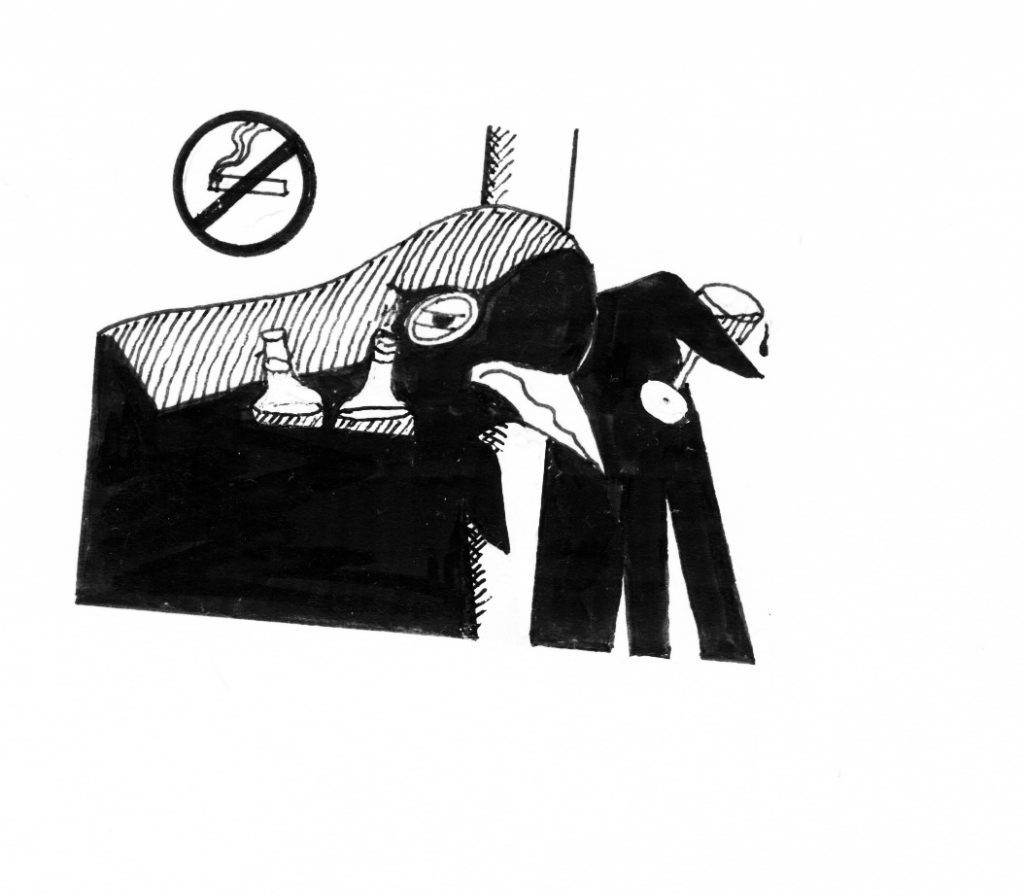
    It’s interesting to read the letters of John Ruskin alongside those of Vincent van Gogh. Most people are aware that Ruskin became rather unbalanced with age, but from reading his correspondence with Euphemia (Effie) it seems to me he was quite mad from the start. It’s the manic density that impresses as much as the content. Writing from Switzerland … “Coming down from the high snows my face burned literally scarlet, you may well talk of the Kalydor [A kind of early patent sun cream. Ed] but it must be for me there – that it wanted. Then the costume. Fancy – first – me with a huge pair of dark blue double glassed spectacles. Over there – over the whole face, a green gauze veil – doubled and fastened down in the waistcoat ¬ then a broad straw hat on the top of all – tied down tight with its flaps over my ears – by a handkerchief over the crown of it – tied under my chin! Many a hard days walk have I had so accoutred and enough to frighten anything in the world.”

    Effie herself was rather odd. She wrote about the eldest son of Earl Somers, who is a beautiful drawer, but also rather fond of queer things, such as he wanted to see a massacre and went some months ago to Algiers where he saw two or three really good ones and has come back quite satisfied.”

    Van Gogh’s letters, in contrast, are models of sanity … “One can never study and toil too much from nature. The greatest most powerful imaginations have at the same time made things from nature which strike one dumb.” His descriptive powers are superb: “Flemish sailors eating mussels and drinking beer happens with a lot of noise and movement, while in contrast a tiny figure in black with her little hands against her body comes stealing noiselessly along the grey wall. Framed by raven black hair a small oval face, brown, orange yellow, I don’t know. For a moment she lifts her eyelids and looks with a sideways glance from a pair of jet black eyes. It is a Chinese girl mysterious as a mouse, small bug-like in character. What a contrast to the greys of Flemish mussel eaters.”

    Before the plague I managed to see two very good exhibitions and a dreadful one at the White Cube gallery, which I won’t bother you with. Up the glass staircase at the Royal Academy you can see the works of Leon Spilliaert, of whom I’d never heard. A mysterious painter mainly of Ostend after dark. I’m fond of Ostend. In the ’70s they held an annual open exhibition. I always did rather well in it and one year they awarded me a medal inscribed ‘Europrix – French Dick’. It occupies pride of place just beneath my turntable. I enjoyed the Spilliaert show, as did the Scrapyard Queen and Mrs Cravat. Dirty Harry, on the other hand, didn’t like it at all and sloped off to the pub. He didn’t believe the story of the artist’s insomnia and thought him more likely a shirtlifter on the cruise.

    There are very dark pictures in chalk and watercolour, vague lights here and there, beach scenes and figures on the promenade. A nice one of a girl showing her bloomers as the wind whips up her dress. I think perhaps he was a bit of both. His portrait of an absinthe drinker inspired the Scrapyard Queen to do a picture of a cider drinker as soon as she returned to her lair in the West Country.

    I wonder if the Beardsley expo will be extended after the plague… It’s certainly worth seeing. I vividly remember the Beardsley show at the V&A in ’66 arranged by Brian Reade. It quite turned my head around. Before seeing Beardsley I had been doing wildly over-praised paintings which were a mixture of Abstract Expressionism and Pop Art. Some of them were enormous and weirdly shaped. As I’m not much of a carpenter they always fell to bits. I’d been a raving Modernist since schooldays but now I decided I wanted to be a decadent (or day cadong as it was pronounced).

    I switched to pen and ink for a few years before I started painting again after a visit to the Gustave Moreau museum in Paris. I came to dislike artists who drew habitually with lots of lines. Don’t be precious, dive in, have a go, it doesn’t matter if you make a mess, you can always do another one. Mistakes are for learning. Look properly at the thing in front of you and don’t square it up, it gives the game away.

    Poking around in my library you never know what you might find. I discovered seven books on Beardley, one of them by Brigid Brophy. Marvellous woman, married to Michael Levey, the director of the National Gallery in the ’60s. Kingsley Amis wrote a humorous limerick about her:

    The first chap to fuck Brigid Brophy

    Was awarded the Krafft-Ebbing Trophy

    And ten thousand quid

    Which for what the chap did

    Was regarded as rather a low fee.

    Stephen Calloway’s Beardsley book is the best. I first met him about twenty years ago in the V&A. He seemed to emerge out of a wall, a vision of Victorian loveliness (it was the concealed door in the museum’s print and drawing room). Off he strode in a white linen suit and, I think, button boots, antique gold specs, floppy hair and a long beard. I mentioned this to David Rodgers, an old friend. They both had the most amazingly posh voices and, along with Brian Sewell, were said to make the Queen sound common. Dave was a great fan of the Rolling Stones, who he referred to as the ‘Railing Stains’. After I’d described my Victorian vision he said ‘Oh that’s Stephen Calloway, he’s extraordinary isn’t he? I was at a meeting at the V&A a few weeks ago and people were setting up their computers when Stephen walked in, put his writing case on the table and brought out a bottle of ink and quill pen.”

    I first met Dave when he gave a lecture on Aubrey Beardsley at the Graves Art Gallery in Sheffield. His first job in London was curator of Old Battersea House, a magnificent ruin on the river, full of second division Pre-Raphaelite paintings and the most splendid dry rot I’ve ever seen. Some of the ‘flowers’ of dry rot on the staircase were two or three feet in diameter. Vandalism and break-ins were frequent and led him to leave after a year. I think it’s been renovated now but it would have been lovely to preserve it as it was in ’67. Maybe it could have been “plastinated” and double as a fairground attraction.

    There was a strong link between the Graves and the Aesthetic and Decadent movements in the 1890s. The gallery was run by John Rothenstein whose father William knew everybody from Oscar Wilde, Beardsley and Ernest Dowson to Leonard Smithers, who became extremely important to Beardsley after the Yellow Book dispensed with his services due to his association with Wilde, who was just then embarking on his hard labour.

    Smithers was a Sheffield solicitor who came to London and set up as a purveyor of rare books, which included a variety of ‘under-the-counter material’. He was very successful for a time with a shop in the Royal Arcade off Bond Street. He had a plump but attractive wife with many admirers with whom he would occasionally agree a price. There used to be a Leonard Smithers Society but I don’t know if it’s still going. Along with Beardsley and Arthur Symons he launched a new magazine, The Savoy, a rival to the Yellow Book, which was becoming rather tame. Many considered Smithers a disgraceful fellow, a bit of a cad, but I wish there were more like him around nowadays. I might be able to display more of my pictures. He died in mysterious circumstances in a small room in Fulham with no furniture and hardly any clothes.

    If you were an art school creature in the ’50s and early ’60s you would most likely be a follower of Sickert, a mild Modernist, or a Cézanne still-life merchant. Underneath all this was a curious current mostly ignored but sometimes referred to as Neo-Romanticism  … dark figures in long smocks (they couldn’t do legs) leading white horses to dark pools is how I remember it. Perhaps it was the legacy of the late 19th century. I think every small provincial art school had a crusty old decadent on the strength.
  • Laura Gascoigne: Pox On All Our Galleries – May 2020

    Laura Gascoigne
    May/June 2020

    At the exit to Tate Modern’s Andy Warhol exhibition, the gift shop tills were barricaded behind an airport queue management system. “You’re preparing for an invasion,” I joshed with a cashier as I emerged from the press view on 10 March. “We’re prepared for anything,” he replied.

    What they weren’t prepared for was nothing, which – within a week – is what we were left with. Days later they started dropping into the mailbox, the regretful notices of museum closures: the first crack in the dam on 13 March was the Wellcome Collection and the trickle quickly became a flood. The big public galleries with most to lose in visitor numbers hung on longer: on 16 March came news from the National Gallery of the postponement of its Artemisia Gentileschi show, but still no word from a tight-lipped Tate – I had to go on their website to find out they’d closed two days later. Then came the emails from commercial galleries announcing, hopefully, that they were still ‘open by appointment’.

    An art world without galleries is a ghostly thing. Commentators attempted measured responses: “It is unlikely that we will hear the refrain ‘business as usual’ any time soon,” was Thomas Marks’ laconic forecast in his April Editor’s Letter in Apollo. As my late mother-in-law used to delight in saying in a menacing tone: “There’ll be some changes made”. Some will be for the worse but, on the evidence so far, some may be for the better.

    On the plus side, the media obsession with ‘time-sensitivity’ has gone out the window, with no tears shed over its defenestration by this arts correspondent. It always seemed to me absurd to be hounded from one press view to the next by arts editors so desperate to be ahead of the news curve they commissioned previews of shows one hadn’t seen, only to set off stampedes of sheep into gallery basements to shuffle past redisplays of pictures they could have enjoyed at leisure, and for free, the week before upstairs.

    Another hopeful sign: fewer art fairs. TEFAF New York Spring has been collapsed into Fall, Masterpiece London is cancelled and the Ifema hangar that recently housed ARCO Madrid has been turned over to a coronavirus hospital. Biennale-hopping will be brought to a halt when the budget airlines all go bust. Manifesta 13 in Marseilles and the second Riga Biennial are both up on blocks, while the locked-down Biennale of Sydney has gone virtual – like Art Basel Hong Kong, a visitor experience described by Susan Moore in Apollo as “not so different from my recent online grocery shopping” – though easier to access for anyone not signed up to Ocado before the coronacrisis.

    It’s an ill plague wind that blows nobody good, as the purveyors of sex toys to the self-isolated are discovering: sales up 13% here, 60% in Italy. Meanwhile virtual reality companies are profiteering from locked-down art lovers clambering onto ‘extended reality [XR] platforms’ to head for the virtual hills. On the heels of the closure notices came an email announcing the April launch of Vortic, a new XR platform for the art world offering “customisable virtual gallery spaces, supported by two seamlessly integrated virtual [VR] and augmented reality [AR] apps.” Don’t ask me what the difference is, I have enough difficulty navigating the real-world real world of RR [real reality]. But for collectors up to speed with these things they open up the possibility of virtual bring-a-bottle private view pyjama parties, with the ability “to make direct real-time enquiries with galleries”. Good that something in the post-Covid-19 Space-Time continuum will remain real. Oh and the moolah too, for those who still have it.

    Meanwhile public galleries without access to extended reality are struggling to lure audiences online. After the torrent of announcements of RR gallery closures came the drip-drip of invitations to visit gallery websites. My first indication from Tate Modern that something was wrong was the announcement of “an exclusive online-only performance” by Congolese artist Faustin Linyekula originally programmed for the BMW Tate Live Exhibition season but obliged to run on empty in the Tate Tanks. That might have attracted a few performance freaks, but getting the general public excited about online displays is more difficult. For most gallery-goers, visiting exhibitions is about the satisfaction of having been there and done that, just as cultural destinations were for cruise ship travellers in the days before they were all quarantined in their cabins. Scholars and researchers trawl online collections, but the general public only visits gallery websites for information on opening times and prices.

    Worse, websites can’t be monetised and even closed galleries haemorrhage funds. A survey by Americans for the Arts estimated that by 18 March the pandemic had cost the US non-profit arts sector $3.2bn – to put that in perspective, just under half the 2018 GDP of Malawi. The Met is expecting a shortfall of $100m on its annual operating budget of $320m. “We very much hope that the cultural world of New York can survive this,” its president Daniel Weiss told The Art Newspaper ­– an expression of hope that didn’t sound that hopeful.

    Is it curtains for culture? For smaller institutions with no discretionary resources or endowments, prospects are bleak: in America it’s feared that a third of small rural museums may not reopen. Here the prognosis for independent institutions outside the charmed circle of National Portfolio Organisations is grim. As for small commercial galleries operating on a shoestring, the expectation that a third will close sounds optimistic. While White Cube was reopening in Hong Kong on 17 March, they were battening down the hatches. Rent holidays only prolong the agony. As for wage packets, there was cold comfort to be taken from ACE’s announcement on 24 March of a £160m emergency response package, of which £50m is reserved for non-NPOs and £20m for individual ‘creative practitioners and cultural workers’ – including writers, translators, editors, freelance educators and curators, all adepts at filling out applications.

    How much will be left over for artists? (The portal for Round Two closes on 30 April: quick or you’ll miss it.) As for Rishi Sunak’s promised handouts, the most self-isolated of the self-employed will be last in line. The only good news is that the Artists’ General Benevolent Institution, which sends out an annual begging letter to buyers of its Christmas cards entreating them to bring its services to the attention of indigent artists of their acquaintance, will finally come into its own. There’ll be queues stretching around the Burlington House courtyard into Piccadilly.

    There’s no silver lining to this poison cloud, except the faint hope that when it lifts it will leave behind a medicine bottle labelled ‘Drink Me’ whose effects will make everything in our bloated art world shrink. No more Brobdingnagian new museums, brain-numbing blockbusters and backbreaking biennials, and no more money to piss away on pointless public art. With a post-COVID-19 depression hanging over us will anyone shed tears over the postponed unveiling of Heather Phillipson’s whipped cream sculpture on the Fourth Plinth, with its cherry, fly and surveillance drone on top? “I wanted to make a monument to hubris and impending collapse,” the Cassandra of the Cornetto told the Financial Times. It was called ‘THE END’; now it may never come.

  • Dick French: On The Town – March 2020

    Dick French
    March/April 2020

    Who now remembers the fashion for wearing two pairs of trousers? It was all the rage in Camden Town twenty years ago but you seldom see it now. The outer pair would be cut at the knee to reveal the underlying pair. There’s one chap on Queen’s Crescent who carries on the tradition. Apart from the trousers, he wears nothing but a leather bondage harness and is festooned with pink feather boas, bracelets etc.. And such apparel serves him even in the most inclement weather. He was in the doctor’s waiting room a few weeks ago shooting everyone with a green plastic ray gun with sparks inside. In these grey days such eccentricities are to be encouraged … but never get talking to them. Eccentrics generally turn out to be colossal bores and offer to cast your horoscope.

    What’s all this rubbish about? Well, I’m just trying to get myself warmed up to write about the Picasso show at the Royal Academy (until April 4th – illustrated Self-Portrait, 1918).

    In the 1890s Toulouse-Lautrec would sometimes take acquaintances down narrow streets and up a dark staircase to an attic in a home on the rue de Douai. He would knock on a dingy door opened by a woman visitors described as stooped, old, wrinkled and almost bald. Henri would give her chocolates and flowers and introduce her as Victorine Meurent, the juicy young morsel who had posed for Manet’s Olympia. She was then in her 50s and, like Henri, an alcoholic, but also a painter. I wonder what became of her work.

    In the first room of the Picasso show at the RA is an exquisite drawing of Jane Avril, great dancer and friend of Henri. With a few delicate scratchy lines beneath the eyes Picasso has managed to suggest  that she is not very well. She was suffering from something called Sydenham’s Chorea which caused unco-ordinated staccato bodily movements. This contributed to her unusual dancing style, a strangeness which appealed greatly to the Parisian audiences of the 1890s. This was the time, of course, of Huysman’s A Rebours. After some time working in a brothel she met Henri at the Moulin Rouge and they became a famous duo. She said that she “owed him the fame I enjoyed from the moment his first poster appeared”. Along with La Goulue and Yvette Guilbert she was among the most famous performers of La Belle Epoque.

    Picasso could have met her at the Moulin Rouge or the Café des Innocents in Montmatre, which later became the Café des Decadents and then the Concert du Pendue which featured an opening act partially hanging himself from a ten-foot rope. Is nothing new?

    Another of Jane Avril’s friends was the English entertainer May Belfort who sang Daddy wouldn’t buy me a bow-wow. “I’ve got a pussy cat and I’m very fond of that but I’d rather have a bow-wow-wow…” The innuendo was the same as it is today. Did Uncle Mac have any idea of what filth he was broadcasting to English children on a Saturday morning?

    A thing you notice in this show is that over a certain scale Picasso couldn’t convey form. He resorted to flim-flam and stick-ons or the rather ghastly pastel renditions of his neo-classical period. There’s an interesting series of photos showing the development of Guernica which didn’t change much from the initial drawing out. I’ve never been convinced that it is such a powerful war painting. It’s an agreeable triangular composition of flat shapes about which much ink has been spilt, and about which doubtless many other interpretations are possible.

    “The hairs of my beard, though separated from me, are just as much gods as I am myself.” An egoist then, and how. Looking at this exhibition, and it is huge, you get the overwhelming feeling of ‘Yo Picasso!’ He just couldn’t get away from himself.

    ‘Yo Picasso! Give me the money!’ He was of course obsessed by money and a notorious skinflint.

    He often carried a small Browning pistol given to him by Alfred Jarry. If anyone criticised Cézanne he would “out with that thing”, as Damon Runyan would say.

    Some of the drawings from the series Minotauromachie (illustrated above) are of interest, especially Dora and the Minotaur, in which he uses colour well, a rare thing for him. The Minotaur seems to have been anatomically complete at some stage but he chickened out and scrubbed the ‘cartso’.  He knew his clientèle and didn’t want to put them off.

    He was still occasionally producing work of interest in the ’60s and ’70s, in particular the etchings for La Celestina by Fernando de Rojas and some etchings of brothel scenes after Degas showing a madam and three tarts. A number of largish paintings included here demonstrate that he was much better at drawing. Some of them are quite horrible.

    There are some interesting stories of his early years, in particular about his lifelong friend Manolo, who had been lent a studio while the artist was away and sold all the Gauguins on the wall to Vollard. He also stole Max Jacob’s only pair of trousers but had to return them as no dealer would make him an offer.

    Even when I was young and obsessed with Modernismo I never liked Picasso. I found him quaint, a tedious old clown who could do no wrong. Included in the show are a couple of those very late cavaliers smoking pipes. I have a friend, a merchant banker, who owns on. One day when I might have been a bit merry I advised him to flog it off while it was still worth something. ‘Yo boca grande!’ I was never asked back.

    Dirty Harry offered me a free trip down to Bath to look at an exhibition by Perry Grayson. I don’t think I was the first to turn it down. He is a creature in the depths of crispation, encrusted by his own myth. I have no wish to draw any more attention to his narcissistic obsessions. His work is so feeble that if he didn’t go trolloping around as a Widow Twankey it would never have been noticed. But he is a national treasure…

  • Laura Gascoigne: Battle of the Sexes – March 2020

    Laura Gascoigne
    March/April 2020

    Large woman to much smaller man at a party: “I love the idea of there being two sexes, don’t you?” James Thurber was the Thucydides of the gender war, dissecting its battlegrounds, victories and reversals with his pen: the fight in the grocery, the battle on the stairs; the rout where the men have the women briefly on the run and the surrender where their leader capitulates to a baseball bat-wielding Boadicea; the female capture of three physics professors and the female spy reporting back on crutches. It’s a nasty business, and judging from the eruption of hostilities in the pages of The Jackdaw it’s not over yet.

    Alexander Adams’ Women in Art Today survey in September set out to demonstrate that women are now equally, if not over-generously, represented in the visual arts and consequently have no axes left to grind. The statistics he gathered from 2018 to 2019 showed more female appointments to administrative and curatorial positions, more female winners of fine art prizes and more female-only art events. He didn’t measure representation in public gallery shows, though a glance through the current exhibition schedules certainly seems to confirm a bias in favour of women. The Tate is devoting five solo shows to women artists – Lynette Yiadom-Boakye, Paula Rego, Magdalena Abakanowicz, Maria Martuszová and Haegue Yang – over the next two years, and this year’s headline-grabber at the National Gallery is Artemisia Gentileschi.

    Truly, a sexual revolution is upon us. The trouble, as Adams was too courteous to point out, is that the women chosen to represent their sex are not always that great. This is not because Brian Sewell was right and women artists are just not as good as men; it’s because historically they have tended to be saved from artistic oblivion by their association with male artists rather than their talent.

    Check out the women artists given solo shows at Tate Modern over the past few years: Sonia Delaunay, wife of Robert (2015); Georgia O’Keeffe, wife of Alfred Stieglitz (2016); Dorothea Tanning, wife of Max Ernst (2019); Dora Maar, muse of Picasso. This does not necessarily reflect on the quality of the work ­ I enjoyed the Tanning and the Maar exhibitions – but it is noticeable that Agnes Martin (2015) is the only singleton (she preferred women) to have been so honoured.

    Men are better than women at getting themselves noticed by clubbing together in art movements-cum-drinking schools. They understand the principle of critical mass. Lazy critics love an art movement; they’re less likely to miss a group of like-painting people than a lone original. Originality, although theoretically prized in art, is in practice often missed because it’s isolated. Women artists are less clubbable than men. They may club together over children but, perhaps because confined to quarters by said children, they tend to work in professional isolation.

    Susan Wilson once wrote an article for the Guardian titled ‘I didn’t know you had a baby’ after a remark made by a male art teaching colleague when she joined the lads in the pub after work – something she felt she had to do to be taken seriously. It’s not surprising that some of the most dedicated women artists – Gwen John, Joan Eardley, Agnes Martin – have been childless, but they too were never really part of any movements; they were artistic dead-ends. Ironically, it may have been Gwen John’s association with a more famous male artist, her brother Augustus – who recognised that she was the greater painter – that saved her from falling through the cracks like so many of her female peers. There are, of course, also male artists who have been dead-ends, most of them mummy’s boys like Morandi and Lowry. It would be interesting to conduct a survey measuring how much testosterone contributes to artistic success. Can it be linked to that distinctly masculine attribute ‘genius’? I’ve never heard the term applied to a woman. 

    Anne Desmet answered Adams’ points pretty comprehensively in her November letter, and I’ve got nothing to add. All I will say is that for a campaigner against identitarianism and its culture of victimhood, Adams’ whole project had a whiff of male victimhood about it. I’m also unconvinced that feminism, in the broad sense of the term, can be defined as identitarian. Being female is not an identity – not yet at least – it’s a gender. You can’t lump women together as ‘victims’ with ethnic or sexual minorities when you’re talking about half the population.

    I won’t deny that it’s tough being a white male artist today; I have every sympathy for any non-ethnic minority man trying to make his way in the art world as currently constituted. I know of one white mid-career male artist who recently had a show at a regional gallery cancelled because the organisers felt they couldn’t justify spending public money on an artist from such a historically privileged group, and confessed as much. Adams is right to campaign against arts funding being devoted to social engineering. But although the constant liberal checking of white male privilege grates, it’s arguable that a correction is overdue. Plus the alternative is not an appealing prospect. Who knows what the fate of arts funding will be under the regency of Demonic Cummings, when he’s finished with the BBC? So far the visual arts have been beneath his liberal-tracking radar. Be careful what you wish for.

    Time to call a truce? Imbalances naturally tend to level out. At the present rate of consumption galleries will run out of dead women artists unless curators do some serious research to dig out new ones. Those so far unearthed have been of uneven quality. The Baroque painter Michaelina Wautier, dusted off by the Rubens House in Antwerp in 2018, looks a serious contender, but the Renaissance nun Plautilla Nelli being promoted – and expensively restored – by a bunch of bien-pensante Americans in Florence marching under the banner of Advancing Women Artists is an obvious dud. The pages of Germaine Greer’s The Obstacle Race are sprinkled with muzzy monochrome photographs of paintings by forgotten women, some of whom – like Giovanna Garzoni with her exquisite Dish of Broad Beans – clearly merit further investigation, and maybe the funding will now be forthcoming.

    Of living women artists there is obviously no shortage. But, as Anne Desmet points out, despite increasing parity in public gallery exposure women remain poorly represented by top-end dealers, who find it a fag to get their prices up – a difficulty that will persist until there are equal numbers of women collectors. Women may represent half the population, but the moneyed half doesn’t always want to buy what they choose to represent. One reason why women abstract artists like Bridget Riley and Gillian Ayres fare better in a male-dominated market than their figurative peers is that their work does not reflect female experience. The truth, and I may be trolled for telling it – except that I’m not on social media, tee-hee – is that men’s art tends to appeal to men and women’s art to women. What woman collector would want a late period Picasso?

    If this is a problem, it will only be solved when the idea of there being two sexes loses its appeal. Call me old-fashioned, but I hope it doesn’t.

  • Laura Gascoigne: The Experience Economy – January 2019

    Laura Gascoigne
    January/February 2019

    The buzz of anticipation in the COL Ballroom in Davenport Iowa is audible, the audience murmurating like a flock of starlings; then the first twangs of an electric guitar tuning up, followed by a smoky voice: “I’m going to ask one question before we start: Are y’all experienced?” “Yeah!” roars the crowd, unleashing a 10-minute guitar solo of yowls, howls, skitterings, screeches and kerrangs. August 1968. How experienced was Hendrix? He was 25.

    I don’t know whose idea it was to call the band The Jimi Hendrix Experience – you can bet it wasn’t Jimi’s – but they were ahead of the economic curve. It would be a generation before America woke up to potential value of ‘the experience economy’, identified in 1998 by B Joseph Pine II and James H Gilmore in a ground-breaking article in Harvard Business Review: “Commodities are fungible (no, me neither), goods tangible, services intangible, and experiences memorable.” (Their italics.)

    Economic trickle-down effects, like leaks, always debouch in the wrong places and the experience economy has now seeped into the art gallery, where the trickle is threatening to become a flood. One of the first to open the stopcock has been Tate Modern with its immersive Turbine Hall installations, the most memorable to date being Olafur Eliasson’s The Weather Project, which reportedly drew over two million visitors in 2003. I don’t remember it, not for the reason I’ve forgotten the 1960s but because I was never actually there. Which made me doubly keen not to miss In Real Life, Tate Modern’s latest show by the Danish-Icelandic artist who “puts experience at the centre of his art”.

    Eliasson really understands this game: his exhibition ticks all Pine and Gilmore’s boxes, beginning with its theme: “An effective theme,” they recommend, “is concise and compelling.” Where the Hard Rock Café has rock music and Planet Hollywood has Sylvester Stallone and Arnold Schwarzenegger, Eliasson has climate change. His show was swarming with Gen Zedders taking selfies of their coloured silhouettes cast on the wall by a row of lighting gels, or dancing in rainbow mist falling from the ceiling. There was something for everyone: for the sober-minded, a wall of before-and-after shots of shrinking glaciers; for the frivolous, a spiral mirror tunnel in which to admire their kaleidoscopic reflections; for the mystically inclined, a longer tunnel of radiant fog that made me feel I’d died and gone to heaven. As fog art goes, the experience was feet-in-front-of-your-face ahead of Gormley’s miserable pea-souper at the Hayward in 2007. So top marks all round. But at £18 a ticket? 

    When you own a press pass you forget how the other half lives, but I looked this up and then, for comparison, I looked up the prices of other London visitor experiences: London Sea Life Aquarium – £22; London Dungeon – £24; Jack the Ripper Walking Tour – £19 for two (you’d look suspicious going alone); The Slide at the ArcelorMittal Orbit – £33 for two; The London Bridge Experience – £36 for two (now half-price, and bring your own narwhal horn); Save Humanity: Cocktail Infused Escape Room for Two at the Grid – £60, for which you get to play with AI tools, do crazy puzzles and try to defeat an evil corporation (while enriching the one that dreamt this nonsense up).

    OK, the Eliasson experience offers something these don’t: a sense of satisfaction at being on the right side of ice age history. But face it, this is a competition art can’t win. True, Gormley’s golden-ager adventure playground at the RA was heaving when I went, mostly with bewildered biddies navigating the energised spaces, negotiating the slabworks (I so prefer slobworks) and gawping in disbelief at a roomful of muddy water describing itself as “a kind of primordial soup of matter, space and time”. Gormley’s “invasion of the inside by the outside” may be a novelty worth £22 to Londoners while the Thames Barrier holds up, though probably not to residents of Tewkesbury where primordial soup is free at the point of delivery. There was a tunnel here too, a dark cuboid cloaca which I chose “to navigate around the outside” as I feared it might get clogged with costive biddies and Dyno-Rod might have to be called to flush us out. Such are the risks of “embodied experiences in art”, as they are now known.

    Still, one can’t object to contemporary art installations being sold as visitor experiences, because if they’re not then what is the point of them? The trouble starts when the experience concept is applied to displays of traditional art. The National Gallery has ventured down this path with its immersive extravaganza Leonardo: Experience a Masterpiece, entered through a sort of Alpine pass constructed of mirror blocks prompting visitors to “explore a landscape populated by the ideas of Leonardo as he set about painting the Virgin of the Rocks”. The pass gives access to a mock-up of a conservator’s workshop with a projected image of the painting’s underdrawing; a chiaroscuro room where you can fiddle with dimmer switches to ‘relight’ a photographic tableau of a seated model dressed as the Virgin; and an ‘imagined chapel’ where you can view the actual panel in a variety of different projected settings.

    All of this for £18 standard admission. If the show was almost empty on a Tuesday afternoon, it’s because it breaks Pine and Gilmore’s cardinal rule: “Before a company can charge admission, it must design an experience that customers judge to be worth the price.” A cocktail infusion might have helped. As it was, the best bits were the quotes from Leonardo’s notebooks reflected in the mirror blocks of the mountain pass: “So we can say the earth has a vegetative spirit, and that its flesh is the soil, its bones are the arrangement and connections between stones which form mountains, its cartilage is the tufa rock, its blood the veins of water.” Match that for eco-sentiment, Olafur.

    How memorable are these experiences? I had to go through my photographs before writing this to remind myself. True, no damage was done by the Leonardo experience if you discount the hit to the wallet of having to pay for what is normally free – visitors do eventually get to see the painting. That’s not always the case with Dulwich Picture Gallery’s old master experience Rembrandt’s Light, for which – to highlight the theatricality of Rembrandt’s art – cinematographer Peter Suschitzky (of Star Wars and Mars Attacks! fame) has been commissioned to design atmospheric lighting. For the night paintings, his lighting notes prescribe “darkness contrasted with a soft, warm light, recreating the feeling of Rembrandt’s candlelit studio” – with a consequent reduction in visibility. Meanwhile the spotlight on Christ and St Mary Magdalene at the Tomb is programmed to fade and brighten “emulating the dawn breaking over Jerusalem”. Oy vey! Gilding and lilies come to mind.

    “Experiences, like goods and services, have to meet a customer need,” suggest Pine and Gilmore. Does Rembrandt really need help with his chiaroscuro? In one of his few recorded remarks, he advised a patron: “Hang this piece in a strong light”. No, there’s only one way to experience paintings, and that’s by looking. 

  • Laura Gascoigne: The Gold Standard – November 2019

    Laura Gascoigne
    November/December 2019

    In October of last year, under the title ‘The Midas Touch’, Sotheby’s held a special sale of ‘objets de vertu’ made of gold. “In a world that speaks 6,900 languages,” cooed the catalogue, “the language of gold remains universal”. To prove it, the auction house promised to take collectors “on a journey through the great civilisations of the world”, starting with an ancient Etruscan-style Greek 22ct gold wine cup (estimate £3,500-4,500) and ending with a Dom Perignon Gold Mathusalem 2002 (£15,000-20,000) of vintage champagne to quaff from it and a 24ct gold thread bedding suite by Federico Buccellati (£30,000-50,000) in which to sleep off the effects.

    It was not all luxury items; there was art too. The lots included a Petit Barbu medallion by Picasso (£12,000-16,000); a Monogold Sans Titre by Yves Klein (£800,000-1,200,000); a Piccolo Miracolo by Marino Marini (£15,000-25,000); and a Marc Quinn head of Kate Moss titled Song of the Siren (£300,000-400,000). To keep things in perspective, Sotheby’s threw in a Madonna of Humility goldback by Jacobello del Fiore (£50,000-70,000) and a portfolio of 20 Sebastião Salgado photographs of the Serra Pelada Gold Mine, Brazil (1986) (£80-120,000).

    In uncertain times investors turn to gold, and Donald Trump’s trade wars coupled with the global economic downturn have boosted the price of bullion to its highest level for six years. So it says something for the buoyancy of the art market that a single photograph should be worth more than a solid gold ancient Greek cup. If there’s going to be a rush for gold, it hasn’t yet started: the buyer of Jeff Koons’ Rabbit (1986) at Christie’s New York in May for a record $91m was none other than Robert E Mnuchin, father of Donald Trump’s treasury secretary. The rich like glitter. Mnuchin wasn’t bothered that the Rabbit was made of stainless steel; when polished to a high enough shine, steel passes for bling.

    Still, the language of gold remains universal, and a smattering of it is an asset to any contemporary artist who wants to make it big. In 2010 that great critic of capitalism – or is it communism? – Ai Weiwei produced a glitzy gilded bronze edition of his Circle of Animals/Zodiac Heads, which he trotted around the world from New York to Montreal to Denmark to Moscow before achieving an auction record of £2.8m at Phillips London in 2015. “Maybe I’m just an undercover artist in the guise of a dissident,” he confessed in the auction catalogue. Maybe he’s just a good salesman who knows his market. 

    As Oprah Winfrey once wisely remarked, when you’ve got all the necessities of life the only significant advantage money will buy you is thicker towels. Brought up against this disappointing reality, the mega-rich have to take comfort in exciting envy by splurging on such rarefied necessities as the 24ct gold-plated vacuum cleaner advertised for £800,000 by online retailer Firebox a few years ago, or the 22ct three-ply bog roll sold by Aussie company Toilet Paper Man for a similar sum. In the immortal words of Zero Mostel in The Producers: “If you’ve got it baby, flaunt it, flaunt it!”

    So it showed a degree of sophistication on the part of the American President when in 2017 he turned down the offer of an 18ct golden toilet from Nancy Spector, artistic director of the Guggenheim Museum New York. Titled America, the fully functioning convenience was the work of Italian conceptual prankster Maurizio Cattelan, Padua’s answer to Bristol’s Banksy, and was valued at $6m. But Trump had requested the loan of Van Gogh’s Landscape with Snow and, to a notorious germophobe, a toilet 100,000 people had queued to use when recently plumbed into a gender-neutral restroom at the Guggenheim seemed a poor substitute. Much as he likes riding in gold-plated lifts, the presidential master of the playground cuss is not so stupid that he can’t recognise a piss-take from a libtard art curator when he hears one. Besides, as the Guardian suggested in its report, he may already have a gold throne of his own.

    The Duke of Marlborough doesn’t, and leapt at the chance of installing Cattelan’s at Blenheim Palace for the artist’s autumn retrospective. Plumbed into the guides’ wood-panelled throne room opposite the bedroom Winston Churchill was born in, it was available for use by visitors for just two days before thieves broke in at 4.50am on Saturday 14 September and ripped it out of the wall, causing flood damage. The family had been aristocratically relaxed about security. Only a couple of weeks before, the Duke’s half-brother Lord Edward Spencer-Churchill, who set up the Blenheim Art Foundation, had told the Sunday Times: “It’s not going to be the easiest thing to nick… Firstly, it’s plumbed in and secondly, a potential thief will have no idea who last used the toilet or what they ate. So no, I don’t plan to be guarding it.”

    As it turned out, the thieves were not that fussy. On any self-respecting burglar or cowboy plumber Spencer-Churchill’s press announcement will have acted as a challenge. Almost inevitably, it was taken up. A 66-year-old man was immediately arrested by Thames Valley Police, followed by a 36-year-old accomplice presumably responsible for the heavy lifting. It’s always the old lags, bless ’em, who rise to this sort of bait; they can’t resist the lure of a trophy heist. And what better trophy than a golden bog? I expect Michael Caine is already being fitted up for the part.

    Cattelan, true to form, took it all in good humour, hailing the heist as a piece of performance art. As the work belongs to the Guggenheim it’s no skin off his Pulcinello-sized nose – Spector and Spencer-Churchill can squabble over the insurance. “America was the one percent for the 99 percent, and I hope it still is,” he told the New York Times. “I want to be positive and think the robbery is a kind of Robin Hood-inspired action.” I doubt there’ll be much of a trickledown effect to the poor of Oxfordshire when it’s melted down, as it surely will be. Burglars don’t waste time betting on art futures when they’re sitting on a pile of valuable scrap. 

    The same fate almost certainly befell Douglas Gordon’s solid gold sculpture The Left and Right Hand Have Left One Another after it mysteriously disappeared from its box in Christie’s King Street warehouse in 2012, never to be seen again. Given that the gold was worth half the work’s £500,000 insurance value, this was hardly surprising. What was surprising was that the auction house only informed the artist of the theft more than two weeks after reporting the crime to the police. “I still own the work and I am the creator of the work,” Gordon sniffed to the press. “There’s something going on here about value and the way the artist is treated in all of this.”

    Artists may fool themselves, but the hard truth is that the value of art as a marketable commodity is monetary. Which is why collectors, like burglars, are better off with gold than steel: when the bottom falls out of the art market, they can melt it down.

  • Laura Gascoigne: Dirty Money and Plenty of It – September 2019

    Laura Gascoigne
    September/October 2019

    Among the many examples of the wit and wisdom of Sir Thomas Beecham is the story of the great conductor seeing a tombstone inscribed: “Here lies a great organist and an excellent musician” and remarking in surprise: “What, both in the same grave?” 

    I was reminded of this when seeing Wafic Saïd, a contributor to Boris Johnson’s leadership campaign, described in the press as an “arms dealer and philanthropist”. What, both in the same skin? You may recall the Syrian-Saudi financier as the fixer behind the notorious 1980s Al-Yamamah arms deal with Saudi Arabia, the investigation into which by the Serious Fraud Office was quietly dropped under Tony Blair in 2006. To salve what he has in the way of a conscience, Saïd likes to make charitable donations: a bit to the Royal Shakespeare Company, a bit to the Science Museum, a massive whack to Oxford University for his eponymous business school. Last year he funnelled £340,000 to the Tory party through his British wife Rosemary; the bung for Johnson’s leadership campaign was in her name, while their son Khaled supported Rory Stewart. Hedging your bets, as it’s known in camel racing.

    No complaints from the Electoral Commission: politics is a dirty business, where dirty money is the norm. Higher standards are expected of culture, I can’t think why. Wasn’t Alfred Nobel an arms manufacturer? And the Hunting Art Prize ticked along happily here for a quarter of a century despite the sponsor’s rumoured involvement with nuclear weapons and cluster bombs, before decamping to the land of the free and the Second Amendment in 2006. (Your correspondent even sat on the judging panel and received a case of wine for her services, which she didn’t choke on.) But now that cultured folk seem to have forgotten that lucre is filthy, they’re getting as jumpy about sponsorship as a passel of cats on a hot tin roof. 

    One campaigning group calls itself ‘Culture Unstained’. Culture unstained, eh?  I’ve been racking my brains for a major arts sponsor, from Cosimo de’ Medici on, whose hands have not been stained with dirty dealings of one kind or another. Lucre is filthy, and art depends on it. But this rather obvious fact seems to have escaped campaigners against BP’s sponsorship deal with four of our major cultural institutions: the British Museum, National Portrait Gallery, Royal Shakespeare Company and Royal Opera House. The focus of recent attacks has been the NPG’s Portrait Award, taken over by BP from John Player in 1989 when tobacco staining was considered the greater evil. (The RA, incidentally, still accepts £45,000 a year from Japan Tobacco International, which supported its 2009 exhibition of Anish Kapoor. Put that in your pipe and smoke it. The BM has also been quietly taking JTI’s yen for acquisitions for its Asia Department. It’s apparently OK to accept money from foreign tobacco companies; we don’t care if the Japanese die of cancer as long as our NHS doesn’t have to pick up the tab.)

    But back to BP. So far the NPG and the BM have stuck to their guns, or pumps, though how long the RSC will hold out after Mark Rylance’s ostentatious resignation from the company is another question. In June Rylance announced that he did not wish to be associated with “anyone who wilfully destroys the lives of others… Nor, I believe, would William Shakespeare.” That’s quite a claim to make on behalf of someone who lived through the Elizabethan era of colonial expansion and legalised piracy, but on climate change, perhaps, the bard was blameless: “Shall I compare thee to a summer’s day? Though art more lovely and more temperate than global warming.” 

    Summoning the spirits of dead artists in support of one’s cause is an interesting gambit. I doubt Van Gogh would have been overjoyed at having his recent exhibition at Tate Britain branded with the initials EY, but short of appearing like Banquo’s ghost and spooking VIP guests at the private view by parading his bandaged ear among the canapés there wasn’t a lot he could do about it. With living artists, though, it’s another matter. In November Nan Goldin twisted the NPG’s arm by refusing to go ahead with a planned exhibition unless the gallery dropped its grant from the Sackler Trust, the philanthropic arm of the owners of the drug manufacturer Purdue Pharma currently facing lawsuits in 35 US states for pushing its addictive painkiller OxyContin across America. Goldin has appointed herself the avenging angel of OxyContin addicts, fronting the campaign that drove the Met to sever its ties with the Sacklers in May. Now the repercussions are being felt over here, though it’s not our problem, and the stink of opioids is overpowering the smell of petrol. Having held the line on BP, in February the NPG’s newly formed ethics committee drew it at the Sacklers, who gracefully withdrew their grant “to avoid being a distraction” – for which read “to avoid more bad publicity”. Yes, there’s no such thing as bad publicity but no, no one in their right mind wants to pay for it. 

    Word has it that the NPG were shamed into action by the plucky little South London Gallery, whose trustees under the chairmanship of Frieze founder Matthew Slotover returned £125,000 worth of Sackler funding the month before. Now the gauntlet has been thrown down to Tate Modern, V&A Dundee, MK Gallery, the Ashmolean, the RCA, Dulwich Picture Gallery, the Science Museum, the Royal Museums Greenwich and all other recipients of Sackler generosity ­– the list of shame is as long as the tracks on a junkie’s arm. Woe to any institution that, like the Serpentine, has the Sackler name affixed in Roman capitals to its entablature; it cannot shed it without the family’s permission. While not wishing to be a distraction, the Sacklers may well balk at being erased from history without seeing a penny of their money back. 

    It’s been a tough year for the Serpentine all round. In June its CEO Yana Peel was forced to resign over her husband’s partnership in Novalpina Capital, a private equity firm with a stake in the cyber security group NSO linked to the murder of Jamal Khashoggi. Peel didn’t go without a fight, complaining of “bullying and intimidation” and “toxic personal attacks” – none quite as bad as being dismembered with a bone saw in the Saudi consulate in Istanbul on the eve of your wedding. In her resignation statement she threatened: “If campaigns of this type continue, the treasures of the art community [the community, note, not the art] – which are so fundamental to our society – risk an erosion of private support.”

    I’m not sure she’s right. While there are donors in search of redemptive publicity, support will continue. What no one mentions is how small the sums involved are. The real scandal is not that our cultural institutions are selling themselves for dirty money, but that they’re selling themselves dirt cheap. The BP sponsorship deal at the root of all the fuss is worth £7.5m, split between four institutions over five years. On the scale of ‘big oil’, this is peanuts. Before staining our culture with dirty money, let’s at least make sure there’s plenty of it.

  • Laura Gascoigne: Redrawing Drawing – July 2019

    Laura Gascoigne
    July/August 2019

    It’s hard to know where to start with Ingres’s definition when nobody knows any more what probity means. And yet drawing is enjoying a resurgence. What is going on?

    When David Hockney breezed into the Royal College from Bradford in 1959, he announced his arrival not with naïve etchings of naughty gay boys but with a drop-dead academic pencil drawing of the college skeleton. It proved to be an ironic last hurrah. Almost immediately after, the idea of drawing as an end in itself went down the drain with the rest of the academic wastewater. But ever since, like Incy Wincy Spider, it has been climbing back up.

    The first sign that it was still alive and kicking was the launch in 1973 of The Cleveland International Drawing Biennale. By the time that ran out of puff in 1996 Anita Taylor had picked up the baton with the Rexel Derwent Open Drawing Exhibition (1994), subsequently the Cheltenham Open Drawing exhibition (1996), the Jerwood Drawing Prize (2001) and as of last year, the Trinity Buoy Wharf Drawing Prize. Then came the Guild of St George’s jolly populist Campaign for Drawing, aka The Big Draw, and the Prince’s, now the Royal, Drawing School, both launched in 2000. Dedicated exhibition spaces opened in London in The Drawing Room (2002) and The Drawing Gallery (2004), and a smattering of public exhibitions with sexy titles promoting ‘new drawing practices’ followed: Tate Britain’s The Stage of Drawing: Gesture and Act (2004), Hayward Touring Exhibition The End of the Line: Attitudes to Drawing (2009) and Tate Liverpool’s Tracing the Century: Drawing as a Catalyst for Change (2012). Now, shazam! the DRAW Art Fair has made its debut at the Saatchi Gallery.

    In the meantime, definitions of drawing have been flapping about like loose sheets on an unmanned vessel as curators have gone overboard with attempts to rebrand it. Announcing its exhibition Drawing in Progress in 2010, Middlesbrough Institute of Modern Art – call me mima – claimed the key to the show’s success was “the way in which the advisory panel refused to define the term ‘drawing’ in the traditional way… forcing a reassessment of all the criteria under which we might produce, view, or discuss drawing.” That was telling them.

    In the 20 years since I’ve been keeping tabs, the reassessment has progressed in leaps and bounds: Richard Long’s 1967 drawing with feet on grass in a Wiltshire field now seems positively plodding after James Capper’s use of the ripper teeth of a mechanical digger to take a line for a walk round an Oxford housing estate in 2011. But mostly there’s been masses of drawings on gallery walls, aka ‘interventions in the space’. A leading exponent of this new drawing practice is Austrian artist Otto Zitko, who in 2010 covered three floors of the Arnolfini in an “all-enveloping drawing intervention in situ”. Zitko had previous, having already “improvised across the walls of cultural institutions around the world”. His “expansive abstract drawings”, the publicity told us, “seem to emerge from an unbounded desire to cover every surface – a primal urge to contain the whole of reality within a subjective cocoon or unbroken lines”. Good luck to him. 

    Wall drawings used to be known as ‘muriels’ back in the day when decorating walls was considered a girly activity, before abstract painters like Blinky Palermo got in on the act in the late 1960s and made it macho. But Blinky’s murals were never as expansive as the 69ft wall drawing on the ICA’s concourse wall that won Toby Paterson the Becks Futures Award in 2002 – since when expansive abstract drawing has become a staple of gallery stairwells from Pallant House to Tate Britain. 

    Why stop at walls? For her 2011 Raumzeichnung (‘Drawing in Space’) exhibition at the Sumarria Lunn Gallery, Berlin-based Polish artist Monica Grzymala contrived to “rearticulate the entire space” with sticky tape designed to “depart from the gallery walls” before eventually succumbing “to the will of gravity, the deterioration echoing humanity like some gigantic vanitas”. Never one to pass up the chance of a gigantic vanitas, Anthony Gormley was an early adopter of 3-D drawing or what he calls “activating the space”. (If he would only activate the space between his ears he might finally produce something worth looking at, though on past form we can fairly assume that his autumn show at his Royal Academy will be the usual waste of.)

    Is change in the air? The DRAW art fair in May was largely works on paper, a substantial number of them in humble pencil. And on the evidence of the last Trinity Buoy Art Prize the standard of, whisper it, draughtsmanship is going up, partly thanks to an infusion of young blood from the Royal Drawing School. Yes, the heir to all those Leonardos currently on show at the Queen’s Galley has been doing his bit towards, as the jammy say, ‘giving something back’. DRAW was dominated by the usual array of approved contemporary drawing styles – obsessive, outsider arty, pop arty, cartoonish, illustrational, Twomblyish – but with the best examples the style was less important than the content. As with writing, it helps if you have something to say. Still, no contemporary artist came close to the throwaway line of Jean Cocteau, whose full-frontal nude pencil drawing of a chef with his toque still on his head and his trousers round his ankles made Warhol’s nude hunk on the same stand look flaccid. It would have knocked Hockney’s pretty boys into a cocked hat too.

    All the signs are that we’re inching forward; now it’s public galleries that need to catch up. The British Museum hasn’t done the cause of graphic probity any favours by bigging up Damien Hirst’s beermat portraits of his former Svengali Frank Dunphy, dashed off during breakfast business meetings at The Wolseley and kindly donated under the cultural gifts scheme, thus saving Dunphy £90,000 in tax. The example released for publicity purposes, titled ‘Frank Eggs-ellent Dunphy’ – boom boom – shows the subject as a Dumpty in an eggcup. “Damien Hirst raised money-making and commercialisation of his art to a new level,” explained the BM’s curator of prints and drawings Hugo Chapman, stopping short of calling it an art form. The drawings he described as “very immediate… drawn with great energy… Damien can draw, there’s no doubt about that.” If there wasn’t any doubt, would it need saying? As a draughtsman Hirst is in a GCSE class of his own.

    In his introduction to the catalogue for DRAW, the fair’s French founder Laurent Boudier quoted Ingres without defining either of his terms. So why is drawing the probity of art? Because it shows artists up. Hirst may have hidden his drawings under the table at The Wolseley, but there’ll be nowhere to hide in Room 90 at the BM. As Wyndham Lewis wrote in The Role of the Line in Art: “It is more difficult upon a piece of white paper, your means of expression reduced to a few lines, to deceive the expert spectator than it is with a lot of oil paint upon a canvas.”

    But where, I hear you wail, are today’s expert spectators? Despair not. Given regular exposure to good drawing, spectators will acquire expertise. 

  • Martin Lang: Against life drawing

    Advocating life drawing at art school is a deeply conservative and reactionary position. Arguments in favour of life drawing usually fall into one of two camps (or sometimes both). I am utterly unconvinced by both.

    The first, and weaker, argument contends that it is necessary to learn the rules before you can break them. This is an authoritarian position where you must learn to draw “properly” before you can make other kinds of art. We can almost dismiss this argument out of hand. Imagine discovering a great artist, falling in love with her work, telling others how wonderful it is, but then finding out that her life drawing wasn’t up to much. Would you re-assess your judgement and decide that the art you once loved must be substandard? You probably wouldn’t dismiss your favourite musician if you discovered that he couldn’t read music: this is irrelevant if the music is good. Perhaps cinema might be a better comparison, since artists also work in film. Most people wouldn’t rubbish their favourite director upon finding out that he couldn’t draw very well. So why would you apply this criterion to an artist film maker? In both cases it is irrelevant if the films are good.

    This first argument shifts the focus away from the artwork and onto the artist’s training. To accept the argument is to accept that you are unable to judge the quality of the artwork without knowing something about the artist’s education. This is a useful argument if you do not like Modern or contemporary art, where such training is not discernible. Under this perspective, Mondrian’s grid paintings or Rothko’s colour fields are acceptable only if they can first prove that they are able to make more conservative kinds of art. This is the concession to Modern and contemporary art that the conservative authoritarian makes, reminding us that Picasso was an excellent draftsman before he dedicated his life to learning to draw like a child. If you value any kind of non-representational art (such as abstraction), any kind of de-skilled art, performance or relational art, then the argument that the prior mastery of life drawing is necessary falls short.

    The second, and more sophisticated, argument claims that mastery of life drawing is not necessary, but that it should be learnt anyway. Even if, after hours of classes, the art student is useless at drawing the figure, and even if she has no intention of making any kind of figurative drawing, painting or sculpture, there are still fundamental benefits to studying life drawing. These benefits include discipline (turning up on time, prepared with the necessary equipment), concentration (the ability to work on one thing for extended periods) and looking (training the eye). Proponents of this argument contend that these skills are just as useful for making non-representational and deskilled practices, because they provide the student with a greater sense of aesthetic awareness and a robust work ethic. But I have never once heard anyone who has made this argument call for the reintroduction of still life classes. Imagine bragging that your fine art degree programme obliges students to spend one day a week drawing fruit to enhance their concentration and observational ability. Why not also teach geometry, perspective and colour theory on a weekly, compulsory basis? You could do this, but you would have a deeply reactionary course that would churn out conservative artists. Readers might note that this second argument is also an authoritarian one, since it assumes that all art students learn in the same way. Whatever the student’s learning style, background (religious sensibilities come to the fore here) and whatever their artistic aims, their training must be grounded in observation of the nude human figure.

    Another strand to the second argument maintains that life drawing can be taught in an experimental manner to produce more cutting-edge artists. Examples include where life drawing concentrates on experiential drawing or experimentation with materials, methods and techniques (there are other examples). But this is no longer life drawing, for to teach these things there is no need for a model. Terming it as such only reinforces the assumption that the underlying tradition of life drawing is something that must be preserved, even when it is irrelevant to the tutor’s pedagogic aims and the student’s artistic ambitions.

    Life drawing was developed as a pedagogical tool to train Western artists to make figurative painting and sculpture. The reason that it still exists in some art schools is mostly down to tradition. While life drawing may be useful for some types of artist, it is not applicable to all. I am not saying that its teaching necessarily prohibits the development of good, exciting and relevant artists. My argument is that it is not necessary and does more to hinder the development of such artists than it does to encourage them. To teach it is to enforce a hierarchy: representation over abstraction, traditional forms of art over more avant-garde kinds. It is also to deny art’s radical potential: must art activists first learn such conservative lessons? Embedded within this hierarchical and authoritarian position lies a reactionary and conservative politics. Nostalgia and fascism have always walked hand in hand. Think of Mussolini harking back to the Roman Empire, or Hitler’s love of classical art and architecture. Today we might think of Trump’s slogan “make America great again” and Brexit talk of “taking back control”. We urgently need free thinking artists able to critique contemporary nostalgia, populism and even outright racism and sexism. For that we need a pedagogical approach that is progressive, inclusive, and libertarian. This will allow for more progressive forms of art to develop and emerge – including non-Western kinds. For these reasons, I am against the teaching of life drawing.

    Martin Lang is a lecturer in Fine Art at the University of Lincoln.
    E-mail: mlang@lincoln.ac.uk

  • Laura Gascoigne: Is Art (Finally) Toast? – May 2019

    Laura Gascoigne
    May/June 2019

    In 2014 the Harvard-based science magazine Annals of Improbable Research presented its Ig Nobel prize for neuroscience to a team of researchers from China and Canada who demonstrated that seeing the face of Christ in a slice of burnt toast is perfectly OK. (That year’s Ig Nobel prize for economics went to the Italian government for factoring illegal earnings from prostitution, drugs and smuggling into the nation’s GDP, so you can see that these Harvard science dudes aren’t messing around.) 

    The neuroscientists’ conclusion will have been good news to the assorted idlers, dreamers and general crackpots who not only see things in toast, but profit from their visions. Because there’s money to be made from this stuff. In 2004 Florida housewife Diana Duyser sold a 10-year-old toasted cheese sandwich with an image of the Virgin Mary on eBay for $28,000 to the Golden Palace internet casino, which proclaimed the sacred sarnie “part of pop culture” and used it to raise money for charity. The fact that it had stood on her bedside table for 10 years without rotting was, Duyser declared, a miracle.

    Laugh, but seeing stuff in toast is a recognised phenomenon with a fancy name: pareidolia. I have this on the authority of Susan Hiller, who in 2012 designed a Christmas screensaver for the Guardian featuring a grid of 15 images of Turin Toasts. On the back of her 2011 retrospective at Tate Britain, Hiller’s collection of found pareidolia will, one imagines, have scored higher with connoisseurs of art crostini than the marmite-on-toast celebrity portraits that propelled young Ebbw Vale artist Nathan Wyburn into the semi-finals of Britain’s Got Talent that same year. “It’s so hard for an artist to get recognition,” he would later lament. No offers were forthcoming from the Tate, though Wyburn did make the front page of the Guardian in 2012 with a composite portrait of Rupert Murdoch incorporating 5000 photographs of hacking victims.

    By now those of you with long memories will have a feeling we’ve been here before, and it’s true, we have. We touched on the topic of toast in 2010. But in the art world what goes around comes around in ever-tighter circles, and one has to keep up. So here, instead of Observer Food Monthly, we give you Jackdaw Toast Decennially (give or take a year).

    I knew it was time to revisit the subject when Martin Creed chose Toast as the title of his recent Hauser and Wirth exhibition, promoted with a publicity shot of the great eejit holding a toasted slice of holed ciabatta in front of his face like a carnival mask. (Swizz, isn’t it, how with ciabatta you pay for the holes. Perhaps they factor them into the Italian economy.) Like most of Creed’s ideas, this one wasn’t new – Los Angeles-based artist Matt Johnson got there before him at the 2004 Frieze Art Fair with a Breadface in cast and painted plastic. But Johnson didn’t have the savvy or the dosh to cast a slice of toast in patinated bronze and butter it in gold as Creed did for his Savile Row exhibition, timed to open in December when the oligarchs were out shopping for stocking-fillers. This from the ersatz master of the ephemeral, whose progression from blu-tack to gold-plated bronze is more stomach-turning than a rack-full of celebrity portraits in marmite.

    It won’t have gone down well with RA Schools student Tania Blanco down the road, whose contribution to this year’s Premiums exhibition featured a shelf stacked with packs of Medium Sliced White titled Emergency with accompanying text quoting Kropotkin’s declaration in The Conquest of Bread: “The social revolution must guarantee daily bread for all. After bread has been secured, leisure is the supreme aim…” Leisure presumably not supposed to be spent in Mayfair galleries salivating over slices of bronze toast buttered in gold.

    As it happens, there’s a long and honourable tradition of bread art associated with artists in reduced or confined circumstances. Hans Prinzhorn’s collection of art of the mentally ill included sculptures made by asylum inmate Karl Brendel from chewed bread. Egon Schiele kneaded a thumbnail portrait of a fellow prisoner from bread while banged up in Sankt Pölten penitentiary in 1912 on charges of kidnapping and rape. (For those who can’t afford Creed’s gold-buttered, Ronald S Lauder’s Neue Galerie in New York is currently offering a bronze version of Schiele’s portrait in an edition of 200 at $250 each.) German-Jewish artist internee Pamina Liebert-Mahrenholz sculpted with her bread ration while incarcerated in Holloway Prison in 1939, and Kurt Schwitters, interned in Hutchinson Camp on the Isle of Man, saved leftover breakfast porridge to make sculptures. They filled his attic studio with a stink of mould that made the atmosphere very unpleasant for fellow enemy aliens who sat for portraits at £5 a pop. (A snip at the price, to judge from the examples currently on show in the exhibition Refuge at Abbot Hall, Kendal. Unfortunately the sculptures biodegraded before opportunistic gallerists could have them cast in bronze.)

    There are good reasons for making art from cereals, and there are bad ones. Confinement and boredom are legitimate mothers of invention:  The Minories, Colchester’s 2015 exhibition The First World War in Biscuits demonstrated from 100-year-old examples what an inventive soldier in the trenches could do with a Huntley & Palmer’s No.4 standard whole wheat ration biscuit – baked so hard it had to be dunked but, unlike Schwitters’s soggy porridge, built to last. For creative purposes biscuits have a structural advantage over bread or toast, with the potential for large-scale projects such as the 12ft installation Eating the City created by Chinese multimedia artist Song Dong in the basement of Selfridges in 2006 from 72,000 McVitie’s biscuits. The starchitect of previous biscuit cities in Beijing and Shanghai, Dong was disparaging about the range of materials on offer – China apparently has a wider biscuit selection. Bad workmen blame their tools. Dong’s pre-fab biscuit city was as nothing to the 4ft replica of St Paul’s Cathedral – perfect in every detail, outside and in – built over three years by retired Willesden mechanic George D’Aubney from home-baked fruitcake and unveiled the following year.

    Whether you have to be a fruitcake to make cathedrals from fruitcake is a question for the neuroscientists for another year. But there is a distinguished art historical precedent for D’Aubney’s creation in Andrea del Sarto’s mixed media model of an octagonal baptistery, described for us by Vasari in mouth-watering detail: “The pavement was a vast plate of jelly, with a pattern of mosaic in various colours; the columns, which had the appearance of porphyry, were sausages, long and thick; the socles and capitals were of Parmesan cheese, the cornices of sugar, and the tribune was made of sections of marzipan.”

    All well and good, you’re thinking, but is it art? I refer you to the wisdom of nonagenarian collector Stefan Edlis who, in conversation with filmmaker Nathaniel Kahn for his art world documentary The Price of Everything, mentioned Swiss artist Urs Fischer’s timber-framed house made from bread, exhibited at the Milan Triennial in 2015. “Ask me if it’s art,” he told Kahn and Kahn, like a good comedy straight man, obliged. “Is it art?” he asked. “Well it’s not food,” said Edlis.