Category: Comment

  • London: the place for a painter

    This article is essentially a follow-up to a piece by The Jackdaw’s editor David Lee, published in The Times on July 25th of this year. In it he detailed just what a fiasco the Arts Council’s contribution to an otherwise successful Olympic year was with £5.4 million spent, and nothing to show for it.

    “Twelve months on,” he noted, “[and] we can evaluate more clearly what we received for a sum that approaches the council’s entire visual arts budget. The short answer is nothing; nothing memorable or of enduring merit – it was all frittered away on trivia. Not a single painting, print, sculpture or ceramic in any gallery. Not a mural or stained glass window in any civic building. No worthy public sculpture. Not even a sprawling installation or soporific video destined for a gallery warehouse. The sum total is three crocheted lions at Twycross Zoo and a boat made from 1200 donated wooden objects currently moored… somewhere.”

    As he also noted, it’s remarkable that this series of abject failures has generated so little concern. Clearly no one is going to be held responsible. The standard reaction, in the cosy world of Britain’s culturati, has been a shrug of the shoulders and a murmured aside: “Poor things, they didn’t really have that much to work with – they did their best.”

    Much of the support material for the Arts Council’s Cultural Olympiad is still up on the Council web site. What one notices about it now is a certain jolly Blue Peter quality, a note of “won’t this be fun for the kiddies”. Also, elsewhere, a note of Pooterish self-satisfaction. This is how the Cultural Olympiad was originally heralded:

    “The London 2012 Olympic and Paralympic Games will be a global event with enormous potential to help deliver our mission of great art for everyone. We have been closely involved in the development of the Cultural Olympiad programme since the bid stage. As a result of our investment, we hope to achieve three things: increased participation in the arts; increased profile for our artists on the world stage; and new collaborations that push boundaries, and leave a legacy of a strengthened sector.”

    Yeah, sure – look at the results: fiasco on every count.

    The context within which this failure, or series of failures, took place is fascinating – also in many respects bizarre and unsettling, though it gives some room for hope. The top end of the market for contemporary art remained strong throughout the early years of the global recession, though some elements are now showing signs of weakness. Sales in China are down, despite a continuing push by major auction houses to find new clients. In mid June, Christie’s announced that it would be the first international fine art auction company to be given a license to operate independently in mainland China. Their first sales in Shanghai will take place this autumn. “In addition to fine art auctions,” they announced, “we will also bring exhibitions, art forums, private sales and other exciting events to Shanghai, offering collectors in China a more direct access to our global network and expertise.”

    The big international art stars, some of them British, on the whole continue to flourish, supported by what one can only describe as warehouse collectors – hoarders and accumulators of work by a relatively small group of ‘approved’ contemporary artists, though it is increasingly noticeable that most of those who reliably make huge prices are now safely dead: Andy Warhol, Francis Bacon, Lucian Freud, Roy Lichtenstein, Jean-Michel Basquiat. There was a delicious incident last May when the extremely rich London diamond dealer Laurence Graff (net worth $4.3 billion according to Forbes) fought off considerable saleroom competition to buy a Lichtenstein canvas entitled Woman with Flowered Hat for $56.1 million including fees. The painting, dated 1963, is in fact just a fairly faithful copy of a Picasso of the same title dated 1939-40, though now with cartoon-strip dots. The Picasso itself probably wouldn’t have fetched quite as much.

    There are, nevertheless, a few signs of cracks in the cement. Damien Hirst, once a darling of this market, is opening a hugely ambitious exhibition in Qatar this coming October, even bigger and grander than the one he held in Olympic Year at Tate Modern. However, as Jonathan Brown, once a big fan of Damien, reported in The Guardian in November of last year: “According to figures from the international art company Artnet quoted in an article in Bloomberg Businessweek works by Hirst produced in his most lucrative period between 2005 and the £111m direct sale of his art in 2008 have sold for nearly 30 per cent less than their original purchase price. Since 2009 one in three of the 1,700 pieces offered at auction has failed to sell at all.”

    There are other indications of stress. Hirst has parted company with the powerful Gagosian Gallery, which used to represent him worldwide. Recently, both the press and the Internet have been strangely silent about Hirst’s project for a personal museum in Vauxhall. This was announced with a great flourish of publicity in May of last year. It is meant to open in 2014. The most recent mention I can find on the Web dates from as long ago as October 2012. There is currently no mention of the museum on Hirst’s elaborate personal web site, either in the News section or the Projects section, or elsewhere.

    Meanwhile the Tate, which was quite a faithful supporter of Hirst during the boom years, and which owns a not inconsiderable number of examples of his work, though usually fairly trivial ones, has been seized with a huge enthusiasm for Performance Art. One can quite see the rationale for this – it is in intention populist. No inconvenient legacy of objects is attached to the programme – one gets the impression that the Tate’s storerooms are bursting at the seams. Each Performance Art event is just that – an event, which supplies a springboard for another burst of publicity, and makes the institution look active not passive, virtuous and involved with society.
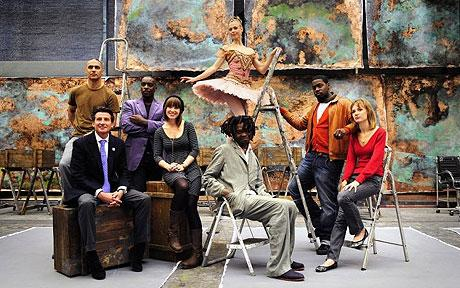
    Cultural Olympiad launch

    The problem is that this initiative, though it hasn’t fallen quite as catastrophically flat as the Cultural Olympiad, has failed to catch fire with the public. If you are looking for ‘official’ successes then the German-Punjabi (but born in Britain) Tino Sehgal, who did an ambitious interactive performance piece at Tate Modern last year, is the hottest thing there is: Golden Lion at the current Venice Biennale, nomination for the Turner Prize, five-star review from The Guardian. Yet major public enthusiasm has been lacking. Maybe the reason for this was nailed down in another (but only three-star) review, by Alastair Sooke in the Daily Telegraph. “There is an atmosphere of ritual, “ he said, “but the rules of the game are not apparent.”

    This, perhaps without the writer being completely aware of it, puts a finger on an aspect of contemporary art that I find disturbing. It is well on its way to becoming a substitute religion, with museums as its cathedrals (Tate Modern, Pompidou, MOMA in New York), curators as its priesthood, and charismatic or would-be charismatic artists as its shamans and miracle workers. The process started with Joseph Beuys and reached a recent peak of publicity with Marina Abramovic’s 2010 retrospective at the Museum of Modern Art in New York. Random visitors to the show were invited to sit on a hard chair directly opposite the artist, seated on a similar chair, and to stare at her for as long as they liked, though they were forbidden to talk. Many of the participants – but not the artist – were so moved by the experience that they burst into tears.

    Today you don’t have to go barefoot and in rags to make a useful reputation doing this kind of thing. Living in a modern capitalist society you can retain your charismatic aura while wearing Prada and Armani. You can make serious dosh without having to hide the fact. No need to paint the stigmata on your palms with a bit of red nail polish. Abramovic, for example, sold a Soho loft for $3.2 million in June 2012, and this year a two-family townhouse in the same trendy part of New York for just over $3 million. Nice work if you can get it.

    Given what has just been said here, it may seem surprising when I go on to say that London seems, at the present moment, to be the most vibrant art city in the world – a present day equivalent of Paris in the 1920s. One reason for this is that it has the most complete roster of facilities – world-class museums, major commercial galleries, art fairs catering to every level, from the big names to artists just at the beginning of their careers, who are trying to find representation. It also has other necessary facilities, though some of these are under threat. Artists can still find affordable studios in the less popular parts of the capital, because London is so spread out. This situation is, however, under threat – there is a growing exodus. There are major art colleges in London, but often staffed with people who are better at theories expressed in immaculate art-speak than they are at passing on skills. In fact, in some institutions there is hostility to passing on skills of any sort. The cry is “Oh, we have to let them find themselves!” Do the mentors now, after several generations of this kind of thing, have any practical skills of their own to pass on?

    Nevertheless, when one looks at London it is visibly better equipped than possible rivals. Berlin has cheaper studios and a city government that encourages artists to settle there – but not a strong commercial scene. In New York, the once vibrant Soho art scene is long gone. Its loft apartments, smartened up, are in the hands of A-list film stars, escaping from Hollywood, or the heroes and heroines of high-end couture. Abramovic sold her Soho town house to Ricardo Tisci, who designs for Givenchy, and her loft to Melissa Ormond, a president at Madison Square Garden Entertainment. Artists are lucky if they can find a place they can afford in some corner of Brooklyn or the Bronx. As for Paris, where’s that? It’s hard enough to find a French artist who is a major contemporary figure. Harder still to find a real community of younger artists in Paris. There are still some older ones who live in the Bateau-Lavoir, though most of it burned down in 1970.

    The really fascinating thing when one examines the London art community is the way it diverges from the official or bureaucratic view of what is happening, or ought to be happening. The Arts Council may lust after a certain kind of populism, framed in their own, unconsciously condescending terms. Tracey and Damien may still be capable of causing a flurry in the tabloids, or be ready to star in an issue of Hello! Their credibility among the younger generation of London artists has long departed. It’s not so much that their juniors dislike what they do – it’s more that they feel no real connection with the once dominant YBAs. “The past is a foreign country: they do things differently there,” as the novelist L.P. Hartley once said. In this case a country where the 1997 Sensation! show looked  wonderfully new and exciting. Three years from now there will be kids starting in art school who weren’t born when Sensation! happened.

    It’s the fate of all once-established avant-gardes to be overtaken and left behind. The one constant in the art world we now have is a perpetual appetite for change. Radical change is what seems to be happening now. Zavier Ellis, of the gallery Charlie Smith London, who is the best informed person I know when it comes to surveying the younger end of the London art world, and I have been preparing an iBook called 100 London Artists. For reasons of space and convenience,‘100 London Artists’ has been divided into two volumes, each featuring the work of 50 artists, mostly in their twenties and thirties. It should appear in time for the upcoming Frieze art fair. These fifty artists are all painters – not because we have any particular bias in favour of painting, as opposed to other forms of visual expression, but because there is now such an abundance of gifted young painters at work here in London. So much so that it has been really difficult to choose. Zavier and I are the technological radicals, choosing to make a digital book rather than something in print on paper. Our subjects have found something new – to be exact, many new things – in this most traditional of mediums. Far be it from us to contradict their radically creative impulses. This number of painters also implies the existence of solid, if non-official, financial support. Much of this isn’t British. London has found a new way to sell to the world.

    Edward Lucie-Smith
  • Out of touch

    I spent a month recently in a 12th-floor ward of the new Royal London Hospital in Whitechapel. Except for the thrilling views of the capital it provides, it is an undistinguished public building, not least because like all hospitals nowadays its corridors are lined with ‘Art’. Not even I could raise a flicker of interest as I was wheeled, sitting or prone, backwards and forwards along passages lined with studio fillers and eyesores. Indeed, more than once I felt an urge to damage the more bombastic abstract daubs which I grew to loathe: their irrelevant avoidance of a subject was an insulting imposition in the context of such lived anxiety and discomfort. Who do these hospital administrators and self-styled ‘curators’ think they’re kidding about the therapeutic value of this stuff? And in all the weeks I didn’t see a single other person stop to look at anything – in this respect it reminded me of the National Gallery. Fortunately, my ward was spared this nonsense. The only visual interest was in the picture window views of what for those of us peering out was a very distant seeming and wistful outside world.

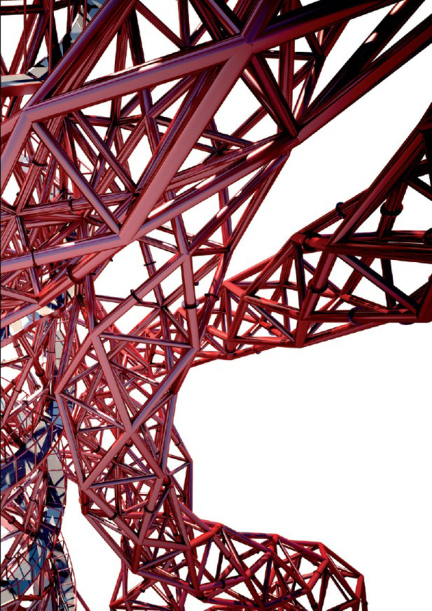
    From my bed I had the worst possible view, a panorama restricted by the hideous wing opposite. It looked north east away from our great meandering river, City monoliths, pretty Wren churches and Greenwich majesty, towards the suburban wasteland of Walthamstow and Gant’s Hill. Central to this limited aspect was our Airfix Olympic stadium with its pet cancer … Anish Kapoor’s Orbit. Disappearing anonymously among cranes and building sites, the little Indian’s inoperable whimsy looked as helpless as any other unfinished structure. Every time I opened my eyes there it was, drug-induced hallucination having the power to transform it into visionary torture. I knew exactly how Macbeth felt at the banquet – “quit my sight”. And every time I wondered what the hell it was there for.

    To discover if it owned any sense I tried drawing it, but it was formless and ungainly, without distinctive mark or symbol, rhyme or reason. Nothing commended it. Neither were the nurses any more insightful. Most hadn’t noticed its existence and of the remainder not one had a kind word, the most frequent observation being: “What’s it supposed to be?” (Incidentally, this is an intelligent question.) Given the shortages, abuse and poor conditions under which these generally marvellous carers toil, this ‘sculpture’ seemed a public folly too far.

    Orbit is a perfect example of the trash you get if you allow art to be governed by a small number of people with mutual interests, none of which concerns public desires or needs. For this is specialist gallery art foisted on a bemused populace. Orbit is and will remain meaningless to everyone who looks at it. It will never become a source of national pride or a rousing emblem because, unlike, say, the Peel Monument on the Pennine ridge above my home town, it is not assertive, commemorative or instantly recognisable, and being asymmetrical, it has no fixed image in memory, no face, no charm. It is the opposite of beautiful and it tells no story and invites no thought. Also, it fails the important Lavender Hill Mob Test: no one will buy a souvenir Orbit in the way that millions own dinky Eiffel Towers, whether of stolen gold, base metal or otherwise.

    Like all the art commissioned for the Olympics which was supposed to form part of the event’s legacy, Orbit is a characterless failure and represents a missed opportunity precisely because it was the result of a State Art establishment stitch-up. Wherever you look into its evolution, all over it are the mucky fingerprints of President-For-Life Serota and his Usual Suspects. Whenever this shower is involved you just know you’re going to get overhyped, over-rated, overpriced shit.

    An essential of public art is that you know what you are looking at and why it was put there. This demands that an artist explores beyond his own motivations and aspires to tap a collective spirit. But, of course, this is precisely the self-effacing quality of which tenth-raters in contemporary art are incapable.

    David Lee

  • The Art Fund subverted: they were only playing leapfrog

    The separate bodies contributing to State Art are now so interrelated, so cosily acquainted, their personnel so readily interchangeable and of identical mindset, that they might as well join forces. (… Liz Forgan is sacked from the Arts Council but remains a Trustee of the Art Fund; James Lingwood swallows his annual  million from the Arts Council and also sits as a Trustee of the Art Fund which has bought a work he commissioned, and so on – I could fill this column ten times over with similar complacent overlaps.) Imagine the savings on personnel and rent alone if the Contemporary Art Society (now funded and run by a former employee of the Arts Council), The Art Fund (headed by an ex-director of the Tate), the Arts and British Councils and the Tates (also directed by a former Arts Council employee) stopped pretending they pursued distinct objectives and pooled resources.

    The Art Fund is the latest to dump any semblance of independence. It is nominally a charity, if, that is, you count bankrolling the already well supplied as ‘charitable’. If the Salvation Army doled out caviare to nobs in Mayfair there would be a fuss. But the Art Fund regularly does the equivalent.

    It was founded by altruists in 1903 solely to help museums buy works of art. It gives £6.3 million a year in grants, spreading it thinly across scores of acquisitions, including some important ones. Its core activities are still nobly worthwhile and more than ever necessary.

    Recently, it announced it would fund two British tours: Jeremy Deller’s ‘immersive works’ (don’t ask) created for the British pavilion at this summer’s Venice Biennale, and Grayson Perry’s six large caricature tapestries on the subject of British life and taste. Why is a charity sponsoring the promotion of Perry and of a Tate trustee, Deller, who are among the most visible, wealthy and successful of recent British artists? And why aren’t their dealers paying for these tours from which they will all benefit? Deller’s exhibition in Venice, funded by the British Council (the tour of his inflatable Stonehenge is already, by the way, covered by the Arts Council), cost over half a million of public money to stage. Why is Deller worth even more from the limited resources of yet another much tinier charity? None of this makes sense. Unless of course there is a privately agreed national consensus between a raft of organisations, public and private, whose objectives – for whatever reason – are to promote the same few reputations.

    In their recent accounts the Fund crows its contribution of £200,000 towards Rachel Whiteread’s infantile defacement of a listed masterpiece, Charles Townsend’s Whitechapel Art Gallery. Again, here is lavish support of a successful, regularly exhibited artist represented by a leading world dealer. Charity? Really? Additionally, they funded the Tate’s purchase for £125,000 of five Whiteread ‘drawings’, or diagrams as they used to be known – they now have 30 of her works.

    The Fund also oversees the annual £100,000 Gulbenkian Museum of the Year whose judges are perennially lazy, predictable and uninspired. It is responsible too for administering ‘Artists’ Rooms’, an overpriced and dubious blunt instrument of State Art which ensures the circulation of work by top brands around regional museums, apparently ­– God help us – in perpetuity.

    The Fund’s magazine, Art Quarterly, formerly a purveyor of scholarly articles, is now a yappy promotional brochure for State Art. The current issue advertises three artist trustees of the Tate, each of whom receives the Fund’s cash. In the case of Wolfgang Tillmans, they contributed £95,000 towards buying 15 of his pictures for Glasgow Art Gallery having the previous year given £62,000 for the purchase of nine others of his works by the Arts Council, which has £450 million a year of its own to spend. The Tate already owns 62 works by Tillmans. Why this obsession with an indifferent German photographer?

    But all is not bleak. In 2011 when the Fund announced public purchase of Yinka Shonibare’s Fourth Plinth bottle the published cost was £362,500. As we demonstrated at the time this was a lie repeated in all newspapers. In their recent accounts the figure has now shot up to £650,000. They’re getting there, slowly.

    David Lee

    The Jackdaw, September/October 2013

  • 100 Works of Art That Will Define Our Age

    Kelly Grovier, Thames & Hudson, £35

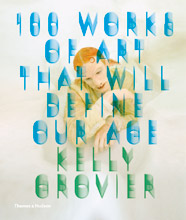
    Every now and then a book about contemporary art appears which informs it audience in ways that neither the author nor the publisher probably quite intended. This seems to be the case with Kelly Grovier’s 100 Works of Art That Will Define Our Age, newly published by Thames & Hudson, just in time for this year’s Frieze Art Fair. This is, without a doubt, a book that no one interested in contemporary artistic manifestations should ignore. Adorned with a cover that suggests the blurred double vision one suffers after a bad knock on the head, it has a comprehensive suite of illustrations, well reproduced in good colour. The choice of names is extremely informative concerning the state of the art world right now. It is perhaps a little more difficult to be complimentary about the text. The flavour of this is well illustrated by this, the final paragraph of Grovier’s description of Damien Hirst’s diamond encrusted skull, For the Love of God:

    “What a strange geometrical hinge Hirst’s outrageous jaw is. It defines our age eloquently, an era of recycled retro that forgot it was retro. When the skull was first unveiled as part of the British artist’s exhibition ‘Beyond Belief’, the lavish security it enjoyed as though it were the rediscovered crown jewels of a legendary realm, led many to attach to it an invincibility that could laugh in the face of time’s ravaging, as though a work of art that could conquer death had at last been found. Others may have seen little more than a gaudy trick, which the slightest wrinkle of a gallery rug might send smashing into eight thousand broken engagement rings.”

    This at least avoids the total opacity of academic Art English, though the first sentence is baffling enough. The description is energetically hyperbolic, but manages to have its cake and eat it. The author adroitly dodges questions about the ultimate importance of the piece described, whether within a contemporary context or out of it.

    What the book, and its author, can’t avoid are the results of simple statistical analysis. For example, look at these figures: counting occasional pairs – artists who work together – as a single entity, 32 of those listed are based in Britain, mostly it seems in London. A high proportion – perhaps two-thirds ­– are British born. An almost equally large proportion are associated with the so-called YBA movement.

    The next largest group comes from the United States – 26 in all, though seven were not originally American. To this one might add the name of Cy Twombly, always considered to be an American artist, though he spent most of his career in Italy. A conspicuous omission is James Turrell, surely one of the most poetic and fascinating artists now living.

    Conclusion: just short of 60% of the artists who made ‘defining’ artworks in the period under review came from the Anglophone art world. Among these were more Brits than Americans. And the YBA movement, according to the choices offered here, was far and away the most important art movement of its time, regarded in global terms. Does anyone really believe that?

    Other well-represented countries are Germany and France. For Germany, however, the list contains only four German-born artists out of nine – Gursky, Richter, Gregor Schneider and Neo Rauch. The others come from elsewhere – for example, Sean Scully, now completely cosmopolitan, with studios in Bavaria, Barcelona and New York. Scully, who is of Irish extraction, began his career in Britain, and had his first exhibitions here. Other artists living and working in Germany come from Argentina, the Lebanon, Denmark and Italy. To the list of German artists one can add Anselm Kiefer, indelibly German, though he now lives and works in Paris, and Martin Kippenberger, who was born in Dortmund, travelled restlessly, and died in Vienna. Other celebrated German artists are absent – Baselitz, Immendorf, Penck, Fettting. So is Sigmar Polke. Conclusion: German Neo-Expressionism must be thought of as largely a spent force.

    Five French artists are listed, plus Kiefer and also Thomas Hirschhorn, who comes from Switzerland. None of those native to France are primarily painters. Conclusion: the long tradition of French dominance in painting is now in its coffin. In fact, the steep fall in French representation, compared to the situation say fifty or sixty years ago, is a marker for how far French cultural prestige has now declined. Germany counts for far more creatively. Berlin has attracted quite a number of non-German artists who once might have settled in Paris, to be near the centre of things. So, for that matter, has London.

    There is a scattering of artists from Latin America – one from Brazil (Ernesto Neto), one from Colombia (Doris Salcedo), one from Mexico (Gabriel Orozco). Two more artists included, now living in Mexico – Francis Alys, and Santiago Sierra – did not originate there.

    After that: three artists from China (one, inevitably, is Ai Weiwei), Two from India. Two from Poland. Two from Canada. One from Spain. One from Belgium. There is a sole representative from Italy – apart, that is, from Twombly. The book suggests that the only major artistic personality that this traditional home of the visual arts now has to offer is the arch-jester Maurizio Cattelan. One artist from Japan. One from the Netherlands – Marlene Dumas, who, though born in South Africa, has spent her entire career in Amsterdam. And just one from Africa itself – the white South African William Kentridge. There is no black African artist. Chris Ofili, who might seem like a candidate, is British born. He now lives and works in Trinidad. Nobody at all from Russia. The enthusiasm for Russian contemporary art that flourished in the 1980s, at the time of Gorbachev’s perestroika initiative, has now apparently evaporated, displaced, perhaps, by an enthusiasm for China. Clearly the vaunted internationalism of contemporary art world has its limits.

    The book scores fairly high in terms of making a place for female artists. In all, there are 23 inclusions – almost a quarter of the total. Rather strangely, however, no fewer than nine of these are British. Evidently we now, here in Britain, do ‘politically correct’ better than anyone else. Yet the most important feminist artist now living – still very active – is the American Judy Chicago, far more of a pioneer than any of these Brits. However, her epoch-defining installation, The Dinner Party, is some time ago now, which may be a reason for her omission. The Dinner Party is, nevertheless, still available today at the Brooklyn Museum.

    100 Works is extremely interesting and informative about the media used by the hundred artists selected for immortality – or at any rate selected for their potential historical significance. Forty of them – 40% – can be defined as makers of installations. Not quite 18% are painters. The rest are occupied with other creative forms, with photography and video occupying a rather smaller place than one might expect. There are very few old-school public monuments, with a message for anyone who might encounter them. The most conspicuous are Antony Gormley’s Angel of the North, and Rachel Whiteread’s Nameless Library, Holocaust Memorial at the Judenplatz in Vienna.

    There are several points to be made about current installation art. First, it is extremely dependent on official support – it is representative, in most of its manifestations, of that paradoxical entity, the ‘official avant-garde’. Many of the installations celebrated here have been presented at major museums of contemporary art, or as part of major art biennials. That is, they are an accepted component – the ‘circuses’ – of our present ‘bread and circuses’ official culture, characteristic of Western European democracies and also of the United States, but not so prevalent or firmly established elsewhere. The installations are also physically ephemeral for the most part. That is, if you missed them when they were initially shown, you will probably never now catch up with them again. Not even those where the mechanisms involved are almost childishly simple, such as Martin Creed’s The Lights Going On and Off. This means that these art works can only ‘define our age’ through the operation of perhaps unreliable individual memory. Who, in any case, can have managed to see them all at first hand?

    The only way most of us can hope to see them now is through books such as this one, which also attempt to tell us what opinions we should form. Yet wait – there is another paradox here. The conventional art book, text and illustrations on paper, is not nearly as efficient in conveying information about large, often labyrinthine three dimensional objects as film. Meanwhile hybrid art ‘books’ – so called – are increasingly available on portable tablet computers through the use of Apple’s iBook software. If these forty installations were all visible on an iBook, each represented by a film clip or a series of film clips, one would have a much better idea of what they are really like, and therefore of both their strengths and their deficiencies as works of art. This is dinosaur technology inefficiently trying to convey information about what is proclaimed to be a new age.

    I called this a bad book, yet also said that it was a book that no one interested in contemporary art should miss. The reasons are twofold. First, it does undoubtedly offer a lot of information about the current state of contemporary art, though not always information that tends to raise one’s enthusiasm for the subject, nor one’s respect for the artists concerned, nor for the curators and institutions who promote this vision of what the art world should currently be doing. Secondly, the information it offers is radically skewed, but skewed in an interesting way.

    The implicit claim here is that Britain, London in particular, is now the unchallenged centre of the contemporary art world. Bold of Thames & Hudson to publish an ambitious book that says this, as their important American market is not going to like it. Yet the fact that over 30% of the artists included in the book are British or British resident is enough to certify that this is the direction it takes. Accumulating evidence shows that the claim may possibly be true. London has the great museums, the major public spaces for contemporary art, art dealers of all kinds, trusts that supply studio spaces. It also has an enormous number of gifted younger artists, some born here, some foreign. Nevertheless, trying to certify Britain’s new status by a celebration of the fast fading YBAs doesn’t help to make the case. In fact, it tends to undermine it.

    Further, the official museum-supported avant-garde that Kelly Grovier seems keen to celebrate is bizarrely akin, certainly in organizational terms, to the world of the great official Salons, dominant during the closing years of the 19th century. Did Bouguereau and Alma-Tadema define the art of their time? Yes, in a way that’s just what they did.

    http://www.thamesandhudson.com/100_Works_of_Art_That_Will_Define_Our_Age/9780500239070

    Reviewed by Edward Lucie-Smith

    The Jackdaw, October 2013

  • Bone idleness at the Tate

    Bone idleness at the Tate

    For the last meeting of Tate trustees of which minutes have been posted on line (i.e. September 2012), only six of fourteen members bothered to show up. Perhaps it was raining. Trustees, you won’t need reminding, are there to oversee the vigilant running of quangos to ensure public interest is looked after. This is important when the Tate costs taxpayers at least £33 million a year in subsidy. You may be forgiven for believing that the trustees report to the Tate director. In fact, it’s the other war round; the director is – in theory – employed by the trustees and is responsible for implementing their sanctions.

    Trustees were in such short supply at the September confab they were outnumbered by Tate directors, eight of whom attended – incredibly, the Tate now has more directors than trustees, seventeen in total. Two of the three artist trustees failed to attend; in fact, at only one meeting in the previous year have all three artist trustees managed to be present at the same time, which is not surprising given that two of them, for reasons doubtless very convenient to Serota, are German. Magazine snapper Wolfgang Tillmans’s record is especially woeful: on average he attends every other meeting.

    Such lack of commitment is unacceptable in a body that effectively runs contemporary art. Trustees should take their jobs more seriously. Attendance ought to be obligatory not voluntary. After all, an afternoon every two months isn’t so arduous. If MPs have to be rolled in half dead on gurneys to vote, so should Tate trustees. This is an important public duty which many might consider a privilege, so if a candidate under nomination can’t give an assurance of attendance then others should be appointed who are prepared to commit themselves enthusiastically to the unpaid effort involved.

    Poor attendance by artist trustees, especially the Germans, highlights the error of appointing foreigners in the first place. Why weren’t British artists appointed? No, seriously, why weren’t they? Surely some can be found who are subservient enough to the President-For-Life not to preclude their consideration. Germans generally are more inventive, harder working, less squalidly materialistic and better educated than we are, but how can they be expected to feel and understand the historical significance of the Tate in British art life? Foreign artists should not be made Tate trustees because we have sufficient intelligent and independently minded candidates of our own. Naturally, it is very handy for the PFL to have a board of indifferent lackeys who will rubber stamp whatever he wants. After all, the process by which they were all vetted in the first place is controlled from his office. Officially, trustees are appointed by the Prime Minister but unofficially we all know they are chosen by him; his mucky fingerprints can be found over the whole process. (See The Jackdaw’s former investigation of Tate trustees on our website).

    No wonder the trustees have lost control of the Tate when they can’t even be bothered to show up to their infrequent meetings. For example, how could they have allowed building work to start on a Tate Modern extension when such a small percentage – under a quarter – of the required funds had been raised? This was surely irresponsible, with the result that this annexe is squaring up to be the longest building project in British construction history. They could have built five Shards in the time it’s so far taken to erect the shanty arrangement of concrete slabs behind the Turbine Hall – currently being augmented, on visual evidence, at the industrious rate of one breezeblock a week. As it is,  trustees have had to loot endowments given to the Tate for other purposes in order to maintain even this pathetic semblance of progress on the site.

    And finally, a snippet of late news to please trustee Herr Tillmans. Glasgow Art Gallery has just purchased two bog standard snaps by him. This adds to the 63 Tillmans held by the Tate, 9 by the Arts Council and 11 by the British Council. Of these 82 only two are currently on display, at Tate Britain. Why didn’t Glasgow save themselves scarce cash and borrow the 80 pictures expensively stored by the other three public collections?

    David Lee

    The Jackdaw, March-April 2012


  • Of cabbages and queens

    Of cabbages and queens

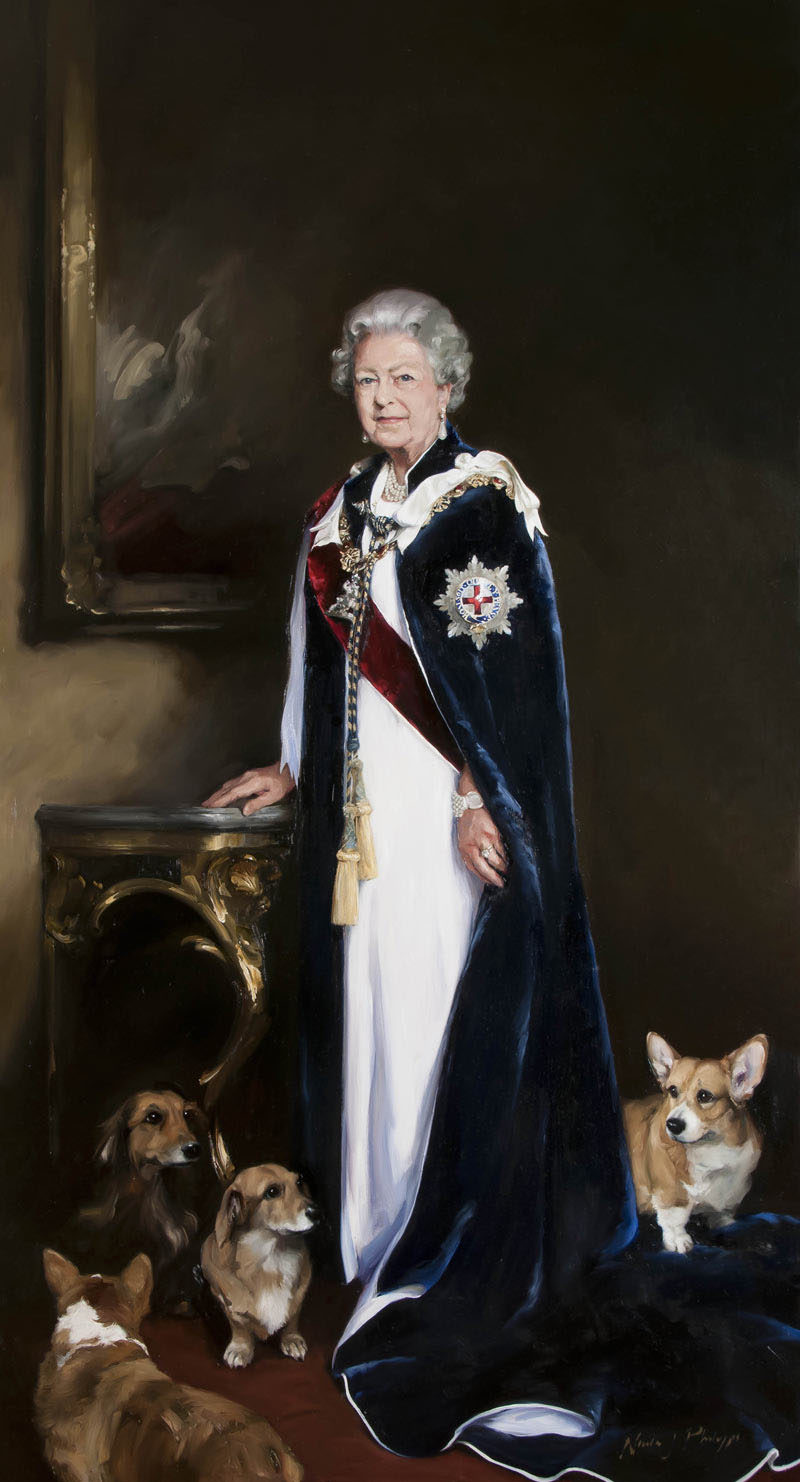
    This is the third portrait of the Queen unveiled in London in the last month … and the third dud. A dull formal portrait, it follows the standard, now threadbare iconography for a picture of standing royalty. Indeed, it seems every monarch since George III has been portrayed with a hand on that table. Like the ghosts of Banquo you can see the other pictures emerging from the mist behind. Do you know, equipped with some ingenious software, I’d be surprised if there wasn’t a computer that might more convincingly paint one of these from now on.

    Background, robes and dogs are as slickly painted as you’d expect from a graduate of the Chocolate Box School. But as usual the real problem lies with the likeness. We know intimately the appearance of this sitter who is daily featured on television and in newspapers. Such familiarity means that, unlike painters of the pre-photographic past, today’s artist must get the likeness spot on. In Nicky Phillips’s effort, we recognise the sitter well enough, not least because the Queen’s hairdo and clothes are unique, but the facial features aren’t accurate. She doesn’t actually look like this, and never has; a distant foreign relative of the Queen perhaps, but not the Queen herself. The sad truth is that the basics of portrait painting aren’t taught in art colleges. We no longer train painters to have the drawing skills to catch a likeness with effortless precision every single time. The result is that our artists look as though they are labouring like slaves to get right even the basics.

    Earlier this month a newly unveiled portrait of the Queen looked more like comedian Stanley Baxter impersonating her. This one more resembles a bloke wearing a wig and earrings with a hint of Churchill. Isolate the face so you see only the features and it is unrecognisable as the Queen.

    David Lee

    The Jackdaw, June 2013

  • In the course of justice

    In the course of justice

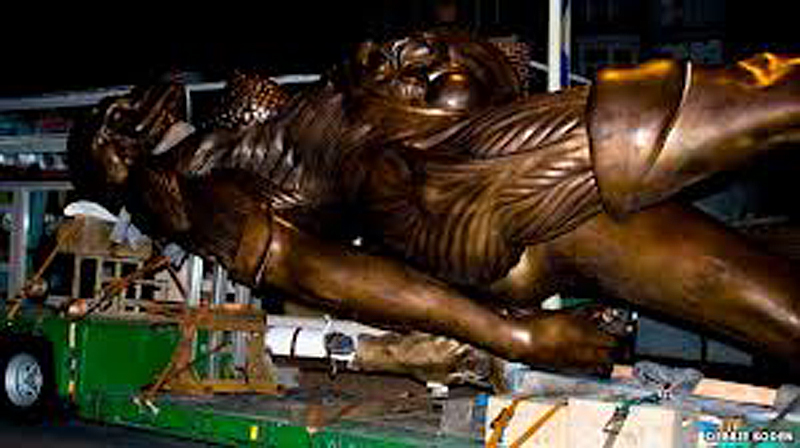
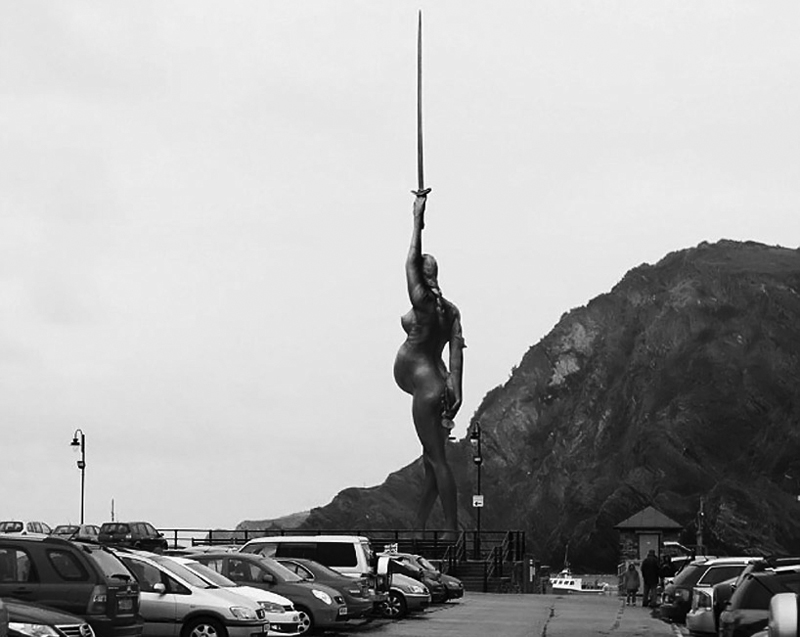
    Damien Hirst has loaned for 20 years to the north Devon seaside resort of Ilfracombe – in which he has one of his many residences – a 20-metre high sculpture of a pregnant woman wielding a sword and scales, called Verity. Made of glass fibre with a bronze effect finish (which is a bit tacky-Essex even by Hirst’s usual vulgar standards), it now stands overlooking the harbour deterring all-comers, especially Welsh privateers heading across the Bristol Channel intent on rape, pillage and illegal benefit claiming.

    We must stop building public art work for the wrong reasons of regeneration, “community cohesion”, “putting Ilfracombe on the map”, and other egregious bollocks. We need far fewer public art pieces of all sizes, and far better ones; those that are built because they are accomplished art and will stop and perhaps inspire people with the beauty and originality of their form. Art is art, not a tactic.

    Conveniently, it is a matter of yards from an expensive fish restaurant, proprietor: D Hirst.

    Hirst’s figure stands on a bronze plinth of legal books. Justice … legal books … clever stuff. Is it of any artistic merit? It can’t be as he’s not a sculptor. All we’ve seen so far are “artist’s impressions”, presumably by an “artist” other than Hirst himself, who can neither model nor draw. Inventing such a figure might defeat a Michelangelo or a Bernini, so what chance has a stunter like Hirst got? Like everything concerned with him, this project reeks of self-promotion and deriving maximum personal gain. Nowhere in any of the blanket publicity about this has there been a single word about the artistic merit or about the form or deeper meaning of the work.

    It is intended to be “a modern allegory of truth and justice” and locals hope it will stimulate tourist activity – that old bogus regeneration chestnut. Realistically, how many are likely to visit Ilfracombe to see this? Four? We repeat: there is no connection between large sculptures and the regeneration of a locality. Newcastle has the Angel of the North and Middlesbrough Gibbereesh Kapoor’s gigantic string underpants. Both were claimed to be important instruments of regeneration yet, years on, both places are top of any indices of social deprivation, unemployment and poverty. Bombastic works like these, and Hirst’s, are only ever about the sculptor’s vanity, bank balance and visibility in the papers. They are not about art or sculpture. In Verity’s case she is out of scale, inappropriate and irrelevant to Ilfracombe.

    And, naturally, like all the large sculptures of Hirst it won’t be the only one. There will be an edition of them (plus any number of artist’s proofs) appropriately priced according to what some thuggish tosser billionaire from Uzbekistan is prepared to pay to have it mounted on the roof of his gold palace.

    David Lee

    The Jackdaw, October 2012

  • Another portrait of the Queen

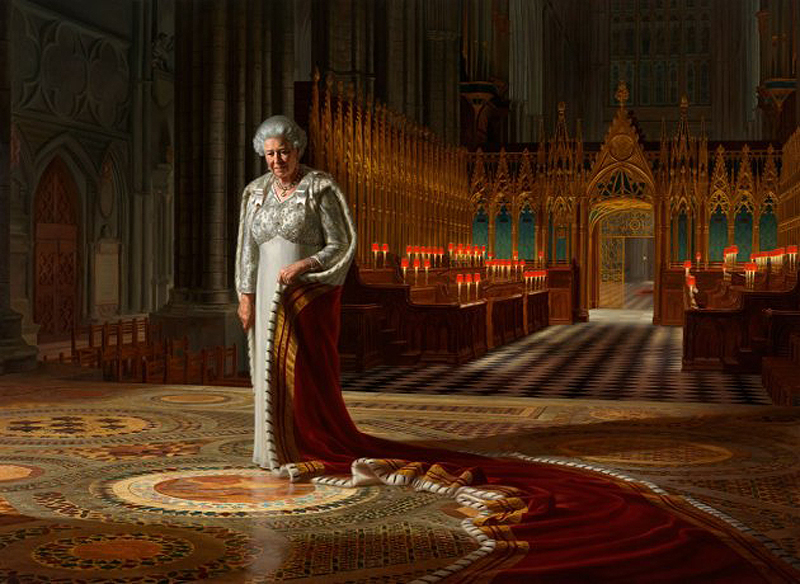
    A portrait of the Queen by Australian artist Ralph Heimans has gone on show at the National Portrait Gallery in Canberra. It shows the monarch at night in Westminster Abbey standing on the spot where she was crowned 60 years ago. She looks like a giant genie has suddenly appeared from the train of a dress and she has succumbed to suspended animation. One gathers she is meant to appear pensive, as though wondering why she didn’t buy Frankel when she had the chance – she might even be pondering the fate of the Liverpool Empire. A typically Australian effort; massive (it is eleven feet by nine feet), ambitious, unsubtle and a little heavy, don’t you think, on the melodrama and narrative?

    Many confuse a photographic appearance with a picture being well painted. This is an easy but fundamental mistake. Here, every detail is painted, the only omissions being real life not theatre and vigour in the execution. In close up the sitter wears the leathery look of a souvenir sailor.

    David Lee

    The Jackdaw October 2012

  • BBC arts programming… and the shock of something good

    BBC arts programming… and the shock of something good

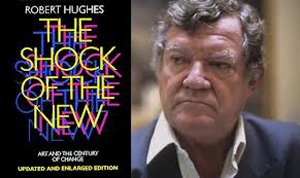
    My word what a revelation Robert Hughes’ The Shock of the New has been second time around. It was pretty good when first aired all those lifetimes ago in 1980. The fourth episode, it had Utopia in the title, reviewing the history of trendy architecture in the 20th century, was the best television about art for decades. It was alive with the authority, enthusiasm and cleverness of its presenter … and of how many current art presenters could one honestly use those words? It should be compulsory viewing in all schools and colleges with tests at the end to ensure attentiveness. Everything is there, from fact to polemic, beautifully expressed by Hughes, and edited with lengthy holds on the buildings themselves so an eager viewer might understand precisely what point the author is making. It encourages its audience to look at the screen, and then to look about them at the buildings in their own lives. And Hughes is one hell of a stimulating guide, whose opinions and insights you want to follow up with a visit to the library. He makes you want to know more.

    One can’t help thinking with regret (and deep resentment) that no way would the BBC commission anything as good as this now. They wouldn’t have the guts to aim so high. They’d think it far too highbrow and well beyond the level of those who wouldn’t watch an art programme whatever the depths plumbed to accommodate their ignorance. The terror of being accused of elitism has bred cowardice. No longer has the BBC the confidence required to say to someone of Hughes’s extraordinary talent: ‘Here’s the money, go and surprise us’.

    Instead, the BBC prefers presenters who know next to bugger all, those who puff their friends and bowl underarm questions; those who genuflect before State Art orthodoxy. Being expert in nothing these people are affably protean, capable of repeatedly delivering the obvious observation about any topic for which weak inexperienced researchers have copied and pasted paragraphs from Wikipedia. (The excellent Mary Beard is the sole exception to this.) Arts programmes on the BBC are now so uncritical they are little more than adverts for their subjects. And the other channels are even worse.

    Come back dear Robert, we’ll even forgive you the sycophancy of more recently calling Hockney ‘the greatest living watercolorist’, which, of course, he wasn’t and still isn’t. It’s only a pity that the recently deceased Hughes can’t bring the programme beyond the 1970s. Can you imagine Yentob trying to update The Shock of the New? What a shudder-inducing thought that is. The result would be pitiable PC guff cobbled together from the State Art handbook.

    Finally, as an example of how low ambitions for programme making can sink, the ‘expert’ presenters of a recent series concerning art on BBC2 were told that they could not use a phrases such as ‘figurative art’ and ‘Impressionism’, unless they were defined, because viewers wouldn’t understand them. How thick does the BBC believe its audience to be? And is such an audience even worth bothering about? This indicates how little faith the BBC has in its viewers to self-educate, and the depths it is willing to plumb to patronise an audience. In the chase for crude ratings the BBC’s obligation to educate has been sacrificed. Its policy has pleased nobody.

    The real shock in The Shock of the New is its identification of the frightening collapse in standards of BBC arts programme making since 1980.

    David Lee

    The Jackdaw October 2012


  • Hockney’s charitable works

    Approached by Bridlington council officials to appear as a town tour guide during a summer charity weekend, David Hockney generously consented and, to the great amusement of the crowd, threw in a hitherto unknown talent for gurning. “He was easily the great attraction of the weekend, like the Pied Piper,” said council leader Bill Cumming. “I had a marvellous time actually,” added the greatest landscape painter since Altdorfer. “I was even able to introduce local youngsters to the life-enhancing joys of smoking. They loved it when I took a drag and gurned at the same time. Aye, there’s a lot to be said for community engagement.”

    The Jackdaw October 2012