Category: Comment

  • Elgin marbles: should they go or should they stay

    Elgin marbles: should they go or should they stay

    David Lee thinks loans both ways should be considered.
    We have rehearsed the pros and antis of retaining, loaning, handing back or exchanging the Elgin Marbles in the pages of the Jackdaw many times. The main arguments on both sides, few as they are, remain the same and recent reiteration of these familiar points would suggest nothing new will ever be proffered on either side. Certainly the case for the sculptures’ return will not be advanced by the Greeks enlisting a junior lawyer because she’s married to a famous actor. Any impetus given by that opportunistic stunt petered out once the press wearied of airport snaps of Mrs Clooney’s million-buck grin while offering nothing but the most fatuous of platitudes.

    Greece claims the balance has recently tipped in their favour with the opening of a new museum below the Acropolis. But their chief arguments in favour of restitution remain predominantly emotional and sentimental ones which play to the home gallery.

    The Acropolis marbles are handsomely exhibited free of charge in the British Museum and have been well cared for, in contrast to the way in which the Greeks have demonstrably failed to protect their own allegedly cherished carvings. Far more visitors will see the works in London than would be the case in Athens where, admittedly out of season, the Acropolis Museum – £12 to enter – can muster negligible trade bulked up (as indeed it is in London) by noisy parties of demob-happy schoolchildren – in the Greeks’ case a generation deemed ripe for the most shameless brainwashing.
    The argument that these sculptures are by Greeks from a unique moment in Greek history and from which all modern Greeks are descended is so much jingoistic claptrap. Greeks claiming descendance from the Athenian Pericles is as preposterous as me citing the ancestry of King Caractacus; as if the Roman, Angle, Saxon, Viking, Pict, Celt, Visigoth, Dane and French invaders, commonwealthers, colonisers and asylum seekers had never come between us, and changed our make up beyond recognition. It’s just silly.

    As someone who simply enjoys looking at classical sculpture, I recently visited Athens to see if workable alternatives about the future of the Elgin Marbles might be considered. Currently, the issue is clouded by irritating, point-scoring politicians intent on manipulating publics for their own ends. All those who love sculpture and art history should have an important say in any outcome because in the end we are the only ones who will actually take the trouble to look at them properly.

    From the outside the new Acropolis museum is as inelegant as most new buildings, its one quirk being a penthouse floor twisted from true as if a Rubik’s cube had had its top layer half-turned. What was left of the Acropolis sculptures after the explosion of 1687 when the Parthenon blew up destroying most of its peristyle and interior, not to mention assorted subsequent lootings, defacings, quarryings and Elgin’s removals, is exhibited on the top floor with gaps left where the frieze and pediment sculptures from other museums, chiefly the BM, would fit in. Having been eroded smooth and rounded by the most poisonous atmosphere of any city in Europe, much of this material is of disappointing impact and quality. Snatches of detail and passages of beauty hint at what might have been, but little in the way of real art appreciation is possible. From looking here at what remains of the Parthenon sculptures you would never suspect them of forming part of an inimitable masterpiece.

    A cynic might conclude that the Greeks need the BM sculptures because their own are largely unreadable wrecks. Unpalatable as it may be for the Greeks, an objective conclusion must be that if Elgin had not removed sculptures their survival may have been jeopardised. This cuts no ice in Greece because wherever you travel Elgin is presented as the Great Satan. The poor wee Scot is denounced in tube stations, museums, airports and on street placards, and even at remote archaeological sites across the country. Nowhere is there any acknowledgement that without Elgin’s intervention during a volatile period of foreign occupation, there might be little worth a second look.

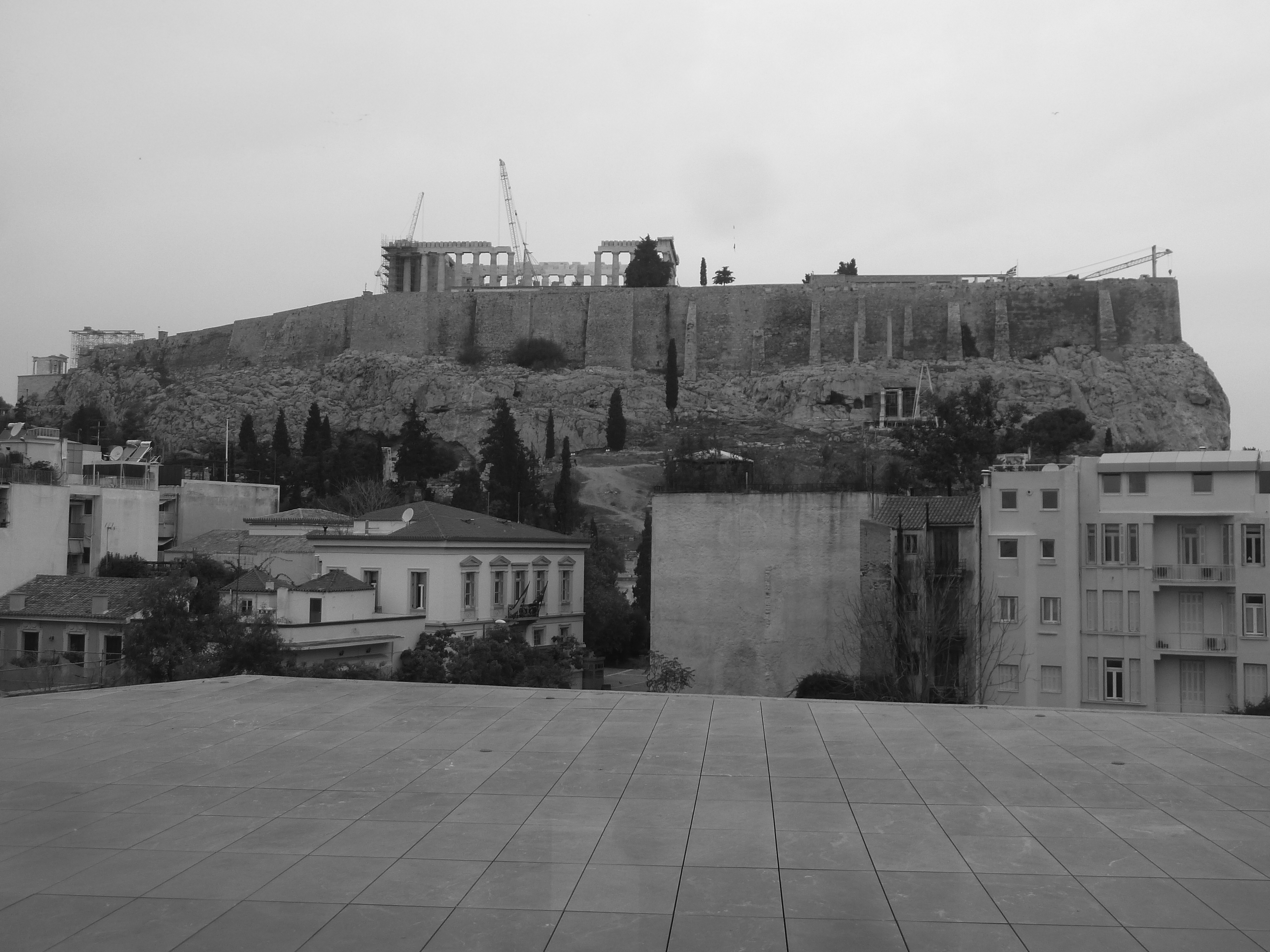
    The argument that the nearly complete frieze would be exhibited within sight of its original location has some little merit. From one side of the new museum (see picture above) one can look up to the rear, less photogenic aspect of the Parthenon, though you can’t see where the frieze would originally have been placed because it was obliterated in the explosion and subsequent collapses, earthquakes and demolitions. It was in any case more or less invisibly located high behind the peristyle arcade.

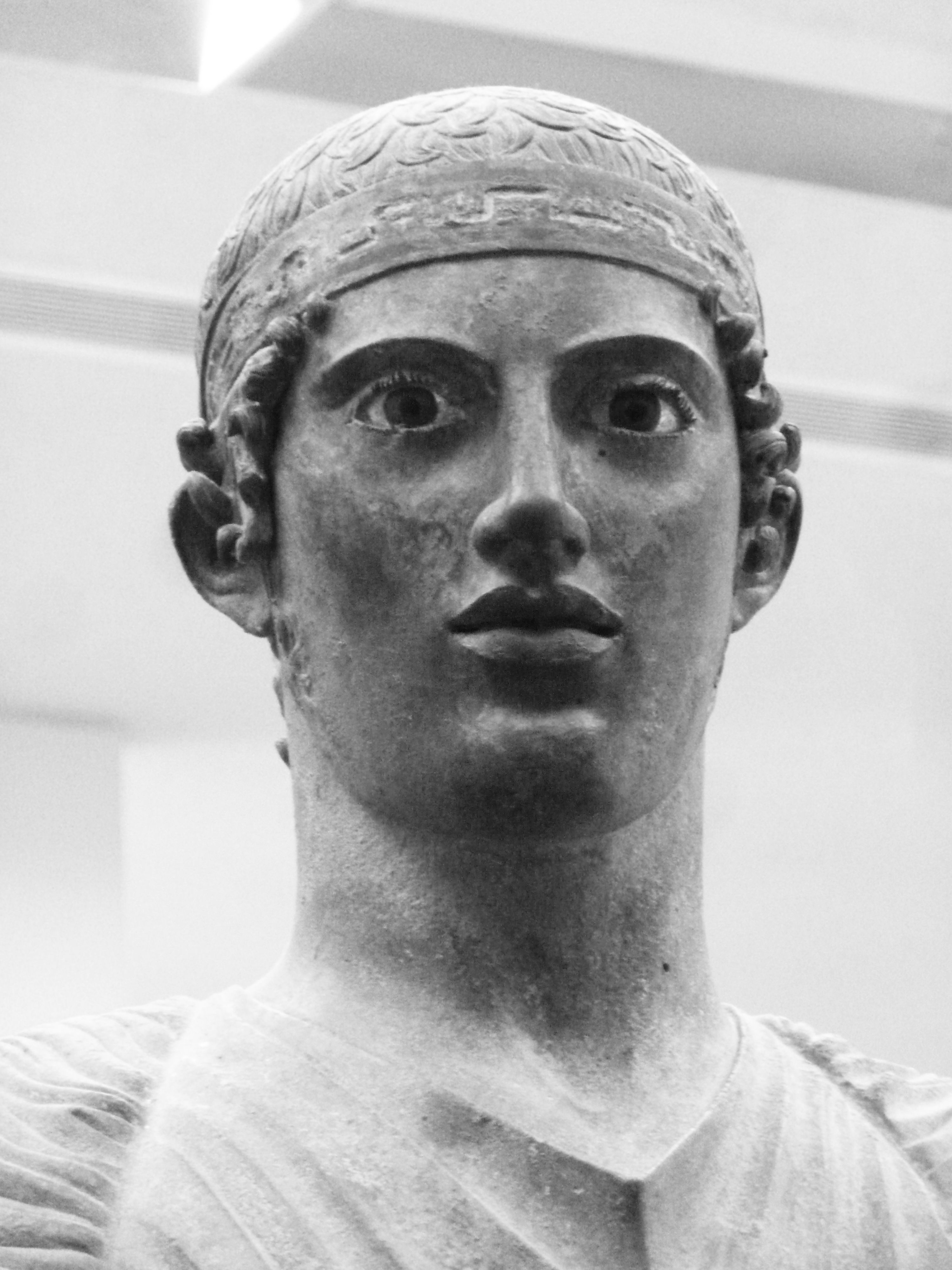
    In its other galleries the Acropolis Museum is an unforgettable experience, spacious and with the most fabulous carvings and bronzes sensitively displayed. For devotees of sculpture and the classical world it is unforgettable, joyful even. The calibre of work, the gradual evolving understanding of form and surface pattern, especially in the archaic, pre-Periclean period, is staggering – the scholarly designation ‘primitive’ is laughably inadequate when dealing with such accomplishment. For students of Greek sculpture this museum, as well as the quality of the even more breathtaking collection at the National Archaeological Museum on the other side of the Acropolis (see cover), fills in stylistic gaps not even hinted at in the British Museum’s story of classical sculpture – it is revelatory.

    Among the main arguments against restitution adduced by director MacGregor is that the BM’s Greek galleries tell the full story of classical sculpture. Familiarity with museums in Greece gives the lie to this fantasy. The British Museum doesn’t even get close to giving a complete account. To start with it is rare that any visitor to the BM experiences all its classical galleries open at the same time. Even after a lifetime of regular visiting I’ve rarely managed it. The architecture galleries in the basement are open only every Preston Guild, and the Halicarnassos galleries daily closed. Getting to see the marvellous Bassae Frieze in its bespoke attic is more of a lottery than El Gordo. MacGregor’s rhetoric  gets a far better press than it deserves.

    BM displays give a decent impression from, say, 450BC to 300BC but a visit to Greece soon exposes the threadbare nature of even that proposition. For all the beauty of some of its exhibits, the BM doesn’t present the full subtlety of what happened. Indeed, it will only be able to make such a claim when major loans are vouchsafed from Greece. This is why we should stop the war of bickering and insults and seriously consider a series of temporary swaps of material that would thrill aficionados in both countries.

    Presently Greek arguments for complete restitution are too easy to skittle. Not least the one about how important they claim the Parthenon marbles are to them. I first visited the Acropolis in 1971 since when the site has changed indiscernibly. The cranes themselves must be antiques by now. My generation is likely to live its entire lifespan with the Parthenon obscured by scaffolding, sheeting, peremptory signage and heavy lift equipment. The hilltop is a chaos of rubble, building works, ugly police-style cordons and railway lines – small wonder so few of the visitors who trek up linger here for more than a couple of minutes, for this is not a pleasant place to be. The Greeks claim to care passionately about this important symbolic site, yet progress is glacial. So far it’s taken them three times longer to restore a few patches than it took Kallicrates, Iktinos and Pheidias to conceive, build and carve the lot from scratch. But the torpor and apparent indifference evident on the Acropolis is typical of that infecting the country’s other important archaeological sites. Wherever you venture, from Epidavros to Delphi to Knossos, there is little or no building at the one cool time of the year when work ought to be forging ahead. Any urgency to conserve is bewilderingly absent.

    One problem to achieving any rapprochement is Greek resistance to negotiation and their attitude in general towards ‘loans’. One can’t blame the BM for a lack of engagement because the Greeks use the same definition of ‘negotiation’ as do the Argentinians when referring to the sovereignty of the Falkland Islands. In both cases ‘negotiation’ means only one possible outcome, total capitulation on our side. No wonder the British Museum is resistant to embarking on such a journey when the Greeks refuse even to acknowledge that it is the sculptures’ legal owner.

    Definition of the word ‘loan’ presents a serious problem for the Greeks. It is perhaps impertinent to mention that the Athenians built the Parthenon with money stolen from neighbours and never repaid. Old habits apparently die hard… Can one have any real confidence that a ‘loan’ of Elgin material would be returned?

    Despite all of this we should try putting aside childish disputes. The possibilities for exchanges of material between the BM and Athens are tantalising for sculpture lovers. Imagine, a swap of Elgin material for archaic kouroi and kore and bronze statuary of a quality unimaginable to regulars of the British Museum. What a mouthwatering prospect that would be, to see, for example, a large kouros, one of so many in Athens.

    The Greeks should change tack. They should magnanimously offer loans to the BM of works of such greatness that those against any form of extended exchanges between the two countries would be disarmed by so generous a spirit and the genius of the work. The main argument Greeks should deploy is this prospect of the mesmerising works they could offer in return.

    David Lee

    The Jackdaw March-April 2015
  • Wonders of creativity

    Laura Gascoigne investigates why what was once so very special is now common as muck and comprehensively commandeered by the fat controllers

    In The Masque of Augurs, Ben Jonson introduces the comic figure of Vangoose, a “rare artist” and producer of masques with a reputation for the wildly fantastical. “Now we would bring in some dainty new thing, dat never was, nor never sal be, in de rebus nature… a mere ‘devisa’ of the brain,” the artist promises his Jacobean audience. “If it go from de nature of de ting, it is de more art; for dere is art, and dere is nature, you sall see.”

    Vangoose’s obvious difficulty with the English language is not due solely to his being Dutch. The 17th century had no word, in Dutch or English, for the quality of artistic creation he’s trying to describe. Astonishingly, the word ‘creativity’ only entered the English language in 1927 in a lecture by the philosopher Alfred North Whitehead. For more than two millennia before that, Plato’s philosophical verdict in The Republic that a painter “merely imitates” held sway, and the advent of Christianity didn’t shake it. If anything, it reinforced it. Leonardo could go so far as to claim that an artist uses “shapes that do not exist in nature” but he could go no further, since ‘creatio ex nihilo’ was the sole prerogative of the Creator. It wasn’t until the Enlightenment, when Joseph Addison dared to suggest that human imagination “has something in it like creation”, that the divine monopoly on creativity was broken. In the next century, Romanticism finished the job.

    Today, creativity is as common as muck. We find the word ‘creative’ applied to everything from art and writing to psychology, philosophy, and technology, not to mention accounting. Like so much else, it has gone cross-disciplinary – it has even jumped lexical categories to become a noun referring to someone working in advertising. But the most significant change of the past 20 years has been not in its range of applications but in its meaning. As the American psychologist Michael Mumford noted in Creativity Research Journal a decade ago, “we seem to have reached a general agreement that creativity involves the production of novel, useful products [my italics].” Out of the Romantic cult of an economically useless imaginative faculty has grown the dreary McKinseyite concept of a mental ability to be cultivated for the purposes of productivity. So we have ‘creative industry professionals’ hot-desking in ‘creative hubs’ and ‘incubator spaces’ to speed the fermentation of moneymaking ‘devisas’ of the brain to boost the economy. One wonders what Ben Jonson would have made of it.

    The ‘creative industries’, according to the CBI, now account for more than 6% of Britain’s GDP – just 3% behind the financial services sector – and represent an inflatable life-raft in a floundering economy. Scoff if you like at Meedja Studies and ‘Mickey Mouse’ courses, but there are number-crunchers at the Treasury who are seriously counting on Mickey and Minnie to save our island from disappearing off the global economic map. For a post-industrial nation that no longer makes things, creativity conjures the illusion of a deus ex machina materialising out blue skies thinking in a shower of gold. It’s no accident that the opening sentence of Alex Salmond’s Guide to an Independent Scotland hailed Caledonia as “an ancient nation, renowned for the ingenuity and creativity of its people”, or that Sir Sean Connery, in a New Statesman article hubristically headed ‘There is no more creative act than creating a nation’ [tell that to the Almighty, Mr Bond] argued that independence would present the Scots “with an unparalleled opportunity to promote our creative excellence”. In these days of corporate-creep, Hollywood and Holyrood speak the same language.

    Don’t get me wrong. I’m as relieved to have escaped a haggisectomy as the next Sassenach, but when I hear the word ‘creativity’ I reach for my revolver. Why? Because what was once a faculty free as the air we breathe has been thoroughly and comprehensively monetized. How did we let this happen? I date the start of the rot to the reign of John Birt, that Blairite Svengali of blue skies thinking and foggy speech who educated a generation of cultural administrators in the language of corporate creative bollocks. Take this example from Jana Bennett, former Head of Vision at the BBC, quoted in Private Eye’s ‘Birtspeak’ column in 2007: “Now that it’s clear the conversation genuinely can be a creative two-way process, and in many cases multi-way, we are witnessing the possibilities opened up when many ripples bump against one another and the patterns of interference, the ‘mash-ups’, they create. We have the opportunity more than ever before to willingly seed the clouds of creativity and see a creative rainfall.” Since Bennett’s speech, the c-word count has risen. She notched up a modest four mentions; the Tate, in the publicity for its new IK Prize for ‘digital creativity’ unveiled in August, managed six.

    The clouds of creativity are clearly massing, thanks partly to the efforts of ‘creativity enablers’ devising ways of optimising meteorological conditions through the establishment of ‘creative hubs’, ‘incubator spaces’ and ‘innovation labs’ in happening places. “When you join THECUBE,” coos the website of one such establishment in Shoreditch, “you join a curated diverse and smart community of scientists, engineers, designers, technologists, artists, futurists and anthropologists”. Artists, one notes, are only fifth on the list – ahead of Marinetti and Lévi-Strauss – but one assumes that all the disciplines share equally in the benefits of “innovation through community”. THECUBE’s founders got the idea, their website says, in the aftermath of the financial crash, when they “hypothesised that it was the start of an economic and anthropological pivot”.

    If you’re wondering how exactly a pivot starts, THECUBE’s engineers may be able to help. But let’s not nitpick. Around a “highly fuzzy concept” like creativity, an occasional lack of clarity is inevitable. There’s no such problem in Africa, however, where of the 28 languages currently spoken only one – Arabic – has a word for ‘creative’. It’s not that Africans are short on creativity, it’s just that in the matter of rainfall they prefer the wet kind that makes seeds grow into edible crops. Fuzzy concepts are luxuries for developed economies. In Taiwan, for example, they take their creative agronomy so seriously that last summer Taipei Contemporary Art Centre staged a Strategic Business Plan Public Stakeholders Consultation Focus Group Exhibition [snappy title] to show the products of three ‘creative game-based workshops’ that ‘looked at aspects of the business of contemporary art’. The workshops were run by visiting Senior Tutor in Curating Contemporary Art from the Royal College, Kit Hammonds, a specialist in “imaginations of the future found in science, business planning and speculative fiction”.

    The line between art and business is now so fuzzy that an IBM Global CEO study of 2010 named creativity as the most crucial quality for leadership success (which could explain why so few CEOs are female, since women, as we know, are better at procreativity). How to reclaim creativity from business? By defending to the death our artistic right to exercise it in pursuit of the wildly irrational and unproductive. As Veronese, a champion of creativity avant la lettre, told the Inquisition: “We painters use the same licence as poets and madmen” – and he meant madmen, not ad men.

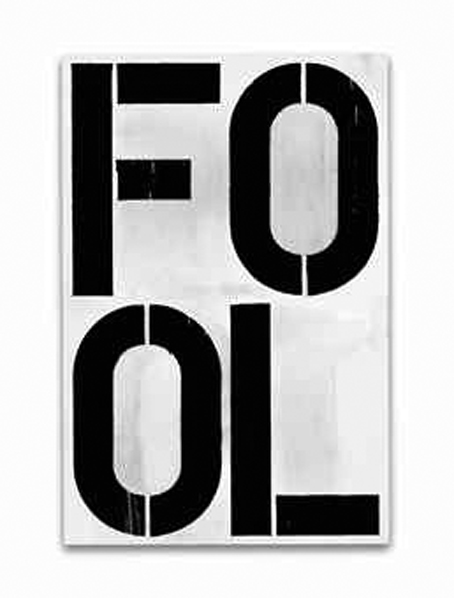
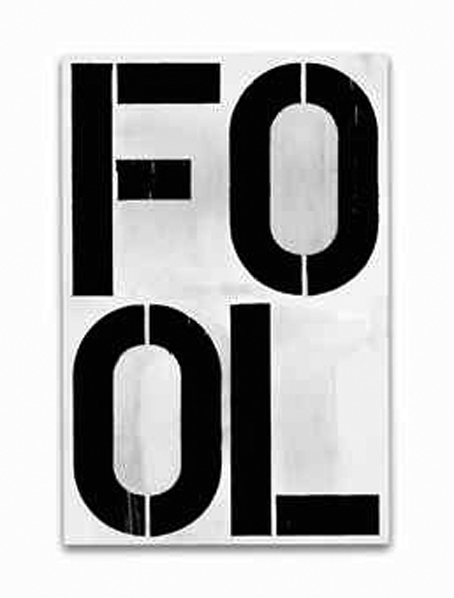
  • Turning Wool into money … or fool’s gold

    Turning Wool into money … or fool’s gold

    Eric Coombes responds to an editorial about the art cash cow

    Is a celebrity a person ‘famous for being famous’, or merely ‘someone in the media that one had never heard of’. Despite being obscure – in this paradoxical and mysterious mode of obscurity – celebrities, however ill-informed and stupid they might be, are entitled to have their ‘opinions’ widely disseminated, and heard, at least with respect, and quite possibly with hysterical enthusiasm – especially if they are ‘comedians’. This entitlement is now regularly exercised, on an almost weekly basis, in supposedly serious discussion programmes such as Question Time.

    If we regard his ‘work’ as the equivalent of the celebrity’s ‘opinions’, then the status of Christopher Wool, who appears to have ‘risen without trace’, as described in the Nov/Dec editorial, is strikingly analogous to that of a celebrity with opinions as fatuous and ungrounded as Wool’s ‘art’. As our editor observes, the ‘value’ of a Wool ‘resides purely in its perceived status as a tradeable luxury’. There is nothing new in the craving for social status, and its pursuit through ostentatious display or ‘conspicuous consumption’, to use Thorstein Veblen’s term. But in the past, the ‘work of art’ – as tradeable luxury and vehicle of social display – however vulgar or spurious, at least had observable features that a rich undiscriminating fool could be duped into mistaking for the marks of aesthetic merit. What is new is the sublimation of social display to the point where the vehicle of display is purged of such features, and reduced to its essence as a counter in the game of social display itself.

    The situation is cleverly described by the editor as one where a ‘work of art’ (improperly so-called, to adapt an expression of Collingwood’s) has value in the same sense in which a share certificate has value, and, moreover, appears to function in much the same way. But a share certificate does not pretend to have value merely in itself: it is evidence of a property right, namely part ownership of a company, and in certain circumstances the right of ownership might be upheld by the production of alternative evidence – if, for example, the certificate had been destroyed in a fire.

    We might, therefore, want to take this analogy even further, to the interesting case of money itself. The real value of a banknote consists in nothing but the shared agreement to treat it as having value, by people who know perfectly well that this is the case, if they trouble to think about it at all.  It appears that the monetary ‘value’ of some ‘works of art’, now consists in nothing but their ownership being evidence of the owner’s having the money to buy the ownership of the evidence of the ability to buy the ownership of the evidence … .  Clearly, this sequence moves endlessly in a circle of self-sufficiency, which has no contact with any reality beyond itself.

    The analogy with money need not be laboured. Here too we clearly have circularity – circularity of a kind which characterizes the logical structure of all human institutions. (See John Searle: The Construction of Social Reality. I am using the term ‘institution’ in the widest sense to include not just formal institutions, but all domains of human possibility established by agreements and understandings, very largely tacit.) Is this a vicious circle? Well, despite recent events, presumably not, since the institution of money has not yet collapsed. Vicious circles are small circles, engaging with nothing but the contents of the circle itself. But the institution of money involves a huge circle, and one which is not self-contained, but part of a wider system of mutually supporting institutions which constitute society itself. The entire edifice of culture is constructed out of this unimaginably complex system of interlocking institutions, all depending on agreements, ultimately tacit, of which we may not even be conscious.

    The arts are no exception to this; and, in this respect like money, are connected with the institutions of the wider culture – in and through which people find meaning and satisfaction – by chains of tacit agreement. These chains can form virtuous circles because they are neither small nor self-contained. But traders in Wool and cognate commodities are confined to a small coterie of art-market plutocrats and their jackals, which excludes the wider culture. Tiny and self-contained, this coterie assembles itself into a vicious circle, which sustains a pretence destined eventually to collapse – not before doing much harm. It is parasitic on established institutions, which support it as the body supports lice. It is, however, no more harmful than the vicious circle of state art, which has also detached itself from the institutions of art (properly so-called), and usurped their authority. This true authority – when it exists at all – emerges tacitly in traditions of practice and criticism that are integrated into the wider culture, and belongs to institutions that are quite distinct from such officially constituted entities as the Tate Galleries, or the Arts Council.

  • The triumph of avant-garde lite

    Edward Lucie-Smith charts the decline of contemporary art from Modernism and the avant garde to being a mere epiphenomenon of the fashion industry

    Ten days or so ago, before beginning to write this, I was idly browsing a slightly out-of-date copy of the Evening Standard Magazine. Anything to avoid the toil of having to write something myself. Faute de mieux, my eye fell on a piece that was ostensibly about the demise of the so-called ‘It-Bag’ – something about as far from my own usual range of interests as one can conveniently get.

    It began as follows: “As I navigated the giant Carsten Holler mushroom sculptures and the sleeping security guard who may or may not have been a work of art at the VIP preview of Frieze art fair earlier this month, my focus drifted from the exhibits to the people standing studiously in front of them. Take away the art and you’d be forgiven for thinking you were at London Fashion Week – every turn revealed a glossy gallerist or collector with a Céline coat draped over her shoulders, power-walking the halls in Chanel trainers. There’s a reason that Alexander McQueen and Gucci are both sponsors of the fair. Designer stores report bigger sales during Frieze week than at any other time of year (even Christmas). Now in its 11th year, Frieze has evolved into and unbeatable style barometer.”

    This paragraph crystallized a thought that had been already hovering in my mind for some time. The fact is that there is no real visual arts avant-garde any more, despite all the strenuous efforts being made by those who see themselves as the guardians and prophets of contemporary culture to persuade us to the contrary.

    Serendipity has it that The Museum of Modern Art in New York is currently celebrating the activity of a woman artist, previously unknown to me, who worked under the name of Sturtevant (American 1924-2014). The MOMA press release proclaims that this retrospective show “identifi[es] her as a pioneering and pivotal figure in the history of modern and post modern art.”

    What did Sturtevant do? Essentially she made versions of works by better-known artists who were her contemporaries – Johns, Warhol, Lichtenstein, Gonzalez-Torres, Keith Haring and Anselm Kiefer among others. MOMA celebrates this process as follows:

    “Though her “repetitions” may appear to be simply mimetic exercises in proto-appropriation, Sturtevant is better understood as an artist who adopted style as her medium and took the art of her time as a loose score to be enacted and reinterpreted. Far more than mere copies, her versions of Johns’s flags, Warhol’s flowers, and Joseph Beuys’s fat chair are studies in the action of art that expose aspects of its making, reception, circulation, and canonization.”

    It would be hard to devise a more comprehensive and emphatic endorsement of today’s mandarin culture.

    The fashonistas and the mandarins are allied. What they promote is a kind of art that assumes the trappings of ‘traditional avant-gardism’ (an oxymoron if ever there was one), but which in fact runs away from real innovation just as fast at its pattering little paws will carry it.

    A process of this kind is not entirely new. If one looks at Chinese literati culture for example, one sees how Chinese ink painting ossified, after the fall of the Ming dynasty, into endless paraphrases of older masters. What counted was not the image actually created, but the nuances of style, the echoes of what had gone before.

    What the MOMA statement quoted above assumes is that the ideal spectator will already be immersed in the previous history of ‘approved’ avant-garde art. He or she will be able to read, not only the actual text presented, but also the sub-text that lies beneath it. It is, for instance, noticeable that the numerous artists Sturtevant has chosen to paraphrase have no stylistic relationship. What they do have in common is, yes, their gender (Sturtevant is taking them on as the champion of her sex), but also, and perhaps more importantly, their celebrity – the fact that they are all famous and, what is more, famous in a characteristically contemporary way, certified by mechanisms of publicity that came into existence only recently.

    The challenge offered to the lay person is not the one originally offered by the Modern Movement, as it existed during the first seven decades or so of the last century. That challenge was: “Allow your mind and your sensibility to be opened to something entirely new, unthought of in all the previous centuries of culture.” Now the lay person is asked a different question: “Are you one of us or one of them? Chav or non-chav? Elite or hoi-polloi? If you want to be on-message, you’d better step up quick and join us.”

    Responses to this challenge are further complicated by the degree to which what is supposedly avant-garde has become embedded in the mechanisms of today’s official culture.

    This culture, in the western European democracies at least, and also (with certain nuances) in the United States, is determined to be popular. It is supported with large sums of public money, and must therefore reach out as directly as possible to as many people as possible. Hence much of the recent emphasis on what is both immediate and ephemeral, qualities encapsulated in performance art. The alliance between supposedly traditional forms of expression, such as painting and sculpture, and performance is in fact much older than enthusiasts for the radically contemporary are prepared to admit. One thinks of the Dance of Death performances held in churchyards during the Middle Ages, which only somewhat later found a more permanent form, as sequences of prints – a form which, of course, had to wait for the invention of the printing press.

    Throughout the Middle Ages the more ambitious expressions of the visual arts were more usually than not addressed to a mass public, not simply to an elite, though they relied on elite patronage. The reason for this was their link to a universal faith. The bedrock was a common system of beliefs.

    To a limited extent, one must admit, things have now come full circle. The supposedly avant-garde visual arts are placed before an audience of every taxpayer, just as the sacred art of the Middle Ages was made accessible to every worshipper. This offers a telling contrast to the private, conspiratorial rituals of the early years of the Modern Movement, when experimental art was in retreat, both voluntarily and involuntarily, from the glare of publicity offered by the official Salons of the same epoch. In fact, it was the brutally hostile Entartete Kunst exhibition organized by the Nazi regime in Munich in 1937 that finally brought Modernism in art to a wider public. One million people attended the show in the course of its first six weeks. It is safe to guess that the attendees represented a much wider social spread, in terms of both class and education, than any audience Modernist work had attracted previously.

    What is different now, from the situation in the Christian Middle Ages, is the lack of a secure, firmly held belief system about what art is, and what it is supposed to do within the social context. We still, however, retain a curious, atavistic attachment to the idea that art is a charismatic product, with a mysterious impact on our psyches. Very often, we now transfer this belief from the object to the personality responsible for producing the object. This has been developed to the point where celebrated artists are regarded as the equivalents of primitive shamans – Joseph Beuys and, more recently, Marina Abramovic are cases in point.

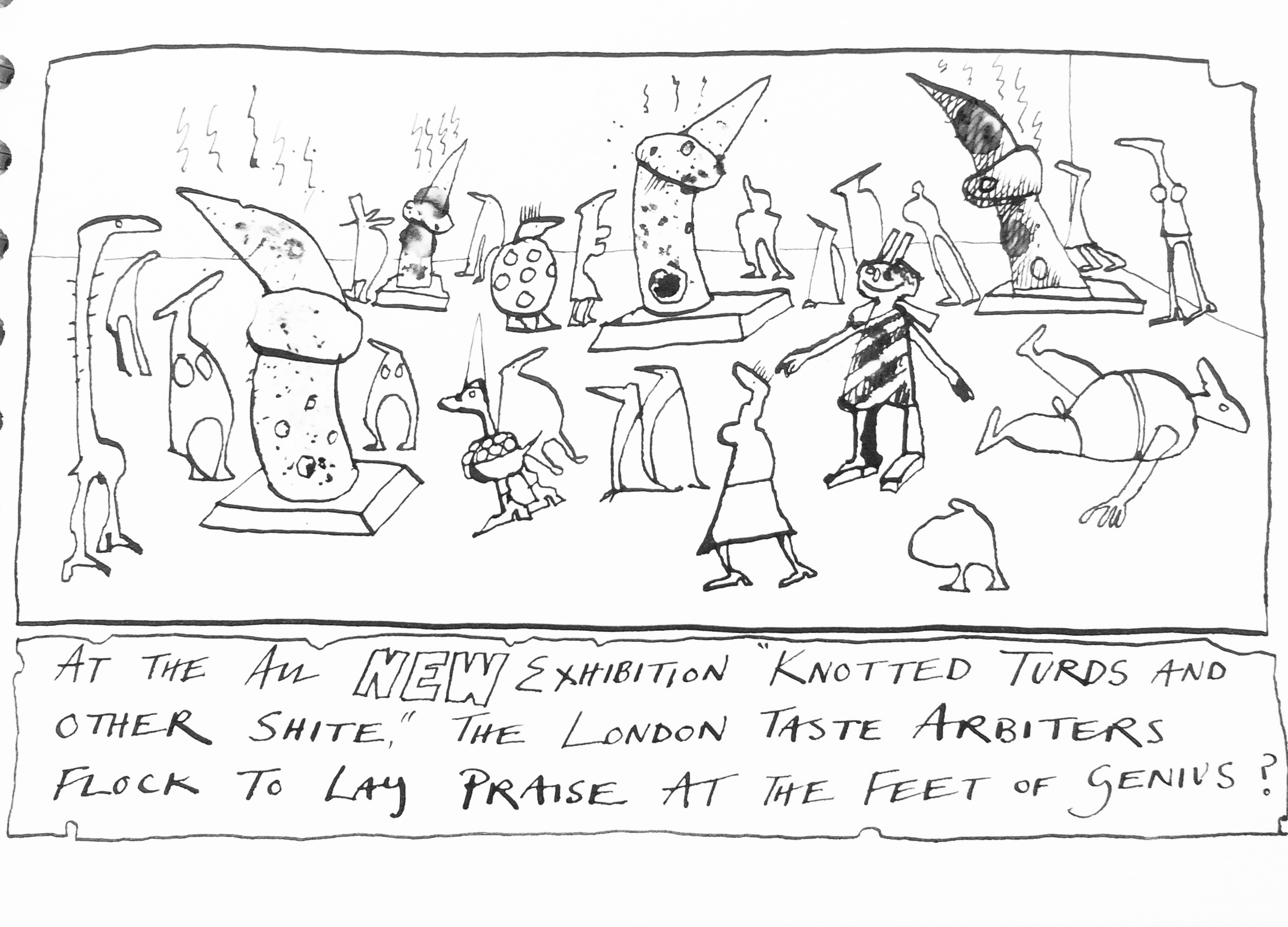
    This lack of a belief system has had a powerful and often catastrophic impact on public art. For example, even now we instinctively expect public sculptures to convey some kind of message, other than a purely aesthetic one. Yet the message, in new monuments of this kind, commonly seems so shallow and clichéd that it doesn’t have any effect. Purely abstract public sculptures – ‘art about art’ – usually fail even more catastrophically. They become simply large-scale open-air ornaments, pretty enough in their way, but with little, or even no, emotional impact. Hence the appearance, in common parlance, of the derogatory term “plop sculpture”, implying that the artwork in question is not much higher in status than a giant dog turd.

    It is notable, in this connection, that the one public image, here in Britain, that did quite recently move and energize a mass audience was the huge display of ceramic poppies, temporarily planted in the moat of the venerable Tower of London to commemorate the dead of World War I. The project was created by two relative unknowns ­– a ceramic artist working with a theatrical set designer. Part of its point was that it was intentionally ephemeral.

    Now that Modernism has apparently run its course, and when the sequence of identifiable Modernist art movements has reached a full stop, we are confronted with a situation in which the art of our own times seems directionless. Attempts to define its salient qualities rely very largely on negative formulations. It is Post Modern. Or Post Post Modern. Or even (in desperation) Post Pop. It often relies heavily on Appropriation – self-consciously copying pre-existing art, stressing its own lack of original invention – in order to make its points.

    The characteristic art of our time also tends to rely very heavily on context. If we encounter a particular object, group of objects or event in a place where we expect to see art, such as in a museum, a contemporary gallery, or at an art fair, then – sure enough, art it is: the context guarantees it. If the place where we encounter it isn’t defined as a space for art, our reactions are not triggered in the same fashion.

    There is also the fact that the knee-jerk reactions that the pioneer Modernists relied on to make their points for them are harder and harder to evoke. The same buttons have been pushed too often.

    Basically once art loosened its age-old ties with religion, and at the same time increasingly ceased to be credibly involved in the celebration of wealth and power, it relied increasingly on being contrarian – on telling its audience things it didn’t necessarily want to hear. Uproar, and frantic opposition to the message, were the first steps towards eventual acceptance and celebrity. If one looks at the development of the 20th century avant gardes (in the plural), one sees that this was largely cyclic. A tendency or style or set of aesthetic ideas established itself after a period of struggle. As soon as the sandcastle was fully built, however, a wave came racing up the beach to overthrow it. It is amusing in retrospect to note how furiously the reigning critics and theoreticians who established the dominance of Abstract Impressionism opposed the rise of Pop Art.

    In crude terms, controversies about art, since the birth of the Modern Movement, have relied on four things. The two most fundamental were, first, the insistence that the world could be seen in new ways – that the established processes whereby what the artist saw could be translated to make an art work that other people were going to see could be radically re-jigged. Secondly, linked to this, but not entirely identified with it, there was the idea that art could be its own subject, entirely self-reflexive. Neither of those impulses seems to be in any way dominant in the art world we now have, though the fashion for Appropriation shows maybe some last, distorted traces of the doctrine of art for art’s sake.

    The third and fourth impulses were cruder. Art threw itself into politics, and it became increasingly candid about sex.

    The political impulse goes a long way back. It began at least a century before the rise of the Modern Movement. One can trace its trajectory from the political masterpieces of J-L David (Marat Assassiné) and Delacroix (The Massacre at Chios) to, perhaps, Picasso’s Guernica. Now it seems to have lost pretty well all of its impetus. The Disobedient Objects show, currently on view at the V & A, offers a classic instance of preaching to the converted.

    Much the same things can be said about aggressive eroticism. The erotic impulse has been present in art ever since men began to make art. In the 20th century, erotic representations and brutally obvious erotic allusions became one of the ways through which artists tried to trademark their work as being ‘radical’ – something opposed to the social conventions of their time. This endured till comparatively recently. Remember those Chapman Brothers figures in the R.A.’s Sensation! show of 1997, with penises for noses? Remember – also from the 1990s – Jeff Koons’ sculptures of himself screwing his then-wife, the Italian porn-star La Cicciolina? You can still find one or two of them on the Web, if you care to look.

    All that seems to be over. Shock tactics no longer shock. Avant-garde art has been gobbled up by the fashion world, and by today’s celebrity culture. What’s it for? It’s for posing in front of, wearing a nice frock. It quotes, daintily, from the avant-garde styles that entertained and enlightened us in the past, but as for trying to change the world – “Have another caviar canapé, darling – all that stuff seems sooo boring now.”

  • ‘The Late’ shows

    Edward Lucie-Smith considers the phenomenon of ‘The Late Style’ in relation to Rembrandt and Turner

    The new Rembrandt show at the National Gallery in London (until January 18th) is clearly meant to challenge the enormous success the same institution enjoyed with its recent exhibition devoted to Leonardo da Vinci. It is a populist homage to one of the undoubted giants of Western European visual culture.

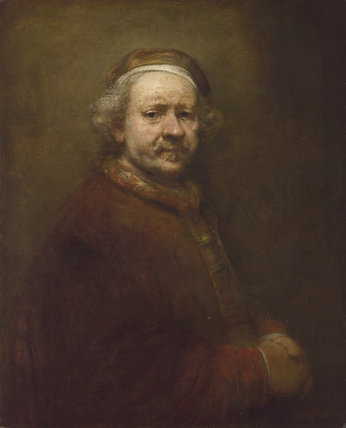
    Instead of trying to embrace the whole man, or at any rate the whole artist, as the Leonardo exhibition did, it focuses on a very specific period of the artist’s life – his last decade and a half, roughly speaking from the time he went bankrupt in 1656 to his death in October 1669, aged 63 (his self-portrait at that age is illustrated here).

    The show has a very particular context, perhaps the result of happenstance. London is currently playing host to another major exhibition devoted to a great master from the past – a painter as well known, and as much of a universal culture hero, as Rembrandt himself.

    This, at Tate Britain, is devoted to the British landscape painter, J.M.W. Turner. Entitled ‘Late Turner – Painting Set Free’ (until January 25th) it focuses on the productions of Turner’s final years, from 1835, when the artist was 40, to his death in 1851, aged 76. Turner began his final phase at an earlier age than Rembrandt, and lasted somewhat longer.

    The idea of the ‘late style’, as a very special, magical phase in the evolution of the work of a great artist, is a comparatively modern invention. To the credit of the organizers, the catalogue of the Rembrandt exhibition is careful to spell this out. As Jonathan Bikker and Gregor J.M. Weber write in an essay entitled ‘Explaining Late Rembrandt’: “At the beginning of the twentieth century the search for specific rules governing the evolution of styles gave rise to a mythology of the aged artistic genius, driven to produce outstanding works in the face of his approaching death.” They add to this: “The concept of ‘Alterstil’ (old age style) emerged to account for late-life creativity…According to the authors who coined the term, the characteristics that defined Alterstil… were a tendency towards abstraction and formal simplicity, combined with greater depth in the subjective and intellectual content. The assumption was that these characteristics can be identified in all art forms and eras.”

    With these two exhibitions, as also with the release in Britain of Mike Leigh’s much lauded new film Mr. Turner, one is therefore dealing with a new phase in the evolution of a myth not as yet formulated in either of the two artists’ own lifetimes. The myth, endorsed by the two museums concerned as instruments of official culture, inevitably affects our own reactions to what is shown.

    One of its effects is to bring the works we are looking at closer to our own contemporary sensibilities. We are certainly not seeing them in the same way as that of the audiences to which they were originally addressed. We are, instead, being presented within a framework where that can confidently be regarded as the productions of genius. It must be immediately noted that the idea of the ‘genius’ – artistic, musical or literary – was itself not fully evolved until, at its earliest, the later years of the 18th century, the period of the Sturm und Drang. There is considerable evidence that Rembrandt’s contemporaries, were often puzzled, or made to feel uneasy, by the stylistic evolution that both artists underwent in the concluding phases of their respective careers.

    The Rembrandt show, held in the cramped basement spaces of the National Gallery’s modern extension, suffers from curatorial overkill. A good selection of paintings from Rembrandt’s last fifteen years is on view, among them a number of acknowledged masterpieces, such as the Jewish Bride from the Rijksmuseum in Amsterdam, which may also be a marital double portrait, and the huge (though still cut down) Conspiracy of the Batavians under Claudius Civilis borrowed from Stockholm.

    There is also an array of self-portraits, which do much to explain why Rembrandt is today regarded as an ‘honorary contemporary’, in a fashion denied to other major painters of the same epoch, such as Rubens. We seem to be offered direct access to the artist’s innermost thoughts and feelings.

    The impact of the show is nevertheless diminished by the fact that the general effect is so cluttered. The paintings are accompanied by a mass of late period drawings and prints, impossible to examine in any detail in the thronging crowd of spectators. One longs to be able to stand back and take an unobstructed look at the major items.

    The Late Turner show at Tate Britain occupies more spacious quarters and is much more logically hung. The artist’s magically vaporous late landscape paintings have long been revered as the very pinnacle of British achievement in the visual arts, and it is an enormous pleasure to see them so generously presented. The catalogue leaves one no doubt, however, about the negative reactions of many of the artist’s contemporaries. His two Venetian scenes dated 1846, Going to the Ball and Returning from the Ball, were exhibited more or less pre-sold at the Royal Academy – Turner was of course a member, an Academician in the strict sense of that term. Yet the buyers pulled out, after unfavourable reactions in the press. The paintings remained unsold, and formed part of the artist’s estate when he died.

    Turner emerges not merely as a visionary, but as someone who had a sophisticated awareness of the processes of change in the Britain of the first half of the 19th century. The celebrated Rain, Steam and Speed – The Great Western Railway (1844) is a good example. The catalogue note on the painting appositely remarks that: “Nature’s sublimity is controlled and condensed by the new industrial paradigm, when water is transformed by heat to produce motive power.”

    Nevertheless, as the exhibition is at some pains to establish, Turner’s art also had deep roots in the classic landscape painting of the past, in particular in the work of Claude and Poussin. There are frequent references to mythological themes, and to be fully understood what he did often needs to be seen within the intellectual framework of an old-fashioned classical education. To force Turner into a totally different mould, as the forerunner of Abstract Expressionism – the prophet of splish, splosh and splash – doesn’t really make sense.

    The fact is that both shows need to be examined with a degree of caution. They propagate an idea, that of the predestined superiority of the Alterstil, as this has been elaborated during the past hundred years or so, which would have been entirely unfamiliar to the two great artists concerned, and also to their contemporaries. The curators concerned offer warnings and qualifications, but the actual titles given to both exhibitions make it plain that the concept lives on. The invitation is to make Rembrandt and Turner over in our own present-day image. For me, that doesn’t work. We need to look at them on their own terms.

  • Art under kleptocracy

    Art under kleptocracy

    Laura Gascoigne examines the paradox of why most artists’ earnings are below the poverty line while the art market is thriving as never before

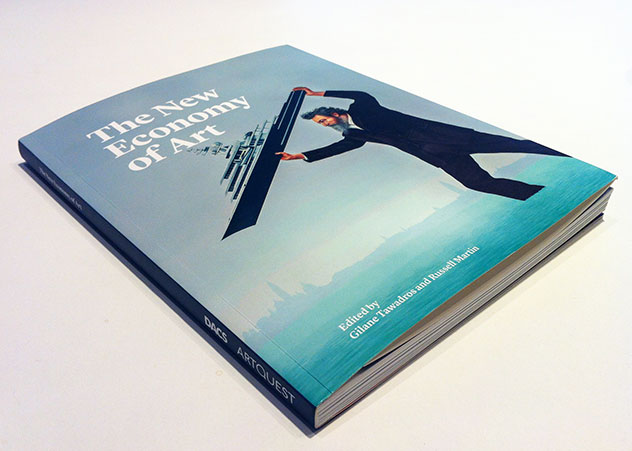
    Another month, another book on the contemporary art economy, this time from an overlooked perspective. The New Economy of Art, a joint publication by DACS and Artquest, looks at the art market from the POV of the average artist. Not surprisingly, it finds plenty to puzzle over.

    The conundrum it addresses is clearly set out in the preface by editors Gilane Tawadros and Russell Martin. “The art world is in crisis,” begins the first paragraph; “The art world is in the best shape it has ever been,” begins the second. The question of how these conflicting statements can both be true at the same time – “the disconnect between how artworks gain financial value even while their makers are poorly, or hardly, paid.” – is the mystery the authors of its six essays try to solve.

    Two weeks before the book came out, Christie’s New York achieved an all-time auction record for its November postwar and contemporary art sale, in which a Warhol Triple Elvis hit the jackpot – kerchung! – at £51.6m – and a row of Four Marlons paid out a further £43.9m. Both, appropriately, had previously hung in a casino in Aachen. The result was hailed by international head of post-war and contemporary art Brett Gorvy as confirmation of “a virtuous cycle of confidence in the art market”. Another season, another reason for making whoopee.

    On the other side of the art market, meanwhile, a more vicious cycle is in operation. The book’s authors quote the usual dismal statistics. It’s depressing enough to learn from the 2011 survey by the Centre for Intellectual Property, Policy and Management at Bournemouth University that UK artists earn a median wage of £10,000 – unchanged for 20 years – without discovering that the statistic includes designers, illustrators and photographers, and that the top 7% earn 40% of the total. Artists now officially rank as ‘marginalised makers’, a marginal constituency politicians aren’t fighting over. The economist Alan Freeman quotes figures showing our ‘creative economy’ growing faster than any other UK production industry, employing 2.5 million people and accounting for 5.2% of gross value added – but take out all the advertising, marketing, fashion, IT and other people he counts as ‘creative specialists’, and the fine artists are still scratching around on the margins.

    The book’s cover reminds us that there is nothing new in this. It reproduces Jeremy Deller’s mural from the 2013 Venice Biennale picturing William Morris as a Victorian Poseidon hurling Roman Abramovich’s superyacht into the Venetian Lagoon. The mural’s title ‘We sit starving amidst our gold’ encapsulates the argument at the heart of the book while reminding us that Morris said it all before, and better. Compare Freeman’s dewy vision of a creative utopia “in which shared values, achievements, hopes and aspirations replace brute greed to lay foundations on which the true individuals of the future can confidently build the new worlds of their choosing” with this trenchant passage from Morris’s lecture Art Under Plutocracy: “So long as the system of competition in the production and exchange of the means of life goes on, the degradation of the arts will go on; and if that system is to last for ever, then art is doomed, and will surely die”. Only the substitution of association for competition, believed Morris, could “give an opportunity for the new birth of art, which is now being crushed to death by the moneybags of competitive commerce.” In the war of words, Morris wins hands down.

    Still, the book contains material which, if not revolutionary, is astonishingly inflammatory for a publication part-funded by the Arts Council. Have they read it? It has a quiet way of dropping bombshells. One is the casual mention by management consultant Keir McGuinness of the apparently generally accepted practice whereby “the decision of whether a [public] gallery will take a show or not depends upon whether you [the artist’s dealer] will make a financial contribution and the person who makes the largest financial contribution gets the shows”. Another is a statistic cited from AN’s recent Paying Artists report that “71% of artists receive no fee for publicly funded exhibitions and nearly 60% do not even have their expenses covered”. This against the background of an international art industry which, arts consultant John Kieffer points out, has a turnover of just under £40bn, with the UK’s market share of 20% amounting to three times the combined budgets of the English, Welsh, Scottish and Northern Irish culture departments.

    But the real eye-opener is the essay by curator Lynda Morris. Born in 1947, Morris is old enough to remember the heady days of the 1960s when a newly international avant-garde was promoted by dealers who were themselves artists, lived like artists on air and were perceived as having ‘moral authority’. What an antiquated concept that now sounds. After reading Morris’s analysis of the process whereby the present nexus of curators, industrialists, bankers and property developers took control of the art world, it seems to belong to another era.

    Morris pinpoints Thatcher’s appointment of Richard Rogers as chair of Tate Trustees in the 1980s as the start of the cultural ascendancy of architecture over art. “It was the moment in late Thatcherism when the State no longer provided social housing and, instead, the national lottery, a new arm of the gambling industry, enabled museum directors and their trustees to start to plan Palaces of Culture.” A proposal to regenerate derelict buildings for low-cost studios, housing and artist-led galleries put forward by officers of the then Arts Council of Great Britain – in association with artists’ collectives ACME and SPACE – was kyboshed by property developer Peter Palumbo, who as chair of the ACGB from 1988-94 presided over the drafting of the rules for National Lottery funding, including the ‘subsidiarity’ clause ensuring that money is allocated only to new projects and thus funneled towards developers and architects rather than artists. Artists are wonderful at sprinkling the fairy dust that turns urban wastelands into developers’ goldmines, but once the gold has been extracted the fairies can piss off and take their dust elsewhere. Prices for a ‘premium apartment’ in Neo Bankside, the new residential development overlooking Tate Modern designed by Rogers Stirk Harbour – formerly Richard Rogers Partnership – start at £4.5m.

    “We seem to have drifted from a market economy to a market society,” comments John Kieffer. It’s a form of society Margaret Thatcher would have recognised, but not William Morris. “It is this superstition of commerce being an end in itself, of man made for commerce, not commerce for man, of which art has sickened,” he wrote in Art under Plutocracy. Art under kleptocracy has brought no improvement. It has been left to President Xi Jinping to uphold moral values, warning Chinese artists last October not to follow the “stench of money” or “lose themselves in the tide of market economy” which the rest of the People’s Republic is happily riding.

    Are artists and Gordon Brown now the only people on the planet still expected to possess a moral compass? That could explain the disconnect highlighted by this book. If our market society is wholly reliant on artists for moral orientation, it has good reason not to seduce them with the stench of money, ie pay them. You could almost call it a virtuous cycle.

    The New Economy of Art, edited by Gilane Tawadros and Russell Martin, published by DACS, £14.99

    http://www.dacs.org.uk/latest-news/order-your-copy-of-the-new-economy-of-art?category=For+Artists&title=N

  • View from the summit

    Laura Gascoigne wades through managerial drivel to consider the plight of museums outside London.

    Searching for quirky museums for a series in The Oldie, I turned up the name of the Astley Cheetham Art Gallery in Stalybridge, Greater Manchester. A recce of the BBC Your Paintings website revealed that its Victorian collection, left to the town in 1932 by mill owner John Frederick Cheetham and his wife Beatrice Astley, contained – alongside later acquisitions of local scenes by the usual artists of the ‘Northern School’ – an astonishing cache of Italian devotional paintings by the likes, or circles, of Niccolò di Tommaso, Jacopo di Cione, Jacopo da Sellaio, Pier Francesco Fiorentino, Timoteo Viti, Bernardino Luini and Girolamo Siciolante da Sermoneta.

    Santa Madonna! I’d struck gold. In high excitement I called the local authority number, to be informed that due to funding cuts at Tameside Council the gallery on the first floor of Stalybridge Library was only open on Saturdays in August from 10am to 3pm, although it was hoped to extend opening times in the near future. But before that happened, the obliging young curator said I was welcome to visit and she’d show me round.

    I arrived to find a mixed hang of thirty works on the theme of Colour, ranging from a red Ship on Fire by James Francis Danby to a blue Heron by Cedric Morris (a gift of the Contemporary Art Society), but of the hoped-for hoard of Italian Renaissance paintings only a St Catherine of Alexander after Luini. When I expressed disappointment, the curator explained that displays had to be rotated and a previous hang on the theme of the collection’s history had included more of the early works I wanted to see. But if people were interested in particular paintings, personal viewings could be arranged. I ended my Oldie article with a warning to readers not to expect to find the Italian masters on view, and received a query from the magazine’s new editor, Alexander Chancellor, wanting “to know why this should be”.

    And very good question. How long had he got? The Museums Summit at the National Gallery organised by The Art Fund in July went on for three hours without getting round to answering it. There was gracious acknowledgement from Liz Forgan, former chair of ACE, that there are galleries outside London with collections of national standard – especially where “local authorities … take their responsibilities seriously like Aberdeen Art Gallery” (ie are lucky enough to be sloshing in oil) – and denial that a problem existed from John Kampfner, perma-tanned director of the newly formed Creative Industries Federation, or CIF (not a multi-purpose cream cleaning solution but a new independent voice for the cultural sector, apparently). “One word I dislike is ‘regional’,” he announced. “It’s not operational in the United States.” Well yes, but that is the United States. Kampfner is touchy on this subject, as he’s also Chair of Trustees of Turner Contemporary, Margate – or should that be Deckchair of Trustees? That would explain the perma-tan.

    I learned not to use the word ‘provincial’ years ago after narrowly avoiding a sock in the puss from the arts editor of the Birmingham Post, but I didn’t know ‘regional’ was now also off limits. What are Londoners to call museums out of London? Awayday museums? A visit takes the best part of a day plus the cost of the train fare, even if it’s free to get in. Which raises that other touchy subject, entry fees. On this point the Deck Chair collapsed into even more convoluted managerial jargon. Turner Contemporary, he admitted, had been under pressure to introduce charging but they’d done some ‘economic scoping’ and concluded that “the fall-off in footfall and civic financial engagement are more negative than the advantages we would get by charging.” In other words, they’re stuffed either way.

    The speaker best qualified to talk about civic financial engagement was Graham Beal, director of Detroit Institute of Arts, who explained in simple English how the DIA’s present problems originated in a civic-minded decision of 1919 to make the museum into a City Department. It was unfortunate that while he was speaking images of the masterpieces the museum is under pressure to sell were flashing up, auction-style, on a screen behind him. Detroit is a special case, but its situation isn’t radically different from that of local authority galleries in depressed areas of the UK. When Javier Pes of The Art Newspaper asked whether decisions by Southampton, Northampton or Croydon councils to sell works in their collections to fund cultural improvements might not be described as democracy in action, his question was passed over in embarrassed silence.

    Statistics were bandied about, though nobody mentioned data confirming that the overwhelming majority of British gallery-goers still belong to social classes A and B. When the DIA ran a poll asking the general population of Detroit what the museum meant to them, the answer came back that it was superfluous. In response, Beal “remade the museum” for the general public, beginning by burying the art history.

    Art history is almost always a casualty when museums are remade for the general public. It doesn’t seem to be high on the agenda of the remade Whitworth Gallery in Manchester which, director Maria Balshaw proudly informed us, will reopen in October with a neon sign by Nathan Coley over the entrance welcoming visitors to ‘A Gathering of Strangers’. Help! If electronic readouts in bus shelters reminded us we were gatherings of strangers, it would trigger murderous paranoia even in those of us not newly released from psychiatric care. But Balshaw believes that museums “should contribute to societal wellness as well as dealing with societal malaise” and that their “natural social work is to bring people together who wouldn’t otherwise meet”. At her use of the word ‘wellness’, I could feel Penelope Curtis in the seat next to me rolling her eyes. Since Curtis’s critically acclaimed historical rehang at Tate Britain visitor numbers have dropped by 10%, making the gallery less popular than Chester Zoo.

    “The intrinsic value and the instrumental value of the arts are not distinct,” Chris Smith insisted in his keynote speech, deputising for George Osborne who had better things to do. Osborne’s Treasury, meanwhile, is doing its best to drive a wedge between the two. The DCMS is currently engaged in trying to put a financial value on the benefit of an individual visiting museums, something both Smith and Munira Mirza, London’s deputy mayor for Education and Culture, agreed was unquantifiable. As Smith also pointed out, the instrumental value of ‘spend’ by cultural tourists only applies in the capital: “If you adopt it as a criterion it becomes a negative argument in the regions.” (He used the R-word.)

    It’s a negative argument regional galleries don’t need. What they need are flourishing economies that produce real revenue – not Creative Industry Federation fluff – so that local authorities can afford to keep them open without flogging off their treasures or turning them into societal wellness clinics. The BBC’s Will Gompertz wound up the summit with the question: “Is the National Gallery only successful when there are 10 million people in there and we can’t see a picture any more?” It’s not a problem for the Astley Cheetham Art Gallery, where people can’t see the pictures because it’s shut.

    Astley Cheetham Art Gallery is now open from 10am-3pm on the first and last Saturdays of every month.

    Laura Gascoigne

    The Jackdaw, 2014

  • Just think

    Laura Gascoigne wonders if the artists who purport to be thinkers are any good at thinking.

    “I think, therefore I am.”

    “I think differently, therefore I am an artist.”

    To traditionalists it may already seem that the entire art world has arrived at destination Hell in a handcart and there is nowhere further to go, but actually the journey isn’t over yet. While the general public remains unconvinced of Josef Beuys’s final solution that everyone is an artist, it still expects a reply to the following question: if it’s not the way artists draw, paint or sculpt that makes them artists, what qualifies them for the title? Here’s the latest answer: it’s the way they think.

    To qualify as a contemporary artist you have to walk the walk, talk the talk and think the thought, all at the same time. (Gum-chewing is an optional extra.) The theory goes, apparently, that by some creative providence artists’ brains are wired differently to everyone else’s, an accident of evolution that lends their thoughts aesthetic value in themselves. Any works that might result, if any do, are only of value as physical manifestations of this mental difference, byproducts of thought processes that may be exchanged as commodities for financial profit but could just as easily be dumped without detriment to the maker’s status as an artist. The kernel, the essence, the nub of art is thought, and the purer its expression, in principle, the better – no gunk, no junk, just the juice of undiluted creative thinking. But in our messy world of gunky realities, this ideal is difficult to achieve. How does the differently thinking artist break the ties that bind him to the world of objects? It’s a problem the Café Gallery, Southwark Park – always at the cutting-edge of creative cerebration and municipal lawn-mowing – has been trying to address.

    Its summer exhibition, which if you hop straight on a number 188 bus you might just catch before it closes on June 29th, is called Thinking Things, and concerns itself with this very problem of “exploring thinking’s ambivalent entanglement with sculptural and visual forms”. It takes its name from an essay by the literary theorist Steven Connor which, if you’ve missed the bus, you can read online. Connor’s thinking on thinking starts from this premise: “Thinking, which is properly nothing and nowhere, can only lay hold of itself in the form of a thing. But not just any thing will do, for it seems that it needs to be a special sort of thing, a thing apt to embody thought – a thinking thing.” That is, as I understand it, a thing with a thought bubble, but not just any old thing with a bubble – not a bar of soap.

    The exhibition, supported by something called Pro Helvetia – not a brand of probiotic yogurt but the Swiss Arts Council – considers the thinking problem in relation to the practices of a number of contemporary artists including Richard Serra (the only one I’d heard of) and to the work of the late French writer, filmmaker and educator Fernand Deligny. (There had to be a Frenchman in there somewhere. When Brits start spouting thought-bollocks, cherchez la grenouille.) And there’s more. “Complicating the dichotomy between ‘things’ (materials, objects) and ‘thoughts’ (ideas, concepts), the exhibition focuses on the contradictory alliances and uneasy codependencies of mind and matter, object and idea. It looks at how thinking often depends on material forms and becomes thing-like, and how objects can become abstract like thoughts.”

    I can’t see quite how you complicate a dichotomy, though I expect you get points in French philosophy class for trying. But concentrate now, because we’re going to another level: “A ‘thinking thing’ has all the qualities of thought, while no longer being a thought. It is an atmosphere, cloud, storm, gas, air, secretion, ooze, balloon and bubble [you see, I knew there’d be bubbles]: all things that in their puzzling incompleteness capture the drifts and vagaries of thought… At the heart of the exhibition is a concern with the fundamental processes of art’s conception: how thinking about form and forms of thinking in art come about.” In other words, it’s the thought that counts.

    Trend-spotters will have seen this idea coming as long ago as the 1998 Hayward touring exhibition Thinking Aloud curated by Richard Wentworth, the thinking man’s artist – or is that the arty man’s thinker? Whatever, let’s not complicate the dichotomy. Wentworth described his show as “an opportunity to see what happens when you fray the edges and actually provoke more open-ended ways of looking.” What happened was that Tate Britain took up the challenge and ushered in the Millennium with New British Art 2000: Intelligence, a show of 20 contemporary artists including Tacita Dean, Douglas Gordon, Bob and Roberta Smith and the crown prince of frayed-edge thinking, Martin Creed. The Tate gave the idea a more sinister spin by comparing contemporary artists to “intelligence agents at large in society, gathering, sifting and transforming the raw data of our life, critically examining our environment, the way we live and our relations with each other… They see art as a means for imagining the world differently, or ‘thinking otherwise’ as the French philosopher Foucault put it.”

    What did I just say about Frenchmen? It’s Foucault and his copains who are largely responsible for spawning a generation of British art school graduates who fondly imagine they have reinvented thinking. And the delusion is spreading. Last year Tate Modern teamed up with a German car manufacturer to launch a series of BMW Tate Live Thought Workshops (yes, really) to teach the general public to think like artists – rather than, presumably, Jeremy Clarkson.

    There’s nothing new about the idea of artistic intelligence. We’ve known all along that in art it’s the thought that counts, ever since Michelangelo explained that “an artist paints with his brain and not with his hands” – or his prick in the case of Renoir. But this obsession with the thought behind the art rather than the art itself is a phenomenon of the last 20 years. Every religion needs a creation myth, and I guess this is the creation myth of conceptual art. It allows conceptualism to be presented to the public as a cult of creativity vested in the artist rather than the work, compensating for the fact that the work leaves the public cold. Meanwhile it swells the heads of the not-so-bright who went into art because they fancied themselves as thinkers while lacking the intellectual cutting-edge to cut the mustard in the Mensa department.

    Artists aren’t stupid but neither, Leonardo excepted, are they intellectual giants. If they had the brainpower of philosophers they’d be philosophers, ditto mathematicians, microbiologists, astrophysicists and all the other professions their ‘thinking otherwise’ now licenses them to dabble in. But should they be wasting creative energy on thinking at all? Not according to Ensor. “Reason is the enemy of art,” said the Oracle of Ostend. “Artists dominated by reason lose all feeling, powerful instinct is enfeebled, inspiration becomes impoverished and the heart lacks its rapture.”

    Fortunately, help may be at hand. The first stirrings of a counterrevolutionary backlash were felt in February when the South London Gallery hosted an evening of talks and screenings titled Stupidious, which proposed “stupidity as both a subject and a strategy of artistic production.” Who would have thunk it? With a healthy injection of stupidiosity, the heart may yet recover its rapture.

    Laura Gascoigne

    The Jackdaw, 2014

  • Poor man’s guide to art investing – don’t

    Wisely, Laura Gascoigne is unconvinced by art as investment.

    Equestrian statues of one sort or another are becoming a regular fixture on the Fourth Plinth. In 2012 we had Elmgreen & Dragset’s paedophile’s delight of the boy on the gilded rocking horse; next up in 2015 will be Hans Haacke’s equine skeleton, inspired by Stubbs, with a live ticker of the London Stock Exchange clipped to its foreleg like a hospital bracelet. Too late for the horse hospital for this old nag, however, reduced to bones by the necrotising fasciitis of the financial market. Titled Gift Horse, Haacke’s monument seems surprisingly near the knuckle for a contemporary art world currently jockeying for position on the FTSE Alternative Investment Market index.

    On the same day in January, two invitations dropped into my mailbox. One invited me to spend $2,500 on a two-day Master Class in Art Finance run by TiasNimbas Business School at a château outside Maastricht, where I would “learn about the art market industry, gain knowledge on the history, development and ranges of alternative types of exotic and emotional assets” and acquire essential information to help me “understand the mirage [sic] of products currently on offer”. Now I may not be Lawrence of Arabia, but I know enough about deserts to understand that a ‘mirage currently on offer’ is by definition guaranteed to disappear before I reach it, along with my $2,500. So I plumped for invitation no. 2, to a free debate at the London Art Fair led by Melanie Gerlis, Art Market editor of The Art Newspaper and a former financial analyst, on the question: ‘Is Art Really a Good Investment?’

    The event, which coincided with the launch of Gerlis’s new book Art as an Investment? A Survey of Comparative Assets (Lund Humphries, £30), was ostensibly aimed at helping cub collectors make informed investment choices, except that it very quickly became apparent that Gerlis’s informed answer to the question under debate was ‘no’. She gave five pretty persuasive reasons why. 1. There is no real market. 2. Art has low liquidity – you can’t sell everything tomorrow. 3. It has no use, unlike property. 4. It generates no income. 5. There are secret rules – rules, she let slip, “which by any other name you would say are manipulation, but I’m not going to say that here.” She as good as said it, and she does it again even more convincingly in print.

    Gerlis’s book assesses art’s performance in the market by coolly comparing its risks and returns with those of other investments: public equities, real estate, private equity and the alternatives assets silver, wine and gold now bracketed with art under the collective acronym SWAG. In every statistical comparison, art comes off badly. It has the lowest returns (7-8%) and the highest volatility (20%) of any sort of SWAG. Twenty-five percent of the stuff consigned for auction doesn’t sell, although the public only gets to hear about the $105m Warhol Silver Car Crash or the $58m Koons Balloon Dog (Orange). Such is the polarization of the market that over the past 25 years 20% of works have generated 80% of sales values. And even the auction houses can’t always be sure which works will be in the winning 20% until the hammer falls, despite presiding over an asymmetrical market in which they have all the information and hold all the aces. “Most investment decisions are based on an asset’s worth in relation to its price,” is how Gerlis sums up the situation, “and neither can be pinned down in the elusive art market”.

    There are of course compensatory benefits to owning art, called ‘psychic returns’. Gerlis quotes the American journalist Malcolm Gladwell’s calculation that these are worth 28% of the value of a work: “If you pay $100m for a Van Gogh, $28m of that is for the joy of looking at it every morning”. Equally, every morning you leave the house without looking at it you’ve pissed away several thousand bucks. But for the ultra-high-net-worth individuals (with investible assets of over $30m) who can afford to piss it away, art also has a social ‘positional’ value, like luxury goods. In her final chapter Gerlis compares these two markets, which both rely on the same 1% of super-wealthy and appeal to the same herd mentality. “One of the most curious features of the contemporary art market boom that peaked in 2007,” she observes, “was that works which were the most commoditised (that is, they looked the same as each other)… were those that were commanding the highest prices and attention. In the age of conspicuous consumption, it became paramount that one’s art was recognisable – and recognisably expensive.” So if not rarity, what determines value in the contemporary art market? Basically, money. The super-rich buy art because it’s expensive, and the more it costs the more they want to buy it. Or as Gerlis puts it: “An artist is good because he sells for a lot.”

    I had a friend in the 1970s, a wit and bon viveur, who announced one day that if potatoes got any more expensive he’d start buying them. I didn’t know, until reading this book, that my friend’s remark illustrated the ‘Veblen effect’. It was the American economist Thorstein Veblen in his 1899 book The Theory of the Leisure Class who first identified the phenomenon of demand for certain goods rising with their cost. Given a choice of two spoons, one silver and flashy, the other aluminium and functional, the modern consumer preferred the silver one because it cost more: “The superior gratification derived from the use and contemplation of costly and supposedly beautiful products is, commonly, in great measure a gratification of our sense of costliness, masquerading under the name of beauty.”

    Laziness is another reason why the bottom line now dominates art news headlines. As New York alpha gallerist David Zwirner recently remarked: “One of the reasons there’s so much talk about money is that it’s so much easier to talk about than the art.” But using price as an index of quality has other consequences beyond the personal risk to UHNWIs when the market in an artist ‘softens’. The damaging perception that art which does not sell for eye-watering sums is intrinsically worth less – even worthless – causes depression, financial and psychological, lower down the market. Here’s another of Gerlis’s statistics: last year the average turnover of art dealers with sales under €500,000 fell by 17%, while those with turnovers of over €10m saw a rise of 55%.

    Gerlis doesn’t address the morality of the market – that’s not what her book’s about – but she does conclude on a wistful note with the observation that “in reality most of what is produced is in the middle to lower end of the market and where so-called real collectors (rather than the trophy-hunting elite) and people who simply consider themselves art buyers are operating… If the system that supports this is struggling… artists are going to find it even more difficult to make a living out of what they do and will increasingly… make work that is primarily market-pleasing. Supporting the development of a healthy, low-to-mid-market for art may be in the best interests of all who love it.”

    At the top end, art investment is a millionaire’s flutter; at the bottom end it’s a struggle for survival. My bon viveur friend made the mistake of opening a gallery, and during the 1980s recession he committed suicide. He was small potatoes.

    Laura Gascoigne

    The Jackdaw, 2014


  • Archive fever

    Artists have re-discovered the cabinet of curiosities, which is to their and our advantage, argues Laura Gascoigne.

    “There really is no such thing as art. There are only artists.” Easy enough to say at a time of rationing when there are few varieties of artist about. When Gombrich made his famous statement in 1950 there were only painters, sculptors, the odd avant-gardist and the usual sprinkling of con and piss artists. But now that artists come in more varieties than Heinz, with less flavour, his distinction no longer helps.

    Things were different then, when artists were still distinguished as a class by the whiff of romance that clung to them. Even piss artists gave off a whiff of something more than drink. But archival artists? They smell about as sexy as musty ledgers. And archival artists is what we’ve come down to, though in our zero hours culture few can stick to just one thing. So Akram Zaatari, who gave a lunchtime talk at the ICA in November, is a filmmaker, photographer and archival artist, as well as a curator.

    Where to draw the line between the last two isn’t clear. In recent years, as artists have watched curators steal more and more of their limelight, the enterprising ones have found ways of edging them out. Rather than merely producing art, they are collecting it, organising it, archiving it. In Zaatari’s case, ‘it’ is “a wide range of documents that testify to the cultural and political conditions of Lebanon’s postwar society… which he collects, examines and recontextualises”, but it could be anything. It could be an inventory of all the exhibitions held in Belfast between March 1968 and March 2001, or a list of everything the artist has put in her mouth for the previous eight months, hopefully minus the recontextualisation.

    Producing things, in a Boris economy, is for bottom-dwelling cornflakes. But sorting things into clever little piles and columns is white-collar work. It requires a system and a language to explain it, putting the artist on a level with curators and directors. If you speak their language, you’re one of them. You’re not some troglodytic creature blinking in the light whose presence needs explaining to the public. Speaking the interpreters’ language saves them the bother.

    In 2009 Tate Britain had a show called Classified that included a display of shells collected by Damien Hirst and a cabinet of ‘archeological’ finds retrieved from the Thames by Mark Dion. It drew attention to “the way artists use ordering systems in their work” and how they “often use these networks and relationships in ways that reveal the inherent instability of meaning.” The implication was that artists’ systems were more exciting because there was more madness in their method, but this wasn’t apparent from the installations. Hirst and Dion both used standard methods of display for objects that logically belonged together. Similarly, Dion’s new Maritime Artist installation for Porthmeor Studios in St Ives could belong in a local history museum.

    What drives our need for ordering systems? Derrida called it ‘archive fever’, but it’s basically fear. We want to find patterns in the world around us that will help us survive the present and predict the future. Fear has a good track record for motivating artists – it inspired the art of the Sublime – but that was fear of the unknown. Fear of the unknown stimulates the human imagination, whereas fear of the known – information overload – shuts it down. In the two centuries since Burke, art’s imaginative possibilities have been shrinking as the pool of unknowability drains. Contemporary artists are driven by a new sort of fear, the fear of the known – the terror of drowning under a tidal surge of facts or being buried under a mountain of knowledge. There is simply too much of it about. What is an artist to do? Grayson Perry in his Reith Lectures defined an artist as “someone who notices things”. But noticing everything is a contradiction in terms.

    The international exhibition at last year’s Venice Biennale, The Encyclopedic Palace, touched on this very problem, “the impossible desire of knowing and seeing everything” in the digital information age. While containing work by several archival artists the exhibition was not itself an archive, more of a mammoth walk-in cabinet of curiosities selected by its curator Massimiliano Gioni. It attracted record numbers and, for the first time, bigger crowds in its final weeks than at the preview. “After the opening five days of the exhibition, the yachts all departed and the following six months were characterized by the presence of the backpack crowd,” announced the Biennale president Paolo Baratta in the closing press release.

    Interesting, the wily old doge with his finger on the art world pulse publicly disassociating the Biennale from the superyachties and turning for validation to the backpack crowd, like an Aussie publican. Bashing the rich art crowd is the coming trend, to judge by coverage of last year’s Frieze Art Fair in The Guardian, previously fawning but now dismissing the event as “an elitist shopping mall”. Art defined by its price tag – “just a big lump of money on the wall”, as Perry described it – is losing its allure. It’s got the thumbs-down from the backpackers, who are buzzing like bees around exhibitions on the popular encyclopedic model also adopted by the Hayward touring show Curiosity: Art & the Pleasures of Knowing at Newlyn Art Gallery and Discoveries: Art, Science & Exploration from the University of Cambridge Museums at Two Temple Place, both opening in January.

    The wunderkammer is the new white cube. You don’t have to be an insider to enjoy these shows, you needn’t worry about whether it’s art or you’re being suckered, because it’s not so much about the art as the pleasure of knowledge administered in tasty bite-sized chunks. We live in interesting times. The continental drift between rich and poor is splitting the art world, leaving the private collectors of wall-mounted money on one side and the exhibition-going public on the other. The aspirational classes have lost interest in wall-mounted money since they gave up aspiring and switched off. The ‘handbag and hipster test’ of fashionable art proposed by Grayson Perry is being replaced by the backpack test, and the vulgar taste of the one percenters by the wisdom of crowds.

    It’s funny to think that just 10 years ago the other ICA – the International Council of Archives – felt the need to launch an Archive Awareness Campaign. It had little impact on the Tate and the V&A, both since accused of dumping picture archives – the Tate’s saved from the skip by the Mellon Centre, the V&A’s ending in an industrial shredder. A thematic archive “wasn’t a method of classification that was really necessary any longer,” said the V&A. Tell that to the archival artist and cabinet curator.

    Pluralism is a problem, as Perry pointed out, but here’s a suggestion. Why doesn’t everyone move up a place? The archival artist can occupy the seat of the museum curator, the museum curator can replace the museum director, and the museum director can shuffle off and become head of an Oxbridge college. That should leave a seat empty for an artist with a pad and pencil to perch on, noticing things – particular things – and jotting them down.

    Laura Gascoigne

    The Jackdaw, 2014