Tag: Laura Gascoigne

  • Poor man’s guide to art investing – don’t

    Wisely, Laura Gascoigne is unconvinced by art as investment.

    Equestrian statues of one sort or another are becoming a regular fixture on the Fourth Plinth. In 2012 we had Elmgreen & Dragset’s paedophile’s delight of the boy on the gilded rocking horse; next up in 2015 will be Hans Haacke’s equine skeleton, inspired by Stubbs, with a live ticker of the London Stock Exchange clipped to its foreleg like a hospital bracelet. Too late for the horse hospital for this old nag, however, reduced to bones by the necrotising fasciitis of the financial market. Titled Gift Horse, Haacke’s monument seems surprisingly near the knuckle for a contemporary art world currently jockeying for position on the FTSE Alternative Investment Market index.

    On the same day in January, two invitations dropped into my mailbox. One invited me to spend $2,500 on a two-day Master Class in Art Finance run by TiasNimbas Business School at a château outside Maastricht, where I would “learn about the art market industry, gain knowledge on the history, development and ranges of alternative types of exotic and emotional assets” and acquire essential information to help me “understand the mirage [sic] of products currently on offer”. Now I may not be Lawrence of Arabia, but I know enough about deserts to understand that a ‘mirage currently on offer’ is by definition guaranteed to disappear before I reach it, along with my $2,500. So I plumped for invitation no. 2, to a free debate at the London Art Fair led by Melanie Gerlis, Art Market editor of The Art Newspaper and a former financial analyst, on the question: ‘Is Art Really a Good Investment?’

    The event, which coincided with the launch of Gerlis’s new book Art as an Investment? A Survey of Comparative Assets (Lund Humphries, £30), was ostensibly aimed at helping cub collectors make informed investment choices, except that it very quickly became apparent that Gerlis’s informed answer to the question under debate was ‘no’. She gave five pretty persuasive reasons why. 1. There is no real market. 2. Art has low liquidity – you can’t sell everything tomorrow. 3. It has no use, unlike property. 4. It generates no income. 5. There are secret rules – rules, she let slip, “which by any other name you would say are manipulation, but I’m not going to say that here.” She as good as said it, and she does it again even more convincingly in print.

    Gerlis’s book assesses art’s performance in the market by coolly comparing its risks and returns with those of other investments: public equities, real estate, private equity and the alternatives assets silver, wine and gold now bracketed with art under the collective acronym SWAG. In every statistical comparison, art comes off badly. It has the lowest returns (7-8%) and the highest volatility (20%) of any sort of SWAG. Twenty-five percent of the stuff consigned for auction doesn’t sell, although the public only gets to hear about the $105m Warhol Silver Car Crash or the $58m Koons Balloon Dog (Orange). Such is the polarization of the market that over the past 25 years 20% of works have generated 80% of sales values. And even the auction houses can’t always be sure which works will be in the winning 20% until the hammer falls, despite presiding over an asymmetrical market in which they have all the information and hold all the aces. “Most investment decisions are based on an asset’s worth in relation to its price,” is how Gerlis sums up the situation, “and neither can be pinned down in the elusive art market”.

    There are of course compensatory benefits to owning art, called ‘psychic returns’. Gerlis quotes the American journalist Malcolm Gladwell’s calculation that these are worth 28% of the value of a work: “If you pay $100m for a Van Gogh, $28m of that is for the joy of looking at it every morning”. Equally, every morning you leave the house without looking at it you’ve pissed away several thousand bucks. But for the ultra-high-net-worth individuals (with investible assets of over $30m) who can afford to piss it away, art also has a social ‘positional’ value, like luxury goods. In her final chapter Gerlis compares these two markets, which both rely on the same 1% of super-wealthy and appeal to the same herd mentality. “One of the most curious features of the contemporary art market boom that peaked in 2007,” she observes, “was that works which were the most commoditised (that is, they looked the same as each other)… were those that were commanding the highest prices and attention. In the age of conspicuous consumption, it became paramount that one’s art was recognisable – and recognisably expensive.” So if not rarity, what determines value in the contemporary art market? Basically, money. The super-rich buy art because it’s expensive, and the more it costs the more they want to buy it. Or as Gerlis puts it: “An artist is good because he sells for a lot.”

    I had a friend in the 1970s, a wit and bon viveur, who announced one day that if potatoes got any more expensive he’d start buying them. I didn’t know, until reading this book, that my friend’s remark illustrated the ‘Veblen effect’. It was the American economist Thorstein Veblen in his 1899 book The Theory of the Leisure Class who first identified the phenomenon of demand for certain goods rising with their cost. Given a choice of two spoons, one silver and flashy, the other aluminium and functional, the modern consumer preferred the silver one because it cost more: “The superior gratification derived from the use and contemplation of costly and supposedly beautiful products is, commonly, in great measure a gratification of our sense of costliness, masquerading under the name of beauty.”

    Laziness is another reason why the bottom line now dominates art news headlines. As New York alpha gallerist David Zwirner recently remarked: “One of the reasons there’s so much talk about money is that it’s so much easier to talk about than the art.” But using price as an index of quality has other consequences beyond the personal risk to UHNWIs when the market in an artist ‘softens’. The damaging perception that art which does not sell for eye-watering sums is intrinsically worth less – even worthless – causes depression, financial and psychological, lower down the market. Here’s another of Gerlis’s statistics: last year the average turnover of art dealers with sales under €500,000 fell by 17%, while those with turnovers of over €10m saw a rise of 55%.

    Gerlis doesn’t address the morality of the market – that’s not what her book’s about – but she does conclude on a wistful note with the observation that “in reality most of what is produced is in the middle to lower end of the market and where so-called real collectors (rather than the trophy-hunting elite) and people who simply consider themselves art buyers are operating… If the system that supports this is struggling… artists are going to find it even more difficult to make a living out of what they do and will increasingly… make work that is primarily market-pleasing. Supporting the development of a healthy, low-to-mid-market for art may be in the best interests of all who love it.”

    At the top end, art investment is a millionaire’s flutter; at the bottom end it’s a struggle for survival. My bon viveur friend made the mistake of opening a gallery, and during the 1980s recession he committed suicide. He was small potatoes.

    Laura Gascoigne

    The Jackdaw, 2014
     

  • Archive fever

    Artists have re-discovered the cabinet of curiosities, which is to their and our advantage, argues Laura Gascoigne.

    “There really is no such thing as art. There are only artists.” Easy enough to say at a time of rationing when there are few varieties of artist about. When Gombrich made his famous statement in 1950 there were only painters, sculptors, the odd avant-gardist and the usual sprinkling of con and piss artists. But now that artists come in more varieties than Heinz, with less flavour, his distinction no longer helps.

    Things were different then, when artists were still distinguished as a class by the whiff of romance that clung to them. Even piss artists gave off a whiff of something more than drink. But archival artists? They smell about as sexy as musty ledgers. And archival artists is what we’ve come down to, though in our zero hours culture few can stick to just one thing. So Akram Zaatari, who gave a lunchtime talk at the ICA in November, is a filmmaker, photographer and archival artist, as well as a curator.

    Where to draw the line between the last two isn’t clear. In recent years, as artists have watched curators steal more and more of their limelight, the enterprising ones have found ways of edging them out. Rather than merely producing art, they are collecting it, organising it, archiving it. In Zaatari’s case, ‘it’ is “a wide range of documents that testify to the cultural and political conditions of Lebanon’s postwar society… which he collects, examines and recontextualises”, but it could be anything. It could be an inventory of all the exhibitions held in Belfast between March 1968 and March 2001, or a list of everything the artist has put in her mouth for the previous eight months, hopefully minus the recontextualisation.

    Producing things, in a Boris economy, is for bottom-dwelling cornflakes. But sorting things into clever little piles and columns is white-collar work. It requires a system and a language to explain it, putting the artist on a level with curators and directors. If you speak their language, you’re one of them. You’re not some troglodytic creature blinking in the light whose presence needs explaining to the public. Speaking the interpreters’ language saves them the bother.

    In 2009 Tate Britain had a show called Classified that included a display of shells collected by Damien Hirst and a cabinet of ‘archeological’ finds retrieved from the Thames by Mark Dion. It drew attention to “the way artists use ordering systems in their work” and how they “often use these networks and relationships in ways that reveal the inherent instability of meaning.” The implication was that artists’ systems were more exciting because there was more madness in their method, but this wasn’t apparent from the installations. Hirst and Dion both used standard methods of display for objects that logically belonged together. Similarly, Dion’s new Maritime Artist installation for Porthmeor Studios in St Ives could belong in a local history museum.

    What drives our need for ordering systems? Derrida called it ‘archive fever’, but it’s basically fear. We want to find patterns in the world around us that will help us survive the present and predict the future. Fear has a good track record for motivating artists – it inspired the art of the Sublime – but that was fear of the unknown. Fear of the unknown stimulates the human imagination, whereas fear of the known – information overload – shuts it down. In the two centuries since Burke, art’s imaginative possibilities have been shrinking as the pool of unknowability drains. Contemporary artists are driven by a new sort of fear, the fear of the known – the terror of drowning under a tidal surge of facts or being buried under a mountain of knowledge. There is simply too much of it about. What is an artist to do? Grayson Perry in his Reith Lectures defined an artist as “someone who notices things”. But noticing everything is a contradiction in terms.

    The international exhibition at last year’s Venice Biennale, The Encyclopedic Palace, touched on this very problem, “the impossible desire of knowing and seeing everything” in the digital information age. While containing work by several archival artists the exhibition was not itself an archive, more of a mammoth walk-in cabinet of curiosities selected by its curator Massimiliano Gioni. It attracted record numbers and, for the first time, bigger crowds in its final weeks than at the preview. “After the opening five days of the exhibition, the yachts all departed and the following six months were characterized by the presence of the backpack crowd,” announced the Biennale president Paolo Baratta in the closing press release.

    Interesting, the wily old doge with his finger on the art world pulse publicly disassociating the Biennale from the superyachties and turning for validation to the backpack crowd, like an Aussie publican. Bashing the rich art crowd is the coming trend, to judge by coverage of last year’s Frieze Art Fair in The Guardian, previously fawning but now dismissing the event as “an elitist shopping mall”. Art defined by its price tag – “just a big lump of money on the wall”, as Perry described it – is losing its allure. It’s got the thumbs-down from the backpackers, who are buzzing like bees around exhibitions on the popular encyclopedic model also adopted by the Hayward touring show Curiosity: Art & the Pleasures of Knowing at Newlyn Art Gallery and Discoveries: Art, Science & Exploration from the University of Cambridge Museums at Two Temple Place, both opening in January.

    The wunderkammer is the new white cube. You don’t have to be an insider to enjoy these shows, you needn’t worry about whether it’s art or you’re being suckered, because it’s not so much about the art as the pleasure of knowledge administered in tasty bite-sized chunks. We live in interesting times. The continental drift between rich and poor is splitting the art world, leaving the private collectors of wall-mounted money on one side and the exhibition-going public on the other. The aspirational classes have lost interest in wall-mounted money since they gave up aspiring and switched off. The ‘handbag and hipster test’ of fashionable art proposed by Grayson Perry is being replaced by the backpack test, and the vulgar taste of the one percenters by the wisdom of crowds.

    It’s funny to think that just 10 years ago the other ICA – the International Council of Archives – felt the need to launch an Archive Awareness Campaign. It had little impact on the Tate and the V&A, both since accused of dumping picture archives – the Tate’s saved from the skip by the Mellon Centre, the V&A’s ending in an industrial shredder. A thematic archive “wasn’t a method of classification that was really necessary any longer,” said the V&A. Tell that to the archival artist and cabinet curator.

    Pluralism is a problem, as Perry pointed out, but here’s a suggestion. Why doesn’t everyone move up a place? The archival artist can occupy the seat of the museum curator, the museum curator can replace the museum director, and the museum director can shuffle off and become head of an Oxbridge college. That should leave a seat empty for an artist with a pad and pencil to perch on, noticing things – particular things – and jotting them down.

    Laura Gascoigne

    The Jackdaw, 2014
  • Building brands, ruining reputations – Laura Gascoigne on the Tate

    Nothing is too squalid for Brand Tate, argues Laura Gascoigne.

    ‘Change the name and not the letter, change for the worse and not the better,’ ran the old wives’ saw on choosing a husband. Nowadays, in the wider world of consumer choice, a change of name is almost always a change for the worse. Whenever a familiar product is rebranded, a deterioration in quality is guaranteed. And when a corporation renames itself, as sure as eggs is eggs (assuming one can still be sure of that) it’s up to no good.

    Last July, there was suppressed hilarity in media circles when multinational accounting firm Ernst & Young announced that henceforth it would be trading under the snappier acronym EY. Unhappily, some in the press pointed out that the initials adopted by the company to “demonstrate boldly and clearly who we are” were confusingly already in use by another entity, the junior beefcake magazine EY! – or Electric Youth!, to give it its full name – a publication equally unafraid to demonstrate boldly and clearly what it is. A typical cover on its website features teen model Sergio Carvajal lifting his Spain 2012/13 Confederations Cup football shirt with one hand while pulling down his pants with the other, alongside the cover line: ‘The beauty and joy of young boyhood’. What’s the male equivalent of nubile? Pubile? Anyway, you get the picture.

    Commentators remarked that it was odd that a firm like EY2 that employs 167,000 people hadn’t done its research before changing its name but not its letters. The reason is, it was in a hurry. The name change came just four months after the then E&Y was persuaded by US criminal prosecutors to reach a $123m settlement with the IRS for marketing tax avoidance schemes that cost the US economy $2bn in lost revenue between 1999-2004. The dodges, dreamed up by a unit called VIPER – Value Ideas Produce Extraordinary Results – included fake investments with names like COBRA – Currency Options Bring Reward Alternatives – for the creation of which four of the company’s magic bean-counters were sent down in 2010.

    A spokesman for E&Y quickly announced that it was “pleased to put this matter from a decade ago behind us”, but unfortunately matters didn’t end there. When top executives from Amazon and Google were hauled before our own Commons Public Accounts Committee last November for a grilling by the terrifying Margaret Hodge as to how they got away with paying almost no taxes, the schemes allowing them to do so, it transpired, had been hatched by er… the erstwhile Ernst & Young. Before people with long memories started to cast their minds back to the collapses of Anglo-Irish Bank and Lehman Bros and to recall the identity of their auditors, a nifty change of name was obviously in order.

    Where’s all this heading? In case you haven’t noticed, Tate Modern’s big autumn exhibition is being marketed under the title The EY Exhibition – Paul Klee: Making Visible. Why, oh EY? Because in July, within days of their name-change, EY signed a three-show sponsorship deal with Tate Modern, publicized in a wince-inducing press release picturing the Tate director and the EY chairman standing shoulder to shoulder with matching business suits and rictus grins, one without a tie (creative industries), one with (creative accountancy). “This collaboration between two internationally-recognised institutions,” the release announced, “has the potential to help build a better working world for their visitors and clients respectively and the communities in which they work.” Take your fingers out of your throat, because it gets worse. It ended with this assertion from the EY chairman: “The arts and services sector can make a significant contribution to building brand Britain.”

    Building brand Britain? I bet Paul Klee had no idea when helping to design a brave new world at the Bauhaus that his name would be posthumously linked with such a preposterous piece of corporate jingoism, and I don’t suppose he’d have been best pleased about it. It’s obnoxious. There may be a respectable tradition of calling lecture series after distinguished scholars, but there’s nothing respectable about flogging a dead artist’s arse to a dodgy firm of accountants and allowing them to brand their initials on it. The Tate would do better to get EY! to sponsor the gents toilets and at least encourage some active philanthropy while they’re at it.

    Fortunately for the survival of old familiar unbranded Britain, there are signs that a rebellion against brandalism is brewing. In September the felicitously named Russell Brand loosed a well-aimed volley at the GQ Men of the Year awards – where he was collecting an award as an ‘oracle’ – when he stood on a stage papered in the logos of the event’s sponsors Hugo Boss and pointed out the absurdity of the fact that German outfitters who supplied uniforms to the Nazis were still trading as a fashion house under the same name, “and the ludicrous necessity for an event such as this to banish such a lurid piece of information from our collective consciousness.” He may cultivate the appearance of Edmund Blackadder’s sexier younger brother, but Brand is more than just a pretty face. He earned his ‘oracle’ award, in spades.

    To the innocent observer, the shocking thing about these you-scratch-my-brand-and-I’ll-scratch-yours relationships is how openly they are conducted. When accepting sponsorship money stolen from the taxpayer, you’d think a public institution would want to keep it quiet. But the Tate is so intoxicated with its own brand that it seems to have lost all sense of propriety. At the risk of turning really green at the gills, visit the Corporate Support page of the Tate’s website and watch it flogging its own arse to prospective sponsors as “one of the best-loved brands in the world… central to the UK’s cultural vibrancy, an agenda-setting arts organisation internationally [which] regularly features in industry round-ups of ‘cool’ and ‘favourite’ brands. Choose a Tate exhibition,” it coos, “and together we can build a package to mirror your brand, ethos and style”. But if Tate is really such a favourite brand, shouldn’t it be in a position to set conditions and bury EY’s involvement in the usual small print? Now that it has rolled over and given EY top billing, every corporate sponsor will expect the same treatment. If anything, their demands will escalate.

    It doesn’t have to be this way. Four years ago the then director of the Fitzwilliam Museum, Timothy Potts, forfeited £80,000 of funding towards the acquisition of Marcantonio Bassetti’s The Dead Christ Supported by the Virgin and Mary Magdalen when he refused to display the Art Fund’s naff new pink heart logo on the label – a logo The Burlington Magazine thought more appropriate to “a mail-order firm for adult lingerie”. Potts agreed to a credit line, just not the logo. “Logos are the currency of marketing and commerce,” he said, “and this introduces a promotional element into galleries that we regard as an unnecessary and unacceptable distraction.” The museum lost the picture but kept its dignity. There were no hard feelings: the Art Fund helped the Fitzwilliam (with Potts still in post) to raise the £3.9m needed to acquire Poussin’s Extreme Unction last year.

    “Economics are the method; the object is to change the heart and soul,” said Margaret Thatcher. When an art institution accepts the currency of marketing and commerce, it risks losing its heart and soul along with its dignity.

     Laura Gascoigne

    The Jackdaw, 2014
  • Mind the funding gap – Laura Gascoigne on NEDs and philanthropy

    It may have been the heat, but in the lead-up to the summer recess accusations of conflict of interest were flying around Whitehall like frisbees. First the PM’s Aussie electioneer Lynton Crosby was outed as a lobbyist for Big Tobacco just as the government announced its decision that plain cigarette packaging represented a danger to public health until proved otherwise, then it was revealed that a trio of Neds advising the government sit on the boards of companies with interests in fracking.

    ‘Neds’, in case you didn’t know, are Non-Executive Board Members brought in to make government ministries more business-like (no, I didn’t know government ministries were glorified boards either). There are 60 of them advising the Coalition, and three of them have been giving off a whiff of shale gas. One of the three, Lord Browne of Madingley, sits within the Cabinet Office as Head Ned.

    Lord Browne has an interesting CV. A former Group Chief Executive of BP (1995-2007), he is now chairman of Cuadrilla, the fracking company whose hydraulic probing of Lancashire was blamed for earth tremors that toppled traffic lights in Blackpool in 2011. With the blessing of our ‘greenest government ever’, Cuadrilla has since shifted its drilling interests to West Sussex. Watch out for belisha beacons in Bognor.

    Browne is a cultivated individual. While at BP, where he developed the company’s arts sponsorship programme, he was a Trustee of the British Museum and he is currently Chairman of Tate Trustees. The perfect person, one might think, for the Art Fund to invite to address a July gathering of art world grandees at the Royal Society of Arts on the theme of A New Age of Philanthropy? in the wake of the Chancellor’s announcement in his Spending Review of a 5% funding cut for national museums in 2015.

    But as Head of the Whitehall Neds and chair of the Tate Trustees, Browne is himself a walking conflict of interest. Had he been sent in by Osborne with the anaesthetic trolley to desensitize the patient in advance of cuts? The nervous tension among the distinguished audience suggested that they had their suspicions, which Browne’s hints about “a new balance between state funding and philanthropy” and the need “to create the right space for private philanthropy” did nothing to dispel. The usual way of creating space being to remove things, Penelope Curtis – on a signal from Nicholas Serota – asked the direct question: “Are you advocating that public funding should be less?” and received the less than direct answer that “the state should be providing for things that are improvements to the state” such as free admission, education, cultural diplomacy and conservation. An attempt at a joke – “Imagine if we outsourced the care of collections to Serco!” – got a hollow laugh. Nor were nerves particularly calmed by Browne’s response to Neil MacGregor’s proposal that philanthropy be taken out of party politics – “How are you going to do that?” – with the free-market mantra: “The Government should probably get out of the way of making choices and let the so-called market get on with it.” Help.

    A stack of Art Fund booklets on the entrance desk explained the tax advantages of Acceptance in Lieu and the new Cultural Gifts Scheme to prospective donors, and Browne talked about the “right incentive structures” and “non-monetary recognition”, even proposing “a period of super-incentives” to ease British tightwads into the pledging habits of rich Americans. He held up the example of Andrew Carnegie, who invested 90% of his wealth in cultural causes during his lifetime, but neglected to mention that in his Gospel of Wealth Carnegie explicitly advised philanthropists against relinquishing control of their money to charities with no guarantee of how they would spend it. He would presumably have bristled at the small print in the Art Fund booklet advising those planning bequests of works that, in the event of the charity’s being unable to present them to appropriate institutions, they could be sold “and the net sale proceeds… used in or towards the purchase of another work of art for a museum or gallery”.

    Super-incentives would not have had no appeal to a man who praised the British system of high inheritance tax by which “the State marks its condemnation of the selfish millionaires’ unworthy life”. Ahem. Philanthropy, in Carnegie’s day, still meant love of your fellow man rather than tax-incentivised amour propre. Even in the 1940s, when the Armenian oil magnate Calouste Gulbenkian offered to leave his Old Masters to the National Gallery in return for tax breaks, he was considered a “slippery benefactor” and refused. Now slippery benefactors are actively courted. If the Israeli shipping magnate Eyal Ofer was prepared to pour another £10 million into Tate Modern’s overextension, who was going to dig up allegations that his late father Sammy sold an oil tanker to a blacklisted Iranian company? This was an Ofer the Tate couldn’t refuse. It has made its Great Bed of Ware, now it must lie in it and not be picky about its bedfellows.

    The trouble is that too many of today’s high-net-worth individuals see ‘non-monetary recognition’ as a way of reversing damage to their reputations. They are not always particularly knowledgeable about or interested in art. Those who are, meanwhile, are making their own arrangements. A new philanthropic phenomenon Browne omitted to mention is the sudden rise in private galleries opened by collectors: four in London in the past six years. Anita Zabludowicz, Alex Sainsbury, David Roberts and Frank Cohen are all philanthropists who slipped the state art net because, like Sainsbury (whose father funded the Sainsbury Wing) they find the public model of patronage “too passive” and want to control what they buy and show. Their galleries may not be quite the ‘spaces for philanthropy’ Lord Browne has in mind, but their motivation is undeniably philanthropic: “to single out contemporary artists who have been left by the wayside,” in Cohen’s words, and “to test art’s purpose outside the marketplace” in Sainsbury’s – something our public galleries can no longer be relied on to do. Plus they want their collections on show rather than in public gallery storage. “It’s not fair on young artists to have their work hidden away,” says Zabludowicz.

    It’s easy to mock DIY magnate Frank Cohen as the ‘Saatchi of the North’, but there’s no denying his artistic enthusiasm. Like the other three DIY galleries I visited, his unpretentiously converted space in the old Express Dairy near St Pancras is a heartening reminder of how things were before the state muscled in on contemporary art. On a Wednesday afternoon three months into the run of its inaugural John Armleder show, mine was the first name in the visitors’ book, but if the public doesn’t share Cohen’s taste in art it’s nobody’s business but his. By the same token Sainsbury can freely confess of his Raven Row Gallery in Spitalfields that “its cultural value is open to question”, since he doesn’t need to justify it to the taxpayer. In the week of my visit the four galleries’ programmes were refreshingly different, representing a free-market ideal of ‘choice’ no longer offered by most public galleries.

    No new age ever dawned by government diktat. If this is a glimmer of a new age of philanthropy, our Ned-led government should wake up to it.

    Laura Gascoigne

    The Jackdaw, 2014
     

  • Beyond criticism

    Beyond criticism

    Laura Gascoigne demonstrates how Artbollocks is now recognised as a joke among almost everyone excepting the time-serving devotees of State Art.

    In January the Guardian’s G2 section published an article by Andy Beckett titled ‘Er, anyone know what transversal means’? It reported on the publication in an American art journal last year of an essay identifying a unique form of English peculiar to the gallery press release. The authors David Levine, an artist, and Alix Rule, a critic and sociology PhD student, had spent two years collating examples in the attempt to codify the language’s distinguishing features. “We’d find some super-outrageous sentence and crack up about it,” said Levine. “Then we’d try to understand the reality conveyed by that sentence.”

    Well whaddya know? The press has finally woken up to Artbollocks, three years after The Jackdaw lost the will to anatomise it. And we thought newspapers were in the business of breaking news. But Levine and Rule had a more newsworthy name for it – International Art English – and a more modern methodology. Their use of language-analysing software gave them a technological edge on The Jackdaw’s researchers, who regard the filing cabinet as an innovation.

    They discovered some interesting things. They noted, for example, that ‘the real’ was mentioned 179 times more often in IAE than Standard English (a figure that sounds suspiciously like a multiple of one). They also detected in its post-structural structure a genetic resemblance to “inexpertly translated French”. They observed that it “has everything to do with English, but is emphatically not English”. They also found it “oddly pornographic” and concluded that, like pornography, it was basically about power – an insider’s coded language that “has made art harder for non-professionals”.

    What their research didn’t explain is how the arts desks of our English-language newspapers have allowed this abstruse verbiage to wash over them for twenty years without objecting – worse, have privileged press releases that use it over those that don’t. For some reason which I’d like to have explained to me – in Standard English – the artists favoured by our leading contemporary galleries, public and private, and reviewed in our national press are invariably promoted in what we old-fashioned types at The Jackdaw still think of as Artbollocks. The language of the press release has become another means of perpetuating artistic class divisions whereby two contemporary art worlds run on parallel tracks, with no points or crossings. The wrong sort of artists come up through the wrong sort of galleries promoted by the wrong sort of press releases written in the wrong sort of language – a language otherwise known as Standard English.

    Nine years ago, John Keane wrote a letter to the Guardian in which he distinguished between three categories of contemporary art: 1) Searle approved (and so reviewed); 2) non-Searle approved but bearing the imprimatur of the art establishment of Charles Saatchi (and so reviewed); 3) the rest (ignored). His conclusion was that, for all the critical attention they got, category three artists might as well be on the planet Tharg. He signed off: “What’s the collective noun for art critics? Herd, I think.” The Guardian’s Letters editor published his letter under the heading Art on Tharg; the paper’s arts editor didn’t commission a review of his exhibition The Inconvenience of History, despite the fact that ideologically speaking – with its focus on Israel and the Occupied Territories – it was core Guardian readership material. If critics are a herd, then arts editors are the cowboys controlling their movements.

    Since Keane wrote his letter things have got worse, not just for artists but for art critics too. Critics are not bad-hearted people. Most of them, left to themselves, like nothing better than to dilate on the merits of the artists they admire, given space to do so. Many are old enough to have started out believing that a critic’s job was to introduce the public to interesting artists they didn’t know about. Keane was himself once a beneficiary of this old belief system, and it’s not really the critics’ fault that he is no longer. The system itself no longer exists. Arts editors, most of whom have little personal interest in or knowledge of the visual arts and regard them as a tiresomely hard sell to a general readership, no longer trust art critics to go out on a limb with reviews of artists they themselves haven’t heard of. They feel safer confining them to critiques of celebrity artists in major galleries. While pop music critics are allowed to write about pub gigs by unknown bands and theatre critics can review fringe productions, it’s considered too risky to let art critics introduce readers to artists whose names might be new to them. But isn’t that’s half the point of being a critic? Surely that’s what arts pages are for.

    I’ve read the Guardian loyally for 20 years and never in all that time do I remember it introducing me to an interesting artist I hadn’t heard of – the only exception being The Guide on Saturdays, with its 100-word reviews of nationwide exhibitions by critics who mostly haven’t been able to see the show. I can’t believe this is all Adrian Searle’s fault. Searle knows what art criticism is about, even if he doesn’t often practise it. “Small events count in painting,” he once wrote, “and still do count, even if writing about such a thing smacks of a kind of connoisseurship that is not just out of fashion, but feels somehow discredited as a way of looking.” The admission, in a review of the RA’s Derain to Kandinsky show in 2002, had more than a whiff of nostalgia about it.

    Most critics in the national press have long since stopped struggling. Waldemar Januszczak made a brief attempt in 2005 at a one-man boycott of exhibitions at the various Tates in protest at their hogging of half the review space – during which time he discovered William Orpen at the Imperial War Museum – but he soon gave up. Younger critics who have never known any different see their job as translating press releases into English. Meanwhile freelances, the last hope of the category three artist, are being squeezed out of the mainstream press by shrinking budgets and left clinging by their fingernails to online perches that are only visited by other critics and the artists being reviewed.

    “The art world is dominated in people’s minds by the thousand artists that are very successful, that are handled by the top fifty dealers around the world. They’re the ones that get all the attention but the real art world is hundreds of thousands of artists around the world who don’t have dealers and are pretty much unrepresented.” Who said that? Not the culture minister from planet Tharg. Charles Saatchi.

    What’s to be done? The cranky old Critics’ Circle of which I’m a member is striking a tiny blow for independence with an exhibition called Critics’ Secrets at the Mall Galleries in June, for which two dozen critics have each selected an established artist they feel the public ought to know about. As a test of the depths of our own ignorance, the experiment has succeeded beyond expectations. Of the 25 names put forward by my fellow critics I’d only heard of seven, this despite spending my waking hours attached to a drip-feed of press releases. Whether their names ever reach the ears of the public is another matter. That will depend on the arts editors.

    Laura Gascoigne


  • Style guide to obfuscation (new updated edition): Laura Gascoigne investigates the continued manglings of syntax and punctuation by those with space to fill and nothing intelligible to say

    “Nothing and no one ever heard so many stupidities as a picture,” remarked Jules de Goncourt, and since he made his observation things have got worse. The insults to intelligence endured by 19th century pictures were as nothing to those routinely heaped on contemporary art.

    Some things never change, however. Stupidity almost always originates in vanity, and art criticism is never more stupid than when it wants to sound clever. If the situation has deteriorated, it’s partly because conceptual art offers endless opportunities for cleverness. But other factors have contributed. For one thing, critical faculties are now weakened in advance by heavy shelling with stupid press releases and wall texts. For another, in order to praise a work of conceptual art it is no longer enough to wax stupidly lyrical; a lot of the time, you have to lie. And lying, for some physiological reason yet to be scientifically researched, affects the part of the brain that deals with sentence construction, resulting in obfuscation, the mortal enemy of intelligence.

    For the liar, tautology and tortuous grammar are lifelines. Consider this sample from a wall text for the 2007 Turner Prize: “Enrico David’s imagery has developed through his use of drawing and painting and also finds form in sculpture, painting and works on paper.” If a stress test is carried out on the meaning of this sentence it collapses into: “Enrico David draws, paints and sculpts.” So why the extra verbiage? Because, on the visual evidence available to anyone visiting the exhibition, he did none of those things. It beats me why the security services waste money on polygraph technology, when a simple, hands-free lie detector test is to listen for the strangulated syntax. Here’s Serota in 2008 defending the Tate against criticism of the Turner Prize selection process: “We’re at the forefront of being as open as we possibly can”. Beep! If the convoluted phrasing sounds familiar, it’s because it comes straight out of Bliar’s Grammar Primer.

    ‘Heavy on style and light on substance’ is the obfuscator’s mantra; once the tortured phraseology has been mastered, the only real obstacle in the way of success is words. If a word has a clear meaning, it must be excised and replaced with one that makes a significant-sounding noise without adding anything quantifiable to the sense. But the trouble with buzzwords, like bluebottles, is obsolescence – when the buzz becomes annoying, people reach for the fly swat. Since we published our A-Z of Artbollocks in 2004, the language has moved on. ‘Innovative’ has lost its novelty and ‘rigorous’ its stiffness. ‘Navigation’ has drifted off course and ‘negotiation’ is grinding to a halt. Even ‘interrogation’ may soon be over. It would no longer be sufficient to say of 2005 Turner Prize nominee Gillian Carnegie that she ‘interrogates painting’. The present climate calls for something tougher: ‘rendition’, perhaps.

    There are survivors from our earlier survey. ‘Investigations’ are ongoing and ‘exploration’ continues; ‘identity’, perforce, is ever with us. And there are newcomers. ‘Conversation’ and ‘discourse’ are now widely practised – witness Mima’s circuitously titled 2007 exhibition Draw: Conversations around the Legacy of Drawing and Kettle’s Yard’s 2008 offering Beyond Measure: conversations across art and space. Not to be left behind, in August the once fuddy-duddy Fine Art Society gave us Wit, Fear and Sarcasm, an exhibition featuring “the work of five artists whose practice presents a discourse with historicity”.

    But the most notable stylistic advances have been in the formerly neglected field of punctuation. The past decade has seen a relentless rise in the use of the hyphen, in defiance of Keith Waterhouse’s sound advice in his immortal handbook On Newspaper Style: “Hyphens should never be used when they have nothing to do,” he warns. “Before admitting one to the page, ask what it has come for. If it cannot say, or if its answer is vague… refuse it admission.” Waterhouse might have made a special case for ‘ludic-artistic’, but I suspect he would have been less welcoming to ‘venue-based’, ‘text-based’, ‘time-based’ or ‘process-based’ – though ‘pizza-based’ he might have allowed. And I doubt he would have given elbow room to ‘site-specific’, ‘semi-site-specific’ or the now preferred locution ‘location-specific’ – not to mention ‘non-specific’, an expression formerly only associated with STDs that now appears regularly in respectable ‘non-specific contexts’, such as the “non-specific sense of discord with the general state of things” experienced by contributors to the Cafe Gallery’s summer exhibition Personal Use. We know how they feel.

    A distinctive feature of the art hyphen is its decorative use, like a grace note, between a prefix and the stem of the word it qualifies. So we have ‘post-structural’ or ‘post-minimal’; if mail art was still in fashion, we might have ‘post-box’. But the art hyphen’s partner of the moment is the prefix ‘re’, sometimes italicised for added impact. In the endlessly repeating cycle of conceptual ideas, there’s no end to this little prefix’s usefulness. From ‘re-contextualising, ‘re-configuring’, ‘re-investigation’ and ‘radical re-visioning’ to ‘re-definition of space’, ‘re-investment in aesthetic language’ and ‘re-assessment of the relationship between realism and spectacle’, re is in a prefixal class of its own. If we’re to believe the publicity for FACT’s 2008 exhibition Sk-interfaces, it’s even capable of ‘re-virginisation’ – a felicitous coinage that, if it had any meaning, might absolve pious Muslims of the need for honour killing. Following the epidemic of art hyphens, we now seem to be experiencing an outbreak of art brackets. Originally introduced by abstract painters as a way of smuggling in a title behind the title Untitled, art brackets now perform a purely ornamental function, like emoticons emptied of emotion. The publicity for a 2010 exhibition organised by Romanian curator Mihnea Mircan for the David Roberts Art Foundation Fitzrovia contained a couple of choice examples: one exhibit was described as ‘a (counter-)manifesto etched in stone’ while another was titled ‘The Remains (The Making of)’. Mircan must be an indexer manqué, since his whole exhibition was filed under the title ‘History of Art, the’. But the prize for prettiest confection in the bracket bracket goes to Flowers East for its reference, re Jerry Judah’s 2009 exhibition Babylon, to “the redundancy of traditional hierarchies at the End of (art)-History”.

    And so we come to subverted commas. Just as inverted commas are used by tabloid headline writers around words like ‘MURDERER’ or ‘RAPIST’ as “typographical crossed fingers to ward off libel actions”, as Waterhouse describes it, subverted commas allow art commentators to shrug off responsibility for apparently loaded, non-relativist statements – or indeed any statements, full (old-fashioned-)stop. Thus the Arnolfini’s current series of exhibitions The Apparatus is “about the ‘makings’ of artists, of artworks, of institutions, and of a cultural infrastructure,” while Sharon Lockhart’s film-making, in the words of the Whitechapel, “looks back to the pivotal interest in gesture and the ‘everyday’ of the late 1960s and examines contemporary manifestations of ‘work’”.

    The ultimate syntactical shrug is, of course, the question mark. In this category Newlyn Society of Artists wins the pioneers’ prize for the trailblazing introduction of the Hispanic inverted question mark into the title of its 2005 exhibition ¿DRAWING? I’m not making this up. ¿Would I lie to you?

    The Jackdaw Nov-Dec 2011

  • Non-visual art: Laura Gascoigne argues for a restoration of the visual

    Fritz Balthaus: Pure Moore

    The traditionalist lament for loss of skill is a distraction. The modernists were right about that: skill on its own is not enough. The first step on the road to recovery is to reinstate the visual as the sole and proper domain of art. Once it is generally agreed that art’s impact is essentially visual, the skills to make it so will resurface.

    It’s a paradox that we keep visual art in museums, when it’s the only branch of art for which there is no muse. Of the nine Greek muses, there was one for history – Clio – and one for astronomy – Urania – neither of which disciplines we now regard as arts. There was one for tragedy – Melpomene – and one for comedy – Thalia; one for music, naturally – Euterpe – and one for dance – Terpsichore. And there were no fewer than three for verse of different kinds: Polyhymnia for sacred, Erato for love and Calliope for epic poetry. But there were no muses for what we now refer to as the fine arts.

    It’s hard to explain why not, unless it has something to do with their parentage. The muses were the daughters of Zeus and Mnemosyne, memory, and memory was a basic requirement for the practice and perpetuation of the literary, theatrical and musical arts (plus history and astronomy) in the days before pen and paper, let alone computers. Nowadays only actors and dancers need rely on their memories, although they too have written texts and notes when learning their parts. But artists rely on a different sort of memory, a memory of the how rather than the what. For the Greeks, this was another distinguishing factor. The muses’ arts were learned via the ears rather than the eyes, with the exception of dance – and that went with music.

    Today we have different denominations and hierarchies. Astronomy and history are out; visual art is in, right up near the top of the table. So preeminent, in fact, has it become that it no longer needs a separate trade description and is classified simply as ‘art’ – except for the purposes of funding, when it is referred to as ‘visual art’. But the strange thing is, the more funding art absorbs the less visual it progressively becomes. Like a disease mimicking the behaviour of other cells, it increases its share of public funding by trespassing on the domains of other arts. How much of the art on show at Manchester International Festival was strictly ‘visual’? From the reviews I read of the exhibition 11 Rooms at Manchester Art Gallery, none. One room contained a live manga avatar, a second a naked woman with a hand-mirror, a third a war veteran standing in a corner, a fourth a man in bed. “In white room after white room you plunge in, 11 times, not knowing what you’ll find there,” wrote Adrian Searle in The Guardian. “More real presences, performances and theatre.” His review, headed ‘Room with No View’, was conspicuous for its avoidance of value judgements. His concluding observation, a propos Robert Wilson’s restaging of Marina Abramovic’s performances, was: “The images keep coming back.” So do traumas and undigested food.

    If critics don’t know what category they’re judging in, how can they judge? Contemporary art criticism is based not on visual grounds but on other criteria (which, appropriately, is the name of Damien Hirst’s outlet in New Bond Street). Other muses sit on art’s judging panel – chaired by Clio’s kid sister, the muse of art history – and the critical faculty they use is the ear rather than the eye. The arrival of word processors has accelerated the verbalisation of art. Curators wrap exhibitions in webs of words as if ashamed of their visual nakedness, while press offices seem actively determined to put audiences off with assurances that there’ll be nothing to look at. Take last autumn’s Gabriel Orozco show at Tate Modern. The press release told us that he was “a sculptor of global significance”: that he “draws on the histories of western and Latin American practice”; that he has a “fascination with combining the systematic and the organic”; that his work “has been informed by his extensive travels and his relationship to the various places he visits”. But nowhere did it suggest that his art was a visual pleasure which, in the event, it turned out to be.

    Non-visual art is by definition visually boring, so a campaign is now afoot to make ‘boring’ interesting. Two years ago Hoxton Square Gallery organised a competition for the title of ‘Most Boring Drawing’, accompanied by ‘Most Boring’ – A Performance. (Performances were sensibly limited to a single entry, or the jury might still be out). But why should non-visual art be boring when, say, non-visual poetry is not? Because it refuses to use the tools it has been given to stimulate the imagination. The connection of the arts with their mother Mnemosyne is umbilical; it goes a lot deeper than learning by rote. Art works on its audience by triggering memory. An education project at MoMA New York has discovered that, in front of paintings, previously vegetative Alzheimer’s patients are spurred to excited recollection. This could explain why ‘iconic’ art is at such a premium, because it occupies a place in our collective memory. Conceptual art, of course, can trigger memory too – we see with our brains – but the memory has to be of something outside itself to elicit a response. It can’t be a memory of another piece of art: ‘exploring issues of representation’ just doesn’t do it. Besides, without a nudge from Ma Mnemosyne artists would have no impetus (other than money) to make work.

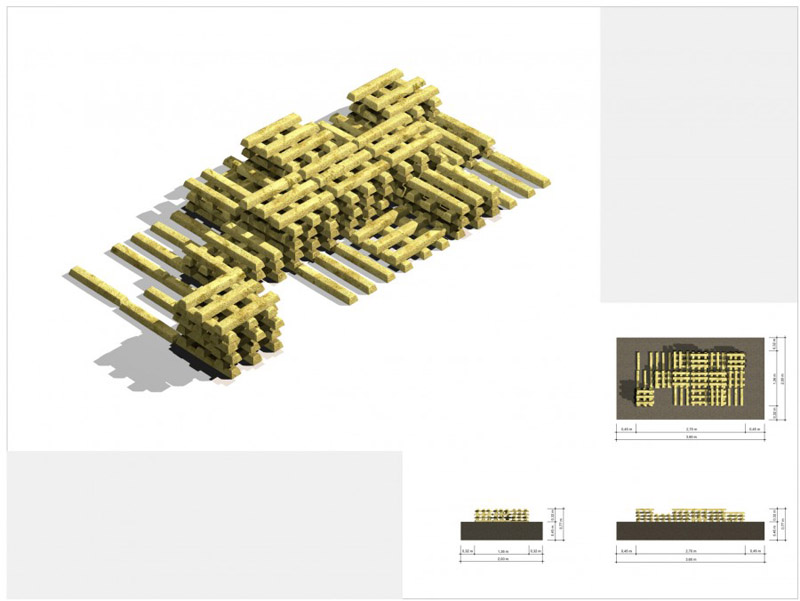
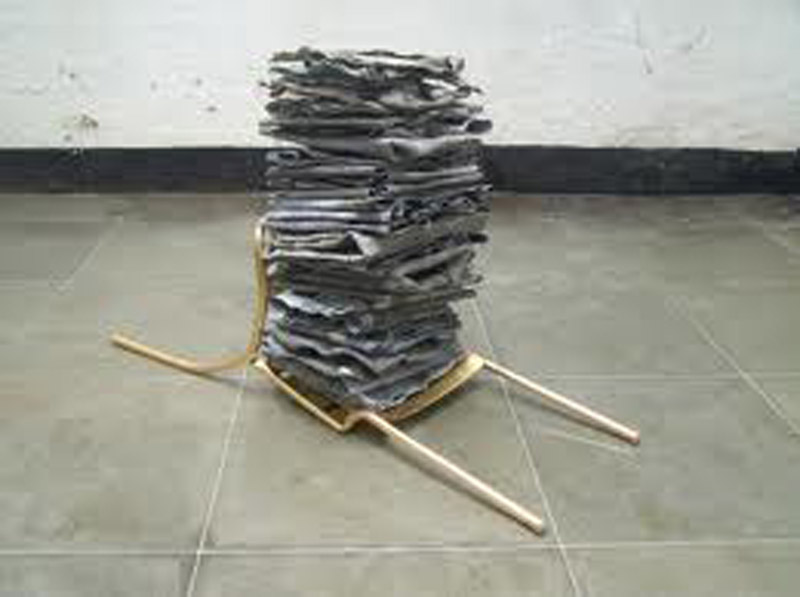
    The process of paring away visual association can only go so far before the stimulus is too weak for memory to pick up. For the past hundred years avant-garde art has been on a forced march of progress, casting off aesthetic baggage as it went. First modernism stripped art down to formal beauty, then post-modernism decided that beauty exceeded the baggage allowance and dumped it, along with skill, by the side of the road, replacing it with found objects picked up en route. Last to go, ironically, was monetary value, now the principal support for the whole flimsy structure. The situation has been succinctly summed up by German artist Fritz Balthaus in his sculpture Pure Moore, a stack of 221 bronze bars representing the 2.1-tonne Reclining Figure stolen for scrap from outside the Henry Moore Foundation in 2005. Appropriately, it is now installed outside the German federal criminal police office in Berlin.

    The traditionalist lament for loss of skill is a distraction. The modernists were right about that: skill on its own is not enough. The first step on the road to recovery is to reinstate the visual as the sole and proper domain of art. Once it is generally agreed that art’s impact is essentially visual, the skills to make it so will resurface. The general public has never stopped responding to the visual, hence its perplexity in front of much contemporary art. All that’s needed now is the insistence that, to qualify for funding, visual art has to be overwhelmingly visual – as opposed to just visible – and our problems will vanish. So let’s drop the ‘fine’ and accentuate the ‘visual’. ‘Fine’ is a value judgment that has to be earned; ‘visual’ is a simple and crucial criterion by which to judge whether a piece of art is good or bad. Enforce it, and we may find our misnamed museums restocked with things that are worth looking at.

    The Jackdaw Sept-Oct 2011

  • Misplaced trust: tripping along with the teddy bears’ picnic, Laura Gascoigne looks at the obvious mismatch of the National Trust and contemporary art

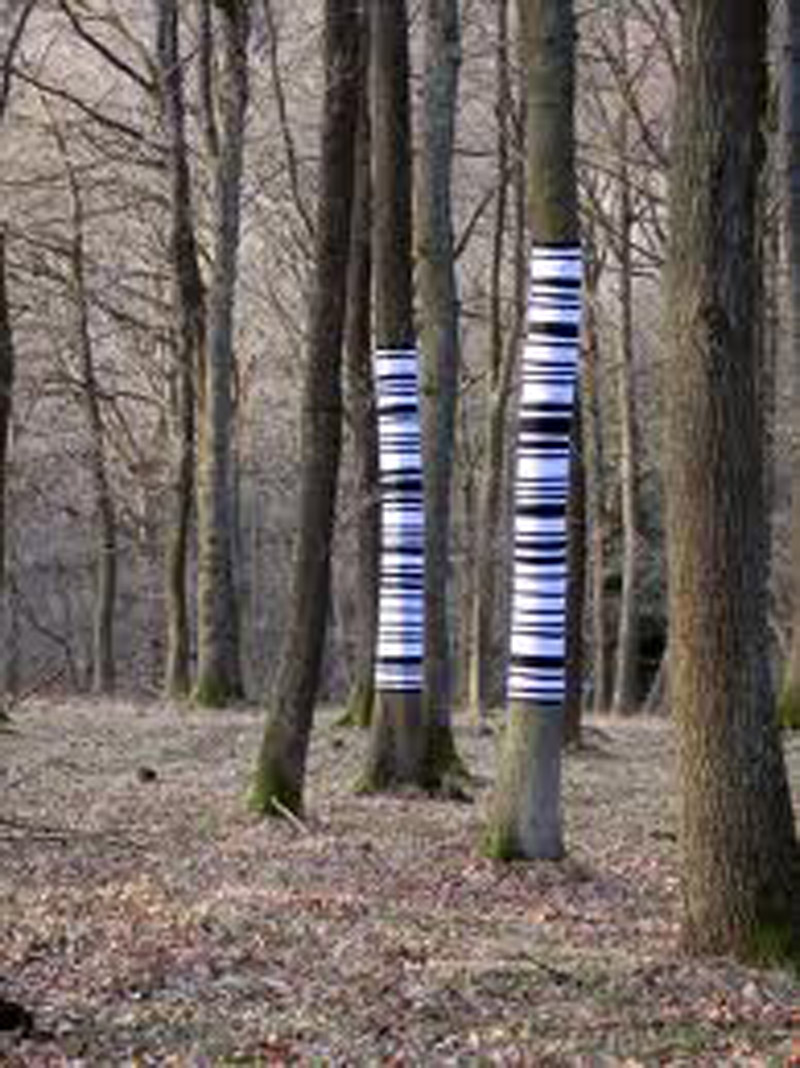
    Philippa Lawrence, Barcode: FB184

    If you go down to the woods today, you’re sure of a big surprise. That’s if the woods are Mortimer Forest in Herefordshire, and the surprise hasn’t by now been deliberately spoiled by tree-hugging vigilante forest rangers.

    Last spring, RCA graduate Philippa Lawrence took it into her pretty little head to barcode the trunks of selected young oaks in this ancient woodland at a spot called High Vinnalls, conveniently close to the Forestry Commission Car Park. The trees are due to be felled to make hardwood dowelling, a product for which the builders’ merchant barcode is FB184.

    Barcode: FB184, organized by Meadow Arts and funded by ACE, is a site-responsive piece (responsive, mind, not merely specific) whose purpose, sayMeadowArts, is to draw “the viewer’s attention to how the individuality of each tree contrasts sharply with the uniformity of the commodity that it becomes”. You may question whether, four centuries after the invention of the sawmill, we need our attention drawn to this fact, but the artist thinks we do. “Hereford is known for its special relationship to trees,” she says – and special relationships, as we know,  need work. She hopes hers may help us “reconsider our relationship to these places and the centrality of wood in all of our lives” – and, quite possibly, in some of our skulls.

    Lawrence’s own relationship with trees, she confides on her website, “is one built on a close and easy physical proximity”. In childhood “local trees accepted my slight young limbs and that [sic] of my friends as we scaled and climbed, testing our dexterity, flushed with delight at our exertions and in being abroad ‘in another place’ within the arms of the tree.” (Steady on, my dear, you’ll get the paedos excited.) Well, I spent much of my childhood up a tree and when the image of her barcoded trunks dropped into my mailbox it made me want to reach for the bow and arrow I used to take up there, dip the arrow tip in curare and lie in wait for Lawrence to waft along, flushed with delight, to install her next site-responsive project.

    Unfortunately, the way things are going, I’ll need a quiverful. Since ACE teamed up last year with the National Trust on a new three-year partnerhip, Trust NewArt, site-responsive blights on the landscape have been spreading. The Trust now boasts a fresh young ContemporaryArts Programme Manager called Tom Freshwater who, with advice from experts including seasoned site-responders Ackroyd & Harvey and Richard Wentworth, is under instruction “to encourage new ways of looking at the work and the world”. Sounds harmless enough as far as it goes, but there’s more. The aim of Trust New Art, the launch announcement informed us, is “to build links between the National Trust and the contemporary arts and crafts sector” and “to make contemporary arts and crafts an integral part of the National Trust’s daily offer to visitors” [my italics]. This sort of management-speak speaks of one thing and one thing only: money. It’s the same old story of mismatched partners climbing into bed together for mutual warmth in a cold economic climate.

    The National Trust has a circulation problem. While more and more visitors swarm freely over its 600,000-acre rural estate the size of Derbyshire, fewer and fewer want to pay an entrance fee to circulate around its historic houses which consequently, like gangrenous limbs,  are in danger of dropping off. Without increased footfall through its miles of stuffy corridors, it cannot meet the expense of keeping up its buildings. But who of the post-end-of-history generation wants to pay good money on a sunny afternoon to traipse around an airless house with the blinds half-drawn admiring the faded possessions of long dead toffs? They’d rather have a tour of Beckingham Palace. While the Trust’s energetic Chairman Simon Jenkins has managed to breathe some warmth into his hypothermic patient by such simple traditional expedients as lighting fires in grates, his organisation has been looking enviously at the inflated attendance figures of contemporary art galleries and, being of a trusting disposition, believing them. The trouble is, the two constituencies are poles apart. The blue-rinsed rump of NT membership wouldn’t Trust New Art further than they could throw it, which at their advanced average age is not very far.

    Trust properties that have so far signed up to the new art deal include Waddesdon Manor in Buckinghamshire, Tatton Park in Cheshire, Croft Castle in Herefordshire, and Calke Abbey and Kedleston Hall, both in Derbyshire. Waddesdon had already converted its Coach House into a contemporary art space, opened in 2009 somewhat inauspiciously with an exhibition of Angus Fairhurst, a contemporary artist who chose to end it all by hanging himself in a wood. But Waddesdon is au fait with art and not in danger of doing anything silly, unlike Calke Abbey, winner of our 2010 Trust New Art Bumpkin Prize for a summer programme of supreme artbollocks titled Profusion – devised for it by Beacon Art Projects – that made no concessions to the rural location,  and no sense. Among its advertised attractions were a Doug Fishbone performance in the Deer Shelter of “a stream-of-consciousness mode lecture incorporating images found on the internet into unlikely scenarios, propositions and diatribes”; a Jimmy Durham video in the Ice House showing the artist “smashing his students’ works, reminding us of the origin and end of all things” – as if we were short of reminders of this in the countryside – and a display of Roger Hiorns’s “intention to dust areas of the smithy with powdered antidepressant, triggering different contradictory avenues of association between the setting and his intervention”. Mercifully Health & Safety intervened to nip his intention in the bud at the display stage.

    Visitors to contemporary art museums go to look at contemporary art; visitors to National Trust properties go to look at flowers and trees in the gardens and cake display cabinets in the tearooms. Thankfully, the heritage-visiting public seems already to be taking things into its own hands. The fightback started in a small way last September in the grounds of English Heritage’s Belsay Hall in Northumberland, where nine Lilliputian hostages were seized from a mini-installation by street artist Slinkachu forming part of the exhibition Extraordinary Measures. A single escapee was later recovered from the weeds by a gardener, but the others are still missing, despite an amnesty. (Jackdaws were, unsurprisingly, on the list of suspects.)

    There is a limit, beyond installing wheelchair ramps and disabled toilets, to how accessible you can make a historic house to a public increasingly uninterested in history. But wait! What’s this? An announcement from the ICA, that body cryogenically frozen in the 1950s and recently chilled to a deeper permafrost by Arts Council cuts.  During the run of its summer exhibition Sketches for Regency Living,  an architectural-cum-choreographic intervention by the fabulously named Pablo Bronstein, gallery guides will be offering daily ‘National Trust-style tours’ of Nash House, with dance performances on the hour and evening talks from historians, architects and antique specialists.  What goes around comes around, in a sexier costume. Time, perhaps, for a revivified National Trust to issue its volunteer room guides with oak leaf-monogrammed tights.

    The Jackdaw Jul-Aug 2011

  • Misappliance of Science: The marriage of art and science is one only of financial convenience, argues Laura Gascoigne

    Royal Society: Beyond Ourselves

    In economically choppy waters, artists without lifejackets can be forgiven for clinging to any passing spar. So when a life raft floats past flying a flag marked ‘EDUCATION’, it’s understandable that they should haul themselves aboard. But the flag is misleading. The raft isn’t headed for the familiar port of art school, where people used to receive an art education. Its course has been reset for the art gallery, where people are educated through art rather than in it.

    Art schools may have fallen off the funding map, but gallery education is riding the storm. Engage has emerged from the Arts Council cuts with a 50% increase in funding, while the Whitechapel and South London Gallery have had their ACE grants boosted – SLG’s by 107% – in recognition of their ‘community engagement’. Sheffield Galleries, meanwhile, have had the bung pulled on them for being, well, simply galleries. In the new rankings they count as ‘agencies with more of a support function’, as opposed to ‘art producing agencies’ like the speciously named Middlesbrough Institute of Modern Art, which has earned a whopping raise of 143.8% as an ‘international-quality visual arts destination’.

    For those of you who happen to be wondering how many visitors it takes to make a destination, I consulted a philosopher of language and he answered one – and intending to visit is enough. But let’s leave that aside and take an instructive look at what this art-producing agency has been producing, in case there are any lessons in it for Sheffield. A recent commission that presumably influenced the Arts Council’s decision was Bonnie Camplin’s autumn exhibition Railway Mania. Camplin, by the way, is one of those ‘internationally acclaimed artists’ whose hitherto unknown existence raises further philosophical questions about how many foreign admirers it takes to generate international acclaim and whether one hand clapping somewhere abroad will do. But let’s not get picky. From the educational point of view, she had two things going for her. 1) She was visiting Professor at Hochschule für Bildende Künste, Städelschule, Frankfurt am Main. 2) She was engaged in an “ongoing investigation into the deeper meaning of science, technology and rational thought”.

    Based on ‘a hoard of research’ into the industrial revolution and the birth of the railways carried out over three years, Camplin’s exhibition opened with a room-sized diorama lined in galvanised steel with ‘two ominous heaps of the combustible black sedimentary rock’ otherwise known as… Come on, science class! You at the back! Yes Stephenson, well done – coal. But the educational value didn’t stop there. The heaps were topped by two giant female heads called Irene Iree and Feral Cheryl, while a later room featured depictions of ‘femme fashion figures in a variety of…uniforms representative of their various roles in industry’. Frau Professor Doctor has a parallel interest ‘in the entangled narratives of feminism’s movements’. On a lighter note, she ended with a film projection for which visitors could choose soundtracks from such popular favourites as ‘Trains in the Hills’, ‘The Power of Steam’ and  ‘The Great Western’.

    Sheffield Museums missed a trick. There they were, sitting on the Ruskin Collection, and they failed to play the science hand. In the ACE funding stakes, they deserved to lose. As you can see from the above example, the education game requires no specialist knowledge. No former experience in the appliance of science is needed, though an MSc in the science of applications helps. If necessary, willing partners can be found in the scientific community to lend a sheen of academic credibility.

    In times of hardship communities need to help each other, and artists and scientists are now pulling together. For artists, an association with science opens up new streams of funding; for scientists, a partnership with art generates publicity and gives off sex pheromones to attract corporate sponsors. This could explain the mystery of why distinguished scientists at the top of their professions should be bending over backwards to let artist ignoramuses look for deeper meanings in their work.

    The Royal Society, no less, is currently hosting Beyond Ourselves – In the spirit of scientific enquiry, an Arts Council-funded exhibition featuring six contemporary artists ‘working within the realms of reflexion, hypothesis, philosophy and sensation and searching for new ways of expressing their compulsion to describe that which we do not yet know’ – a privilege of compilers of dodgy dossiers not normally accorded to scientists. Promised highlights include ‘a Starbucks coffee cup holder with scientist’s notation depicting Feynman diagram for an electron positron interaction’ by Geraldine Cox, an artist-in-residence at Imperial College ‘whose practice involves spending many hours with scientists listening to and developing a fuller understanding of the nature of their work’. Also on show is a series of sculptures by Chris Dunreath extending ‘his investigations into the deep realms of relativity and quantum physics’, using a choice of materials – in this case paper pulp – that ‘prompts us to remember that earthly things have their roots deep in the history of our universe’. Amazing really, I might have forgotten that without a reminder from a funny-shaped egg box.

    Eventually some sharp-sighted curator was bound to spot an opening for a commissioning organisation to mine this potentially rich scientific seam. In 2009 Alice Sharp set up Invisible Dust with the marvellously named Professor Peter Brimblecombe – who sounds like an escapee from Hogwarts but is actually Professor of Atmospheric Chemistry at the University of East Anglia – and already she has five other scientists on her books. They include hydrologist Dr Kevin Hiscock, who recently put his Environmental Sedimentary Fluid Dynamics Laboratory at the disposal of UEA resident artist Liz Ballard. Their collaboration bore fruit at Cambridge Science Festival in March in a site-specific artwork at Jesus Green Lido which pumped a continuous jet of water into the air, alerting viewers to the dangers of pollution by activating ‘movement and interaction between water and sediment’ and disturbing ‘the usual topography of the pool’. Meanwhile fellow Invisible Dusters HeHe took inspiration from the lido’s ‘Deep Water’ sign to recreate the Deepwater Horizon oil disaster in miniature (without environmental impact on the pool). HeHe, incidentally, stands for Helen Evans and Heiko Hansen, a Parisian duo ‘renowned internationally for their architectural interventions that play with scale’. Which poses a final philosophical conundrum: if the currency were to devalue as fast as the price of international renown, would there be any money to pay international artists?

    More Invisible Dust will be kicked up in May at the Norfolk and Norwich Festival, where with support from the Wellcome Trust HeHe, Ballard and other Invisible Dust mites will be art-educating the inhabitants of the UK’s greenest city about pollution – HeHe via a fleet of vapour-trailing model aeroplanes and Ballard by melting luminous green dye in the River Wensum. (Interesting that one form of invisible dust recently dominating the news has yet to receive artistic attention, perhaps because funding has not been forthcoming.)

    You Wensum, you lose some. Art and science partnerships would be harmless enough if they didn’t foster the pernicious notion that art needs added educational value to be worth funding. That way lies danger. Science doesn’t need art to find deeper meanings, nor does art need science. It’s a marriage of economic convenience that cheapens both.

    The Jackdaw May-Jun 2011

  • Eh up Arup! Laura Gascoigne looks into the real brains behind the public sculptures we don’t need

    Plensa: The Dream

    Two beavers are standing looking at the Hoover Dam and one says to the other, “I didn’t build it, but it was my design”. Cue laughter. Now picture the same gag line under a cartoon of two artists looking at an enormous public sculpture. The gag still works, but the laughter’s forced. Because while a beaver has an innate grasp of the fundamentals of dam building, your average contemporary artist doodling a landmark sculpture on the back of an envelope could fit his knowledge of structural engineering on the other side.

    This might bother a beaver, but we’re not fussed. In a world of ever narrowing specialisations, we habitually depend on the skills of others. Renaissance artists working in the public sphere were expected to master the principles of construction: Michelangelo and Raphael were architects, Leonardo was an engineer. But in this age of alpha males rather than Renaissance men, our public artists only seem able to function with specialist support from Ove Arup.

    For a decade, the global firm of structural engineers which cut its teeth on the Sydney Opera House has kindly put itself at the disposal of contemporary sculptors in distress. A regional development agency, say, has commissioned a landmark sculpture you have absolutely no idea how to construct: simply summon the Arup genie from the bottle and all your structural worries will disappear. With added Arup, you can aim higher and think bigger. The firm can turn any 3-D dream into reality, and if you split the money with them you can take all the credit. They won’t mind, it’s just a job to them. When it’s over they’ll go back to doing something useful with their time, like building bridges.

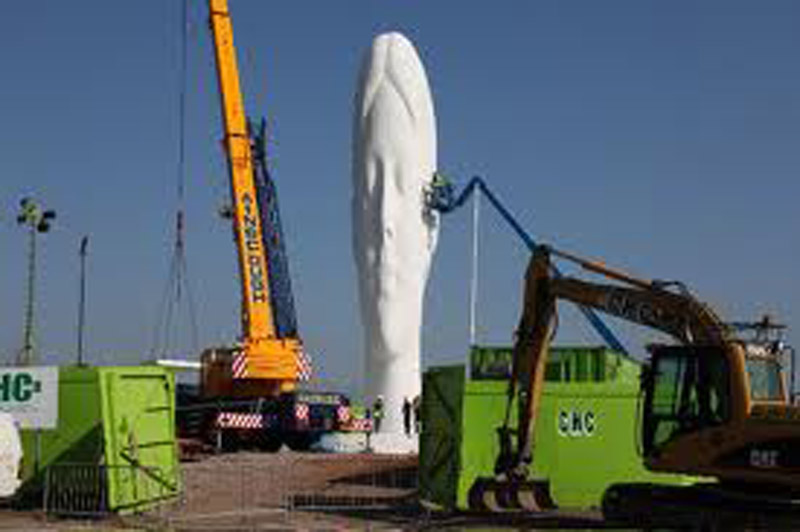
    Search the small print of the biggest public art commissions of the past decade, and the magic name of Arup will appear. If it’s a massive sculpture lifting the profile of a blighted skyline, Arup will be behind it holding it up. Conveniently, the firm seems to have an office in every northern town. When St Helens Council commissioned Jaume Plensa’s The Dream – the 20m concrete head now sprouting like a giant mushroom on the site of the former Sutton Manor Colliery – Arup’s Liverpool office made the dream come true.

    Their assistance goes beyond structural design. According to the Arup website, they also took charge of the “planning, tendering and commissioning processes”, plus the “specialist ecology, lighting engineering and 3-D imagery, all required for the planning application submission”. Don’t stare in despair at your landmark doodle; just hand Arup the envelope and they’ll work out the “complex geometries” and come up with a professional “assessment of overall stability and  ‘buildability’.” Arup is the Jim’ll Fix It of the landmark sculpture business, a one-stop-shop for local enterprise partnerships wishing to lay the ghosts of the industrial past by commissioning monstrous beacons of false hope for the future.

    It was Arup that calculated the wind-resistance of the Angel of the North’s 54m wingspan and stopped the 20m Gormley falling on its face, winning such gratitude from the artist that he has retained their services ever since. Arup’s Advanced Geometry Unit was the eminence grise behind Gormley’s Quantum Cloud at Greenwich and the brains behind the collapse mechanism built into his latest batch of iron men in the Waters of Leith, designed to make them go down like ninepins in the event of flooding (a sight I’d pay good money to see). If Thomas ‘Spillikins’ Heatherwick had had the humility to call on their superior expertise The B of the Bang might not have blown up in his face, but he was foolish enough to imagine he could go it alone. Anish Kapoor has no such illusions. It was Arup that stopped his Marsyas idea from going down like a PVC balloon in 2002. “If the calculations had been 1% out,” their engineer admitted, “it would have been sitting on the ground” – along, presumably, with the artist’s career.

    After that, Kapoor was Arup’s for life. He hasn’t put pen to back of envelope since without the firm’s deputy chairman and AGU founder Cecil Balmond in attendance to do the workings out in the margin. They share an interest, apparently, in “interrogating form”. It was Balmond who ensured that Kapoor’s Temenos, the £2.7m 120m windsock launched in Middlesbrough last year, didn’t take off, and it is Balmond who will guarantee that the Arcelor-Mittal Orbit stays up for the duration of the 2012 Olympics. Now a celebrity in his own right, Balmond left Arup last October to found his own company and devote more of his time to art. It can’t be long before the engineers remove the artists from the equation altogether. But they’ll have to do better than the July 7th Memorial, a soulless experiment in art-free design by architects Carmody Groarke and, yes, engineers Arup that surely ranks as the world’s least memorable monument, while serving as a stark reminder of why monuments need sculptors.

    The question is, do monuments need engineers? The answer is, only when they are unjustifiably big. There are good reasons for making enormous dams, but there are almost never good reasons for making enormous sculptures. In fact, the reasons are almost invariably bad: jingoistic, militaristic, imperialistic, narcissistic or just plain hubristic. Temenos was to be the first of a £15m series of five giant Kapoors destined to ‘rejuvenate’ the Durham towns, with four more planned for Stockton, Hartlepool, Darlington and Redcar & Cleveland. Together, boasted the scheme’s publicity, the ‘Tees Valley Giants’ would “form the most significant public art project anywhere in the world”. With even greater hubris, the director of Middlesbrough Institute of Modern Art Kate Brinsley proclaimed that Temenos would “call on the traditional twin skills of the region: precision engineering and heavy industry”. She neglected to say how many workers with those skills it would take off the dole queue in what has just been named the most economically vulnerable city in Britain. Now the North East’s regional development agency is being abolished and Tees Valley Unlimited, the local enterprise partnership behind the scheme, has had its budget slashed and lost its tourism arm. It looks as if four of the giants may never awaken, and cultural tour operators will have to strike Teesside off their itineraries.

    Interrogating form is a game best played on a small scale, a scale at which the sculptor can work unaided. The RA exhibition Modern British Sculpture includes a 1937 piece by Naum Gabo titled Spheric Theme: Transparent Variation, a twisted double parabola of striated celluloid that speaks of flight more eloquently than the Angel of the North and, at its full eight inches, is more imposing. Unlike Hepworth, whose Single Form (Memorial) was scaled up to a monumental 21ft outside the United Nations Building, Gabo never hit the public sculpture jackpot (although ironically, with his engineering background, he would have had no trouble making monuments stand up). And so his sculptures remain as pure experiments in form, material and light on which no weight of meaning has to rest. They don’t have to trumpet anything, rejuvenate anything, apologise for anything. Their thinking was done in the materials of which they are made, with the result that they are entirely self-supporting.

    The Jackdaw Mar-Apr 2011