Category: Comment

  • Moping Owl: Dropping a brick

    Moping Owl: Dropping a brick

    … from yonder ivy-mantled tow’r The moping owl does to the moon complain Of such as, wandering near her secret bower, Molest her ancient solitary reign.

    DROPPING A BRICK

    My old friend, Sir Jack Daw, Bart, the last in a very long line of distinguished Daws – the first Sir Jack was Barted by one of King Charles’s spaniels some time after the Restoration, and very painful it was – looked in the other day for a drop of mulled elderberry and a peck at a spot of ripe vole I had hanging in the pantry, and among the gossip he’d picked up was a bit of news from Farmer Nick’s on Bankside. It seems they’re in a bit of a state in the state farmyard these days on account of a certain brickmaker (yes – a brickmaker) going bust far across the sea in America. So what, you might say, and so might I. Ahaa, but this is not just any old brickmaker, you understand, but a firebrickmaker no less, and the only one of his kind, so we’re told. Does that drop a brick, or ring a bell?

    Well, children, cast your minds back a little. Do you remember old Mr Andre and his famous Bricks, his ‘Firebricks’? Oh good: you do: for the trouble is that Farmer Nick has a rare and important pile of these very bricks in the back of the barn somewhere, which were bought when Farmer Norman, a crusty old Scotchman, you may remember, was running the place. And the worry now is that there will be nowhere to go to for spares, ever again, ever.

    It is quite a story, so if you are sitting comfortably, I’ll begin. Once upon a time, when the world was young and all, Mr Andre, who called himself a sculptor, scratched his beard one morning, and scratched it again, and then had a bright idea. He thought he’d make some sculptures for a change, and some very low and level ones at that, as he thought it was most important that they should be low and, most important, level. He’d been out in his boat on the local lake and was rather taken by the way the water was, sort of, level.

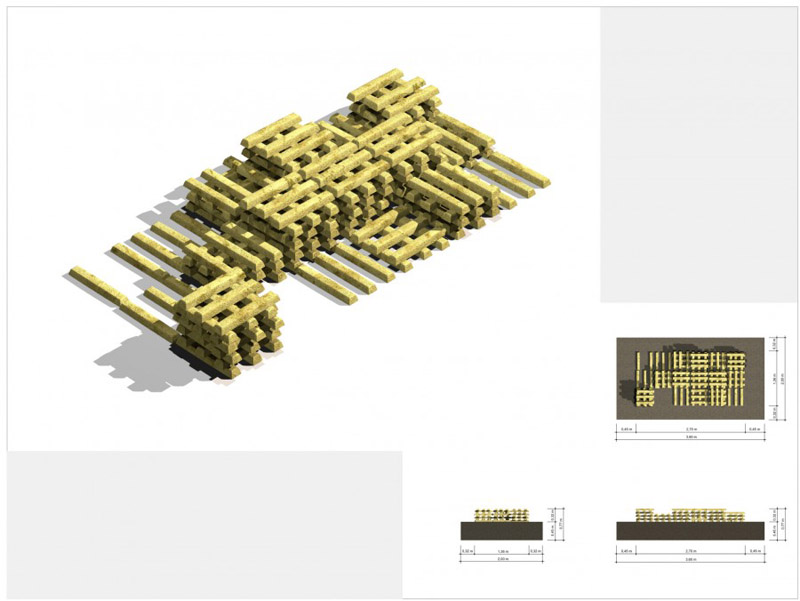
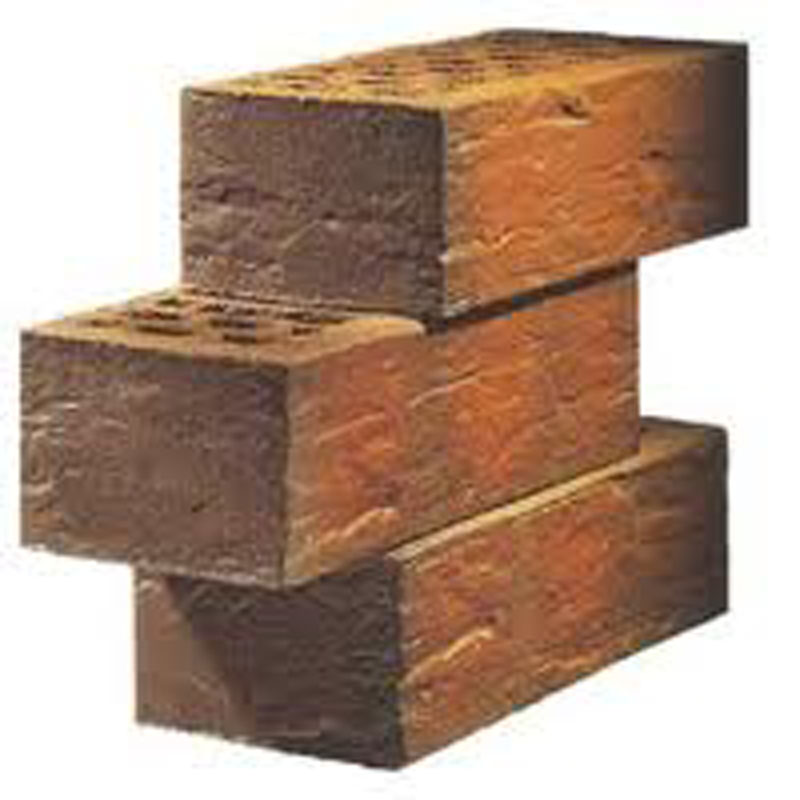
    So he went round to his local brickworks and ordered a load of ordinary bricks, which he divided into sets of 120, and laid them out on the floor of kind Mr de Nagy’s gallery in New York in 8 different rectilinear, two-layered arrangements. And, would you believe it, he didn’t sell one of them, so he took the bricks back to Long Island City Brickworks Inc., and got his money back.

    Anyway, some years later Mr Andre decided to have another go with these low and level bricks of his, so back he went for some more, only to find his friendly neighbourhood brickworks had by now closed down, so he had to get them somewhere else. But this time he couldn’t get any of the bluish-white sand-lime bricks he’d used before (sorry squire: no demand), but only yellowy-brown firebricks instead. But never mind, he said to himself, they’ll do just as well. And this time he sold the lot, and one of them moreover, number 8 in fact, to Farmer Norman. Only they didn’t arrive in a crate as he might have expected, but came through the letterbox in the form of an envelope (no: don’t laugh) containing a receipt and the instructions telling him how to figure his particular configuration out. It is after all the idea, or the concept as we say these days, that counts.

    So dear old Scotch Norman had to slope off to Travis Perkins, or whoever it was down the road, and buy the bricks himself, which he did, and proudly set them out on the floor of the gallery as instructed, to universal uproar and acclaim. But when the time came for his ‘Equivalent VIII’ to be taken down, what was Farmer Norman to do? He certainly didn’t do what Mr Andre had done, and even a sensible person like you would do – ie. take the bricks back to Mr Perkins for a refund and tuck the diagram back in its envelope in the drawer. No: the bricks were taken up carefully one by one, scrupulously registered so as to be put back in exactly the same way next time, and then tucked away each in its own foam­-lined box and shoved back in the cupboard. Where, when not on view, they rest to this day, totting up the storage.

    So much for the concept in conceptual art.

    JUST SINKING

    I don’t know about you, but whenever I hear of yet another ‘artist-in-residence’ taking up residence in some fondly trusting institution, my poor old heart does sink a bit – it must be near the bottom by now. I know these artist birds must roost somewhere, but don’t they have dustios of their own to go to? What’s so special anyway about having an artist mooning about the place, poking his beak into things that don’t concern him, leaving his paints all over the place, that’s if he uses them these days, and getting in the way? And now this scrap of news flutters by on the breeze from South Kensington; and, yes, there’s a bit of room left, so down it sinks again, lower still.

    “British artist, Conrad Shawcross”, we read, “will complete his residency at the Science Museum with ‘Protomodel’, a series of five small-scale artworks …” Oh dear oh dear: I must sit down for a minute. Artworks!! Good Grief, as the sainted Charlie Brown would say. I think I’ve told you about the ‘artwork’ word before, it being the sure sign and signal that Art will be the one thing nowhere to be found.

    But where was I? Oh yes: “… dispersed throughout the Mathematics Gallery.” And there this ‘Protomodel’ “opens up a playful, questioning dialogue exploring how model-making, natural processes, cultural practices and historical circumstances all play their part in mathematical thinking.” So you see what I mean. And that sound you heard was the old ticker hitting rock bottom.

    Play their part do they, these playful processes, practices and circs? Well I suppose they do, in a way, or at least they might, or then again, now you come to think about it, perhaps not. I have to say that when I was a young Owl, sitting in the front desk covered in ink and quailing under the beady eye of Mr Griffon Vulture MSc, the Maths Beak, the one-way dialogue was full of questions, certainly, most of them coming my way, but never particularly playful. Painful memories.

    “As part of his residency, young Crossbill has also developed a curatorial exhibition concept, which extends his personal investigations into the constructions of certainty and beliefs in science.” A ‘curatorial exhibition concept’ eh? That sprains the brain a bit, I must say. I rather think I shall have to sit down again, and give it a rest. Or perhaps I’ll just slip down to the National Gallery, and see how old Titian and Rembrandt got on with their personal investigations into constructions of certainty and beliefs, all those years ago.

    VISIONS OF VISIONS

    I do wonder sometimes whether I’m missing something important. I mean when I listen to music, I listen to music as it were, and when I go to the theatre, I buy a ticket and, well, go to the theatre to see the play. I sort of know where I am, and what I’m doing, if you get my drift. And I’ve always quite liked the flicks too, and the girls selling ice-cream at half­time, and a quiet smoke in the dark afterwards – those were the days. But the trouble is that I don’t think of the Hayward as being quite same thing as the Regal or the Granada, or even the Ritzy, and nor do those birds of paradise, with their funny hair and tight jeans, the film critics, who seem to spend all their working days shut up in darkened rooms in Soho or Leicester Square.

    So when I see that the fair and accomplished Little Pipit, Miss Pipilotti Rist all the way from the land of the cuckoo clock and cowbell, is soon to show her films at the Hayward Gallery, I can’t mug up on what said critical layabouts said about her offerings last time, for they have clearly never heard of her, nor would I look for help and guidance from them this time, for they couldn’t find their way to the Hayward even if you promised them the ice-cream girl herself in the interval.

    For the problem is that Miss Lottie Pipit is not just a film­maker but “one of the world’s leading contemporary artists” no less, “acclaimed for her innovative installations”, and show me a film critic who’s interested in what passes for Art these days. So what quite does Risty Poppet do? Well, “she creates (its that word again) films – playful, psychedelic, sensuous and often provocative – exploring themes and imagery of birth and death (here we go); family and love (I knew it); the body and the natural world (give me strength). By exploring size and scale, high and low technology, the natural world and the urban environment (is that all?), Poppy invites her audience to (no, please no) question ways of seeing and experiencing art (groan), and to constantly change their perspectives (groan groan).”

    It seems she will do all this by projecting images onto a chandelier made of underpants, and by hanging a television monitor in a suspended bathing suit. One film will show a woman strolling along the street smashing car windows with the stem of a flower. How lovely. And “ visitors will be able to peer down at a naked human being beseeching them from a tiny hole in the floor.” Do you know, I’ve rather changed my mind about those film critics – thorough-going sensible chaps and chapettes, every pretty finch of them.

    SOBORING THOUGHTS

    I do rather miss old Wally when he hasn’t been around for a bit, trundling into every passing bush or ditch while mugging up his GCSE Art History notes and not looking where he’s going. There’s a grim inevitability to it that is not grim at all. And it’s been so long this time I can’t help feeling something must have happened to him. But no such luck. Here he comes again, careering through the wood on his special-offer Sunday Times Mobility Trolley, still talking to himself when he should be keeping his eyes on the tree trunk ahead. What’s he on about this time? He’s certainly even more full of himself than usual, and very excited too.

    Oh I see: yes, that’s it: he’s going to be on the box, again, and this time he is going to be telling us all about his latest discovery, or perhaps it’s his latest rediscovery of a previous discovery he’d forgotten all about, and fears we’ve forgotten too. And his discovery this time is – go on: have a guess – Impressionism. Yes, Impressionism, on which he intends to expatiate (look it up) in some 23 interminable episodes, for our greater good and moral benefit. Lord Dodo? – it’s only a matter of time.

    His principal theme is what he feels to be the essential elusiveness of Impressionism – which by the way, leaving aside such trifles as Classicism and Romanticism, he tells us was “the first great –ism”. For Impressionism, so it seems to him, darts hither and thither, as it were, like a butterfly, so hard to pin down. “Whenever you chase after Impressionism”, he bleats (yes: Dodos do bleat), “it darts off somewhere else.” You see, he’s noticed what no one has ever noticed before, that “Monet was an Impressionist. But so was Degas. Monet painted out of doors. Degas painted indoors. Except when Monet painted indoors and Degas painted outdoors.” Goodness me: we must all have been looking the other way. Anyway, clearly our response to M&D & Co. needs gingering up, and he’ll do the gingering. “In some opinions,” he quacks (they also quack, you know) in his gravest Dodoese, “Impressionism has already committed the gravest sin a cultural phenomenon can commit in the modern world: it has become boring.” I say, do go easy with that ginger, Wally old thing.

    And no, Wally, I’m afraid you’ve slightly missed the point: leaving that ‘cultural phenomenon’ bit to one side for a moment, what is boring beyond tedium is yet another Dodo telling us that Impressionism isn’t what the Dodo before last told us it was, but something quite different if only we can bring ourselves to think of it another way. Forget looking at the paintings as paintings as we find them, some good, some not so good, some brilliant, and making up our own minds. Goodness me no. Far too obvious. What a waste of time and thought. Oh no, no, no.

    So on he quacks (or bleats) again. “The movement was not just about sunny river banks (and whoever said it was?), it was revolutionary (that really is boring) in more ways than one… I enjoy the achievements of Frederic Bazille, who had the original idea of forming a gang of painters who would show their work together.” Revolutionary, eh? A bit like the Royal Academy, you mean, or the RBA, or even the French Salon in its early days? “Bazille died young, and only just had time to invent outdoor figure painting …” Hmmm. Invent it, did he? One does rather think back to Giorgione, and Titian, Rubens, Rembrandt, Lely, Watteau, Fragonard, even Etty, but we mustn’t quibble. But the idea of flesh amongst the foliage was always there, at least, and do we really believe that until Bazille no artist ever took his latest bit of inspiration out into the nearest wood or field for a spot of nature study?

    “Impressionism was a revolution, not an art movement. Its ambition was to overthrow things, to replace them.” Oh no it wasn’t. Nor was it any active ‘cultural phenomenon’, whatever that might be, committing sin. If it is anything at all, the cultural phenomenon in question, Wally dear, is you. As you yourself have so perceptively quacked, all the artists concerned were doing different things, whether indoors or out. And all that they were trying to do, in their very different ways, was to paint a picture, and to paint it well, and, in their own terms, to get it right. And sometimes they succeeded, wonderfully well, and made a good few bob into the bargain. That is all we need to know. And all we need to do is to look at those pictures for ourselves.

    And Wally do look out: no, the other way. Oh dear, he’s hit that tree again, full on. Good job he was in reverse. I hope he’s all right. They also squawk, do you know, Dodos, when agitated or alarmed. That was quite a squawk, I must say. I shall drop a note about it to that nice blonde bird with long legs on Autumn Watch.

    The Jackdaw Sept-Oct 2011

  • Moping Owl: On yer trike

    Moping Owl: On yer trike

    … from yonder ivy-mantled tow’r The moping owl does to the moon complain Of such as, wandering near her secret bower, Molest her ancient solitary reign.

    ON YER TRIKE

    What joy it is to learn that the lucky folke of Folkestone have been given another Trike at last. Was it really three years ago since their last one was ridden over a cliff? Goodness how time flies. I expect their only regret is that the wait wasn’t a bit longer. So what’s on the menu this time? It’s been put together again by Andrea Schlieker, that Silvery Swan who not so long ago graced the Serpentine, but is now away with our chums the Gulls and Oyster Catchers. And what she promises is “one of the most ambitious public art projects ever to be presented in the UK”, and we all know what that means.

    This time she has invited 19 international artists whom we’ve never heard of (well just one or two ring a faint bell) “to develop new works (groan) for Folkestone’s streets, squares, beaches and historic buildings (groan groan) to create a cutting-edge (groan groan groan) contemporary (do stop: I’m not feeling very well) art exhibition in the public domain.” Well, there you have it, and don’t say you weren’t told.

    Don’t worry: I won’t go through the whole lot, but, if you can bear it, here are just a few of the treats in store. Someone called Tonico Lemos Auad (there, I told you so) is bringing along some figureheads “more usually found on riverboats in northeast Brazil”, and rather less usually, as one might say, scattered around Folkestone harbour. Tonic&Lemon is also showing “a silver ink covered wallpaper installation (installed on a wall no doubt) that acts as a giant scratch card. Visitors can draw their own messages (Oh I do hope they will) and reveal images of processions  (processions?!!) in Brazil and Folkestone (in Folkestone? Processions?)” I think I’d better have that G&Tonico after all, a large one.

    Charles Avery will create a 20 foot long sea monster … a hybrid of horse, snake, fish and wallaby – yes, a wallaby. The huge creature will rest on the floor of a large room in Folkestone library.” The rest of us will rest on that nice sofa downstairs by the paper rack. But then there’s CAMP, and we can’t miss that. This Mumbai-based collective, no less, “has collaborated with the National Coastwatch over the year, inviting the volunteers to keep their eyes on the coast to collect data, contributing to CAMP’s research into the shipping trade, tourism and fishing for their D.Phil at Dogger Bank University.  This information will form the basis of, yes, you’ve guessed it, a film script, which will be acted out by those skinned-eyed volunteers.” Can’t wait.

    Turner Prize-winning Martin Creed will create a something or other, which says it all, and quite enough. Hala Elkoussy “will create a ‘reading room’ filled with historical documents, photographs, maps, music as well as a specially made film (what else), all relating to Egypt’s colonial past (which was rather a long time ago, I must say) and highlighting the complex urban, political and historical entity that is Cairo.” How very kind of her to point all that out. I expect there’s a D.Phil in that too, from Goldsmith’s probably.

    Cornelia Parker, for it is she, “will create (fancy that) a Folkestone version of Copenhagen’s ‘Little Mermaid’ by creating  (the c word again) a bronze life cast of lovely local resident Georgina Baker (34.22.36).” And the bells, the bells: A K Dolven “will suspend (or hang) a 16th century tenor bell from two steel beams right on the edge of the sea. The bell can be rung by visitors using a rope (whatever next?), allowing it to contrast or interact (ie. clash) with the eight bell carillon of the nearby Parish Church.”

    Oh yes, and there is the Spencer Finch, who has been doing much valuable research observing “the ever-changing tone and colour of the English Channel over a number of weeks (looks like rain again), and so creating a palette of colours that have been used to dye a hundred flags and create a special colour wheel. Each day an observer will choose a colour (greeny blue) which most closely reflects the colour of the sea (bluey green), and then hoist a flag at midday in the centre of the town (silvery grey), before sloping off to the Fox & Whippet for a bacon sandwich and a pint of beer.” The Folkestone trike is ridden by something called The Creative Foundation, and, among other funders, receives financial support from the Arts Council.

    Oh I do like to be beside the seaside.

    VOCABULARY:

    create; develop cutting-edge historical documents; interact; create; colonial; create collective riverboats; complex urban; reflects;  colour wheel; highlighting; gin&tonic; relate; create.

    BARGAIN TIME

    I think I may have mentioned the Booby already, that innocent and friendly bird of the South Seas, whose trusting habit it was to land on any ship passing through those remote waters, only to be greeted by a sharp knock on the head and a quick plucking. The sailors, in short, saw it coming. Now the funny thing is that only the other day, out for an evening pass over Trafalgar Square and resting the old wings for a while on the roof of the National Portrait Gallery, I chanced to overhear Booby-in-Chief, dear old Sandy Nandy, being interviewed by an eager young chickabiddy whose name I didn’t quite catch, about its acquisition policy. And what he was going on about at quite some length was how pleased with himself he was to have acquired for the Collection a cast of that now not so Young British Duck or Diver, Marc Quinn’s Bloody Frozen Head, and at the knockdown, special-offer, don’t-miss-it price, mark you, of £300,000. Well done, I hear you gasp: quite a snip.

    Well yes, up to a point I suppose you might think it is, and anyone’s life’s blood is of course beyond price. But what is it quite that’s been bought on our behalf at such a price, other than a bucketful of body fluid, a refrigerated cabinet from Peter Jones (which don’t come cheap, I know), and a strict warning not to pull the plug out? For the thing to bear in mind is that this is not a self-portrait, or indeed a work of art at all in any meaningful sense of being modelled from a lump of clay in front of the mirror. It is, rather, a mere common-or-garden life-cast of Quinquam’s summit, and as such a thing for the curiosity cupboard, but nothing more.

    For it is made by a purely mechanical process, the principles of which can be mastered in half an hour: i.e. 1. Put a bit of cling-film over the hair to avoid an involuntary tonsure later on; 2. Liberally apply Vaseline to the face and other fleshy bits; 3. Generously slap on the plaster-of-Paris, having made sure all essential orifices remain open; 4. Wait a bit; 5. Call the fire brigade; 6. Pull off the hardened plaster, portion by portion, along with the odd eyelash and pimple; 8. Grease the inside of the mould and reassemble; 9. Pour in the required medium – plaster, blood, ice-cream, whatever; 10. Off comes the mould again, to be laid aside for later use. And Bob’s your Uncle, or your Aunt as the case may be in these dissolute times. There’s your cast.

    Nothing to it, as I say. The Victorians did it all the time, by which to remember the Dear Departed, or their latest baby’s feet and fingers. Blake’s death mask is somewhere, I seem to remember, and Cromwell’s somewhere else. OooM’Gormless does it to himself repeatedly, with a distant look in his eyes, but we won’t go into that. And an art master of my acquaintance once showed his Sixth Formers how to do it, who promptly turned it into a profitable if short-lived lunch hour cottage industry, at a quid a time.

    So what makes Quidsin’s life-cast head so special, other than the fact that it is cast in his own blood? It could just as well have been cast in cream cheese, or sherry trifle, which would at least have made it a shade more appetising. But it’s the thought that counts these days, I suppose, and a bloody expensive thought it is, is all I can say.

    It is not of course the original cast – we can’t have everything – nor even the second or third, but something like the 5th or 6th, I think Sandy Pandy said. He didn’t mention VAT. It seems young Quickscam does one every five years or so, so I suppose he’ll go on until the blood runs dry, and at 300,000 smackeroons a throw who can blame him. I only hope he doesn’t charge the Blood Transfusion lot quite as much. And like the sailors of old, he clearly knew a Booby when he saw one coming.

    INVOICE:

    Air-tight Glass Box – (P.Jones): £1,200

    Refrigeration unit – (Homebase): £500

    Electricity p/yr (estimate): £50

    Nurse Trixie – 5hrs @ £200 p/hr (private):  £1,000

    Materials – bucket; mop etc. (Lidl’s) £38.68

    8 pints of blood – (DIY): £297,321.32

    sum-total: £300,000.00

    VAT @ 17.5% £52,000.00

    Total: £352,000.00


    WALK ON BY

    I don’t seem to get down to the City as much as I used to, what with cranes everywhere, and those vast shiny glass walls to fly into if you’re not careful. And they’re so tall: too tall for my old wings to manage. My ancient tow’r is quite high enough at my age. Good job it’s listed, though, or it would have been pulled down long ago. I’m quite glad I didn’t after all – how shall I put it? – get rid of those rare dormice that had moved in under the floorboards, though I must say I was sorely tempted. They came in quite handy in winning the planning appeal.

    Where was I? Oh yes: the City: getting down to it not so often – and I must say that some things make me quite glad I don’t. Now you may not have heard of it, but there is, I should warn you, something called The Parasol unit foundation for contemporary art, every syllable and missing capital letter of which should put you on your guard. And what is more, this very summer, it brought to Exchange Square something called ‘Walk the Line’, a vibrant site-specific public art-work (see what I mean) that it promised would be “one of the most thrilling summer events in London.”

    Oh dear: I’m afraid I missed it. But, if you are sitting comfortably – and do keep quiet at the back, there – I’ll try to tell you just what it was I missed. It seems an American bird, a  ‘summer occasional or vagrant’ as any self-respecting twitcher would say, called Kate Gilmore, had flown in with a scheme, or project as we like to say, under one wing, and a grant application tucked under the other. She proposed the setting-up of a structure in the middle of said Square, the size of which – and do follow carefully here – was to be “in keeping with the measurements of typical office cubicles and corridors in the neighbouring modern office blocks where  (and here comes the important bit) countless  ‘perhaps’) without, poor dears, ever having noticed or reflected upon the effect their daily activities have upon their body and stamina.”

    Well yes, I suppose they don’t notice or reflect all that much, but then does anyone? I always thought the whole point of daily activities was to have some sort of an effect upon said b and s, so that we’d all then go home, put our feet up for a while with a restorative bottle of something or other, have a bite to eat, a slice of dormouse pie perhaps, and then get a good night’s sleep.

    Anyway, the lovely Gilly Moorhen clearly saw it as her chief aim in life, to make those fragrant City toilers sit up and jolly well take notice. So the scene was set for what came next, to wit (or to whoo if you like) a live performance in which, for five whole June days, “working teams of eight women in two shifts walked continuously on top of that bright red wooden structure for nine hours a day; from 8.30am to 5.30pm. Members of the public were able to walk both around the structure (goodness me) in order to experience the work visually (ie, look up at the birds above) and through the passageway beneath the platform to get a sensory experience of the women walking above (ie. tramp, tramp, plod, plod)… as they adamantly (?!) negotiate their personal space, weaving around each other.” And so the long day wore on.

    “With this art work”, we were told, “Kate Gillymot comments on the meaning of labour and life in everyday conditions, and skilfully (of course) turns a mundane phenomenon into a dramatic visual spectacle.” Hmmm: there’s not much more one can say really, though it would be mildly interesting to learn quite what those comments actually were. Much more to the point would be to hear what comments her little band of lovelies made as they trooped up and down and round and round: “oooh these heels ain’t ’arf killin’ me:  surely time for a smoke by now: I do believe that nice young man is looking up my skirt: oh I do feel dizzy: coo, what a waste of time.”

    The happy news is that this dramatically mundane phenomenon was ‘generously funded’ by The Arts Council. My own comment is, perhaps, best left unspoken.

    The Jackdaw Jul-Aug 2011

  • Moping Owl: Hoo ra ra

    Moping Owl: Hoo ra ra

    Gormley, Salisbury Cathedral
    Gormley: Flare II, Salisbury Cathedral


    … from yonder ivy-mantled tow’r The moping owl does to the moon complain Of such as, wandering near her secret bower, Molest her ancient solitary reign.

    HOO RA RA

    If I seem to be hooting on rather too much these days about that Zoo down in Piccadilly, I do apologise, but you know how it is when you get to my age, and it don’t get any better. First there’s Dicky Stork, stuck in his nest of twigs up on the chimney pot, still cawing away about whatever he’s told to caw away about this month – we know, Dicky: we know. Then there is that Sculpture Show that forgets about sculpture halfway through. And now this.

    Where did I put it? Oh yes: here it is. “Announcement from the Royal Academy of Arts: Perry Mason elected Royal Academician at a recent General Assembly.” Well well, or there you go, as they say these days. Now this Gerry Pacemaker creature, it seems, is quite rare, and therefore quite a catch, being some sort of Cassowary, which is a very large flightless bird, native to the tropical forests of New Guinea, north-east Australia and parts of Essex – I blame global warming. Anyway, the cassowary is a shy and solitary creature, apparently, except during the breeding season or when there’s lots of food about. And when it’s disturbed it is capable of inflicting serious injury to dogs and people with its sharp claws and powerful kick, so I’d better be careful what I say. How shall I put this, for it is quite important? Point 1: the behaviour of the cassowary is not yet well understood. 2: the female is bigger, and more brightly coloured.

    So it all fits in. Young Barry Grayson set out in life making large pots or jars, with lids of course, which he decorated, if that’s the word, with narrative cartoon-like graphic illustration, though no-one took much notice of it for quite a while. So, as any good cassowary would, and he quite a large lad too, he thought he’d make himself a bit more conspicuous, or brighter so to say, and the work too. So out of the old chest-of-drawers came the frock and ankle socks, and a bit of ribbon for his hair, and thus arrayed he began calling himself Doris – or was it Cynthia? Doesn’t really matter. And onto those same old pots or jars went images that were somewhat more ‘challenging’ and ‘interrogative’, along with crisp slogans suitable to subvert established notions of the meaning of life and all, such as ‘Frock me’, and  ‘Frock You’, and ‘Nice Ones Gloria’.

    And of course Charles Saatchi bought him up, lock and stock, for his private menagerie, since when there has been no looking back – though I have to say that while we’ve been seeing quite a lot of Cynthia on the telly lately, sorting out the world with his wit and wisdom on Question Time and Thought for the Day (must have missed that one), we haven’t seen too much of the Gerry Pots lately. Never mind: For it came to pass in these latter days, that a great clamour went out among the Academites, who dwelt in those parts, to anoint him as one of their own: And so he cast off his pots, for pots were not allowed to him in this sort amongst the Academites: And so contrariwise it was for the prints of his own handiwork that he put upon them that they sought him, if you get the drift. So he is Gerry Printmaker now. Nice one, Doris.

    FEELING FAINT

    There are times when I’m not sure I can go on. I don’t want to fall off my perch just yet, but then again, the old head’s not what it was. I can still get it round most things, even in these post-literate days, but sometimes it seems to get just in a twist too many. This, for example, has just blown by on the wind from Farmer Jobbin’s state-of-the-art milking shed and chicken coop down in Mason’s Yard. It’s left me with quite a crick. In fact the head is still spinning.

    It’s about a mixed show called ‘New Order’, which is a sort of warning in itself, so I should have known better. But here we go, building a New World, with an admiring quote from one Jacques Ranciere to set the scene. “The dream of a suitable political work of art is in fact the dream of disrupting the relationship between the visible, the sayable, and the thinkable without having to use the terms of a message as a vehicle.” All I would say to that is that Frere Jacques should have gone a bit easier on that ripe old Brie last night.

    But it gets better, which is to say worse. “The late 20th century saw an overt politicisation of critical discourse amidst collapsing colonial hegemonies, global wars and the emergence of civil rights movements across the world”. You could say that again, but please don’t. “A number of key figures (so they say) emerged on the international art scene, whose practice specifically dealt with power structures, injustice, race, gender and dissent.” So is there still hope for us all. “The works featured in ‘New Order’ share a focus (a bit tricky, that, I’d have thought) on the transformation of ideological structures that shape experience (even trickier), and in different ways they explore existing communal, political and physical constructs of the everyday. ”We get the drift: We are none the wiser: We want to go home.

    No, sorry, you can’t, not yet. Miroslaw Balka shows his ‘Kategorie’, “a 6 metre long,  2 metre high tunnel interrupted (??) by five fine coloured threads, suspended from rotating motors on the ceiling (as of course they would be). The work is rich (only to be expected) in associative historical and political references, such as the traumatic memory of wartime atrocities in his native Poland.”

    What more is there to say? But then Doris Salcedo shows “part of her ongoing series in which found domestic furniture is used as a vehicle to explore the traumatic political history of her native Columbia.” David Hammon’s practice “rooted in black urban experience, comments on the iniquities present within social, political and economic systems.” And I’m losing the will to live.

    Mark Bradford’s densely-collaged abstract paintings “reference alternative cartographies that burgeon within cities, such as the spread of an economic underclass, the movement of immigrant communities and race relations.” Julie Mehretu’s ‘Mumbo Jumbo’ (sic) “conveys the destructive power of uncontrollable nature within a stricken cityscape, mired in bureaucratic chaos.” Some people I know felt like that filling in the Census. And all the while our old friend Anselm Kiefer “revisits the iconography of his own art-history, as a means of investigating the resonance of totalitarian symbols across the passage of time.”

    I can’t help thinking they should all get out more, go for a nice long walk in the park, and, with a bit of luck, get lost. I need a drink.

    GOR BLIMEY

    Oh yes, I’m afraid so. It’s that man again, as my dear old Pa, the Rt Rev Dr R G H E Olw, DD. rtd., used to say long ago as he tuned in the old crystal set. In the event it’s the Oh M’Gooley Bird, that flies too low over bush and forest, and the occasional thorn or thistle, letting out the while its plangent cry of ‘ooomgooleyoohmgooleyoooh’, with tears in its eyes. There was some hope that it was by now on the endangered list for loss of habitat and gullible twitchers (I blame global warming), but clearly no such luck. And now, to cap it all, we have news that it is roosting safe and high in the soaring nave of Salisbury Cathedral, where even as we speak it is probably looking down to admire its reflection in the still waters of that genial old greenshank’s (ie. Bill Pipe: by appointment purveyor of water-features to the nobility and gentry), smart new font.

    A confection of stainless-steel wire, which M’Gooley calls ‘Flare II’ for some reason, is now hung from the ceiling of the South Transept, where it will stay “bathed in light celestial from the surrounding windows, providing an inspiring and illuminating experience for all who visit”, for a full 12 months. And here’s what Gor Blimey himself has to say about this latest expression of his ineffable creative and imaginative powers. But before we go on, it might be as well to have pen and paper handy, as you may need to make the odd note, just to keep up. People have been given Doctorates for less, you know, and by our Ancient Universities, steeped in time, for untangling stuff like this. “In order to express the human state of embodiment less as a thing or narrative than a state I have tried to make the space of the body open to light, to the gaze and to space at large. The act of sustained and materialized imagination of Salisbury Cathedral and the volume and transparency of the south transept is (tut tut) a wonderful context for this work.”  Deep stuff, eh? Well, stuff at least. What a treasure he is.

    ALL STEAMED UP

    Oh dear, do forgive me. I can’t help myself. Look, here comes Wally the Dodo again. Haven’t seen him for a bit: thought he might have hit the buffers once too often. No, he’s still the same, chuntering through the wood on his mobility trolley (S. Times special offer), and talking to himself. He once asked me why I keep having a go at him, and I said there there Wally old thing, I know you’re a nice chap really, but the trouble is you’re a Dodo. He blinked a bit, or at least I thought he did behind those specs. It’s all right for some, he muttered darkly, and dodoed slowly off into the ditch.

    So what’s he on about this time, with his glasses all steamed up again – watch out Wally, left hand down a bit, gosh, that was close. Talk about endangered species. Anyway, it seems he’s been at the vintage V&A again, strong stuff, and come all over, well, all over, with the Cult of Beauty. “Almost all the pictures feature beautiful women. Some are so shockingly irresistible that even your Dodo, who is usually immune to the machinations of Victorian exploiters (what a good Dodo he is), found himself twitching Swinburnishly at the lips.” The twitches, eh? Are sure it’s only the lips? Smelling salts might help.

    But on he goes regardless. “All the painters gathered here are male, and chiefly (oh that ‘chiefly’) heterosexual, so the fatal attractions they record are invariably feminine (funny that). Interestingly, none favours the proper woman, round of hip, buxom of bosom, curvaceously proportioned (I say, steady on old boy). Big hair aside, most of their Stunners are boyish and flat-chested (I’ve told him time and again to wipe those glasses of his). Something is emerging here you feel cannot be hidden.” Indeed it is, Wally, and I’d say it’s coming from your fevered imagination.

    The trouble is the poor old thing doesn’t know what he’s allowed to like. He’s always so anxious not to stray off message, and never takes his own line, ever. I blame that feminist harpy with the big tits and dungarees, down at the Community College beyond the railway sidings, where he took his O Level retakes in art-work and origami all those years ago. “Those of us who have previously had difficulty taking the aesthetic movement seriously – by which I am confident I count most people (oh yes, oh yes) – have been put off chiefly (again) by its decadence and its absurdity.”

    Hang on, Wally: I can’t for the life of me see what’s wrong with a spot of decadence, now and again, to keep the pecker up. We owls know a thing or two about decadence, I can tell you, and great-aunt Athena, who saw quite a bit of life in Greece in the good old days, and quite a goer herself by all accounts, told me things that would make your feathers quiver like quills upon the fretful pomegranate. As for absurdity, when was most of Art not absurd, and its fashionable enthusiasts most of all? Just wander down to Farmer Nick’s and take a look. I mean to say.

    But where was I? Oh yes. “The argument put forward here is that Britain in the 1860s was a ghastly place to be. Soul-destroying. Pleasure-crunching. Toxic. Capitalistic (here we go again). Socially rigid (yawn, yawn). Aestheticism is here presented as an enterprising mutiny mounted against repression. The aesthetic movement was not so much a challenge to Victorian values as a stamping down on them. There is something brutal about this showy nay-saying, something fierce.” Dearie me. As always, when in doubt, and just to make sure you’re on the right side of the orthodox view of things, the safest thing is to put the boot into the Victorians.

    As I say, Wally has very odd ideas. Now he’s got himself into quite a state over that interesting painter, Albert Moore, whom he doesn’t like to admit he likes, “who painted pretend Roman girls in diaphanous taffeta gowns.” Now Wally, which is it, diaphanous or taffeta? It can’t be both, you know. “The magnolia orange robes worn by the three Midsummer girls are murderously alluring.” He means the robes and the colour, you understand, not the girls: perish the thought. Can’t have that. But magnolia orange? He really should get those glasses seen to.

    Wally! Watch out Wally. No, not that way. Too late: he’s in the ditch again.

    The Jackdaw May-Jun 2011

  • Moping Owl: Eye spy

    … from yonder ivy-mantled tow’r The moping owl does to the moon complain Of such as, wandering near her secret bower, Molest her ancient solitary reign.

    EYE SPY

    Dear old Dicky Stork is still cawing away, if that’s what storks do, from his nest high on the chimney pots of Burlington House. I can hear him from here, and it’s even worse when the wind’s in the East. He seems to be quite a fixture there nowadays, but then if he caws what the Wildlife Managers in the Academy Zoo below want him to caw, he won’t get the chimney-sweep’s broom up the bottom for a while yet. He works as some sort of beady eye or look-out to give the ground-feeders early warning of what’s going on elsewhere. And what has just caught his eye is a foreign exotic or rare vagrant, blown in all the way from Mexico on all this Global Warming we’ve been having lately, and now come to roost at Tate Modern.

    It seems this particular bird, Gabriel’s Orozco, is so rare a sight as to make any twitcher twitch like fury, Storky included. So unpredictable is he, indeed, that no twitcher can “pin him down” – which I thought was only what one did to butterflies. I may be wrong. Even so, perhaps it’s just as well young Ostrich (one of the rare flying ones, I’m told) seems to be pretty quick on his feet, for he has always “moved restlessly around the world” and won, so Storkage tells us, an international reputation for moving restlessly around the world.

    But the main thing, in Sticky’s eyes, is that he has this wonderful gift for “employing a limitless range of found objects”. I sympathise: the world is such a big place, and just full of stuff – you should see the cellar of my old tow’r. I might ask this O’Roscoe round to take a look. Who knows, he might find just the thing. For what he does that is so special is that he ‘transforms’ these things, yes transforms them, ‘just like that’ as the Great Tom used to say, and does so, moreover, “so surprisingly that they catch us off balance.” I would have thought it more a case of looking where you’re going, Storky old thing, and laying off the Tate’s dodgy Sauvignon Blanc at the Press View.

    Now you can tell when Dicky’s really excited, for then he dips deep into the adjective bag he always keeps handy. How he loves his adjectives, and his adverbs too, come to that. Any one will do. “We are often invited to participate in the sculptural structures Orinoco displays.” Oh those structures: so sculptural, don’t you know, though quite how to participate in them I’m not altogether sure. “A bizarre (here we go) work, wittily (and again) entitled ‘Ping Pond Table’ (ho ho, my sides, my sides, oh, ha ha, do stop, please) sets two ping-pong tables, cut into four halves (I think I follow) in the form of a cross around a lily pond (now I’m lost). Although we can play with the bats and balls provided, the pond in the middle is strangely distracting.” Nothing strange about it, I’d have thought. Silly, perhaps. Cocky goes on to say that Orasbo  “delights in playing with vehicles”, just like most little boys, I suppose. He once sliced a Citroen DS into three and spliced the outside bits back together again, thus making it, transforming it I mean, into something rich and, yes, wait for it, “strangely thin and menacing.” DS, Dicky helpfully points out, “is a pun on déesse (goddess, you see: nudge nudge), so this work is a kind of double sacrifice – the cutting up of a legendary (there goes another one) car that is also a deity.”  How strange that is, Dicky. You can tell he’s flown down from Cambridge.

    “In ‘Four Bicycles’ Rockio jammed together four old Dutch bicycles in a tangled, thrusting mass.” Those Dutch bikes, I must say, are the best, especially with a bit of age on them.  Nothing like them for a bit of massive tangled thrust. “They take on an explosive dynamism  (I’ve lost count), but also appear futile – there is often a playful melancholy in his work.” I should say so: he once rolled a large playful ball of plasticine through the streets of New York, picking up, well, just imagine…. “His Tate show reveals just how much he relishes the artist’s life-affirming ability to transform everyday objects into sources of wonder.” Corky, you’ve said it all.

    HERITAGE CORNER

    It doesn’t do to brood too much, but sometimes it can’t be helped. And now a soggy scrap of paper I’d forgotten all about has fallen out of the ivy, to set me off again. It seems that wily old Farmer Nick has had a useful little purchase fund set up to the benefit of Tate Farm Holdings (Int.), to make sure that they never run out of stuff to fill their cellar shelves down by the river. This Outset/Frieze Fund can only be spent at the Village Church Bazaar & Bring & Buy Sale, held in the Park every autumn. It’s sole purpose is, groan groan, “to enable the Tate to acquire works by emerging and leading international artists”: in other words, any old charlatan, mountebank or flyby-night with a bright line in art-speak and a sharp dealer.

    So who does the spending on the Tate’s, which is to say our behalf, amounting this year to the tune of £120,000? Why: “prominent international curators, whom we’ve neverheard of, alongside Tate curators, ditto.” Whew: so that’s all right then. “We are grateful for the continuing support of the Fund, which has enabled the Farm to significantly (of course) extend its collection of work by new and emerging artists,” says Farmer Nick. “This is increasingly importantat a time when funding for new acquisitions is so limited.”

    So let’s see what he got for Christmas this time:

    1. ‘Five Day Forecast’ (1991) by Lorna Simpson, an American aged 51 – ie. 5 black & white silver gelatin prints, and 15 engraved plaques.

    2. ‘A long title in French all about native villages deep in the forests” (1993) by Jimmie Durham, another American, aged 71 – ie. A construction of cardboard, wood, bone, a Mexican (v. signif.) Coca Cola bottle, aluminium, steel, glass and text.

    3. ‘Question Mark b (Anti-Painting, Text Painting’1969) by Julius Kollar, a Slovakian who died in 2007, aged 68 – ie. latex on wood.

    4. ‘Universal Futurological Opening’ (1978), also by Mr Kollar – ie. toilet paper and felt-tip pen.

    5. ‘Conceptual’ (1972), again by Mr Kollar – ie. stamp on paper.


    Quite a bargain, I should say. And at least it will keep Chickens in the Conservation Coop in a job through these hard times.

    The Jackdaw Mar-Apr 2011

  • Moping Owl: Sooke Sayings…

    … from yonder ivy-mantled tow’r The moping owl does to the moon complain Of such as, wandering near her secret bower,  Molest her ancient solitary reign.

    SOOKE SAYINGS

    I fear I may have made a mistake in always taking Little Sookey for one of Old Mother Dorment’s gaggle of goslings down on Telegraph Farm. He is certainly still there in the rick-yard, waddling along after Old Goosey, gabbling away and picking up the scraps, only these days he seems rather more like a Twite, that little brown bird with a pink bottom and a merry cheep. Here he is now,  twittery-twiteing on about the work of The Glasgow Boys, yet another lot of painters he never quite got round to for his GCSE (art app & flwr arr). A ‘nebulous association’ he calls them, which is to say a ‘small, cloudy, foggy, misty cluster of indistinct stars.’ Quite good really, if he meant it. I almost wish I’d thought of it. I suspect he meant ‘loose’.

    You have to hand it do him, though: he does have a go at winging it, and talking about anything but painting. “Certain adjectives spring to mind”, he chatters on, “‘Charming’, ‘elegant’ and ‘lovely’ might judiciously describe their paintings” – which is of course what adjectives are judiciously supposed to do, or they’re not judicious. And there’s not much wrong with a spot of charming, elegant loveliness, I’d have thought. But no: our Sookey has a judicious doubt or two on that very point. “Whether or not these are admirable qualities, “he suggests, “depends on your point of view.” Well yes: I suppose it does.

    Yes indeed: Sookey takes judicious exception to all such admirable qualities, I mean seductive aesthetical traps and snares. We are not put into this wicked world for pleasure alone, he seems to say, and he’ll hammer the point home with every judicious adjective he can. Quite the Johnny Knox, he is. Take Guthrie’s Schoolmates, a ‘rustic scene’ of three ‘impoverished’ children walking along a lane: he doesn’t like it one bit. “Pleasing on the eye, it has been executed with skill, but the sweetness feels overdone: … the children’s faces have been meticulously finished to emphasise their pretty features and flawless, delicate complexions. The result (here we go) is a piece of whimsy (surely not) that indulges  (can’t have that) middle-class fantasies about the countryside.” Oh dear: I shall have to have a word with the Vicar before all this gets out of hand, what with Christmas coming on and all – or is that a middle-class fantasy too?

    Lavery’s Tennis Party certainly is, which “offers a charming vision of the ball zipping back and forth, gilded in the foreground (no, not the ball) with dabs of white, primrose and cream that represent thick sunlight (??*!! – not such a judicious adj. there, Sookey old thing).  But everything about it is designed to flatter and seduce (oh the shock and horror and wickedness of it all), down to the detail of the gate opening on to the court (sheer depravity)  … to entice viewers (I can hardly bear to go on) into the action – promising that we too might mingle injudiciously with the rich and beautiful (smelling salts, Vicar, please).”

    No Sookey, you’re quite right. We must never mingle. Nor must artists flatter and seduce, let alone offer charming visions, meticulously finished. Whatever next? Perish the judicious thought.

    O WALLY WALLY

    I do sometimes worry about old Wally the Dodo. I mean to say, he’s still with us, even now after all these years, still chuntering around the wood on his Sunday Times Mobility Trolley (special offer), gibbering the first words that come into his head and crashing into everything that … no: crashing into everything. It would be a kindness really. It would help, perhaps, if he cleaned his glasses once a year. I’m sure he can’t see anything through them. And they were cracked to begin with.

    Here is, going on about poor old Tom Lawrence, as though he’s never heard of him, let alone seen him, ever before. “If Lawrence is not being given the credit he deserves, then the reasons for this neglect are clear: the modern world has put him down as a lackey. The National Portrait Gallery’s task is to prove us wrong.” How I love that ‘us’. Speak for yourself, Wally.

    Now his glasses have steamed up again. “The gallery began its defence with an ill-judged [attempt] to pass Lawrence off as a fascinating Regency sex pest.” Ah ha, Wally old thing: that’s more like it. “This nakedly (naturally) manipulative (I say, steady on: there are ladies present) press effort zoomed in on his simultaneous love affair with two of the daughters of (wait for it) the much-tortured Sarah Siddons.” Well, I must say: I know that Regency Society got up to all sorts of fun and games, but really. Much tortured, eh? Who’d have thought it? She of all people.  No wonder her hair went a bit grey and frizzy. Well I never.

    And a simultaneous love affair too, whatever that is, and which, Dodo primly quacks, “did nothing to nuance the young goat’s reputation.” Oh, come come, surely it must have nuanced it one way or the other, just a bit. Nothing like a bit of nuancing, now and again, I always say. So, where were we? Ah yes, on we go. “What a relief, therefore, to find the exhibition itself not only avoiding entirely the topic of his tortuous testosterone …” – and I had to stop reading at that point,  and give myself a stiff drink. Quite made my eyes water even to think about, and I still can’t quite get my poor old wits round what it means. Still, it all comes out straight enough in the end, as you might say, rather as it did for the Young Man from Kent – but we won’t go into that now: there are, as I say, ladies present. Anyway, in the event, and to Wally’s inestimable relief, the show proves, “beyond any conceivable doubt (which is what doubts are, of course) that our Tom of Bristol was indeed a much more substantial and talented artist than most of us had suspected.”

    “Than most of us had suspected”, Wally? Or weren’t you paying attention when were taking your art-history A Level resits down at the Poly all those years ago? “Substantial and talented”? Have you never noticed? You really should get out more. No, on second thoughts, better not. And mind that ditch:  right hand down a bit, no, no, yes, no .. I can’t watch. Straight in. Oooohh.

    OL History note

    Queen Charlotte, whose great portrait by Lawrence has graced the National Gallery for ever and a day, though somehow Wally must have missed it, was never “the reigning British Queen”, as he avers, therefore never Lawrence’s ‘monarch’. She hated the painting, and it remained unsold in his studio until his death.

    The Jackdaw Jan-Feb 2011

  • Style guide to obfuscation (new updated edition): Laura Gascoigne investigates the continued manglings of syntax and punctuation by those with space to fill and nothing intelligible to say

    “Nothing and no one ever heard so many stupidities as a picture,” remarked Jules de Goncourt, and since he made his observation things have got worse. The insults to intelligence endured by 19th century pictures were as nothing to those routinely heaped on contemporary art.

    Some things never change, however. Stupidity almost always originates in vanity, and art criticism is never more stupid than when it wants to sound clever. If the situation has deteriorated, it’s partly because conceptual art offers endless opportunities for cleverness. But other factors have contributed. For one thing, critical faculties are now weakened in advance by heavy shelling with stupid press releases and wall texts. For another, in order to praise a work of conceptual art it is no longer enough to wax stupidly lyrical; a lot of the time, you have to lie. And lying, for some physiological reason yet to be scientifically researched, affects the part of the brain that deals with sentence construction, resulting in obfuscation, the mortal enemy of intelligence.

    For the liar, tautology and tortuous grammar are lifelines. Consider this sample from a wall text for the 2007 Turner Prize: “Enrico David’s imagery has developed through his use of drawing and painting and also finds form in sculpture, painting and works on paper.” If a stress test is carried out on the meaning of this sentence it collapses into: “Enrico David draws, paints and sculpts.” So why the extra verbiage? Because, on the visual evidence available to anyone visiting the exhibition, he did none of those things. It beats me why the security services waste money on polygraph technology, when a simple, hands-free lie detector test is to listen for the strangulated syntax. Here’s Serota in 2008 defending the Tate against criticism of the Turner Prize selection process: “We’re at the forefront of being as open as we possibly can”. Beep! If the convoluted phrasing sounds familiar, it’s because it comes straight out of Bliar’s Grammar Primer.

    ‘Heavy on style and light on substance’ is the obfuscator’s mantra; once the tortured phraseology has been mastered, the only real obstacle in the way of success is words. If a word has a clear meaning, it must be excised and replaced with one that makes a significant-sounding noise without adding anything quantifiable to the sense. But the trouble with buzzwords, like bluebottles, is obsolescence – when the buzz becomes annoying, people reach for the fly swat. Since we published our A-Z of Artbollocks in 2004, the language has moved on. ‘Innovative’ has lost its novelty and ‘rigorous’ its stiffness. ‘Navigation’ has drifted off course and ‘negotiation’ is grinding to a halt. Even ‘interrogation’ may soon be over. It would no longer be sufficient to say of 2005 Turner Prize nominee Gillian Carnegie that she ‘interrogates painting’. The present climate calls for something tougher: ‘rendition’, perhaps.

    There are survivors from our earlier survey. ‘Investigations’ are ongoing and ‘exploration’ continues; ‘identity’, perforce, is ever with us. And there are newcomers. ‘Conversation’ and ‘discourse’ are now widely practised – witness Mima’s circuitously titled 2007 exhibition Draw: Conversations around the Legacy of Drawing and Kettle’s Yard’s 2008 offering Beyond Measure: conversations across art and space. Not to be left behind, in August the once fuddy-duddy Fine Art Society gave us Wit, Fear and Sarcasm, an exhibition featuring “the work of five artists whose practice presents a discourse with historicity”.

    But the most notable stylistic advances have been in the formerly neglected field of punctuation. The past decade has seen a relentless rise in the use of the hyphen, in defiance of Keith Waterhouse’s sound advice in his immortal handbook On Newspaper Style: “Hyphens should never be used when they have nothing to do,” he warns. “Before admitting one to the page, ask what it has come for. If it cannot say, or if its answer is vague… refuse it admission.” Waterhouse might have made a special case for ‘ludic-artistic’, but I suspect he would have been less welcoming to ‘venue-based’, ‘text-based’, ‘time-based’ or ‘process-based’ – though ‘pizza-based’ he might have allowed. And I doubt he would have given elbow room to ‘site-specific’, ‘semi-site-specific’ or the now preferred locution ‘location-specific’ – not to mention ‘non-specific’, an expression formerly only associated with STDs that now appears regularly in respectable ‘non-specific contexts’, such as the “non-specific sense of discord with the general state of things” experienced by contributors to the Cafe Gallery’s summer exhibition Personal Use. We know how they feel.

    A distinctive feature of the art hyphen is its decorative use, like a grace note, between a prefix and the stem of the word it qualifies. So we have ‘post-structural’ or ‘post-minimal’; if mail art was still in fashion, we might have ‘post-box’. But the art hyphen’s partner of the moment is the prefix ‘re’, sometimes italicised for added impact. In the endlessly repeating cycle of conceptual ideas, there’s no end to this little prefix’s usefulness. From ‘re-contextualising, ‘re-configuring’, ‘re-investigation’ and ‘radical re-visioning’ to ‘re-definition of space’, ‘re-investment in aesthetic language’ and ‘re-assessment of the relationship between realism and spectacle’, re is in a prefixal class of its own. If we’re to believe the publicity for FACT’s 2008 exhibition Sk-interfaces, it’s even capable of ‘re-virginisation’ – a felicitous coinage that, if it had any meaning, might absolve pious Muslims of the need for honour killing. Following the epidemic of art hyphens, we now seem to be experiencing an outbreak of art brackets. Originally introduced by abstract painters as a way of smuggling in a title behind the title Untitled, art brackets now perform a purely ornamental function, like emoticons emptied of emotion. The publicity for a 2010 exhibition organised by Romanian curator Mihnea Mircan for the David Roberts Art Foundation Fitzrovia contained a couple of choice examples: one exhibit was described as ‘a (counter-)manifesto etched in stone’ while another was titled ‘The Remains (The Making of)’. Mircan must be an indexer manqué, since his whole exhibition was filed under the title ‘History of Art, the’. But the prize for prettiest confection in the bracket bracket goes to Flowers East for its reference, re Jerry Judah’s 2009 exhibition Babylon, to “the redundancy of traditional hierarchies at the End of (art)-History”.

    And so we come to subverted commas. Just as inverted commas are used by tabloid headline writers around words like ‘MURDERER’ or ‘RAPIST’ as “typographical crossed fingers to ward off libel actions”, as Waterhouse describes it, subverted commas allow art commentators to shrug off responsibility for apparently loaded, non-relativist statements – or indeed any statements, full (old-fashioned-)stop. Thus the Arnolfini’s current series of exhibitions The Apparatus is “about the ‘makings’ of artists, of artworks, of institutions, and of a cultural infrastructure,” while Sharon Lockhart’s film-making, in the words of the Whitechapel, “looks back to the pivotal interest in gesture and the ‘everyday’ of the late 1960s and examines contemporary manifestations of ‘work’”.

    The ultimate syntactical shrug is, of course, the question mark. In this category Newlyn Society of Artists wins the pioneers’ prize for the trailblazing introduction of the Hispanic inverted question mark into the title of its 2005 exhibition ¿DRAWING? I’m not making this up. ¿Would I lie to you?

    The Jackdaw Nov-Dec 2011

  • Non-visual art: Laura Gascoigne argues for a restoration of the visual

    Fritz Balthaus: Pure Moore

    The traditionalist lament for loss of skill is a distraction. The modernists were right about that: skill on its own is not enough. The first step on the road to recovery is to reinstate the visual as the sole and proper domain of art. Once it is generally agreed that art’s impact is essentially visual, the skills to make it so will resurface.

    It’s a paradox that we keep visual art in museums, when it’s the only branch of art for which there is no muse. Of the nine Greek muses, there was one for history – Clio – and one for astronomy – Urania – neither of which disciplines we now regard as arts. There was one for tragedy – Melpomene – and one for comedy – Thalia; one for music, naturally – Euterpe – and one for dance – Terpsichore. And there were no fewer than three for verse of different kinds: Polyhymnia for sacred, Erato for love and Calliope for epic poetry. But there were no muses for what we now refer to as the fine arts.

    It’s hard to explain why not, unless it has something to do with their parentage. The muses were the daughters of Zeus and Mnemosyne, memory, and memory was a basic requirement for the practice and perpetuation of the literary, theatrical and musical arts (plus history and astronomy) in the days before pen and paper, let alone computers. Nowadays only actors and dancers need rely on their memories, although they too have written texts and notes when learning their parts. But artists rely on a different sort of memory, a memory of the how rather than the what. For the Greeks, this was another distinguishing factor. The muses’ arts were learned via the ears rather than the eyes, with the exception of dance – and that went with music.

    Today we have different denominations and hierarchies. Astronomy and history are out; visual art is in, right up near the top of the table. So preeminent, in fact, has it become that it no longer needs a separate trade description and is classified simply as ‘art’ – except for the purposes of funding, when it is referred to as ‘visual art’. But the strange thing is, the more funding art absorbs the less visual it progressively becomes. Like a disease mimicking the behaviour of other cells, it increases its share of public funding by trespassing on the domains of other arts. How much of the art on show at Manchester International Festival was strictly ‘visual’? From the reviews I read of the exhibition 11 Rooms at Manchester Art Gallery, none. One room contained a live manga avatar, a second a naked woman with a hand-mirror, a third a war veteran standing in a corner, a fourth a man in bed. “In white room after white room you plunge in, 11 times, not knowing what you’ll find there,” wrote Adrian Searle in The Guardian. “More real presences, performances and theatre.” His review, headed ‘Room with No View’, was conspicuous for its avoidance of value judgements. His concluding observation, a propos Robert Wilson’s restaging of Marina Abramovic’s performances, was: “The images keep coming back.” So do traumas and undigested food.

    If critics don’t know what category they’re judging in, how can they judge? Contemporary art criticism is based not on visual grounds but on other criteria (which, appropriately, is the name of Damien Hirst’s outlet in New Bond Street). Other muses sit on art’s judging panel – chaired by Clio’s kid sister, the muse of art history – and the critical faculty they use is the ear rather than the eye. The arrival of word processors has accelerated the verbalisation of art. Curators wrap exhibitions in webs of words as if ashamed of their visual nakedness, while press offices seem actively determined to put audiences off with assurances that there’ll be nothing to look at. Take last autumn’s Gabriel Orozco show at Tate Modern. The press release told us that he was “a sculptor of global significance”: that he “draws on the histories of western and Latin American practice”; that he has a “fascination with combining the systematic and the organic”; that his work “has been informed by his extensive travels and his relationship to the various places he visits”. But nowhere did it suggest that his art was a visual pleasure which, in the event, it turned out to be.

    Non-visual art is by definition visually boring, so a campaign is now afoot to make ‘boring’ interesting. Two years ago Hoxton Square Gallery organised a competition for the title of ‘Most Boring Drawing’, accompanied by ‘Most Boring’ – A Performance. (Performances were sensibly limited to a single entry, or the jury might still be out). But why should non-visual art be boring when, say, non-visual poetry is not? Because it refuses to use the tools it has been given to stimulate the imagination. The connection of the arts with their mother Mnemosyne is umbilical; it goes a lot deeper than learning by rote. Art works on its audience by triggering memory. An education project at MoMA New York has discovered that, in front of paintings, previously vegetative Alzheimer’s patients are spurred to excited recollection. This could explain why ‘iconic’ art is at such a premium, because it occupies a place in our collective memory. Conceptual art, of course, can trigger memory too – we see with our brains – but the memory has to be of something outside itself to elicit a response. It can’t be a memory of another piece of art: ‘exploring issues of representation’ just doesn’t do it. Besides, without a nudge from Ma Mnemosyne artists would have no impetus (other than money) to make work.

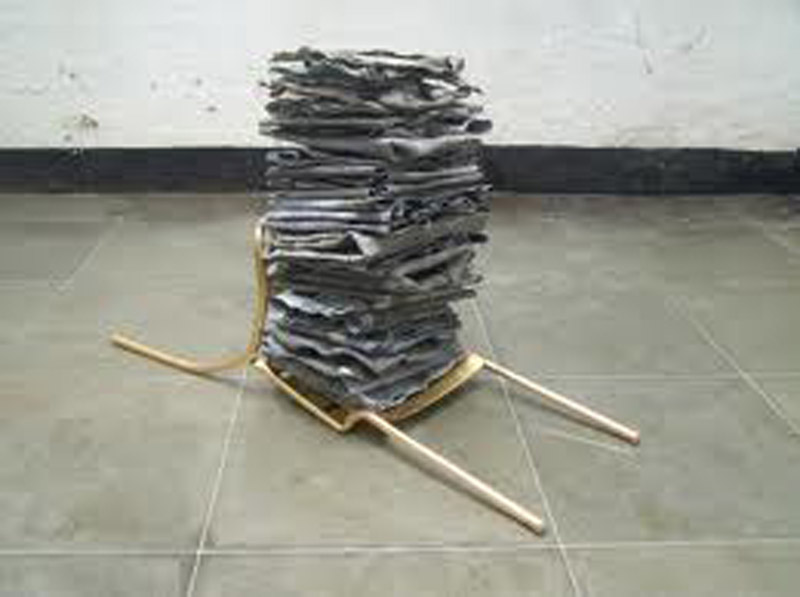
    The process of paring away visual association can only go so far before the stimulus is too weak for memory to pick up. For the past hundred years avant-garde art has been on a forced march of progress, casting off aesthetic baggage as it went. First modernism stripped art down to formal beauty, then post-modernism decided that beauty exceeded the baggage allowance and dumped it, along with skill, by the side of the road, replacing it with found objects picked up en route. Last to go, ironically, was monetary value, now the principal support for the whole flimsy structure. The situation has been succinctly summed up by German artist Fritz Balthaus in his sculpture Pure Moore, a stack of 221 bronze bars representing the 2.1-tonne Reclining Figure stolen for scrap from outside the Henry Moore Foundation in 2005. Appropriately, it is now installed outside the German federal criminal police office in Berlin.

    The traditionalist lament for loss of skill is a distraction. The modernists were right about that: skill on its own is not enough. The first step on the road to recovery is to reinstate the visual as the sole and proper domain of art. Once it is generally agreed that art’s impact is essentially visual, the skills to make it so will resurface. The general public has never stopped responding to the visual, hence its perplexity in front of much contemporary art. All that’s needed now is the insistence that, to qualify for funding, visual art has to be overwhelmingly visual – as opposed to just visible – and our problems will vanish. So let’s drop the ‘fine’ and accentuate the ‘visual’. ‘Fine’ is a value judgment that has to be earned; ‘visual’ is a simple and crucial criterion by which to judge whether a piece of art is good or bad. Enforce it, and we may find our misnamed museums restocked with things that are worth looking at.

    The Jackdaw Sept-Oct 2011

  • Misplaced trust: tripping along with the teddy bears’ picnic, Laura Gascoigne looks at the obvious mismatch of the National Trust and contemporary art

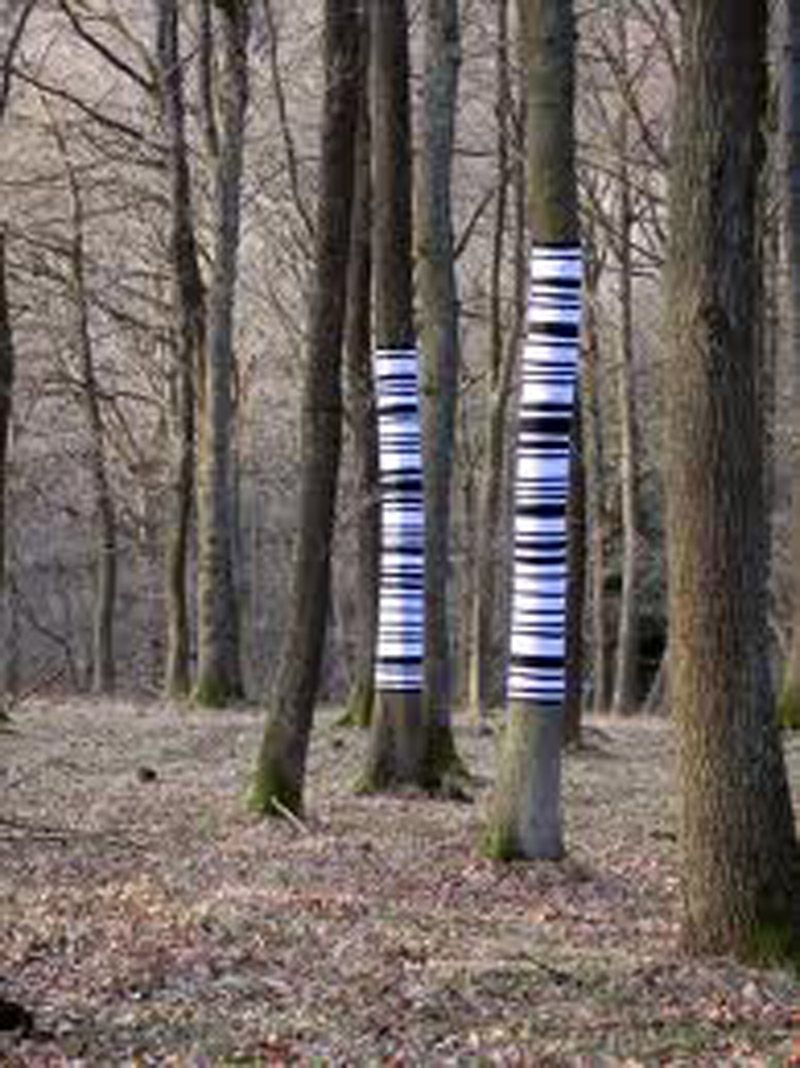
    Philippa Lawrence, Barcode: FB184

    If you go down to the woods today, you’re sure of a big surprise. That’s if the woods are Mortimer Forest in Herefordshire, and the surprise hasn’t by now been deliberately spoiled by tree-hugging vigilante forest rangers.

    Last spring, RCA graduate Philippa Lawrence took it into her pretty little head to barcode the trunks of selected young oaks in this ancient woodland at a spot called High Vinnalls, conveniently close to the Forestry Commission Car Park. The trees are due to be felled to make hardwood dowelling, a product for which the builders’ merchant barcode is FB184.

    Barcode: FB184, organized by Meadow Arts and funded by ACE, is a site-responsive piece (responsive, mind, not merely specific) whose purpose, sayMeadowArts, is to draw “the viewer’s attention to how the individuality of each tree contrasts sharply with the uniformity of the commodity that it becomes”. You may question whether, four centuries after the invention of the sawmill, we need our attention drawn to this fact, but the artist thinks we do. “Hereford is known for its special relationship to trees,” she says – and special relationships, as we know,  need work. She hopes hers may help us “reconsider our relationship to these places and the centrality of wood in all of our lives” – and, quite possibly, in some of our skulls.

    Lawrence’s own relationship with trees, she confides on her website, “is one built on a close and easy physical proximity”. In childhood “local trees accepted my slight young limbs and that [sic] of my friends as we scaled and climbed, testing our dexterity, flushed with delight at our exertions and in being abroad ‘in another place’ within the arms of the tree.” (Steady on, my dear, you’ll get the paedos excited.) Well, I spent much of my childhood up a tree and when the image of her barcoded trunks dropped into my mailbox it made me want to reach for the bow and arrow I used to take up there, dip the arrow tip in curare and lie in wait for Lawrence to waft along, flushed with delight, to install her next site-responsive project.

    Unfortunately, the way things are going, I’ll need a quiverful. Since ACE teamed up last year with the National Trust on a new three-year partnerhip, Trust NewArt, site-responsive blights on the landscape have been spreading. The Trust now boasts a fresh young ContemporaryArts Programme Manager called Tom Freshwater who, with advice from experts including seasoned site-responders Ackroyd & Harvey and Richard Wentworth, is under instruction “to encourage new ways of looking at the work and the world”. Sounds harmless enough as far as it goes, but there’s more. The aim of Trust New Art, the launch announcement informed us, is “to build links between the National Trust and the contemporary arts and crafts sector” and “to make contemporary arts and crafts an integral part of the National Trust’s daily offer to visitors” [my italics]. This sort of management-speak speaks of one thing and one thing only: money. It’s the same old story of mismatched partners climbing into bed together for mutual warmth in a cold economic climate.

    The National Trust has a circulation problem. While more and more visitors swarm freely over its 600,000-acre rural estate the size of Derbyshire, fewer and fewer want to pay an entrance fee to circulate around its historic houses which consequently, like gangrenous limbs,  are in danger of dropping off. Without increased footfall through its miles of stuffy corridors, it cannot meet the expense of keeping up its buildings. But who of the post-end-of-history generation wants to pay good money on a sunny afternoon to traipse around an airless house with the blinds half-drawn admiring the faded possessions of long dead toffs? They’d rather have a tour of Beckingham Palace. While the Trust’s energetic Chairman Simon Jenkins has managed to breathe some warmth into his hypothermic patient by such simple traditional expedients as lighting fires in grates, his organisation has been looking enviously at the inflated attendance figures of contemporary art galleries and, being of a trusting disposition, believing them. The trouble is, the two constituencies are poles apart. The blue-rinsed rump of NT membership wouldn’t Trust New Art further than they could throw it, which at their advanced average age is not very far.

    Trust properties that have so far signed up to the new art deal include Waddesdon Manor in Buckinghamshire, Tatton Park in Cheshire, Croft Castle in Herefordshire, and Calke Abbey and Kedleston Hall, both in Derbyshire. Waddesdon had already converted its Coach House into a contemporary art space, opened in 2009 somewhat inauspiciously with an exhibition of Angus Fairhurst, a contemporary artist who chose to end it all by hanging himself in a wood. But Waddesdon is au fait with art and not in danger of doing anything silly, unlike Calke Abbey, winner of our 2010 Trust New Art Bumpkin Prize for a summer programme of supreme artbollocks titled Profusion – devised for it by Beacon Art Projects – that made no concessions to the rural location,  and no sense. Among its advertised attractions were a Doug Fishbone performance in the Deer Shelter of “a stream-of-consciousness mode lecture incorporating images found on the internet into unlikely scenarios, propositions and diatribes”; a Jimmy Durham video in the Ice House showing the artist “smashing his students’ works, reminding us of the origin and end of all things” – as if we were short of reminders of this in the countryside – and a display of Roger Hiorns’s “intention to dust areas of the smithy with powdered antidepressant, triggering different contradictory avenues of association between the setting and his intervention”. Mercifully Health & Safety intervened to nip his intention in the bud at the display stage.

    Visitors to contemporary art museums go to look at contemporary art; visitors to National Trust properties go to look at flowers and trees in the gardens and cake display cabinets in the tearooms. Thankfully, the heritage-visiting public seems already to be taking things into its own hands. The fightback started in a small way last September in the grounds of English Heritage’s Belsay Hall in Northumberland, where nine Lilliputian hostages were seized from a mini-installation by street artist Slinkachu forming part of the exhibition Extraordinary Measures. A single escapee was later recovered from the weeds by a gardener, but the others are still missing, despite an amnesty. (Jackdaws were, unsurprisingly, on the list of suspects.)

    There is a limit, beyond installing wheelchair ramps and disabled toilets, to how accessible you can make a historic house to a public increasingly uninterested in history. But wait! What’s this? An announcement from the ICA, that body cryogenically frozen in the 1950s and recently chilled to a deeper permafrost by Arts Council cuts.  During the run of its summer exhibition Sketches for Regency Living,  an architectural-cum-choreographic intervention by the fabulously named Pablo Bronstein, gallery guides will be offering daily ‘National Trust-style tours’ of Nash House, with dance performances on the hour and evening talks from historians, architects and antique specialists.  What goes around comes around, in a sexier costume. Time, perhaps, for a revivified National Trust to issue its volunteer room guides with oak leaf-monogrammed tights.

    The Jackdaw Jul-Aug 2011

  • Misappliance of Science: The marriage of art and science is one only of financial convenience, argues Laura Gascoigne

    Royal Society: Beyond Ourselves

    In economically choppy waters, artists without lifejackets can be forgiven for clinging to any passing spar. So when a life raft floats past flying a flag marked ‘EDUCATION’, it’s understandable that they should haul themselves aboard. But the flag is misleading. The raft isn’t headed for the familiar port of art school, where people used to receive an art education. Its course has been reset for the art gallery, where people are educated through art rather than in it.

    Art schools may have fallen off the funding map, but gallery education is riding the storm. Engage has emerged from the Arts Council cuts with a 50% increase in funding, while the Whitechapel and South London Gallery have had their ACE grants boosted – SLG’s by 107% – in recognition of their ‘community engagement’. Sheffield Galleries, meanwhile, have had the bung pulled on them for being, well, simply galleries. In the new rankings they count as ‘agencies with more of a support function’, as opposed to ‘art producing agencies’ like the speciously named Middlesbrough Institute of Modern Art, which has earned a whopping raise of 143.8% as an ‘international-quality visual arts destination’.

    For those of you who happen to be wondering how many visitors it takes to make a destination, I consulted a philosopher of language and he answered one – and intending to visit is enough. But let’s leave that aside and take an instructive look at what this art-producing agency has been producing, in case there are any lessons in it for Sheffield. A recent commission that presumably influenced the Arts Council’s decision was Bonnie Camplin’s autumn exhibition Railway Mania. Camplin, by the way, is one of those ‘internationally acclaimed artists’ whose hitherto unknown existence raises further philosophical questions about how many foreign admirers it takes to generate international acclaim and whether one hand clapping somewhere abroad will do. But let’s not get picky. From the educational point of view, she had two things going for her. 1) She was visiting Professor at Hochschule für Bildende Künste, Städelschule, Frankfurt am Main. 2) She was engaged in an “ongoing investigation into the deeper meaning of science, technology and rational thought”.

    Based on ‘a hoard of research’ into the industrial revolution and the birth of the railways carried out over three years, Camplin’s exhibition opened with a room-sized diorama lined in galvanised steel with ‘two ominous heaps of the combustible black sedimentary rock’ otherwise known as… Come on, science class! You at the back! Yes Stephenson, well done – coal. But the educational value didn’t stop there. The heaps were topped by two giant female heads called Irene Iree and Feral Cheryl, while a later room featured depictions of ‘femme fashion figures in a variety of…uniforms representative of their various roles in industry’. Frau Professor Doctor has a parallel interest ‘in the entangled narratives of feminism’s movements’. On a lighter note, she ended with a film projection for which visitors could choose soundtracks from such popular favourites as ‘Trains in the Hills’, ‘The Power of Steam’ and  ‘The Great Western’.

    Sheffield Museums missed a trick. There they were, sitting on the Ruskin Collection, and they failed to play the science hand. In the ACE funding stakes, they deserved to lose. As you can see from the above example, the education game requires no specialist knowledge. No former experience in the appliance of science is needed, though an MSc in the science of applications helps. If necessary, willing partners can be found in the scientific community to lend a sheen of academic credibility.

    In times of hardship communities need to help each other, and artists and scientists are now pulling together. For artists, an association with science opens up new streams of funding; for scientists, a partnership with art generates publicity and gives off sex pheromones to attract corporate sponsors. This could explain the mystery of why distinguished scientists at the top of their professions should be bending over backwards to let artist ignoramuses look for deeper meanings in their work.

    The Royal Society, no less, is currently hosting Beyond Ourselves – In the spirit of scientific enquiry, an Arts Council-funded exhibition featuring six contemporary artists ‘working within the realms of reflexion, hypothesis, philosophy and sensation and searching for new ways of expressing their compulsion to describe that which we do not yet know’ – a privilege of compilers of dodgy dossiers not normally accorded to scientists. Promised highlights include ‘a Starbucks coffee cup holder with scientist’s notation depicting Feynman diagram for an electron positron interaction’ by Geraldine Cox, an artist-in-residence at Imperial College ‘whose practice involves spending many hours with scientists listening to and developing a fuller understanding of the nature of their work’. Also on show is a series of sculptures by Chris Dunreath extending ‘his investigations into the deep realms of relativity and quantum physics’, using a choice of materials – in this case paper pulp – that ‘prompts us to remember that earthly things have their roots deep in the history of our universe’. Amazing really, I might have forgotten that without a reminder from a funny-shaped egg box.

    Eventually some sharp-sighted curator was bound to spot an opening for a commissioning organisation to mine this potentially rich scientific seam. In 2009 Alice Sharp set up Invisible Dust with the marvellously named Professor Peter Brimblecombe – who sounds like an escapee from Hogwarts but is actually Professor of Atmospheric Chemistry at the University of East Anglia – and already she has five other scientists on her books. They include hydrologist Dr Kevin Hiscock, who recently put his Environmental Sedimentary Fluid Dynamics Laboratory at the disposal of UEA resident artist Liz Ballard. Their collaboration bore fruit at Cambridge Science Festival in March in a site-specific artwork at Jesus Green Lido which pumped a continuous jet of water into the air, alerting viewers to the dangers of pollution by activating ‘movement and interaction between water and sediment’ and disturbing ‘the usual topography of the pool’. Meanwhile fellow Invisible Dusters HeHe took inspiration from the lido’s ‘Deep Water’ sign to recreate the Deepwater Horizon oil disaster in miniature (without environmental impact on the pool). HeHe, incidentally, stands for Helen Evans and Heiko Hansen, a Parisian duo ‘renowned internationally for their architectural interventions that play with scale’. Which poses a final philosophical conundrum: if the currency were to devalue as fast as the price of international renown, would there be any money to pay international artists?

    More Invisible Dust will be kicked up in May at the Norfolk and Norwich Festival, where with support from the Wellcome Trust HeHe, Ballard and other Invisible Dust mites will be art-educating the inhabitants of the UK’s greenest city about pollution – HeHe via a fleet of vapour-trailing model aeroplanes and Ballard by melting luminous green dye in the River Wensum. (Interesting that one form of invisible dust recently dominating the news has yet to receive artistic attention, perhaps because funding has not been forthcoming.)

    You Wensum, you lose some. Art and science partnerships would be harmless enough if they didn’t foster the pernicious notion that art needs added educational value to be worth funding. That way lies danger. Science doesn’t need art to find deeper meanings, nor does art need science. It’s a marriage of economic convenience that cheapens both.

    The Jackdaw May-Jun 2011

  • Eh up Arup! Laura Gascoigne looks into the real brains behind the public sculptures we don’t need

    Plensa: The Dream

    Two beavers are standing looking at the Hoover Dam and one says to the other, “I didn’t build it, but it was my design”. Cue laughter. Now picture the same gag line under a cartoon of two artists looking at an enormous public sculpture. The gag still works, but the laughter’s forced. Because while a beaver has an innate grasp of the fundamentals of dam building, your average contemporary artist doodling a landmark sculpture on the back of an envelope could fit his knowledge of structural engineering on the other side.

    This might bother a beaver, but we’re not fussed. In a world of ever narrowing specialisations, we habitually depend on the skills of others. Renaissance artists working in the public sphere were expected to master the principles of construction: Michelangelo and Raphael were architects, Leonardo was an engineer. But in this age of alpha males rather than Renaissance men, our public artists only seem able to function with specialist support from Ove Arup.

    For a decade, the global firm of structural engineers which cut its teeth on the Sydney Opera House has kindly put itself at the disposal of contemporary sculptors in distress. A regional development agency, say, has commissioned a landmark sculpture you have absolutely no idea how to construct: simply summon the Arup genie from the bottle and all your structural worries will disappear. With added Arup, you can aim higher and think bigger. The firm can turn any 3-D dream into reality, and if you split the money with them you can take all the credit. They won’t mind, it’s just a job to them. When it’s over they’ll go back to doing something useful with their time, like building bridges.

    Search the small print of the biggest public art commissions of the past decade, and the magic name of Arup will appear. If it’s a massive sculpture lifting the profile of a blighted skyline, Arup will be behind it holding it up. Conveniently, the firm seems to have an office in every northern town. When St Helens Council commissioned Jaume Plensa’s The Dream – the 20m concrete head now sprouting like a giant mushroom on the site of the former Sutton Manor Colliery – Arup’s Liverpool office made the dream come true.

    Their assistance goes beyond structural design. According to the Arup website, they also took charge of the “planning, tendering and commissioning processes”, plus the “specialist ecology, lighting engineering and 3-D imagery, all required for the planning application submission”. Don’t stare in despair at your landmark doodle; just hand Arup the envelope and they’ll work out the “complex geometries” and come up with a professional “assessment of overall stability and  ‘buildability’.” Arup is the Jim’ll Fix It of the landmark sculpture business, a one-stop-shop for local enterprise partnerships wishing to lay the ghosts of the industrial past by commissioning monstrous beacons of false hope for the future.

    It was Arup that calculated the wind-resistance of the Angel of the North’s 54m wingspan and stopped the 20m Gormley falling on its face, winning such gratitude from the artist that he has retained their services ever since. Arup’s Advanced Geometry Unit was the eminence grise behind Gormley’s Quantum Cloud at Greenwich and the brains behind the collapse mechanism built into his latest batch of iron men in the Waters of Leith, designed to make them go down like ninepins in the event of flooding (a sight I’d pay good money to see). If Thomas ‘Spillikins’ Heatherwick had had the humility to call on their superior expertise The B of the Bang might not have blown up in his face, but he was foolish enough to imagine he could go it alone. Anish Kapoor has no such illusions. It was Arup that stopped his Marsyas idea from going down like a PVC balloon in 2002. “If the calculations had been 1% out,” their engineer admitted, “it would have been sitting on the ground” – along, presumably, with the artist’s career.

    After that, Kapoor was Arup’s for life. He hasn’t put pen to back of envelope since without the firm’s deputy chairman and AGU founder Cecil Balmond in attendance to do the workings out in the margin. They share an interest, apparently, in “interrogating form”. It was Balmond who ensured that Kapoor’s Temenos, the £2.7m 120m windsock launched in Middlesbrough last year, didn’t take off, and it is Balmond who will guarantee that the Arcelor-Mittal Orbit stays up for the duration of the 2012 Olympics. Now a celebrity in his own right, Balmond left Arup last October to found his own company and devote more of his time to art. It can’t be long before the engineers remove the artists from the equation altogether. But they’ll have to do better than the July 7th Memorial, a soulless experiment in art-free design by architects Carmody Groarke and, yes, engineers Arup that surely ranks as the world’s least memorable monument, while serving as a stark reminder of why monuments need sculptors.

    The question is, do monuments need engineers? The answer is, only when they are unjustifiably big. There are good reasons for making enormous dams, but there are almost never good reasons for making enormous sculptures. In fact, the reasons are almost invariably bad: jingoistic, militaristic, imperialistic, narcissistic or just plain hubristic. Temenos was to be the first of a £15m series of five giant Kapoors destined to ‘rejuvenate’ the Durham towns, with four more planned for Stockton, Hartlepool, Darlington and Redcar & Cleveland. Together, boasted the scheme’s publicity, the ‘Tees Valley Giants’ would “form the most significant public art project anywhere in the world”. With even greater hubris, the director of Middlesbrough Institute of Modern Art Kate Brinsley proclaimed that Temenos would “call on the traditional twin skills of the region: precision engineering and heavy industry”. She neglected to say how many workers with those skills it would take off the dole queue in what has just been named the most economically vulnerable city in Britain. Now the North East’s regional development agency is being abolished and Tees Valley Unlimited, the local enterprise partnership behind the scheme, has had its budget slashed and lost its tourism arm. It looks as if four of the giants may never awaken, and cultural tour operators will have to strike Teesside off their itineraries.

    Interrogating form is a game best played on a small scale, a scale at which the sculptor can work unaided. The RA exhibition Modern British Sculpture includes a 1937 piece by Naum Gabo titled Spheric Theme: Transparent Variation, a twisted double parabola of striated celluloid that speaks of flight more eloquently than the Angel of the North and, at its full eight inches, is more imposing. Unlike Hepworth, whose Single Form (Memorial) was scaled up to a monumental 21ft outside the United Nations Building, Gabo never hit the public sculpture jackpot (although ironically, with his engineering background, he would have had no trouble making monuments stand up). And so his sculptures remain as pure experiments in form, material and light on which no weight of meaning has to rest. They don’t have to trumpet anything, rejuvenate anything, apologise for anything. Their thinking was done in the materials of which they are made, with the result that they are entirely self-supporting.

    The Jackdaw Mar-Apr 2011